How about this: Marx's labor theory of value, an average product theory, is weaker than modern monopsony (marginal product). Marx's LTV not only understates exploitation (with diminishing returns, APL > MPL), but monopsony lets wages rise without disrupting competitve equilbrium
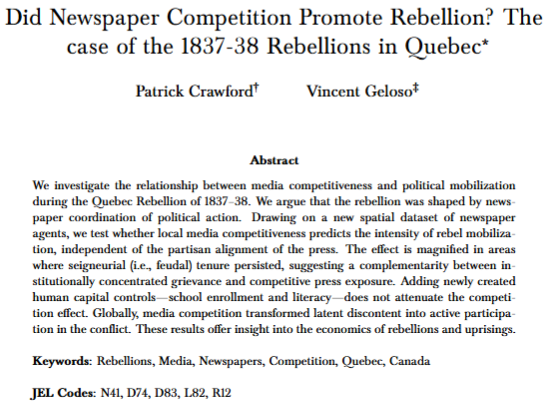
🧵 What caused the 1837–38 rebellions in Canada?
Was it nationalism? Poverty? Institutions?
We (Patrick Crawford and I) argue: it was the newspapers. And the result flips how we think about rebellions
Part of the problem with the right’s total alienation from pmc institutions is that they never actually meet the Zohran’s of the world. You have to be a bit of a rube to truly think the leftist son of a Columbia professor and a film director would see his religion as anything more than progressive stack fodder. More to the point, Zohran’s mom is a Hindu, which would make his parents marriage illegal under Islamic law, his wife doesn’t wear the hijab, and he pals around with gays. If you can’t spot the difference between a Yuppie and an Islamist you don’t have any business commenting on political affairs.
What I am working on now with one of my graduate students (@_pcrawford) whom you should totally hire this year (he is really good). We investigating the infamous and foundational 1837 rebellions in Canada (which led to confederation) and the role of media competition. We find that competition increased rebelliousness. The effect was stronger in areas under seigneurial tenure since the newspapers could tie multiple issues together to coalesce people.
Media competition was a big deal. Patrick was pretty awesome in this. I told him about the idea for this paper and that I had some of the necessary data to create the paper. We simply needed to create a measure of competition. Using the names of listed newspaper agents, we know where newspapers were distributed and we can create measures of overlapping competition by region. Patrick created cool measures out of this source. And of we were to the races.
I will keep you updated!
You will miss liberalism when it’s gone. You have no idea how privileged we are to have lived at the time we did, when being apolitical was an option.
We’ve spent so long criticizing liberalism that we’ve forgotten that there’s something much worse waiting in the shadows.
MAGA Latinos be like: "I don't want United States to end up like my homeland, so I am gonna vote for the impulsive, baby strongman who goes around placing arbitary tariffs everywhere, tries to destroy the competent civil service, is trying to destroy independent central bank..."
This nonsense keeps getting repeated. Countries use tariffs when they don't have more efficient tools of taxation, because all they can control and enforce is the border. Reliance on tariffs is the sign of being a developing country, not something that you aspire to.
Railroad network expansion in Germany (1835-1914) increased creation of new ideas and formed specialized knowledge clusters.
New ideas were formed by combining ideas coming from cities connected by the railroad. But denser network meant that new ideas diffused less on average.
@LSEEcHist My student @PatRubenFitz on how access to iron reduced violence costs in ways that created the Greek economic miracle that happened via fragmentation. @MasonEconomics is well represented
That’s because *they are lying*
We have mass surveys of prices across the country via price indices
The BLS uses CPI, the Fed uses PCE, we have private company datasets like The Billion Dollars Project
Groceries have not doubled in price
This is a *LIE*