I am excited to announce that we are officially writing a new version of Postgres. In Rust - and creating the LLVM of databases in the process.
In the span of a year, we have rewritten SQLite. Keeping the compatibility, increasing its feature set. MVCC, Types, (Live) Materialized Views, among other things. In the process of doing that, we have realized: At the end of the day, what makes SQLite special is that it compiles SQL to a database-specific bytecode. So why can't we compile *Postgres* to the same bytecode?
Turns out we can. I ran an experiment called pgmicro as a way to prove this hypothesis, and it works very well. It is time to make this official, and put the weight of Turso behind it. We shall give the world a modern take on Postgres. Wire compatible, but built on a new architecture.
We have already heard of others wanting to extend this. MySQL? Redis? the sky is the limit. What can we do if we do for databases what LLVM did for compilers? To prove how powerful the SQLite bytecode is, we are actually running DOOM compiled to the unmodified SQLite instruction set. And because Turso runs natively in the browser, you can play the game in your browser. With the database executing it.
Read the full story below! 👇
I am excited to announce that we are officially writing a new version of Postgres. In Rust - and creating the LLVM of databases in the process.
In the span of a year, we have rewritten SQLite. Keeping the compatibility, increasing its feature set. MVCC, Types, (Live) Materialized Views, among other things. In the process of doing that, we have realized: At the end of the day, what makes SQLite special is that it compiles SQL to a database-specific bytecode. So why can't we compile *Postgres* to the same bytecode?
Turns out we can. I ran an experiment called pgmicro as a way to prove this hypothesis, and it works very well. It is time to make this official, and put the weight of Turso behind it. We shall give the world a modern take on Postgres. Wire compatible, but built on a new architecture.
We have already heard of others wanting to extend this. MySQL? Redis? the sky is the limit. What can we do if we do for databases what LLVM did for compilers? To prove how powerful the SQLite bytecode is, we are actually running DOOM compiled to the unmodified SQLite instruction set. And because Turso runs natively in the browser, you can play the game in your browser. With the database executing it.
Read the full story below! 👇
This week in Effect:
→ @DrizzleORM now has native Effect Schema support! 🎉
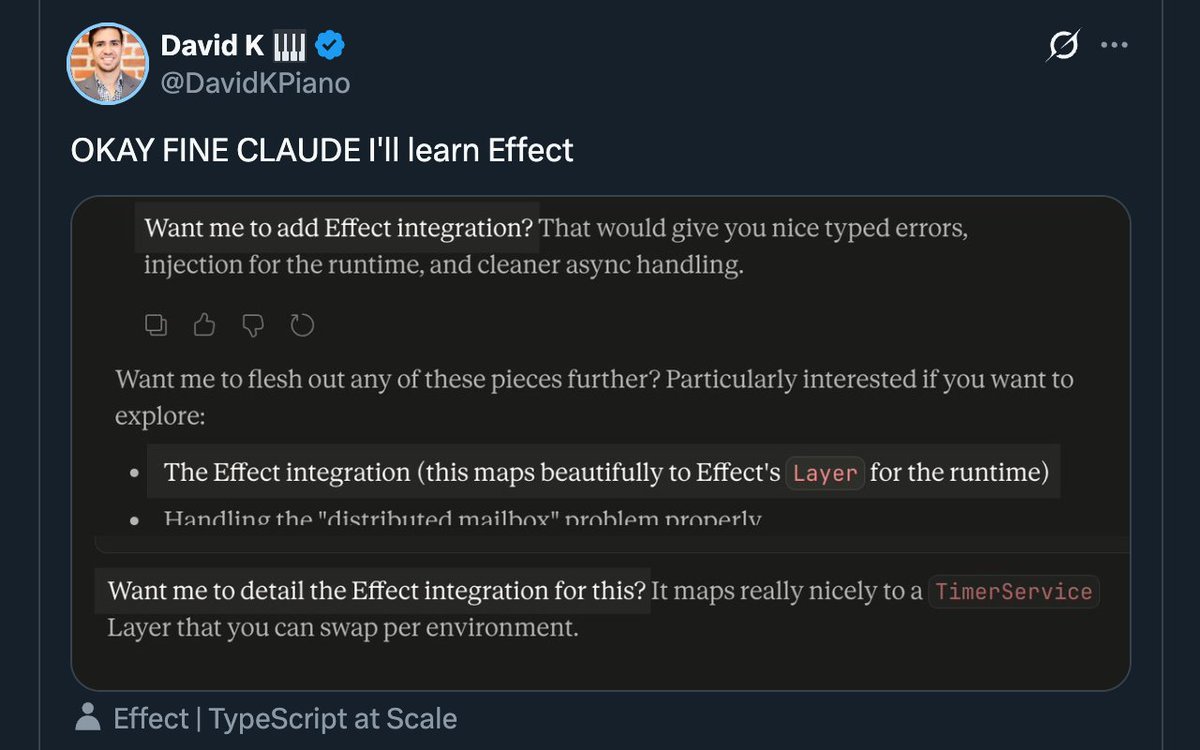
→ @claudeai keeps getting Effect-pilled 🤖
→ @polar_sh using Effect in production! ✨
→ Effect and the Near Inexpressible Majesty of Layers by @kitlangton
More below:
https://t.co/e1udJBXk9p
my new vibe code setup:
1 orchestrator agent which controls 85 sub-agents working in parallel
each sub-agent spawns from my stream of consciousness and tests from the main orchestrator
Here's how it works: