@qaribasmad Listening to proper recitation gives me solace. Being able to recite the Qur'an without reading from the Mushaf, there is nothing I would want more.
Jazakallahu khairan.
I took a break from here because I needed to remember what real life felt like.
This place, for all its brilliance, its noise, its infinite conversations, has a way of swallowing you whole. It tricks you into believing that this is life, that these glowing screens and endless exchanges are enough. But they aren’t. They never were.
So I took a break, not out of disdain, though maybe a little, if I’m being honest. You scroll through here long enough and you start to feel it, that ache behind your eyes when you see some of the things people believe, the kind of takes that make you want to curse, to punch, to scream, because you can’t believe that a sentient being competing for the same scarce resources as you harbors such ideas. But in the end, you make peace with it, because stupidity, for all its bad reputation, does make the world a little more colorful. Still, I left out of necessity.
You see, the longer you stay here, the easier it becomes to forget the texture of the world: the weight of silence, the tremor in someone’s voice, the way dusk stains the sky in colors no algorithm can name.
To remain human, you have to go out and touch what still breathes. You have to touch the grass, not in the meme sense, but in the sacred one. You do it for your sanity, for the small and fragile parts of your soul that crave unfiltered life.
While I was away, I kept building. I kept writing. @tzeir_inc has grown in ways that feel almost sacred; changes I can’t wait to share with you all. @scorivo keeps rising, steady and certain, like it always knew where it was going. And the book, it still lives, painfully, beautifully, stubbornly. And I hope that when you read it, you’ll see me, not as an idea or a collection of words on your screen, but as I truly am—raw, flawed, reaching, alive.
A little question to @BenHundeyin@PoliceNG. Please are your people allowed to break into people’s home lying they are NEPA officials?
That aside, are they allowed to treat us like fraudsters just because we work remotely even with evidence of what we do??
Every child must, at some point, learn the hard lesson of staying out of their parents’ quarrels. It is a brutal kind of wisdom, one that comes too late and costs too much.
When I was much younger, my mother would often come to me in tears, confiding in me as though I were her friend, not her child. She would tell me stories of my father’s high-handedness, of his coldness, of how impossible he could be. I never once saw him raise a hand to her, never heard him shout or curse, but in her tears, I could feel the weight of something that words couldn’t quite carry. And so, in my young heart, anger began to form; anger for my father, for how he treated my mother, for how he seemed to not care.
For a long time, that anger festered. I loathed him—quietly sometimes, loudly at other times, but completely all the same. It wasn’t only what she told me, it was what I saw: a man who could love fiercely yet appear utterly detached. A man who could give you everything and still make you feel like you meant nothing when things went sour. No human being I’ve met has mastered the art of not caring the way my father did. And maybe that’s where I got it from: my indifference, my tough skin, my calm in the face of storms. I am my father in more ways than I care to admit.
But time has a way of revealing what emotion once concealed. Now that I am grown, I no longer see my father through the lens of my mother’s hurt. I no longer see my mother as the wounded heroine of my childhood tales. I see two human beings—flawed, trying, failing, loving, breaking. And I understand now that my mother wasn’t trying to poison me against my father. Her intentions weren’t malicious. I remember, in moments of anger, when I’d speak ill of him, she’d hush me immediately, telling me to respect my father, warning me never to use her pain as fuel for disrespect. She’d say, “I’m not telling you these things to make you hate him, but so you can learn how to love your wife better than he loved me.”
This is also why I think my idea of love is warped. I do not see love the way others do—not as romance, not as grand declarations, but through the lens of my parents. Through my father’s provision and my mother’s receptiveness. Through his silence and her tenderness, even toward him. I grew up watching two people who loved each other without ever quite knowing how to show it. Their love was not soft; it was survival. It was duty wrapped in exhaustion, affection disguised as endurance. I do not believe love should be subsuming. I watched my father love my mother deeply and still, when she was wrong, detach from her completely, so coldly, so fully that you would wonder if he ever loved her at all. That’s where my confusion began. I learned that love could coexist with distance, that care could live beside coldness, that presence did not always mean warmth. It is through their love that I have learned that love means duty—not the poetic kind people write about, but the kind that stays even when it no longer feels good to stay. I never once heard my father say “I love you” to my mother, yet I watched him break his back every single day for her, for us, for the family. And maybe that’s where I inherited this version of love—the one that works more than it speaks, the one that builds but rarely confesses, the one that bleeds daily and refuses to speak of it, even with the person you love, and calls it responsibility. And maybe that’s why I understand them now, why I can no longer blame either of them.
I do not write this to villainize either of them. I write this because this is the quiet tragedy of many African homes. Mothers, without realizing, often shape how their children see their fathers; through tears, through stories, through silence. Fathers, performing strength, pretend not to care, thinking stoicism is leadership. And between those two performances, the home, that sacred cradle of civilization, becomes a battlefield.
Every year comes with it's own baggage but I think this year broke and undid my previous years of "healing".
2025 so far;
I was laid off without reason from my full time role in the US in February.
March - June; Autistic burnout / depression.
July - I lost a $240k/per year job with relocation plans after having verbal agreement with the team and CEO, woke up to "we had to move on with another candidate email". This was after Nigeria - US reciprocal visa issue.
Same July, I found out I had a bone tumor that had eaten/weakened my femur and hip.
August - September: I spent it in the hospital literally tied to a bed, drips and injections everyday. I'd eventually have a femur and hip replacement surgery and spent over $17k in medical expenses in two months.
September again, confronted something from my past I thought I had healed from, it turned out I just wasn't triggered enough lmaoo.
I am currently learning how to walk/live again but honestly this year so far has been a big lesson in pain and tears but on the good side I started my design studio and things are looking up 🙂↕️.
We move 🫶❤️
Good morning everyone
I want to talk about something controversial today - concerning "take profits"
I'm here to pause your doom scrolling again by asking for 40 seconds of your day.
Nothing improves your quality of life better than delayed gratification. You see, when we start making money that we haven't made before; let's say you just got a form of gig or your first six figures in funding and now you make at least $1000 in a month.
First off,you would start craving all the things you have ever wanted- the iPhone, the clothes, the outings, the cool gadgets and all. So it's like your proof of enjoyment or proof of growth.
While this makes sense at surface level, if you start outrightly increasing your spending based on an increase in your earnings, this is like walking on a thin line.
If you make $1k monthly , 1% of your net worth (assuming you had nothing) is $10. But if you keep that $1k saved and accumulate it for 5-6 months, now 1% of your worth is $60. You can live on at least 3-5% of your worth in a month.
If you withdraw every profit you make on an account and spend or something, how are you going to grow? I believe compounding is the only actual way to wealth, and delayed gratification is the only true way to becoming a big boy or a big girl while still maintaining financial security.
All it would cost you is 6 months of delayed gratification at least.
Have a nice day ahead.
A huge “hurdle” to accept psychologically as a man is that your life is PERPETUAL work. It never stops. Forever. EVERYTHING you want requires energy to get & maintain
But you need to view this as an absolute blessing because the meaning in your life will be found IN the work itself. It’s not “do a bunch of work so i can do nothing”… the work IS the reward
“Blessed is the man that’s found his work”
Choose something you ACTUALLY want to work towards, then go after it - and you’ve built your own little stretch/chapter of paradise
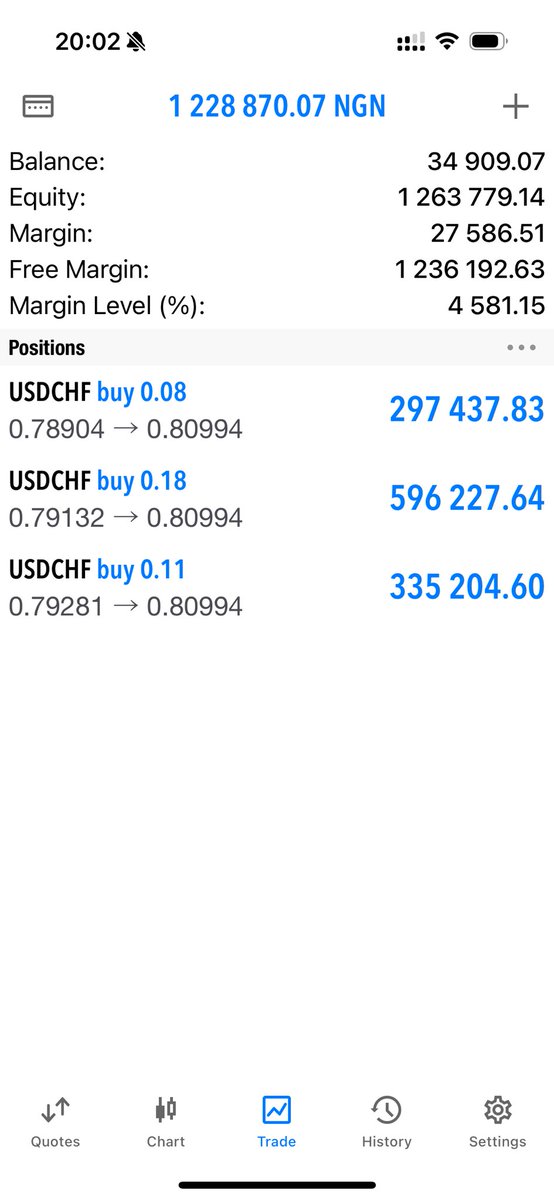
Lately I’m so hyped about trading and making it my career. Hard to explain, but it feels different now, like success is closer than ever. My setups flow, habits are clear, and trading finally feels simple.
I stopped overloading my brain with everyone’s opinions and just focused on what I’ve tested and know works. Best decision I’ve made.
unpopular opinion but i think reading > watching when it comes to consuming info...
it's easier to skim thru to find what you're looking for & it's easier to drop into an LLM
reading is a better form of info consumption than watching course material 80% of the time
the 20% is for practical hands-on stuff, so anything got to do with navigating a UI, for e.g. n8n tutorials, graphics design, media buying, etc.
When a man tries to fix his life, isolation is the price he has to pay.
The moment he commits to growth, he begins to separate; not by choice, but by consequence. The same friends who once validated his weakness will now resent his improvement.
The same environment that once comforted him will start to suffocate him. Every step forward will quietly exile him from the familiarity that kept him stagnant.
You cannot rise and remain liked. You cannot grow and still belong to the crowd that refuses to evolve.
The more disciplined you become, the more your very existence offends the undisciplined.
The man who begins to sharpen himself becomes a mirror, and people hate mirrors when the reflection exposes decay.
The isolation begins subtly. Fewer invitations. Colder conversations. The jokes that once amused you now bore you. The noise that once distracted you now irritates you.
You start to realize that connection without alignment is just slow corrosion. So you withdraw - not out of arrogance, but out of necessity.
This is the stage most men cannot survive. They mistake loneliness for failure when in truth it is the proof that transformation has begun.
You are supposed to feel detached. You are supposed to feel unseen. You are supposed to lose people who only knew the old version of you.
You cannot drag them with you, not everyone is meant to survive your evolution.
Use isolation as fuel, not punishment. While the herd wastes time in trivial validation, you refine.
You train when nobody watches. You study when nobody praises you. You plan moves years ahead while they spend days chasing comfort.
The silence that terrifies them will become your fortress.
And then, one day, when you emerge - sharper, calmer, self-sufficient; you will realize that the isolation was never a punishment.
It was the forging process. The loneliness was the toll you paid to earn clarity. The distance you endured was the barrier that protected your becoming.
Most men fear isolation because it forces them to meet themselves.
But the man who can sit in silence without needing to be seen, who can live without applause and still move forward - that man becomes unstoppable.
Because isolation does not break the strong. It separates them from the weak.
Two traders can have the exact same strategy, but the one who executes it with discipline, proper risk management, and emotional control will outperform every single time.
The market rewards behavior, not brilliance.