@selecaoportugal 🇵🇹 Portugal's football story proves what's possible when talent meets opportunity. @govpt @educ_pt We hope you'll champion the next generation by supporting the #FIFAGlobalCitizenEducationFund. 🌍
@rfef@FIFAcom Every great player starts somewhere.
A classroom. A local club. A community field.
@rfef@SEFutbol@LaLiga Your success inspires millions. Join the movement to help more young people access education and opportunity through the #FIFAGlobalCitizenEducationFund.
⚽ Four World Cups.
📚 Millions of children still waiting for opportunity.
@giz_gmbh@bmz_bund We hope you'll help secure a win for education by backing the #FIFAGlobalCitizenEducationFund and investing in young people's futures.
Minister @LarsKlingbeil called for a stronger international role for the EU.
A strong EU budget for global partnerships, development cooperation, and climate resilience helps make that vision possible.
@BMF_Bund@germanyintheeu
Defending human rights is not a crime.
Buzurgmehr Yorov was imprisoned after representing politically marginalized clients and speaking out against torture.
Stand with those defending justice.
#FreeBuzurgmehrYorov#StandAsMyWitness
.@sanchezcastejon, help expand access to sport-based education programmes through the FIFA Education Fund. Every child deserves the chance to play and learn. ⚽✨ #PlayToLearn
The FIFA Global Citizen Education Fund is bringing together leaders committed to the next generation. Will Australia, Mexico, Ghana, and Côte d'Ivoire join the movement? @AlboMP@Claudiashein@JDMahama@AOuattara_PRCI
⚽ Canada stepped up. Who's next? Spain, Portugal, and Morocco have a chance to help create a lasting legacy for children around the world. @sanchezcastejon@LMontenegro_PT#Morocco
What's your role in the movement? ✊ I'm an Amplifier, and I'm ready to get loud with @GlblCtzn. We need Storytellers, Builders, and Organizers to change the world. @[Friend's Handle], take action and let's assemble our squad! https://t.co/zFTBuyoP7y
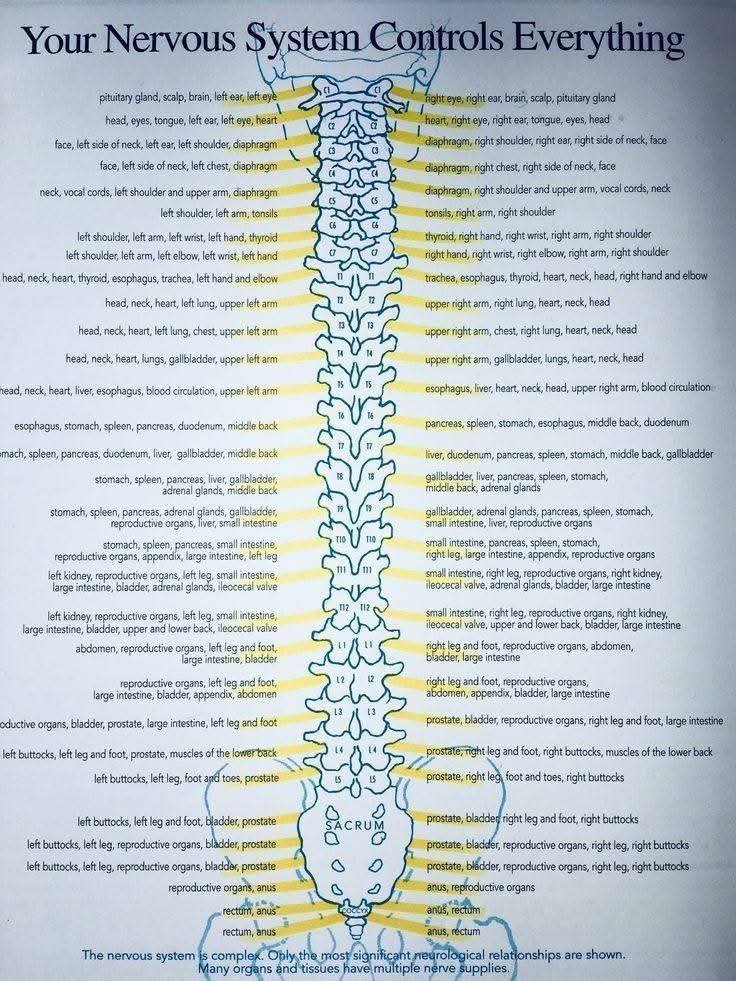
Your spine isn’t just a backbone, it’s your body’s "wiring harness."
Your spine isn’t just a stack of bones.
It’s the main cable connecting your brain to every organ, muscle, and sensation in your body.
Each level of your spine sends out branches (spinal nerves) that control specific regions.
That means:
• A nerve in your neck can affect your shoulders, arms, or even your diaphragm.
• A nerve in your mid-back can influence digestion.
• A nerve in your lower back can change how your legs feel or move.
• Pelvic nerves can affect bladder, reproductive organs, and bowel function.
Here’s why this matters:
🔹 Poor posture compresses nerves → headaches, tingling, tightness
🔹 Weak core or glutes shift spinal load → lower-back pain, hip issues
🔹 Stress changes muscle tone → tightening around the spine, altered nerve signals
🔹 Sedentary habits reduce blood flow to spinal tissues → stiffness, inflammation
🔹 Injuries can irritate nerve roots → pain that radiates far from the spine
When a nerve is irritated, the organ or muscle it serves can’t communicate as well with the brain.
That doesn’t mean one vertebra controls your entire life—but it does mean the quality of your nerve signaling affects how well your body functions.
Your nervous system really does control everything you do -
movement, breathing, digestion, heartbeat, hormones, reflexes, pain, emotion.
Protecting your spine means protecting every system that depends on it.
If you’ve ever felt pain in one place but the issue was somewhere else
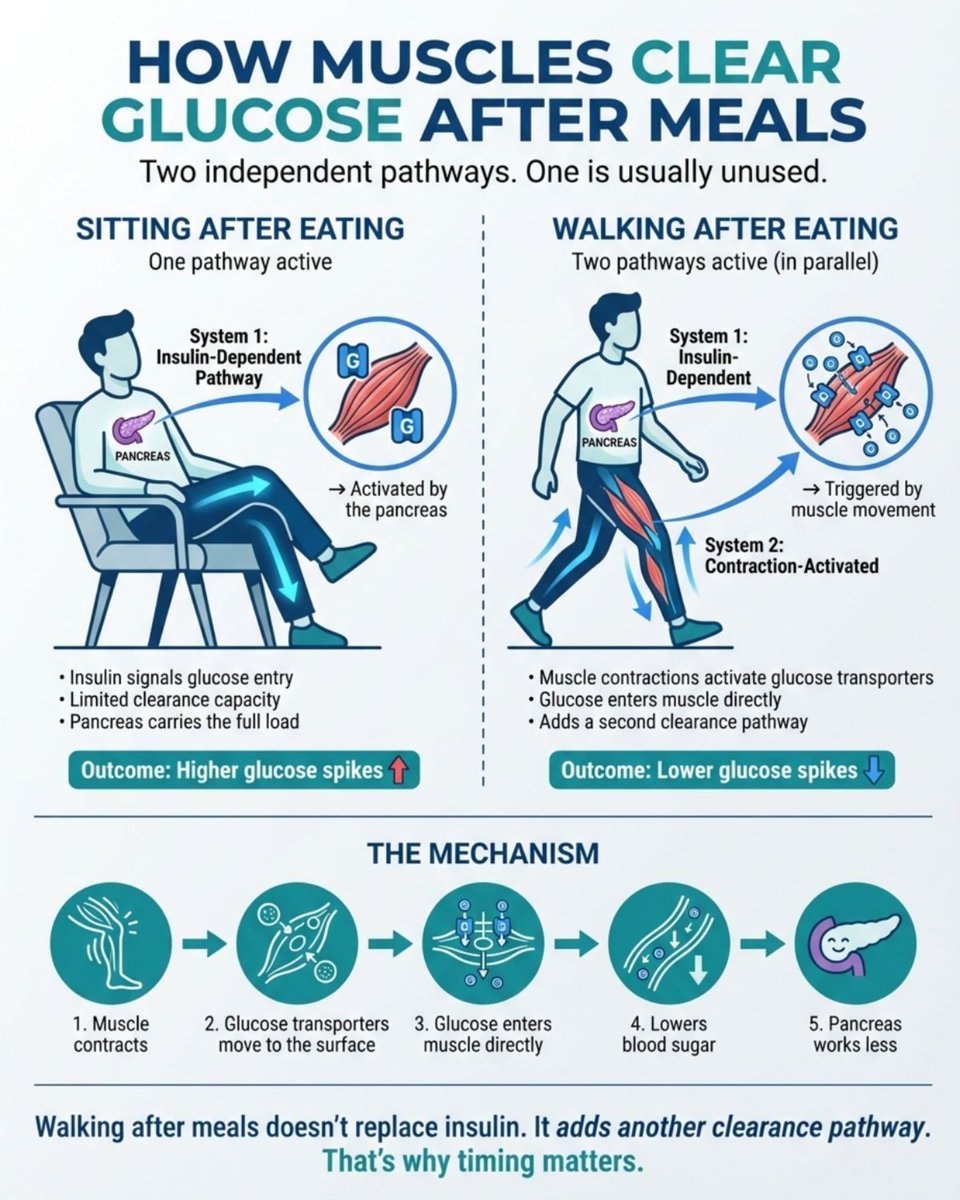
Your muscles clear glucose in two different ways after a meal.
Most people only use one.
When you sit after eating, glucose disposal depends almost entirely on insulin signaling from the pancreas. That pathway works, but it has limited capacity, which is why post-meal glucose spikes are higher and longer.
When you move after eating, even lightly, a second pathway turns on in parallel.
Muscle contraction independently activates glucose transporters (GLUT4), allowing glucose to enter muscle without waiting for insulin. The result is faster clearance, lower peaks, and less strain on the pancreas.
What’s happening under the hood:
• Muscle contraction triggers GLUT4 translocation
• Glucose enters muscle directly
• Blood glucose falls more quickly
• Insulin demand is reduced, not replaced
This isn’t about burning calories or “earning” food. It’s about using the physiology you already have. Walking after meals doesn’t override insulin. It adds another clearance pathway.
That’s why timing matters.