Excited to share that my second paper from graduate school is out now at Nature Genetics. We show that Enhancer-Promoter interactions can form de novo in the absence of loop extrusion.
https://t.co/GOGyzCf8U8
Excited to share our latest work on bioRxiv! Using cell-cycle dynamics and NIPBL depletion, we show that long-range enhancer interactions can form de novo without loop extrusion. Alternative mechanisms, including LDB1 and YY1, may play key roles.https://t.co/CgBN4QJcuL
Wild experience to have seen our story shared at the #ASH24 Plenary in San Diego by my wonderful co-lead @Shan_Liu_ ! Looking forward to further proving that we can enhance cancer treatment by modulating readily-actionable patient lifestyle factors.
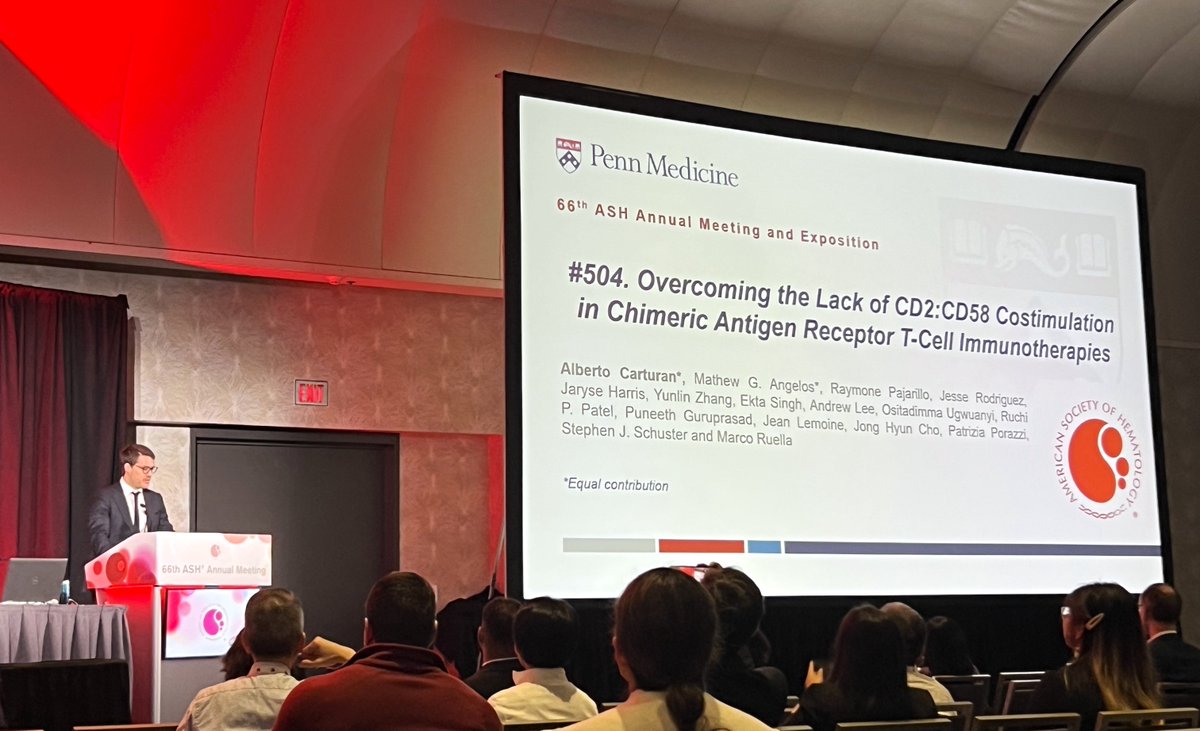
Grateful to #ASH2024 for the chance to present our work on overcoming the absence of CD2:CD58 co-stimulation using an innovative PD1:iCD2 switch receptor. Thanks to my mentor @MarcoRuella and the @RuellaLab for their invaluable support. Excited to delve deeper into this approach!
Learn more about the exciting advances in blood cancer and benign hematology research that Penn Medicine and @PennCancer experts will be presenting at the @ASH_hematology Annual Meeting this weekend. #ASH24 https://t.co/U3XQpA89Ae
A simple dietary supplement may provide a new approach to boost #CART cell function – hear more in the #ASH24 Plenary Session today. @MarcoRuella @MaayanLevy_Lab @PuneethGuru_ https://t.co/8SnrY5iJGd
Very excited to share this work that could not have been done without the help of @RaisBahrami and @arnabguonc ! Big thank you to The Oncologist for this opportunity!
Happy to share my thesis work, now online at bioRxiv. We show that LDB1 organizes Enhancer-Promoter interaction networks and can function independently of cohesin!
https://t.co/rSSZPpv4Bh
The effectiveness of #CARTCellTherapy against a variety of cancers, including solid tumors, could be boosted greatly by using CRISPR-Cas9 technology to knock out the gene for CD5, according to research led by @PennCancer's Dr. @MarcoRuella. https://t.co/UPgMLh7dx2
In a study published in @SciImmunology, @PennMedicine researchers identify #CD5 as an immune checkpoint protein & potential target of future cancer therapies ft. @MarcoRuella (@PennCancer) https://t.co/8nC1QIWCuH
@UCLA@UCSF@cityofhope@DanaFarber A discovery from PICI Investigators @Penn has revealed that deleting the CD5 gene in CAR T cells significantly enhances their antitumor activity across multiple cancer types, opening new avenues for more potent and effective immunotherapies. https://t.co/S4VfmPDXaw (5/5)
Patel et al. used the CRISPR-Cas9 system to ablate expression of the TCR-associated T cell inhibitory receptor CD5 from CAR T cells of several specificities and TCR-redirected T cells. https://t.co/Og6DA7IOnz @_ruchipatel@MarcoRuella@PennMedicine
Genetic deletion of #CD5 in CAR T cells given to mice led to enhanced expansion, persistence, and anti-tumor effects against a range of preclinical solid and blood #cancer models.
Read more in Science #Immunology: https://t.co/krHkOKS1sk
NEW -CD5 deletion enhances the antitumor activity of adoptive T cell therapies in vivo (liquid & solid cancer models) by enhancement of T signaling, cytotoxicity, and persistence. Stellar work by @_ruchipatel@MarcoRuella@PennMedicine@SciImmunology https://t.co/jqrgPgcgc6
A @PennCancer research team led by @MarcoRuella has found that CD5 knockout boosts #CARTcell anti-tumor efficacy, in a preclinical study published in @SciImmunology. https://t.co/7OsiP2tDWZ