Accelerating Cancer Immunotherapy Research. A free weekly digest of the latest findings in the field. We also make cool images :) Listen to @ImmunoTalks.
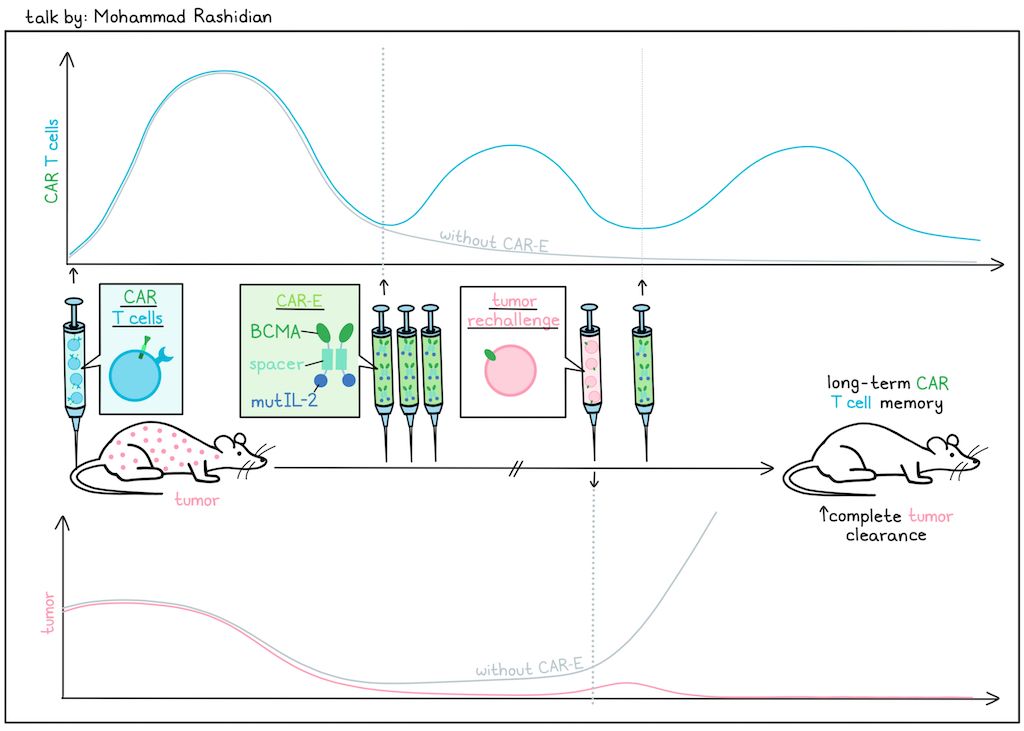
To enhance CAR T cell persistence and long-term functionality, Mohammad Rashidian and colleagues engineered a CAR enhancer (CAR-E) molecule. Read more about it here https://t.co/7CW4mg2VSR
In a 5-year follow-up (minimum 57.3 months) of the RELATIVITY-047 trial, which led to the approval of nivolumab (anti-PD-1) plus relatlimab (anti-Lag3) for patients with metastatic, unresectable melanoma, Long et al. noted long-term benefits in progression-free, overall, and melanoma-specific survival versus nivolumab alone. In a subset of patients with PD-L1 ≥1%, survival curves separated after 3 years, and while those with high Lag3+ CD8+ T cells showed worse outcomes with nivolumab alone, they experienced greater late or post-progression benefits from relatlimab, suggesting mitigation of Lag3+ T cell-mediated primary resistance.
https://t.co/uUS4Bls2My
@ProfGLongMIA@HTawbi_MDPhD
Cheung et al. showed that the onset of antitumor immunity in murine breast cancer models following cytotoxic chemotherapy (CCT) and loss of perivascular (Pv) TAM-derived heme oxygenase-1 activity was characterized by tumoral accumulation and differentiation of clonally diverse stem-like TCF1+PD-1+CD8+ T cells to tumor-reactive TCF1-CD8+ effector T cells. Their accumulation in the TIME was CXCR4-dependent and associated with CCT-induced expansion of proliferating Pv CXCL12+CD34+ cancer-associated fibroblasts. In human breast cancer, more favorable clinical outcomes post-CCT were associated with a high stem-like CD8+ T cell gene signature.
https://t.co/xNufDuZFKd
@tikshingcg@JNArnoldlab
In a phase 2 clinical trial for high-risk, resectable CSCC, Galloway, Das Neves, Amatore, et al. evaluated neoadjuvant treatment with two doses of pembrolizumab. Upon surgical resection, 56% of the 27 evaluable patients had a pathological complete response (PCR; no viable tumor remaining). While 81.5% patients continued on adjuvant pembrolizumab, 93.3% of those with PCR chose to forego adjuvant radiation, with no recurrences during a median follow-up of over 3 years. PCR was associated with post-treatment lymphoid aggregates of DCs, B cells, TCF1+CD8+ T cells, and HEVs. Non-response was associated with a TIME rich in PD-L1+ macrophages.
https://t.co/xsUo0eauG5 @diwakardavar
In contrast to conventional tumor cell-targeting dendritic cell (DC) vaccines, Hu, Shi, and Zhao et al. explored the clinical potential of a therapeutic vaccine loaded with the gut commensal Bacteroides fragilis (DC-Bf). DC-Bf significantly enhanced infiltration of TILs and activation of diverse, cross-reactive CD8+ T cells that recognized and killed tumor cells while decreasing Tregs and immunosuppressive TAMs in the TIME. DC-Bf significantly enhanced the efficacy of anti-PD-1 via an IL-12-driven CD8+ T cell-dependent mechanism in both primary tumor and metastasis models, suggesting translational potential as an off-the-shelf cancer vaccine.
https://t.co/h4oirMXeQI
To specifically expand NY-ESO-1 TCR-T and CD19 CAR-T cells following CRISPR-cas9 knock-inKI to the TRAC locus, Johansen et al. decorated dextran scaffolds with IL-2, IL-21, and either pMHC or CAR antigen, respectively. The scaffold increased TCR/CAR expression and expansion over stimulation with the soluble components. Compared to cytokine-expanded T cells, scaffold-expanded T cells had greater proliferative capacity, cytotoxicity through serial tumor rechallenge in vitro, and superior antitumor efficacy and expansion in vivo. Mixtures of scaffolds displaying several pMHCs expanded pooled TCR-T cells.
https://t.co/cTTOuWoliP @DTUtweet
Utilizing a high-throughput barcoded KO screen targeting all non-essential E. coli genes, Chen et al. identified that KO of non-glucose phosphotransferase system genes enhanced intratumoral fitness and tumor colonization by increasing glucose avidity. A quadruple-mutant, tumor-avid E. coli strain (Ec-TA) outcompeted and displaced wild-type E. coli from pre-colonized tumors, demonstrated tumor specificity and a favorable safety profile, and increased delivery of an IFNγ payload upon intravenous administration. Ec-TA-IFNγ enhanced intratumoral IFNγ and effector T cell responses, and reduced tumor burden across colorectal tumor models.
https://t.co/xoQkHamaso
@columbiaMed@arpaialab@Columbia_MI
Inducing TLSs in tumor models https://t.co/EYBZlBQ6cR
👉
Ascic, Chatelain, et al. investigated TLSs initiated in various tumor models after PIB-transduction of tumor cells into cDC1s. Immunogenic TLSs formed in tumors and were associated with improved outcomes, immune memory, and, in some cases, synergized with ICB. TLS formation was dependent on T and B cells, and on MHC-I and CD40 signaling. @CellReproLab@AsgardThx
Tang, Liang, Sun et al. developed a process to prepare haem-containing erythrocyte-derived microparticles (EMPs) from UV-irradiated erythrocytes as DC adjuvants. EMPs mixed with tumor cell lysates simultaneously activated and delivered antigen to DCs in vivo, providing CD8+ T cell-dependent prophylactic and therapeutic tumor control and enhanced survival. EMPs functioned by haem binding the nuclear receptor REV-ERBα, thereby inhibiting PPARγ transcription and driving DC activation. Human erythrocyte-derived EMPs were active in stimulating human DC maturation, and demonstrated in vivo activity in a humanized model.
https://t.co/d7KvDGHbCO
Using genetic deletion, Luri-Rey et al. showed that in mouse models, the therapeutic efficacy of a PD-L×4-1BB bispecific antibody required PD-L1 expression on cDC1s, but not tumor cells. TdLN removal prior to therapy impaired tumor regression. PD-L1×4-1BB therapy enhanced tumor-antigen cross-presentation through IL-12, 4-1BB costimulation, and cDC1 licensing by CD40L. Therapy boosted cDC1–T cell contacts, T cell activation transcriptional programs, and tumor antigen-specific CD8+ T cell proliferation. cDC1 and activated CD8+ T cell infiltration and adjacency were increased in treated tumors. Flt3L increased DC prevalence to promote efficacy.
https://t.co/MWQPPKebcG @ClinicaNavarra
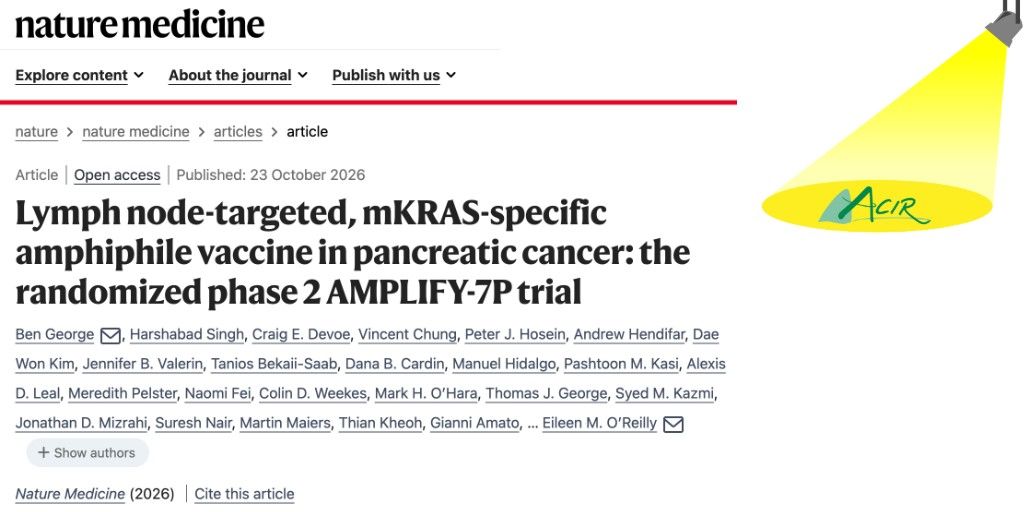
In a phase 2 clinical trial, patients with stage I-III KRAS-mutated PDAC recently (<6 months) cleared by standard therapy were treated with either camupepimut (a lymph-node targeting, CpG-adjuvanted vaccine targeting KRAS G12D and G12R neoantigens; n=96) or standard-of-care/observation (n=48). DFS lasted a median of 23.8 versus 21.2 months, which did not meet the primary endpoint, but an improved 6-month DFS rate of 75.7% vs. 61.7% was significantly associated with treatment. In camupepimut-treated patients, mKRAS-specific T cell responses above 9.17-fold over baseline correlated with improved DFS (NR vs. 6.08 months), with evidence of epitope spreading.
https://t.co/ge6Fl6RCUB
@mayoclinic@MSKCancerCenter@EileenMOReilly
Khateb et al. developed NeoSelect to expand ultra-rare neoantigen-specific peripheral blood lymphocytes (NeoPBL) using two cycles of stimulation with neoantigen-specific peptides and enrichment of APC–T cell conjugates followed by a rapid expansion protocol. This strategy amplified NeoPBLs to high frequencies and absolute numbers, and even recovered neoantigen-specific TIL clonotypes that failed to expand ex vivo. NeoPBL clonotypes overlapped with those of highly differentiated and exhausted TILs. The on-target stimulation during NeoSelect shaped the transcriptional and epigenetic profile of NeoPBLs, resulting in polyfunctional, TPEX-like effectors.
https://t.co/IQClU5AU5I @nicholasklemen
In a phase 1/2 clinical trial in patients with ICB-resistant, antigen-rich solid tumors, Sullivan, Tschernia, Friedman, et al. evaluated invika – IL-2 fused to a bispecific antibody targeting Vβ6 and Vβ10 TCRs (enriched in TILs and memory-like T cells). While 2 patients experienced reversible dose-limiting toxicities. iviika was generally well tolerated, with low-grade CRS as the most common trAE. At the optimal biological dose across phase 1 and 2 (52 patients), the ORR was 14.8% and the DCR was 59.3%. Dose-dependent increases in Vβ6/Vβ10 T cell expansion, IFNγ, and soluble CD25 were also observed. A phase 2 trial is currently ongoing.
https://t.co/r2LouyrPwI
@MGHInstitute@nih@MSKCancerCenter