Can a robot assemble tight-clearance parts using only its proprioception? No camera, no tactile sensor, no F/T sensor, no joint torque sensing, no priors over the object geometries or poses: just joint position readings.
It actually can! Blind policies trained in simulation insert pegs, mesh gears, and thread nuts, and the peg policy works zero-shot in the real world. Here's what we found 🧵
Joint work with @BronarsToni, my wonderful co-first author, who's on the job market right now! Advised by @kushalk_ and @pulkitology.
BeyondMimic is published in Science Robotics and it made the Science front page.
A follow-up paradigm shift that will solve the problem of humanoid whole-body control will be released soon. Stay tuned.
Meet FetchMan: a vision-based humanoid policy trained entirely in simulation that transfers zero-shot to diverse real-world scenes and objects.
Simulation has produced impressive locomotion policies that transfer to the real world. We wanted to see how far the same recipe goes for vision-based loco-manipulation. More below🧵
PPO had a second wave in the LLM era for reasons unanticipated by the original paper
- the importance-ratio objective fixes biases from numeric error, async training, and forward pass noise
- the clipping objective affects entropy through a mechanism that we didn't know about at the time of publication (DAPO, https://t.co/sBo9DeFS5Y)
PPO has long dominated robot locomotion training in simulation. SAC, despite its sample efficiency, couldn't keep up.
We analyze why:
🔗https://t.co/w8cR5lgxjf
🔥Integrated into RSL-RL, our approach requires only minimal changes, making SAC a drop-in alternative out of the box.
was reading a paper last night that felt very timely and refreshing, like the sort of thing that was bound to anchor the next wave of innovation in self-teaching
then i realized it was from 2022
@IliaLarchenko@LightwheelAI Congrats! By the way, I have a quick question — could you share roughly what the simulation overhead is like when running parallel RL for cloth? I’ve found it extremely expensive on my side, and pure RL approaches barely seem to work at all.
How do we make LLMs faster and lighter? Don’t force the GPU to adapt to sparsity. Reshape the sparsity to fit the GPU! ⚡️
Excited to share our new #ICML2026 paper in collaboration with @NVIDIA: "Sparser, Faster, Lighter Transformer Language Models". This work introduces new open-source GPU kernels and data formats for faster inference and training of sparse transformer language models:
Paper: https://t.co/3Avj8N8iYO
Blog: https://t.co/SqFkkKvkbd
Code: https://t.co/PHSzMq8pg0
While LLMs are undoubtedly powerful, they are increasingly expensive to train and deploy, with a large part of this cost coming from their feedforward layers. Yet, an interesting phenomenon occurs inside these layers: For any given token, only a small fraction of the hidden activations actually matter. The rest approximate zero, wasting computation. With ReLU and very mild L1 regularization, this sparsity can exceed 95% with little to no impact on downstream performance.
So, can we leverage this sparsity to make LLMs faster? The challenge is hardware. Modern GPUs are optimized for dense matrix multiplications. Traditional sparse formats introduce irregular memory access and overheads that cancel out their theoretical savings for GEMM operations.
Our contribution is twofold:
1/ We introduce TwELL (Tile-wise ELLPACK), a new sparse packing format designed to integrate directly in the same optimized tiled matmul kernels without disrupting execution.
2/ We develop custom CUDA kernels that fuse multiple sparse matmuls to maximize throughput and compress TwELL to a hybrid representation that minimizes activation sizes.
We used our kernels to train and benchmark sparse LLMs at billion-parameter scales, demonstrating >20% speedups and even higher savings in peak memory and energy.
This work will be presented at #ICML2026. Please check out our blog and technical paper for a deep dive!
What is missing to bring real-time motion research into AAA games and real-world robotics?
We present MotionBricks, a step toward bridging this gap with two key components:
- a single generative latent motion backbone covering 350,000+ motion skills, running at 15,000 FPS with 2 ms latency and substantially improved quality and reliability.
- a unified smart primitive interface for locomotion, object / scene interaction, with fine-grained control over generated behaviors.
Webpage: https://t.co/aJE5skUuWD
Code: https://t.co/r56D3TJ8CW
Paper: https://t.co/CtOHXnHZMv (ACM TOG / SIGGRAPH 2026)
Can we build a standalone, modular, and reusable naturalness reward for training motor controllers?
#SMP is a step toward that vision. Once SMP has been trained on a motion dataset, the priors can be reused to train new controllers to perform diverse tasks while adhering to the behaviors in the dataset, without original dataset or retraining.
🔥 Excited to share our latest work, SMP: Score-Matching Motion Priors, accepted to @siggraph
Webpage: https://t.co/Pz4yFAg1wo
Code: https://t.co/rZPp5b5GPD
Paper: https://t.co/K0z1oQkdFZ
Video: https://t.co/gPkyQCqNWz
Self-play led to superhuman Go performance, why hasn’t it for LLMs?
In practice, long run self-play plateaus like RL. We study why this happens, and build a self-play algorithm that scales better. It solves as many problems with a 7B model as the pass@4 of a model 100x bigger.
No world model is accurate, especially the intuitive one in your head
Most video models collapse the future into one deterministic rollout, slowly
ManiDreams keeps the uncertainty, and plans over it in a modular framework
😴Dream, 🤔Predict, 📦Constrain
https://t.co/qHWdwbb7IS
What's different between these two BC policies? It's the same architecture, training budget, and data collection setup — the only difference is the controller gains!
Controller gains are an understudied design parameter in robot learning. In our new work (w/ @BronarsToni*, @pulkitology), we show how they act as an inductive bias across BC, RL, and Sim2Real transfer, with real consequences on performance. Here's what we found 🧵
* Equal Contribution
📄arxiv: https://t.co/SMYgh7i8cA
🔗website: https://t.co/cLCd1FYCdJ
Newton 1.0 is now generally available. 🙌
Take robot learning to the next level with:
🤖 Stable Articulated & Complex Mechanism Simulation – accurate, reliable machine modeling.
🖐️ High-Fidelity Hydroelastic Contact Modeling – realistic soft contact and touch-based interactions.
🧵 Deformable Body Simulation – simulate cables, cloth, rubber, and other elastic materials with VBD.
⚡ Accelerated Robot Learning at Scale – seamless integration with open simulation and learning frameworks, NVIDIA Isaac Sim and Isaac Lab for scalable workflows.
Learn how to integrate this open-source physics engine into your workflow: https://t.co/b0HmPpiEXv
#NVIDIAGTC
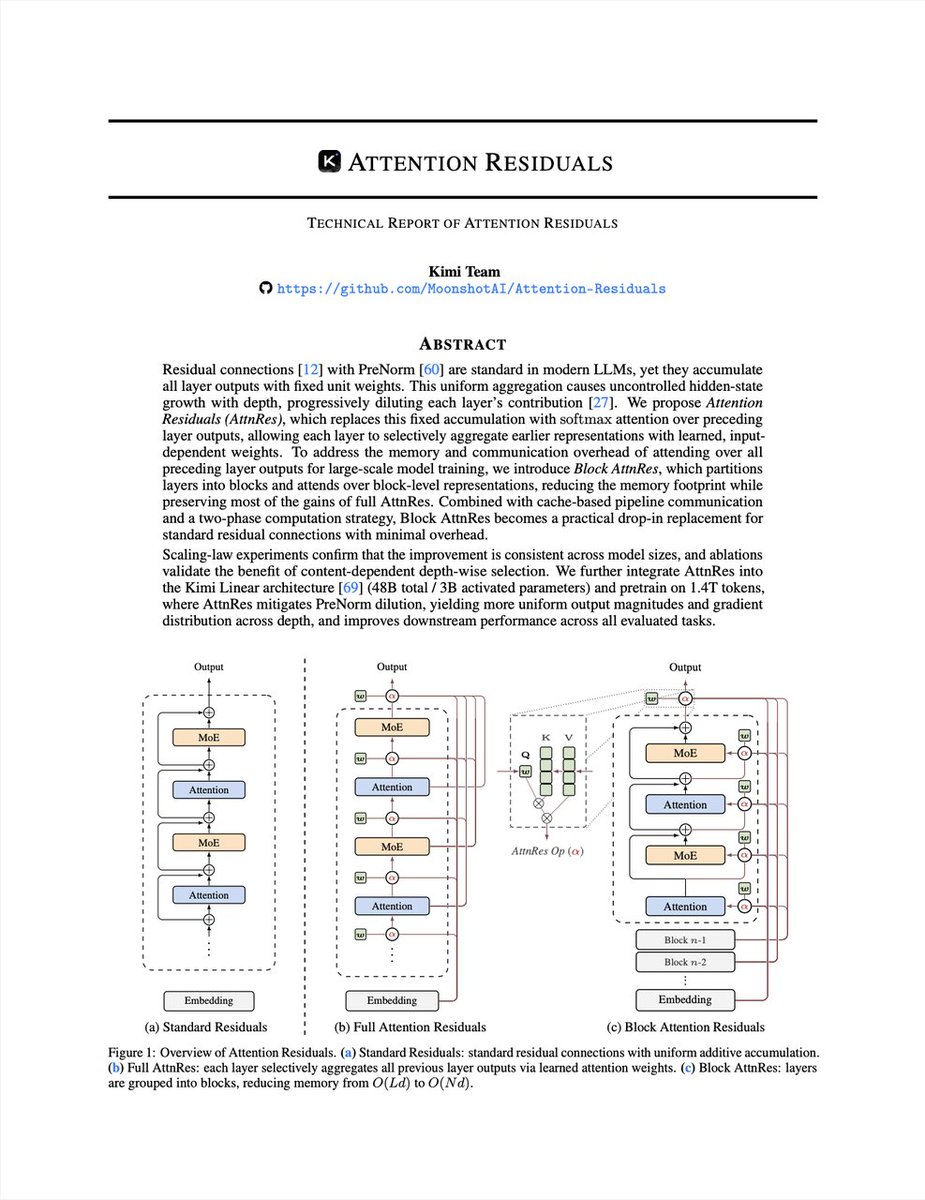
Introducing 𝑨𝒕𝒕𝒆𝒏𝒕𝒊𝒐𝒏 𝑹𝒆𝒔𝒊𝒅𝒖𝒂𝒍𝒔: Rethinking depth-wise aggregation.
Residual connections have long relied on fixed, uniform accumulation. Inspired by the duality of time and depth, we introduce Attention Residuals, replacing standard depth-wise recurrence with learned, input-dependent attention over preceding layers.
🔹 Enables networks to selectively retrieve past representations, naturally mitigating dilution and hidden-state growth.
🔹 Introduces Block AttnRes, partitioning layers into compressed blocks to make cross-layer attention practical at scale.
🔹 Serves as an efficient drop-in replacement, demonstrating a 1.25x compute advantage with negligible (<2%) inference latency overhead.
🔹 Validated on the Kimi Linear architecture (48B total, 3B activated parameters), delivering consistent downstream performance gains.
🔗Full report:
https://t.co/u3EHICG05h