LIVE: Fidelity International, a global asset manager with $1+ trillion total client assets, launches its first tokenized fund FILQ, powered by Chainlink.
Through onchain NAV, Chainlink is enabling Fidelity International to bring regulated yield-bearing liquidity into 24/7 digital market.
Today we announced progress toward our goal of advancing 24/7 collateral mobility. DTCC’s Collateral AppChain, a shared infrastructure platform for collateral, will leverage the Chainlink Runtime Environment (CRE) and @chainlink data standard to enable near real-time collateral management across financial markets and blockchains.
The integration will enable the seamless pairing of asset prices, valuations, and movement, with the aim of overhauling how market risk is managed globally and unlock greater capital efficiency.
This milestone reflects our broader vision to enable 24/7, near real-time collateral management across the global financial system.
Read the full announcement: https://t.co/ELVio44scA
Most people's mental model of Chainlink $LINK is completely wrong
Here's why👇
People often think of oracles as simple middleware bolted to the side of a blockchain, simply injecting price data
In their mind, Chainlink is "just an oracle" so who cares right?
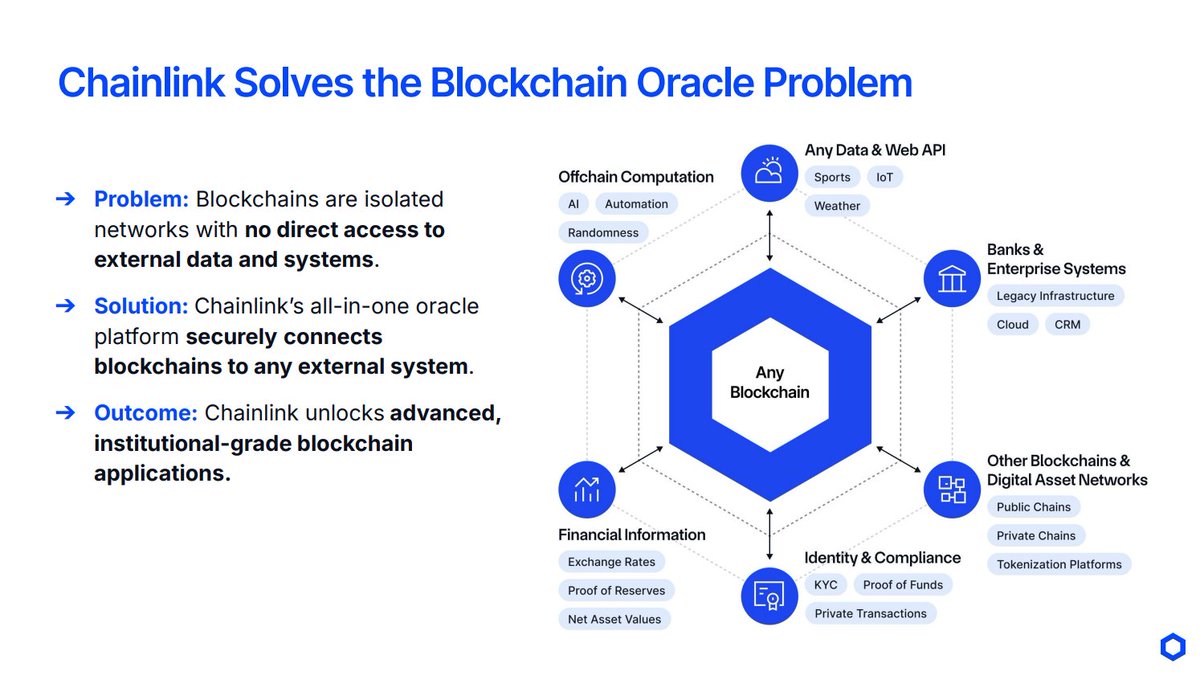
A more complete mental model is that Chainlink is the global orchestration layer that sits above and across all blockchains and external systems
A unified platform that enables organizations to create advanced business workflows spanning any number of blockchains, legacy systems, and oracle services, all powered by a decentralized runtime environment
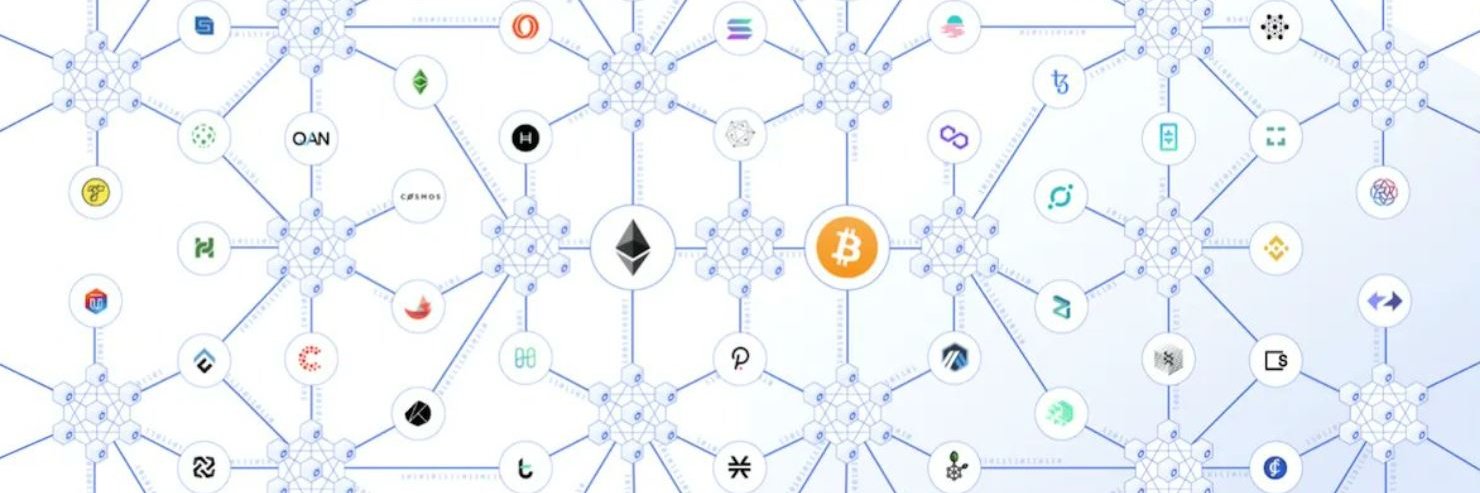
This matters now more than ever because we are entering a Cambrian explosion of blockchains of all kinds (public & private, L1 & L2, DeFi & TradFi, EVM & non-EVM)
The cost and friction of launching a new blockchain network has never been lower
And what we have seen historically is that in order for a blockchain to be successful, it needs critical oracle services:
- Data oracles: DeFi needs market data to secure lending and derivatives, while TradFi needs NAV data for tokenized funds and corporate actions data for tokenized equities. Proof of Reserve provides public visibility into the reserves backing tokenized assets
- Cross-chain oracles: Digital assets in both DeFi and TradFi need to be securely transferable across any public or private blockchain to access a greater pool of buyers, minimizing liquidity fragmentation and enabling advanced settlement workflows
- Compliance oracles: Regulated tokenized assets need to comply with various regulations and internal business logic rules around identity verification and risk management to become adopted by institutions
- Privacy oracles: Sensitive information needs to be made accessible to blockchain apps without revealing the underlying data, while private chains need to connect to public chains while only selectively revealing what is needed to complete transactions
- Legacy-system oracles: Institutions want to access public and private blockchains using their existing infrastructure and messaging standards (Swift, FIX, DTCC) through a single integration gateway rather than manually integrating with thousands of chains individually
- Orchestration oracles: Institutions need to be able to coordinate complex business workflows that span multiple blockchains, legacy systems, and oracle services through a simple API gateway
Chainlink is the only unified platform that provides all of these solutions in a single offering, minimizing trust-assumptions and eliminating the complexity of using a patchwork of service providers
This is how institutions adopt blockchains, not by betting on specific chains, but integrating with a unified platform that provides them access to any public or private chain
While blockchains fiercely compete amongst each other to become the transactional database layer, Chainlink wins regardless of which chains are used
For Chainlink, every new blockchain introduced to market is all the more justification for why organizations need a global orchestration layer to manage the complexity
Financial market infrastructures like Swift, DTCC, and Euroclear understand this, which is why they have adopted Chainlink alongside J.P. Morgan, Mastercard, Central Bank of Brazil, UBS, SBI, Fidelity International, ANZ, and many others
In addition to powering the DeFi economy (70%+ marketshare globally, 80%+ on Ethereum, and 90%+ on L2s), Chainlink directly monetizes the integration and deployment of its services on blockchains via the Scale program and enterprise deals
Onchain revenue from the usage of Chainlink services, as well as offchain revenue from Scale and enterprise deals, directly fuel $LINK token buybacks which grow the Chainlink Reserve
Chainlink services have already enabled $28+ trillion in transaction value across 77+ blockchain networks via 2,000+ oracle networks used by 500+ applications, with more public and private blockchains regularly integrated all the time
Today, developers build on blockchains and plug into Chainlink
In the future, developers will build on Chainlink and plug into blockchains
The result is straight forward:
More blockchains
↓
More Chainlink adoption
↓
More onchain & offchain revenue
↓
More $LINK token buybacks
↓
Chainlink's dominance compounds
The full deep dive report into everything Chainlink:
• Vision
• Technology
• Use Cases
• TradFi & DeFi Users
• Adoption metrics
• Economics
And much more ↓
https://t.co/3jP399fCey
@elonmusk Could unchecked AI development push society toward the kind of social breakdown seen in Universe 25?
Without careful oversight, human- centered design, and adaptive governance, the risks grow.
Are we steering this technology wisely enough to prevent that trajectory?
We're excited to announce that Chainlink and the United States Department of Commerce (@CommerceGov) have worked together to bring U.S. government macroeconomic data onchain.
https://t.co/Bea4iLirfZ
These new Chainlink Data Feeds securely deliver critical information around key U.S. economy metrics onchain, sourced from the Bureau of Economic Analysis (@BEA_News).
Metrics include the Real Gross Domestic Product (GDP), Personal Consumption Expenditures (PCE) Price Index, and Real Final Sales to Private Domestic Purchasers.
Bringing key U.S. government data onchain unlocks innovative use cases for blockchain markets, including:
• Automated trading strategies
• Increased composability of tokenized assets
• Issuance of new types of digital assets
• Real-time prediction markets for crowdsourced intelligence
• Transparent dashboards powered by immutable data
• DeFi protocol risk management based on macroeconomic factors
These datasets are updated monthly or quarterly as applicable, and are initially being made available across ten blockchain ecosystems, starting with Arbitrum, Avalanche, Base, Botanix, Ethereum, Linea, Mantle, Optimism, Sonic, and ZKsync. Support for additional blockchain networks can be incorporated over time based on user demand.
This development builds upon Chainlink’s accelerated work with the U.S. government in 2025, including meeting with several key officials and regulators to make policy recommendations that are advancing the growth of the blockchain industry.
THE CHAINLINK ENDGAME
The updated Chainlink vision is here.
What started as a data solution is now an extensive platform of essential services for integrating the world into the onchain economy ⬇️
https://t.co/HlnmFeiEWY
What TCP/IP did for the Internet and the Java Runtime Environment (JRE) did for online development, Chainlink is doing for blockchains and onchain apps.
In the early days of the Internet, scaling required more than innovation—it required unification and seamless orchestration.
TCP/IP and the JRE emerged, bringing coherence to a fragmented digital world and abstracting away complexity so developers could focus on building.
Blockchains are at the same turning point.
With more chains and even more financial institutions and real-world assets moving onchain, the main challenge now is building apps that efficiently orchestrate across blockchains and existing systems.
Advanced blockchain apps now involve multiple types of data, cross-chain interoperability, compliance policies, integration with legacy systems, and much more.
Building these next-gen apps is nearly impossible to do in-house and overly complex if you have to rely on a growing list of vendors, who each only solve a small portion of the application’s overall requirements.
Chainlink changes that.
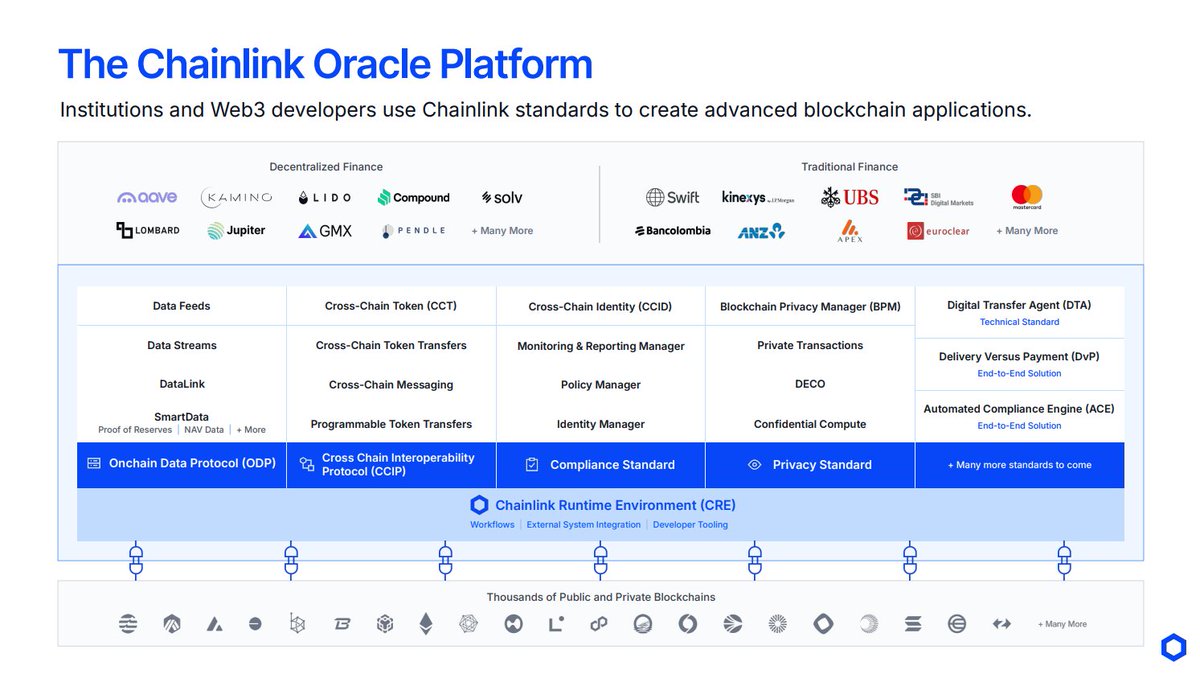
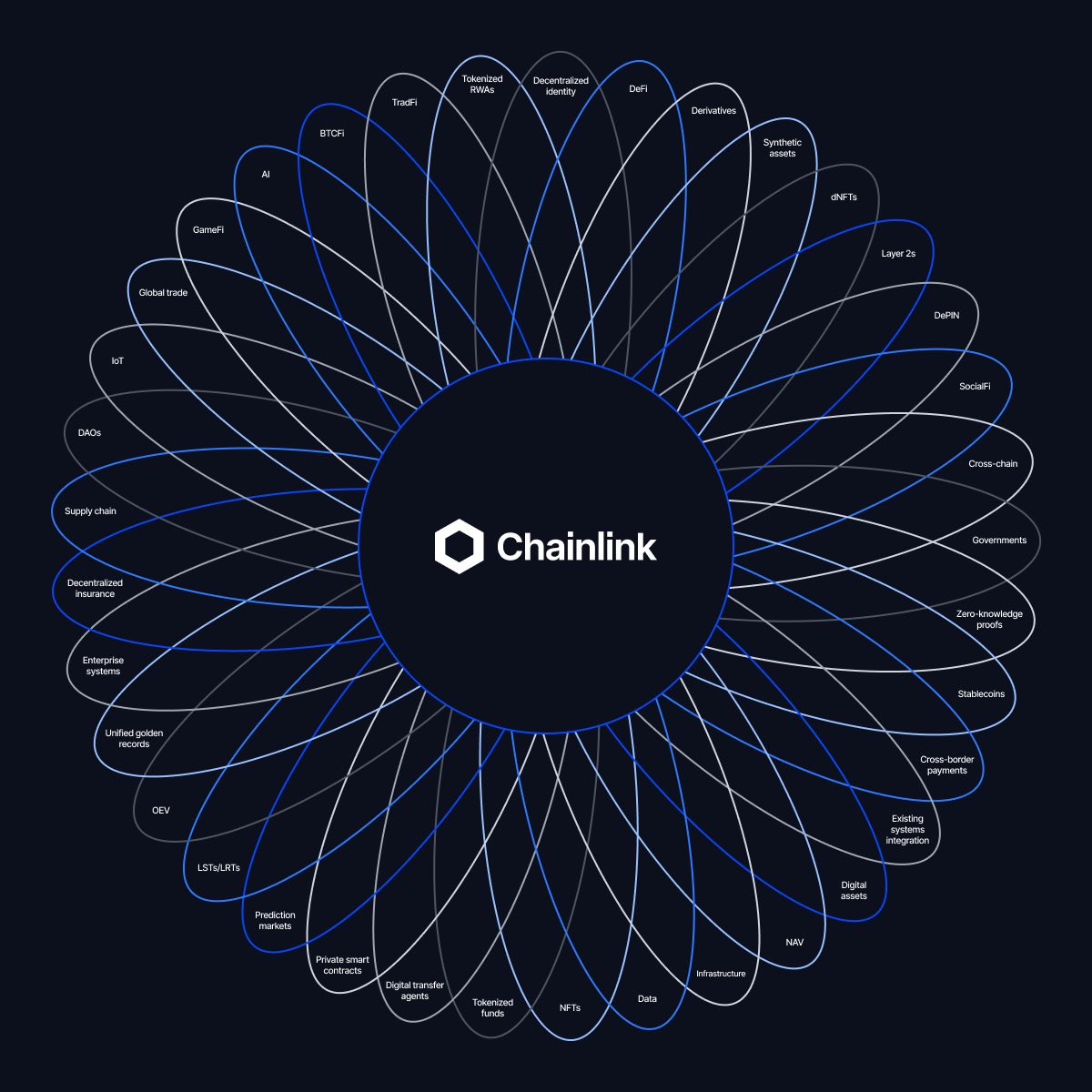
Chainlink is not just a price feed. It’s a unified oracle platform that underpins critical standards, services, and end-to-end solutions needed to unlock advanced blockchain applications:
• Data oracles for publishing mission-critical data onchain
• Interoperability oracles for moving data and value cross-chain
• Compliance and privacy oracles for meeting regulatory and internal business requirements
• Legacy system integration for seamless connecting between onchain and offchain systems
• Verifiable orchestration and compute to power entire applications in a decentralized manner
Like Java and TCP/IP before it, Chainlink unifies blockchains and abstracts away complexity, empowering developers and institutions to build and power the entire lifecycle of onchain use cases via a single, secure platform.
Now, enterprises can efficiently build onchain apps that mirror the sophistication of traditional finance yet benefit from the transparency, security, and composability of blockchains and Chainlink technology.
Chainlink is how the world integrates into the onchain economy.
We're excited to announce the launch of the Chainlink Reserve, a new upgrade centered on the creation of a strategic onchain reserve of LINK tokens.
https://t.co/Fgib8zR9uj
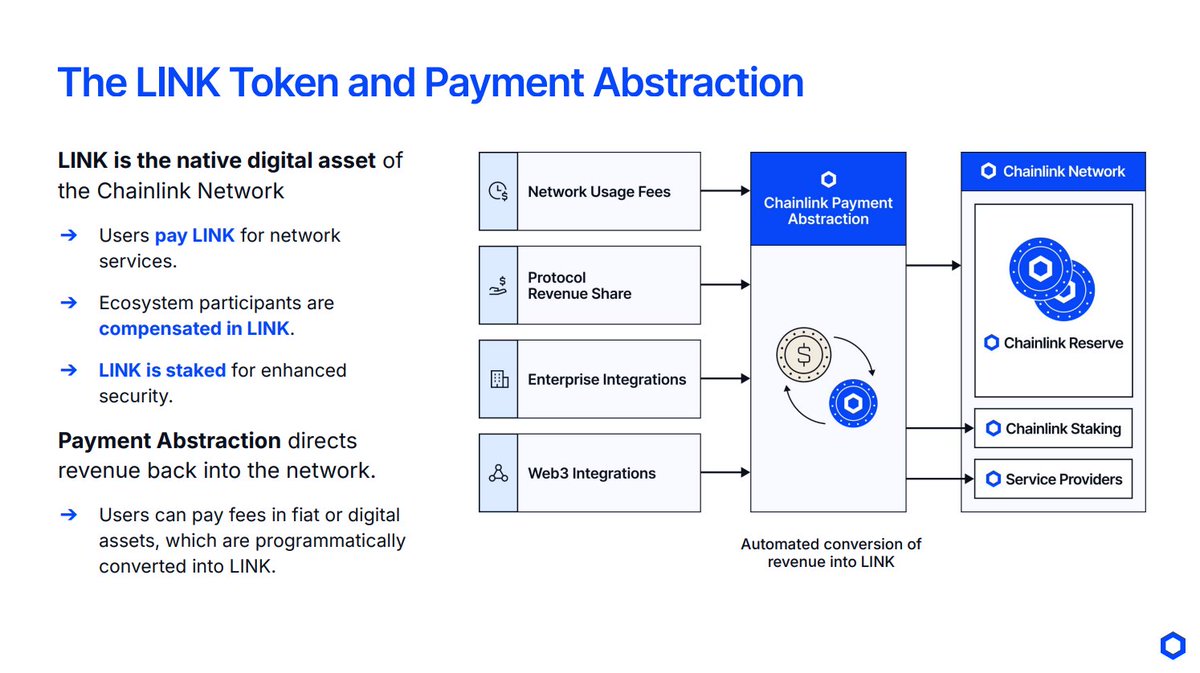
The Chainlink Reserve is designed to support the long-term growth and sustainability of the Chainlink Network by accumulating LINK tokens using offchain revenue from large enterprises that are adopting the Chainlink standard and from onchain service usage.
The Chainlink Reserve is being built up by using Payment Abstraction to convert offchain and onchain revenue into LINK, using a combination of Chainlink services and decentralized exchange infrastructure.
Demand for Chainlink has already created hundreds of millions of dollars in revenue, substantially from large enterprises that have paid offchain for access to the Chainlink Platform.
With increasing demand from a number of the world’s largest banking and capital markets institutions, this form of paying for the Chainlink standard is expected to grow into the future as the industry grows.
The Reserve has already accumulated over $1M worth of LINK from this early stage launch phase, which is expected to gradually grow in the coming months as more revenue is converted into LINK and placed into the Reserve.
We do not expect any withdrawals from the Reserve for multiple years and thus it is expected to grow over time. We believe that as the industry demand for Chainlink’s unique capabilities increases, that adoption of Chainlink services will enable the Reserve to grow further.
🧵👇
We’re excited to announce that Chainlink and @Mastercard have partnered to enable billions of cardholders to purchase crypto directly onchain.
https://t.co/bN5IVe1ieL
Chainlink verifies and synchronizes key transaction details to enable Mastercard holders to access crypto directly onchain.
This marks a major step forward in the mainstream adoption of Web3. Chainlink and Mastercard power the new @swapperfinance platform, with @ZeroHashX providing the onchain service and access to liquidity needed to convert fiat into crypto with seamless smart contract execution, alongside @Shift4, and @xswap_link, with liquidity sourced from @Uniswap.
Combining Mastercard’s global payments technology and Chainlink’s industry-standard infrastructure creates a secure user experience for billions 🧵
We're excited to announce Build on Solana, a new startup program from @chainlinklabs to help leading teams build, launch, and grow in the @Solana ecosystem.
Selected teams join Chainlink Build and gain hands-on guidance, ecosystem incentives, and go-to-market resources from both Chainlink and the Solana Foundation.
✍️ Apply now: https://t.co/hYeHLYRvrx
🔗 More info: https://t.co/yCxAxp9wUI
We’re excited to introduce Chainlink Rewards—a community engagement & rewards program.
This allows Chainlink Build projects to make their token claimable by ecosystem participants, including eligible LINK Stakers.
Season Genesis launches May 8 with @spaceandtime.
🧵👇
Chainlink Payment Abstraction—a cross-chain payment system that converts user fees into LINK—is officially live on mainnet 🔥
As the first use case, Payment Abstraction has been integrated with Chainlink SVR to convert the Chainlink Network portion of fee revenue into $LINK
@aave, the largest DeFi protocol by TVL, integrated SVR last Friday to recapture liquidation MEV, featuring a revenue split of 65% to the Aave ecosytem and 35% to the Chainlink ecosystem
Historically, tens of millions of dollars in liquidation MEV has been leaked to blockchain validators. SVR fixes this
Network revenue generated from SVR feeds not yet secured by Staking will be initially be paid to node operators by helping cover their existing oracle reward payments for Data Feeds (replacing subsidy with fees)
SVR feed revenue will transition to being paid to $LINK stakers once Staking secures the node set powering an SVR feed (e.g., Staking secures the standard ETH/USD feed, so it also secures ETH/USD SVR feed)
When revenue from Staking-secured SVR feeds are made available to $LINK stakers, 50% will be used to support the existing Staking reward rate (replacing subsidy with fees)
The other 50% will serve as an additional fee reward for $LINK Stakers split 50/50 between the node operator and community staking pools
More info on when/how SVR fees will be made available to $LINK Stakers will be provided in the future
Payment Abstraction infra will also be used to consolidate existing node operator oracle reward payments from 40+ chains to a single blockchain, starting with CCIP (important as Chainlink scales to more chains)
The announcement also notes that the first phase of the Chainlink Build claims mechanism is code-complete and expected to launch this year (making Build tokens claimable by $LINK Stakers) 👀
🔗👇 Full announcement below