Proteins are life’s most important molecules. And in the words of the Nobel committee, Baker “has succeeded with the almost impossible feat of building entirely new kinds of proteins.”
https://t.co/LjXeBs53Il
BREAKING NEWS
The Royal Swedish Academy of Sciences has decided to award the 2024 #NobelPrize in Chemistry with one half to David Baker “for computational protein design” and the other half jointly to Demis Hassabis and John M. Jumper “for protein structure prediction.”
Excited to share that I recently left Stanford AI PhD to start Pika. Words can't express how grateful I am to have all the support from our investors, advisors, friends, and community members along this journey!
And there's nothing more exciting than working on this ambitious & creative project with the best team I can ask for :)
GPT-4 for radiology. Far from perfect, but state-of-the-art performance on some tasks: “Surprisingly, we found radiology report summaries generated by GPT-4 to be comparable and, in some cases, even preferred over those written by experienced radiologists”
https://t.co/bi6RwqgeHw
He 5X'ed AstraZeneca's productivity from pre-clinical to phase III completion and transformed the company's R&D strategy, culture and approach to innovation.
I spent hours researching Mene Pangalos.
10 key principles from his leadership playbook:
That title says it all. AI has collided with bio is it is producing some pretty incredible results.
@schubertcm@UWProteinDesign
How AI is changing the way scientists engineer drugs, biosensors, enzymes and more – GeekWire https://t.co/olXGsxUUQy
First video of LK-99 Full Levitation, aka flux-pinning
This video was just posted to the Chinese video-sharing site BiliBili and claims to be a highly pure synthesized sample of LK-99.
What is the physical phenomenon behind this and what does it mean?
Levitation of superconducting materials is a phenomenon unique to what is called Type-II superconductors, and is an effect whereby magnetic field lines becomes 'trapped' as it passes through the material, providing the force needed to levitate. These are the popular images and videos of cryogenically-cooled discs floating above a magnet frequently seen online and in the pinned post on my profile.
You can think of this like strands of hair being caught in gum - the gum is suspended in mid-air by adhering strongly to the hair as the hair passes through it. The hair in this case is magnetic field lines and the gum is the Type-II superconductor. Just like hair comes in individual strands, or in other words hair is 'quantized' or 'discrete', so is the flux trapped at the 'pinning centers' quantized in what are called 'magnetic vortices' - the quantization of pinned flux lines is a key property and distinguishing characteristic of Type-II superconductors (although technically can occur in Type-I superconductors if the material thickness is smaller than the London penetration depth, which is indeed very small - specifics for the physics nerds out there).
Flux-pinning is entirely unique to superconductors and is also wholly distinct from the Meissner effect. It is not a property of diamagnets or diamagnetism.
At @TRIUMFLab I contributed to flux-pinning studies in Niobium crystal superconducting radio-frequency cavities used for particle acceleration. In that application, trapped flux poses an issue by increasing the remnant surface resistivity of the cavity, which has the effect of decreasing its effective quality factor or Q-factor, which is a measurement of a resonators efficiency. SRF cavities typically have Q-factors of 10E10 and trapped flux at pinning centers reduces the maximum effective accelerating electric field used to drive charged particle bunches close to the speed of light.
Flux pinning is thought to arise in some Type-II superconductors by small imperfections in the crystal, also called volume defects, that enable flux to penetrate the material. In SRF cavities an issue that arises is any magnetic field that is passing through the material, e.g. by the Earth's background field, can become pinned or trapped inside the cavity as it transitions into a superconducting state. See some attached plots in the comments from a study showing how the surface resistivity of SRF cavities increases the more there is a background field as the cavity transitions into superconducting state.
This is the first video I am aware of that claims to show the flux-pinned levitation of a LK-99 sample. If this is in fact what is happening, then it is a very unique and promising finding of this new materials properties and potential for future study.
If this is real then it is truly ground-breaking
It’s coming together: Genes involved in embryonic development are discovered to turn on in old human tissue, consistent with the information theory of aging (ITOA) https://t.co/L7bESRk1lV
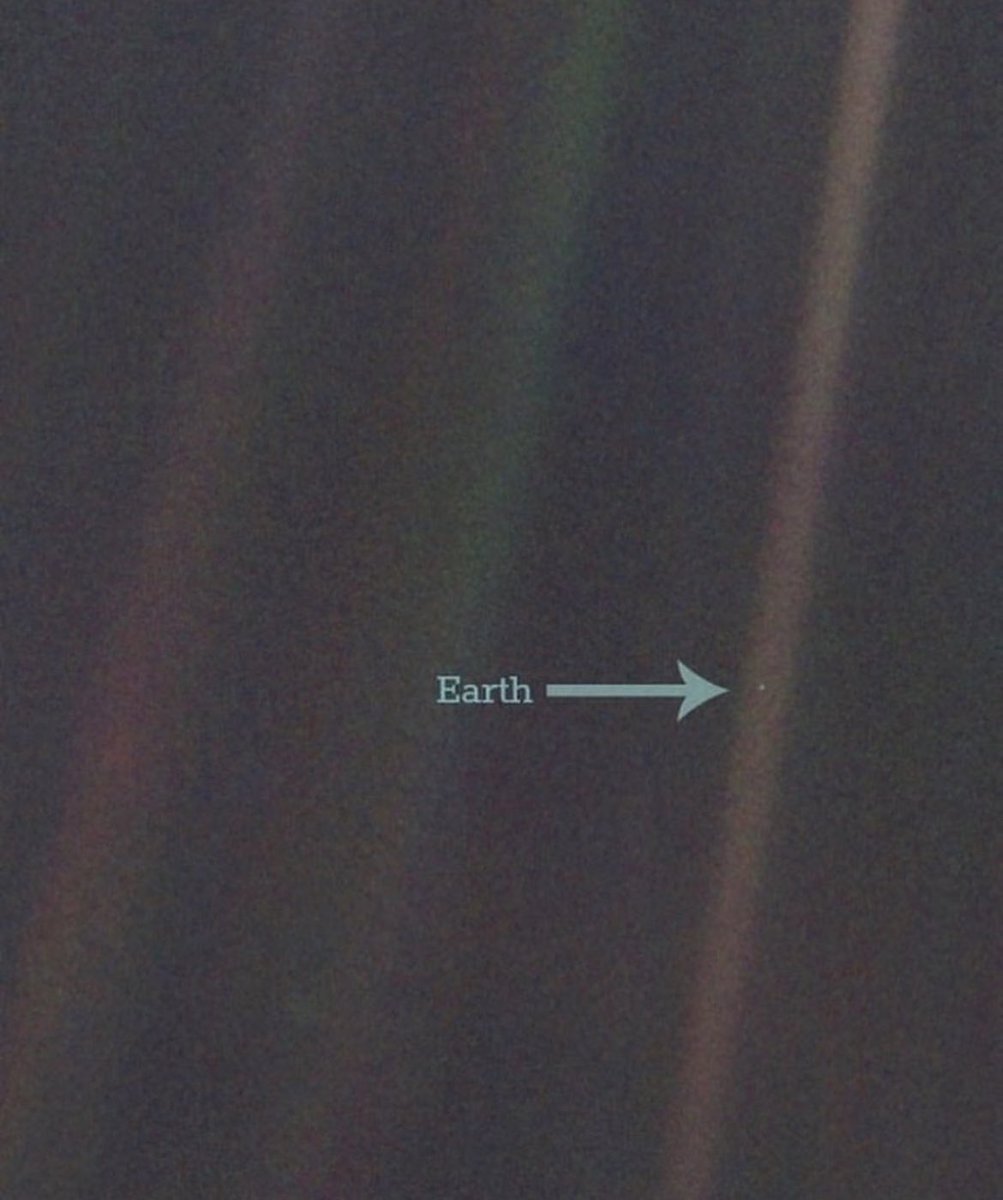
Pale Blue Dot is a photo of Earth that was taken by the Voyager 1 space probe in 1990 from a distance of about 6 billion kilometers (3.7 billion miles) as it was leaving our solar system. This is what Carl Sagan said about the photo:
"Look again at that dot. That's here. That's home. That's us. On it, everyone you love, everyone you know, everyone you ever heard of, every human being who ever was, lived out their lives. The aggregate of our joy and suffering, thousands of confident religions, ideologies, and economic doctrines, every hunter and forager, every hero and coward, every creator and destroyer of civilization, every king and peasant, every young couple in love, every mother and father, hopeful child, inventor, and explorer, every teacher of morals, every corrupt politician, every 'superstar,' every 'supreme leader,' every saint and sinner in the history of our species lived there — on a mote of dust suspended in a sunbeam.
The Earth is the only world known so far to harbor life. There is nowhere else, at least in the near future, to which our species could migrate. Visit, yes. Settle, not yet. Like it or not, for the moment the Earth is where we make our stand. It has been said that astronomy is a humbling and character-building experience. There is perhaps no better demonstration of the folly of human conceits than this distant image of our tiny world. To me, it underscores our responsibility to deal more kindly with one another, and to preserve and cherish the pale blue dot, the only home we've ever known.”
PROMPT CHALLENGE #74: DNA
1. I’d like to see how you interpret the phrase to come up with whatever you imagine. Please be creative! You can use any A.I. platform to create with, whether it is Adobe Firefly, MidJourney, StableDiffusion, Bing, or others.
2. You can share several images.
3. Please share the prompt you used to create the image. I started this challenge as a learning opportunity
4. Please do like your favorites from the submissions!
5. This is just for fun! Everyone is a winner.
Imagine ChatGPT but for research papers.
SciSpace is an AI-powered personal research assistant that will help you do hours worth of reading in minutes.
& it's completely FREE!
When you eat sugar, some of it attaches to your body’s proteins, an aging process called glycation. New study says oral resveratrol protects against glycation & kidney damage in a sugar-induced aging mouse model. Me: still taking resveratrol in yogurt https://t.co/Cnnfsc2gYs
Midjourney's remix feature keeps getting better.
A quick tutorial on how to turn your photo generations into illustrations while maintaining the same overall composition.
🧵It's really easy
Interested in how classical rule-based modular biology & #deeplearning fit together for the design of artificial proteins?
A new preprint combines these two modeling strategies to generate novel proteins!
Let's take a closer look at this innovative framework🧵👇