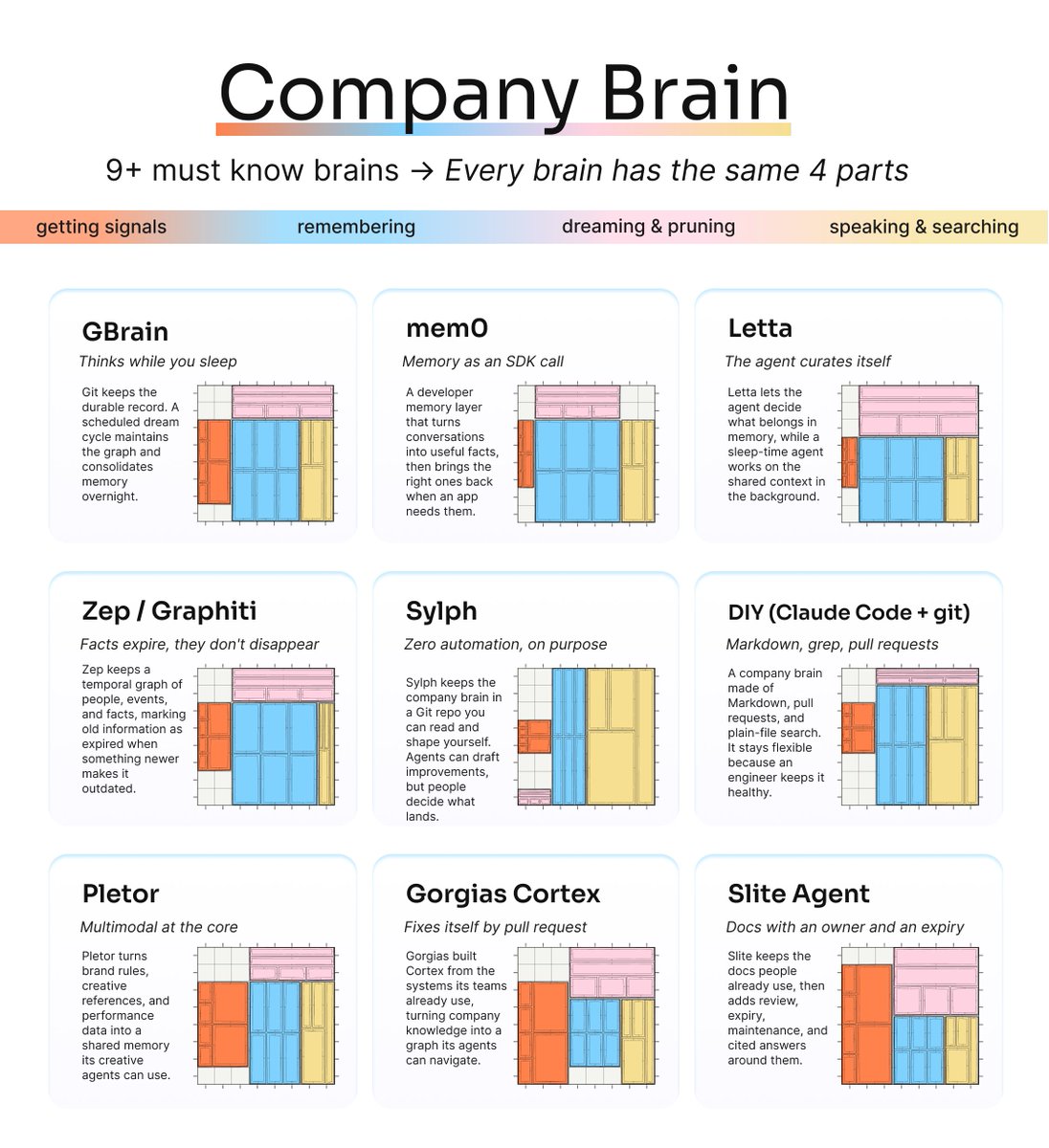
Everyone's suddenly building company brains.
Nobody agrees on what's inside one. 😵💫
So we opened up 9+ company brains to see how they're actually built.
Every single one does the same four things: getting signals, remembering, dreaming & pruning, speaking & searching.
𝟭. 𝗚𝗕𝗿𝗮𝗶𝗻
Garry Tan's open-source personal brain. Your email and calendar flow into a git repo, and a nightly job re-links everything and flags what's gone stale.
𝟮. 𝗺𝗲𝗺𝟬
A memory library you call from your own code. It only stores what you explicitly tell it to, and ranks fresh facts above idle ones at search time.
𝟯. 𝗟𝗲𝘁𝘁𝗮
For building agents that remember across sessions. The agent decides what's worth keeping, and a second agent tidies up its memory in the background.
𝟰. 𝗭𝗲𝗽 / 𝗚𝗿𝗮𝗽𝗵𝗶𝘁𝗶
A knowledge graph with a clock in it. When a fact changes, the old one gets an end date instead of being overwritten, so you can still ask what was true last March.
𝟱. 𝗦𝘆𝗹𝗽𝗵
A content brain that lives entirely in a git repo. Agents write drafts, humans publish, and afterwards the agent reads your edits to learn what it got wrong.
𝟲. 𝗗𝗜𝗬 (𝗖𝗹𝗮𝘂𝗱𝗲 𝗖𝗼𝗱𝗲 + 𝗴𝗶𝘁)
What most engineering teams actually do. Markdown in the repo, grep instead of search, and pull requests as the only thing keeping it honest.
𝟳. 𝗣𝗹𝗲𝘁𝗼𝗿
A brand brain for marketing teams. Campaigns, assets and performance data in one tree, and the brand rules only move when a human signs off.
𝟴. 𝗚𝗼𝗿𝗴𝗶𝗮𝘀 𝗖𝗼𝗿𝘁𝗲𝘅
Built in-house by an eight-person AI team. 12,000 markdown nodes in GitHub, and every night the questions it got wrong become PRs that fix it.
𝟵. 𝗦𝗹𝗶𝘁𝗲 𝗔𝗴𝗲𝗻𝘁
For teams whose knowledge lives in docs and across sources. It watches ~20 connected tools (Slack, Drive, GitHub, Jira, etc.) for what's gone stale and sends the diff to whoever owns the page. Nothing changes without human approval.
We just launched an interactive ebook with architecture notes from real 149 teams of builders and users, interview insights, and the complete research.
The ebook is free, get it here: https://t.co/B7QBztEqgI
Which brain would you pick? 🧠
I'm having trouble wrapping my head around just how crazy this is.
Someone:
> Created a custom library to replicate brushstrokes in JS
> Trained a custom model with RL to use the library to create paintings
> Now has a model that can programmatically generate oil paintings with code
Engineers are not real people man istg
People of @pidotdev! I just clanked up pi-shepherdr (KEKW): talk to one Pi, let it run the others.
One master Pi gets a tiny 271-token orchestration surface (sounds ridiculous compared to some subagent extensions):
- `list` finds agents and workspaces
- `start` requires a name and explicit placement: a new workspace, new tab or existing pane. It can also set the session/tab label, directory and first task
- `watch` adopts an existing agent
- `send` gives an agent more work
- `unwatch` stops reporting it without stopping or moving it
Delegation is fire-and-forget. Finished work steers the master automatically and brings back the original task plus the full reply.
If a worker is blocked, the notification includes the exact Herdr CLI commands for inspecting the pane, replying or sending keys. No skills, convoluted @herdrdev introduction or `--help` archaeology needed. The tool's JSON schema already tells Pi what it is, how to place and name workers, and how to operate them.
The boundaries are deliberate. Shepherdr does not focus, move, stop or close panes. Herdr owns the terminals, layout and session lifecycle.
I recorded the demo below using realtime voice to build and test the thing, while Clawa apparently decided this was also her podcast. New meta for filming videos buahahhahaha.
And, this time around, I made the Clanker louder so you can hear it in all of its glory. Fun times.
pi install npm:@howaboua/pi-shepherdr
https://t.co/5eIHLWDVrE
Happy Clanking!
- Clawa
PS. Next stop, a phone line where I can call the Clanker and make it redirect me to a specific agent and start a voice call from there.
Asked GPT 5.4 Pro for SAAS ideas that will not be made obsolete by AI...
After for thinking for 29m 26s, it lead its answer with:
"No SaaS is immune to AI."
🤦♂️
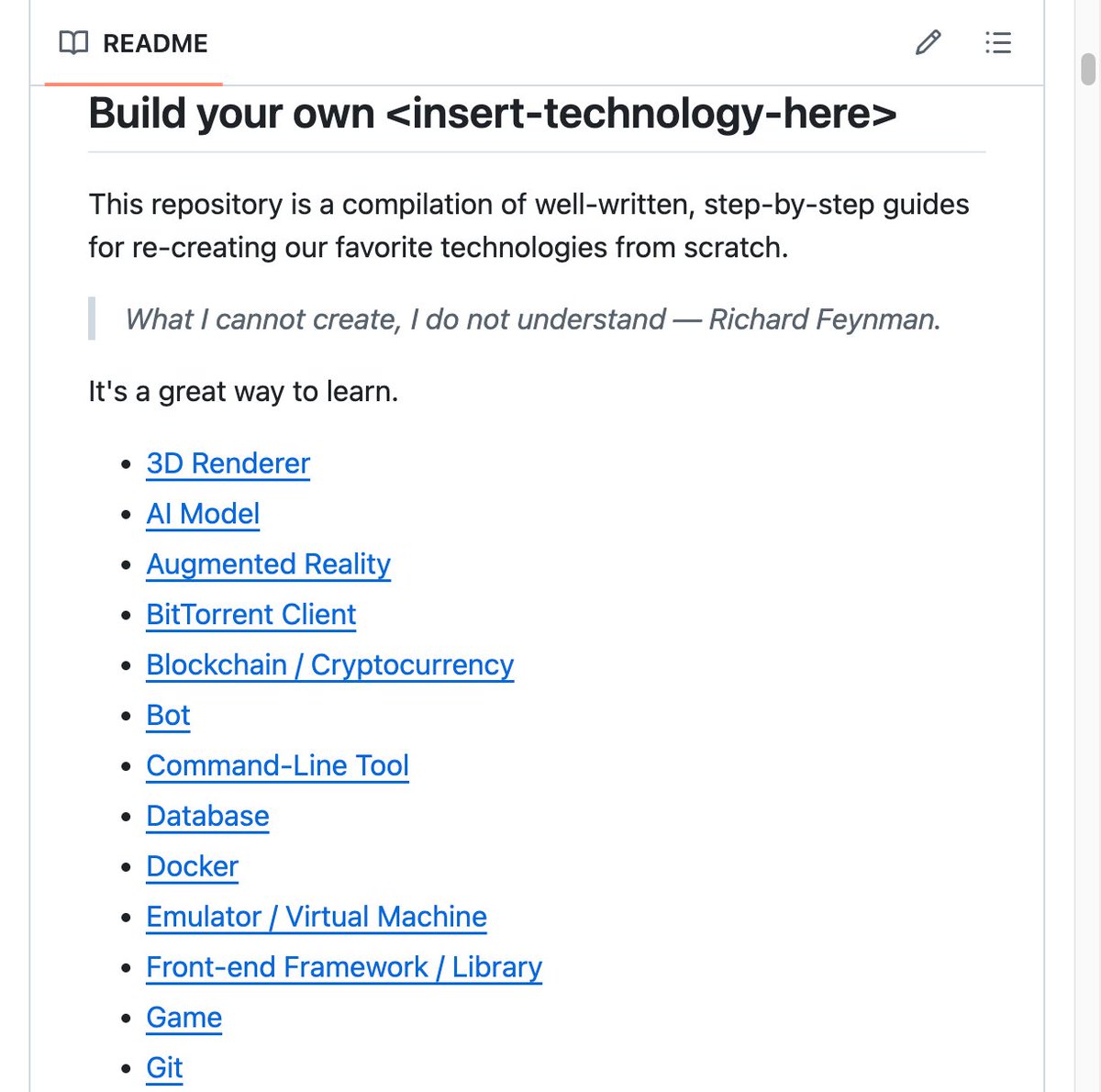
🚨 Someone compiled every "build it from scratch" tutorial on the internet into one place.
It's called build-your-own-x and it's the most starred repo in GitHub history.
466,000 stars. More than React. More than TensorFlow. More than any tool ever built.
And it's not code. It's a curated collection of step-by-step tutorials that teach you how to rebuild the technologies you use every day. From scratch.
Richard Feynman said: "What I cannot create, I do not understand."
That's the entire philosophy.
Here's what's inside:
→ Build your own Database from B+Trees to a full Redis clone
→ Build your own Docker containers in 500 lines of C
→ Build your own Git finally understand what a commit actually is
→ Build your own Neural Network not import tensorflow, real backpropagation from scratch
→ Build your own Operating System write a kernel in C
→ Build your own Programming Language interpreters, compilers, garbage collection
→ Build your own 3D Renderer ray tracing, pixel by pixel
→ Build your own Web Server, Web Browser, Search Engine, Shell, Regex Engine, Game, Blockchain, BitTorrent Client, Physics Engine, and more
Every category has multiple tutorials in multiple languages. C, C++, Python, Go, Rust, JavaScript, Java, Ruby, Haskell, TypeScript, and more.
Here's the part most people miss:
This isn't a beginner resource. This is the most advanced learning material that exists for software engineers. Because rebuilding something from scratch forces you to confront every design decision the original creators made.
You can't skip anything. You can't hide behind a library.
In the age of AI-generated code, this is the knowledge that becomes MORE valuable, not less. AI can import libraries. AI cannot replace an engineer who understands WHY systems work the way they do.
466K stars. 43.7K forks. Every tutorial is free. No paywalls. No sign-ups.
The best way to learn how something works is to build it yourself.
100% free. 100% Open Source.
GitHub link in the comments 👇
@tibo_maker Point 3 hits hard. I'm spending seemingly-absurd amounts of time iterating on specs before having the agents write any code. The quality shift is real.