Perhatikan deh pas dia ngomong "hitung kasar saja, mana orang matematik itu, mana sarjana ekonomi..", gayanya congkak merasa orang2 pintar kerja di bawah dia, sementara dia ga perlu pintar2 amat.
Negara lo dipegang orang-orang begini dari bawah sampe atas 🤣😭🤣😭
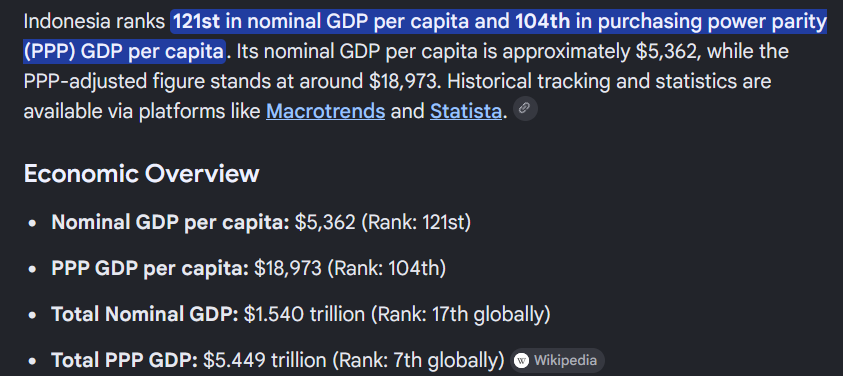
Tidak ada yang spesial. GDP Indonesia memang seharusnya di atas Jerman Perancis bahkan Jepang karena jumlah penduduk Indonesia terbesar ke empat di dunia.
Beda kalau bicara pendapatan per kapita. Indonesia masih berada di peringkat seratus lebih.
Avoid the Prajogo Pangestu complex. If the repo financing begins to unravel, the downside could become highly nonlinear.
When highly valued shares are pledged as collateral, falling prices can trigger margin calls, forced deleveraging, and additional selling. That creates a dangerous feedback loop: lower prices weaken collateral coverage, weaker collateral coverage forces more selling, and more selling pushes prices even lower.
The real risk is not simply an earnings disappointment. It is the possibility that the financing structure supporting the ecosystem begins to fail. Until there is greater transparency around pledged shares, leverage, and related funding arrangements, I would stay away.
Investor: Foreign selling in Indonesia has continued even when the KOSPI and Nikkei weakened. Doesn’t that suggest Indonesia is simply being caught in a broader regional risk-off environment?
Ricky: I do not think that explanation is sufficient. If this were only about regional risk appetite, we should see Indonesian equities moving broadly in line with other Asian markets. Instead, foreign investors have remained persistent net sellers of Indonesia even when the weakness elsewhere was comparable or, in some cases, more severe.
That tells me the issue is increasingly Indonesia-specific.
Foreign institutions do not only look at whether the index is rising or falling. They examine earnings quality, return on capital, funding structure, governance, liquidity, effective free float, valuation and the credibility of price discovery. They are asking whether the reported profit is sustainable, whether the balance sheet is becoming stronger or weaker, and whether they can actually exit a position without becoming trapped.
Investor: But some Indonesian companies are still reporting decent earnings. BMRI, for example, looked strong on the headline numbers.
Ricky: The headline numbers looked good, but institutional investors rarely stop at net profit growth.
In BMRI’s case, they would look beneath the surface and notice that funding costs were rising, the CASA ratio was deteriorating, and the funding mix was shifting toward more expensive time deposits and wholesale funding. Those details matter because they determine whether current earnings can be sustained.
A bank can report strong loan growth and headline profit while the underlying economics are becoming less attractive. If loan yields fall, funding becomes more expensive and liquidity tightens, future NIM and ROE can weaken even before the headline profit starts disappointing.
That is exactly the kind of divergence foreign investors try to identify early.
Investor: So you think the market is becoming more fundamental?
Ricky: Gradually, yes.
For several years, parts of the Indonesian market were driven less by earnings and more by liquidity, index mechanics, concentrated ownership and the assumption that another buyer would eventually arrive at a higher price.
That environment is becoming much harder to sustain.
Foreign passive flows are becoming less reliable, active managers are increasingly willing to avoid uninvestable stocks, and domestic liquidity is not unlimited. When incremental buying disappears, valuation eventually matters again.
Investor: What does that mean for the large conglomerate stocks?
Ricky: I would continue avoiding many of them, particularly stocks associated with conglomerate groups where the valuation is impossible to reconcile with the underlying earnings, cash flow and return on capital.
This includes many of the stocks connected to Prajogo Pangestu and other conglomerate groups that have achieved enormous market capitalizations despite limited effective liquidity, concentrated ownership and valuations far above global peers.
The issue is not that every conglomerate-owned company is a bad business. Some may own real assets and operate in structurally attractive industries. The issue is that a good asset can still be a terrible investment when the valuation is detached from economic reality.
If a company trades at hundreds of times earnings, investors are no longer paying for the existing business. They are paying for many years of perfect execution, permanent scarcity of shares and the assumption that someone else will continue buying at an even higher valuation.
That is not fundamental investing. That is a liquidity bet.
Investor: But those stocks have performed extraordinarily well in the past. Why can’t they continue rising?
Ricky: They can continue rising for a while. A stock does not need to be fundamentally cheap to move higher, particularly when ownership is concentrated and the effective float is extremely small.
When very few shares are genuinely available, it may take surprisingly little capital to move the quoted price. The new share price is then multiplied across every outstanding share, creating an enormous increase in paper market capitalization even though only a tiny amount of real money changed hands.
But this creates a very different risk profile from a broadly owned, liquid stock.
The price can remain elevated for as long as sellers remain scarce and new buyers continue arriving. The problem begins when the market needs genuine exit liquidity.
Investor: What do you mean by exit liquidity disappearing?
Ricky: Market makers and large holders can support prices while they still have access to fresh capital, index-related demand, speculative retail flows or new investors willing to enter.
But if foreign institutions are reducing exposure, passive inclusion becomes more difficult, and sophisticated domestic investors refuse to buy at extreme valuations, the pool of incremental buyers becomes much smaller.
At that point, the mechanism becomes increasingly circular. Existing participants may continue trading among themselves, creating the appearance of volume, but circular turnover is not the same as genuine liquidity.
Eventually, someone has to buy the shares with fresh capital and hold the economic risk.
If no new institutional buyer appears, retail investors increasingly become the final source of liquidity.
Investor: Are you saying retail investors are being used as the exit?
Ricky: In some cases, yes. That is the risk.
Retail investors see spectacular historical charts, enormous market capitalizations and narratives about energy transition, digitalization, infrastructure or national champions. What they may not see is how little genuine liquidity exists beneath the quoted price.
A stock can look liquid during the ascent because the same shares are traded repeatedly. But when large holders genuinely want to reduce positions, liquidity can vanish very quickly.
The market may have been liquid only while someone wanted it to look liquid.
Investor: You also mentioned repo financing. Why is that important?
Ricky: Because a rapidly rising share price can be monetized without selling the shares.
Controlling shareholders or related parties may pledge shares as collateral for loans or repo financing. A higher share price increases the value of the collateral, allowing the borrower to obtain more financing, fund expansion, purchase other assets or refinance existing obligations.
This creates a powerful incentive to keep the share price elevated.
The problem is that repo structures introduce a feedback loop. If the share price falls, the lender may require additional collateral or partial repayment. If the borrower cannot provide either, the pledged shares may eventually be sold.
That creates the possibility of forced selling.
Investor: But if the controlling shareholder owns most of the company, can’t they simply continue supporting the price?
Ricky: Only while they have sufficient liquidity.
Supporting a share price is not free. Financing costs accumulate. Interest must be paid. Collateral requirements can increase. If the price fails to recover, the borrower may need to inject more cash or pledge additional assets.
At some point, balance-sheet capacity becomes the constraint.
When a stock is highly concentrated and thinly traded, forced selling does not need to be enormous to create a severe price decline. The same scarcity that helped push the stock upward can make the decline much more violent because there may be almost no genuine bids below the market.
That is why I believe another leg lower remains possible in some of these names.
Investor: Are you saying a collapse is inevitable?
Ricky: No. I am saying the risk-reward is unattractive.
I cannot know the timing, the specific financing arrangements or which shareholders may eventually face pressure. A highly concentrated stock can remain detached from fundamentals for far longer than most investors expect.
But as an investor, I do not need to predict the exact day the structure breaks. I only need to decide whether the expected return adequately compensates me for the valuation, liquidity, governance and financing risks.
In many conglomerate stocks, it does not.
Investor: What if the company has exposure to a strong structural theme, such as renewable energy, data centers or commodities?
Ricky: A powerful theme does not eliminate valuation discipline.
Renewable energy can be a good industry. Data centers can be a good industry. Copper can be a good commodity. But if the stock already trades at a valuation that assumes decades of flawless growth, the industry tailwind may already be more than fully priced.
Investors frequently confuse a good narrative with a good security.
The right question is not whether the sector will grow. The right question is how much of that growth is already embedded in the share price, what capital is required to produce it, and what return shareholders will earn from the current valuation.
A company can double earnings and still produce a poor investment return if the starting multiple is absurd.
Investor: So what should investors own instead?
Ricky: I would focus on companies where earnings are supported by real cash flow, balance sheets are understandable, governance is credible, liquidity is genuine and valuation provides a reasonable margin of safety.
That does not mean buying every statistically cheap stock. Cheap companies with deteriorating fundamentals can remain value traps.
The better opportunity is in businesses where earnings quality is improving, returns on capital are sustainable, leverage is manageable and the market price does not require perfect execution.
In the banking sector, for example, I still view BCA as the cleanest exposure despite weaker NIM and lower ROE because the funding franchise is real, the customer base is prime, governance is strong and directed-lending risk is effectively zero.
The stock may not be an aggressive buy, but the business quality is independently verifiable.
That is fundamentally different from paying hundreds of times earnings for a stock whose quoted market value depends on extreme scarcity and minimal genuine turnover.
Investor: So your main recommendation is simply to avoid conglomerate stocks?
Ricky: I would be more precise.
Avoid conglomerate stocks whose valuations cannot be justified by earnings, cash flow, return on capital and genuine liquidity.
Do not buy merely because a billionaire controls the company, because the stock has risen dramatically, or because its market capitalization has become enormous. Market capitalization is not proof of economic value when only a microscopic number of shares determine the price.
Do not assume that a stock is safe because it rarely falls. In an illiquid market, stability may simply mean that almost nobody is trading.
And do not assume that index inclusion or passive flows will always provide an exit. MSCI is becoming increasingly skeptical of extreme price increases, concentrated ownership and reported free floats that do not translate into real investability.
The old playbook was to push a stock higher, qualify for index inclusion and distribute into forced passive demand.
That exit is closing.
Investor: What happens to the Indonesian market if this transition continues?
Ricky: In the short term, it will be painful.
Stocks supported primarily by liquidity, concentration and financial engineering may continue derating. Some companies may need to raise genuine equity, sell assets, reduce leverage or accept lower market valuations. Retail investors who bought near the top may suffer losses.
But in the long term, this transition is necessary.
A healthy capital market cannot be built on the assumption that prices can remain permanently detached from earnings and that passive investors or retail buyers will always absorb the supply.
Indonesia needs a market where strong companies outperform because they generate superior cash flow, allocate capital well and treat minority shareholders fairly.
If the market moves in that direction, foreign capital can eventually return with greater confidence.
But that capital will not return indiscriminately.
It will go to companies with sustainable earnings, strong balance sheets, credible governance, genuine liquidity and sensible valuations.
The era of buying a stock simply because a conglomerate owner can keep pushing the price higher is ending.
Investor: Final conclusion?
Ricky: Avoid the conglomerate names where the valuation makes no economic sense, particularly those with highly concentrated ownership, negligible effective liquidity and possible dependence on pledged-share financing.
The companies may be real. The assets may be real. The narratives may even be attractive.
But the quoted prices may not be.
When foreign capital is leaving, passive exit liquidity is disappearing and repo financing may be sitting beneath the structure, investors should not ask how high the stock once traded.
They should ask a much more important question:
Who will buy when the holders finally need to sell?
Investor: Example?
Ricky: One example would be Prajogo Pangestu complex. $BREN $TPIA $BRPT $PTRO $CUAN $CDIA
Plato raised the same concern more than 2400 yrs ago. In The Republic, Plato argues that democracy tends to elect leaders based on popularity n the ability to flatter, rather than on genuine knowledge or skill
BREAKING NEWS
Tukin TNI dan pegawai Kemenhan resmi naik
Jabatan bintang empat Rp 48,61 juta perbulan (sebelumnya Rp 37,81 juta)
Jabatan bintang tiga Rp 44,87 perbulan
(Sebelumnya Rp 34,9 juta )
Pepres : nomor 42 dan 43 tahun 2026
Udah tau belum?
Mamdani Walikota New York bikin Municipal Groceries Store yang tujuannya sama kaya Koperasi Desa Merah Putih yang jual harga barang subsidi.
Tapi gak gedebak-gedebuk sembarangan, ini bikinnya pake konsep, dimulai dari 5 unit dulu, dengan harga bahan pangan pokok 30% lebih murah dari harga pasar.
Kenapa bisa lebih murah?
Karena biaya overhead dan pajaknya ditanggung oleh anggaran kota bukan karena beli lebih murah dari supplier.
Canggihnya setiap produk bisa di cek bar code nya yang berisi transparansi harga dan edukasi program.
Ini praktik sosialisme yang bener.
Makanya kemaren2 gue bilang kalo KDM itu GOBLOG. Warga jabar banyak yang miskin, terjerat pinjol, kecanduan judul, terus dikasih sayembara nangkep begal. Jadi pemimpin malah ngerusak mental warganya.
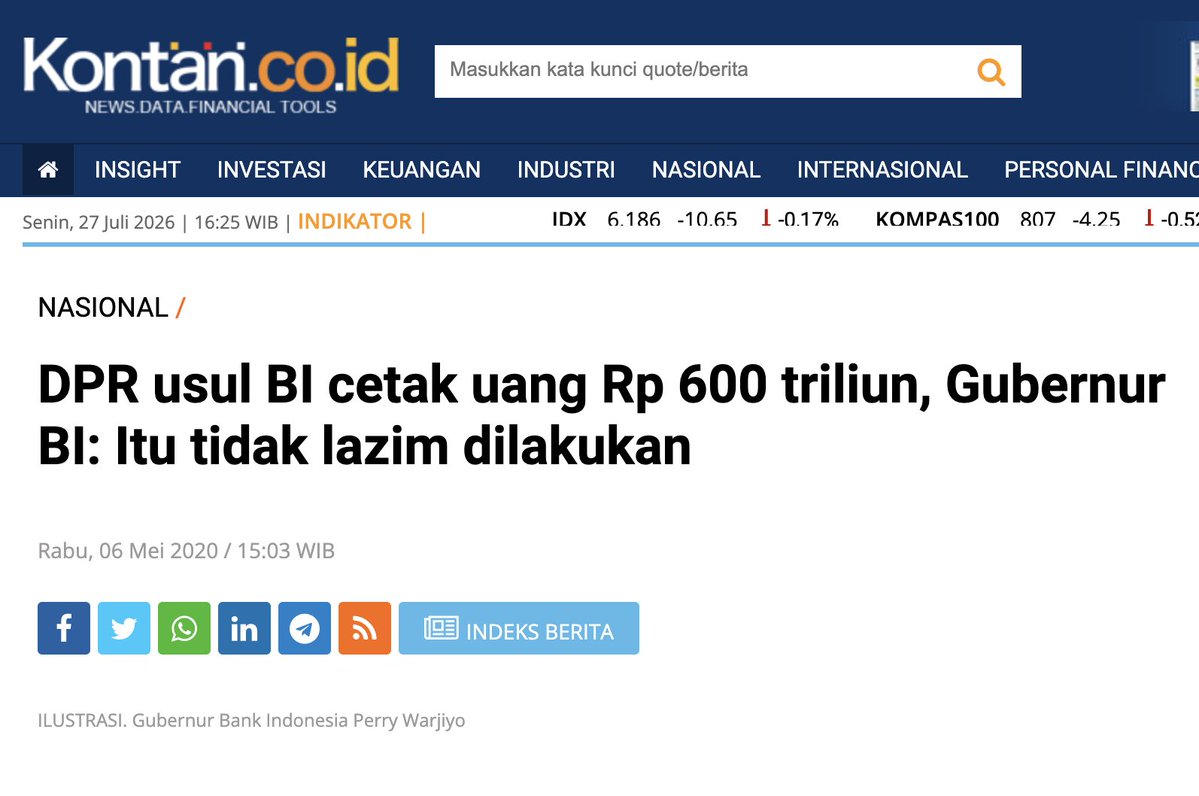
Ini berita lama, tapi saya yakin orang-orang Banggar DPR itu masih berhasrat untuk mendorong BI cetak uang buat nutupin defisit pemerintah.
Mimpi basah penganut MMT
Y’all aren’t listening: data centers are killing bees. Every third thing you eat? Bees made that possible. They are way more important than any fancy AI or server room we keep prioritizing.