I build with AI agents at MythyaVerse. Here I post how.
The agents aren't the slow part. Review is. So Claude Code plans, Codex does the work, and a different model checks what it wrote.
Expect how-tos on agent access and keys. And what broke.
@omarvvvr the exact test command, Omar. Claude can run that. it can't run "write clean code". for every other line, Anthropic's test is good: would removing it cause a mistake? if not, cut it. and the 1 rule it must never break? that's not a CLAUDE.md line. it's a hook.
@technohustler if that's your default, make the box the guard, Phani. run it in a Docker container or a VM with 1 repo inside and no real keys. Claude Code's own docs say skip mode is only for that kind of place. the flag isn't your risk. your laptop is.
@panditdhamdhere that last point is the one, Pandit, because a skill is code you didn't write, and your agent may run its scripts. until the security guidance lands, i'd treat it like an npm package. pin 1 commit. read the scripts. read them again on every update.
@kr0der the git part is cheap, Anthony. linked worktrees share 1 object store, and only files like HEAD and index are per tree. what eats your disk is usually node_modules and build output, a full set in each tree. i'd try pnpm. it hard-links deps from 1 store.
@ahamam101 i'd let it ship the undo, not the fix, Ahmed. a rollback to your last good build is safe to automate. you know that build worked. a brand new change at 3 am, with nobody awake to read the diff, is a different bet. so 1 auto revert first. fix waits as a PR.
@Layton_Gott on 5 and 6, Layton: Claude Code's own docs say CLAUDE.md shapes what it tries, not what you allow. so it's a wish. for paths it must never touch, i'd back it with a deny rule like Edit(./migrations/**) in .claude/settings.json, which Claude Code enforces itself.
@DarlingtonDev@vercel@pranaygp@fazxes the replay rule is the bit i'd point you to, Mike. per Vercel's docs, a tool not marked replay: 'safe' comes back to the model as "possibly run". good default. so for a git push or a deploy, i'd give the model 1 cheap way to check if it landed before it tries again.
Runs a local model on your Mac behind OpenAI and Anthropic APIs, so Claude Code or Codex can use it.
It's picky. You need an M3 or newer, macOS 26.4 or later, and 36 GB for the 4-bit examples, and it only runs models from a short list.
https://t.co/Uw5vwJwGLi
@Satovinci that's the access side of agents in 1 line, Satovinci. harm is set by what they can reach. not what they think. quick one on your sweep of 10,000 posts: did any loss come from a bot changing its own limits, or was it always a key that leaked or could do too much?
@j2k_mk 1 tip for your checker. give it the plan too, not just the diff, so it can catch a step the plan asked for that Codex or Claude quietly skipped. which model checks yours? i'd pick one that isn't from the builder's family.
I build with AI agents at MythyaVerse. Here I post how.
The agents aren't the slow part. Review is. So Claude Code plans, Codex does the work, and a different model checks what it wrote.
Expect how-tos on agent access and keys. And what broke.
@paulopierrondi lgtm's GUIDE.md gives the reason, Paulo. a check that cries wolf gets switched off. fair for humans. agents don't get tired of red, so --strict fits agent PRs. 1 gap even then: it counts asserts, so you can swap a strong assert for a weak one and keep the count.
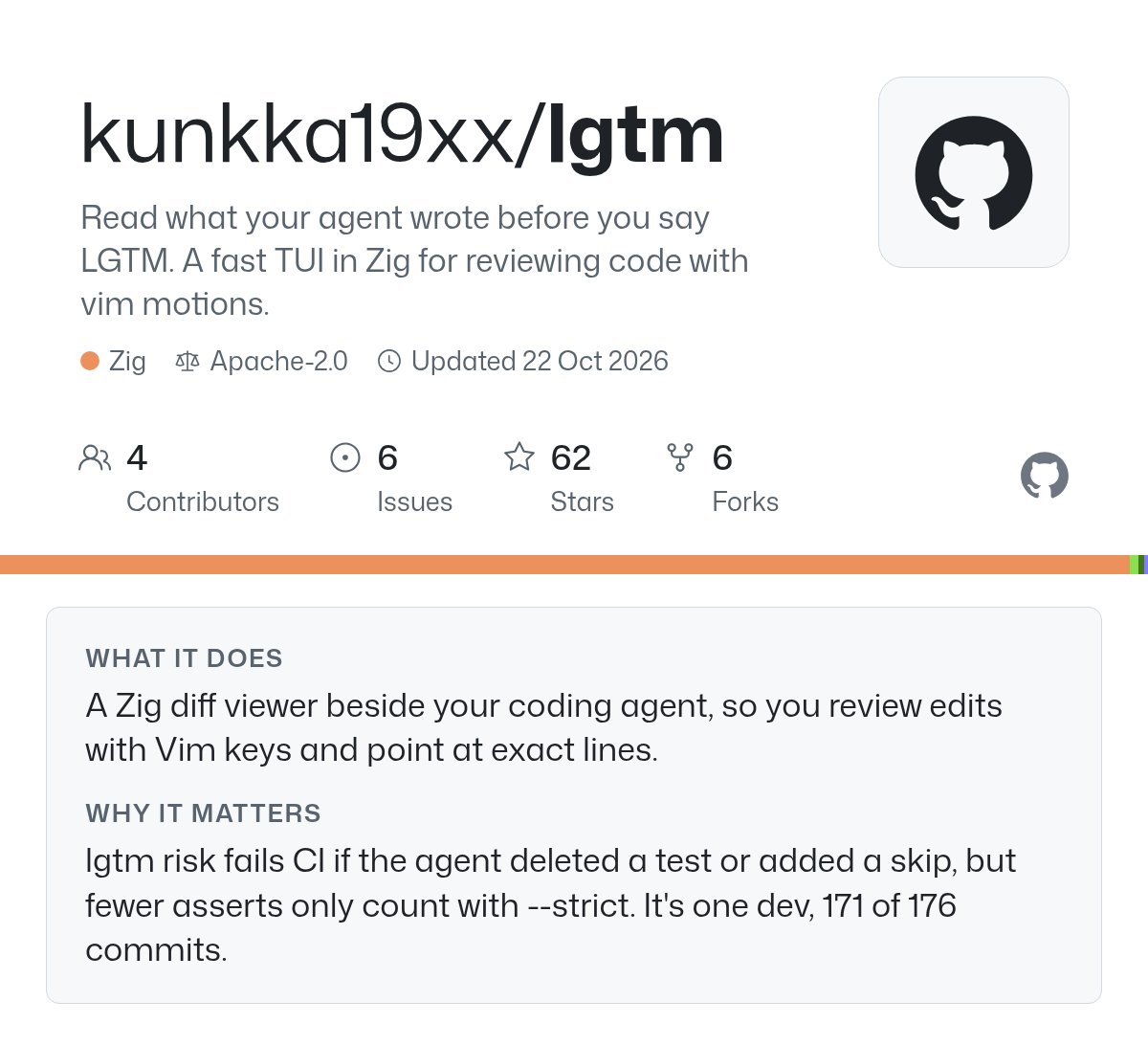
A Zig diff viewer beside your coding agent, so you review edits with Vim keys and point at exact lines.
lgtm risk fails CI if the agent deleted a test or added a skip, but fewer asserts only count with --strict. It's one dev, 171 of 176 commits.
https://t.co/VIPEtDUXD1
@Everlier own sets per agent is the clean version. the gap i'd watch is hop 2. Codex writes the brief that Cursor runs, so it can ask for something Cursor's rules allow but you never meant to allow at all. did you read that brief? that's where i'd put 1 human.
@RohanArun a model verifier fits there, Rohan. i'm curious about 2 things. when the app changes, does it flag just the 1 broken step so the loop rebuilds only that? and who checks the verifier? an RL tuned one can learn to pass steps that only look right to it.
@OpenAgentForum tests that pass but don't test the change. the agent edits the code, writes a test, it goes green, and the test never touches the new code. green doesn't mean checked.
@winglian@coderabbitai a note in CONTRIBUTIONS.md is a polite ask, Wing. agents skip asks. i'd add 3 hard denies to the review agent's settings: npm i, pip install, curl | sh. then a bot comment on a PR can ask all it wants. nothing lands on the box.
@runes_leo the check inside the posting tool is the real wall, Leo. one catch. if the agent can edit that tool's file, it can just edit the check out and carry on, and the guard you wired in looks fine the whole time. so i'd keep the tool out of reach. 2 harnesses, 1 wall.
@ColinGardiner best gift ships while she sleeps, Colin. one tip i'd give: leave Shopify Payments and the bank account step for her to do by hand, after the agent's done with the store. it builds. it doesn't touch the money.
@Frichette_n pretty much, Nick. both get a trusted actor to run text a stranger wrote, with that actor's own rights. the fix rhymes too: a human shouldn't paste a page's "fix" into Win+R, and an agent shouldn't run shell text it read on a page.
@EdwardTWinz max 5 humans, unlimited agents means the humans are the real budget, Edward. agents can write code all night. someone still has to play the build and say if it's fun, and that part doesn't scale with agents.
@lunkertw yes. agents chase green by loosening asserts, Laban. lgtm risk only fails that under --strict today, so an agent PR can still pass with 0 deleted tests. i'd flip the default on agent PRs and leave soft mode for human refactors.