IBM just shattered the nanometer barrier with the world’s first sub-1-nanometer chip technology.
At just 0.7 nm (7 angstrom), IBM’s revolutionary “nanostack” 3D architecture vertically stacks and staggers transistors in ways never before possible, packing nearly 100 billion transistors onto a chip the size of a fingernail—nearly twice the density of its groundbreaking 2 nm chip from 2021.
For reference, a hydrogen atom is about 1.1 angstroms.
The results are impressive: up to 50% more performance or 70% greater energy efficiency than the previous cutting edge 2nm IBM chips, opening the door to at least another decade of scaling.
As IBM Research Director Jay Gambetta put it, we’re moving beyond the nanometer era into the age of atoms. Human ingenuity keeps pushing the physical limits of computing, unlocking exponentially more capability from ever smaller foundations.
Honestly, I didn't even think this would be possible. The quantum tunneling effects alone were thought to be a showstopper for a long time. But, here we are. The future of technology just got dramatically smaller, and the genius of human innovation just notched another big win.
@levelsio Love it! Thanks for sharing!
If I may suggest one improvement, it seems that the city and distance to center is not accurate in some cases (see example from hotels in Aix-en-Provence: app says city is Avignon, and distance to centre is 28km whereas it should be 0.5 km or so.)
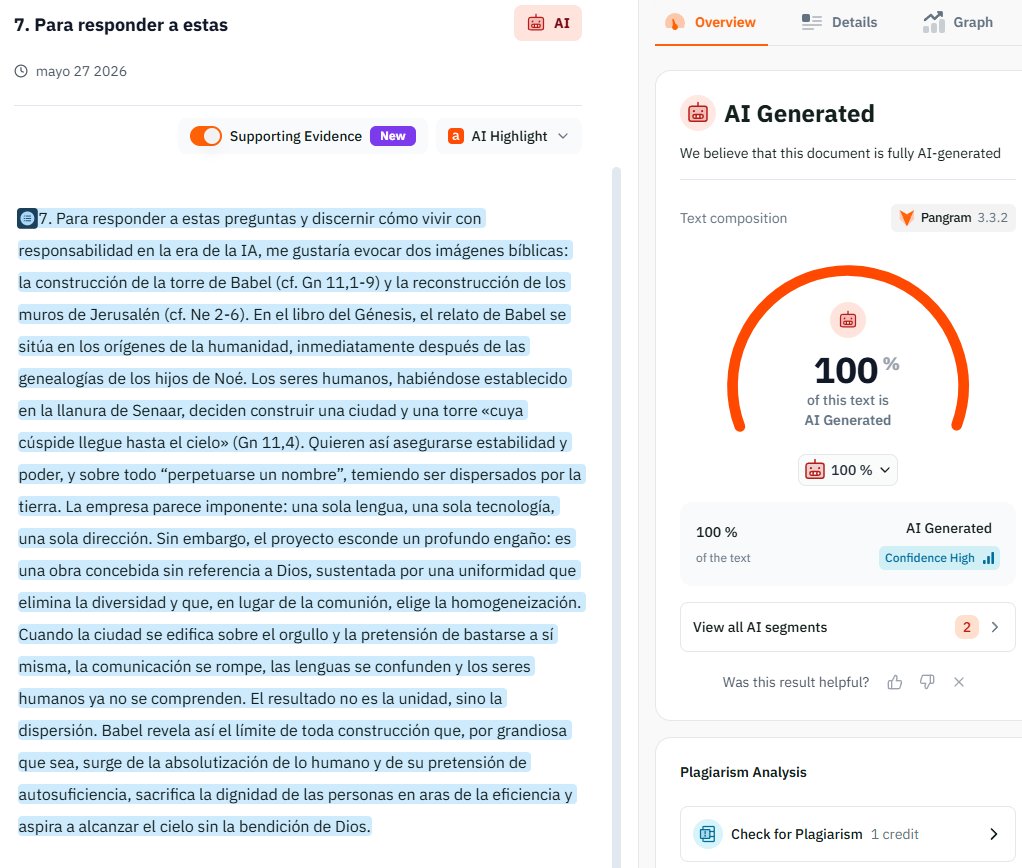
La primera encíclica del Papa sobre cómo proteger a la persona humana de la inteligencia artificial parece, en parte, escrita con ayuda de una inteligencia artificial. Y probablemente por Claude, el modelo de Anthropic, cuyo cofundador estaba —precisamente digámoslo entre guiones largos— sentado en la presentación en el Vaticano.
El análisis en LessWorng me ha parecido bastante convincente. Veamos:
> Empieza por reconocer la "voz de Claude" en algunos pasajes (sintaxis, palabras recurrentes). A partir de ahí construye un caso forense.
> Los guiones largos: 127, frente a cero en Laudato Si' o Fratelli Tutti. El «genuine/genuinely» repetido muy por encima de cualquier texto papal anterior, justo uno de los tics más reconocibles de Claude.
> Una densidad altísima de tricolones, esas estructuras de tres elementos que delatan a los modelos.
> Y Pangram, el detector más fiable del mercado, marcando párrafos enteros como artificiales mientras las encíclicas de los últimos Papas salen completamente humanas.
Aclaración: no hay que dar por bueno lo que nos responde un "detector de textos de IA" porque ninguno es certero al 100%. Dicho esto, Pangram es de lo mejorcito que hay y tiende más a falsos negativos que a falsos positivos.
Lo más curioso es la variación por secciones: unas salen muy humanas, otras muy artificiales. Su hipótesis tentativa es que algunos cardenales colaboradores tiraron de IA (ojo puede que como editora tras la base de un texto humano) y otros no, y que quizá ni el propio Papa León era consciente de cuánto Claude había en su documento sobre proteger lo humano de la máquina.
https://t.co/HnuFjQxYwF
A la imatge de L'Orion (Artemis II) es veu (rotada) la Península Ibèrica, nord d'Àfrica i estret de Gibraltar, amb les principals ciutats il•luminades.
We see our home planet as a whole, lit up in spectacular blues and browns. A green aurora even lights up the atmosphere. That's us, together, watching as our astronauts make their journey to the Moon.
A truck carrying antiprotons will drive across Europe. A team at CERN just transported antimatter across the laboratory's campus in a truck. Literally. 92 antiprotons packed into a portable trap weighing one tonne. As everyone knows, antimatter annihilates on contact with ordinary matter - which is basically everything. The final destination is Germany: Heinrich Heine University in Düsseldorf. An extraordinary delivery in the history of road transport. https://t.co/3Gb1HCHszA
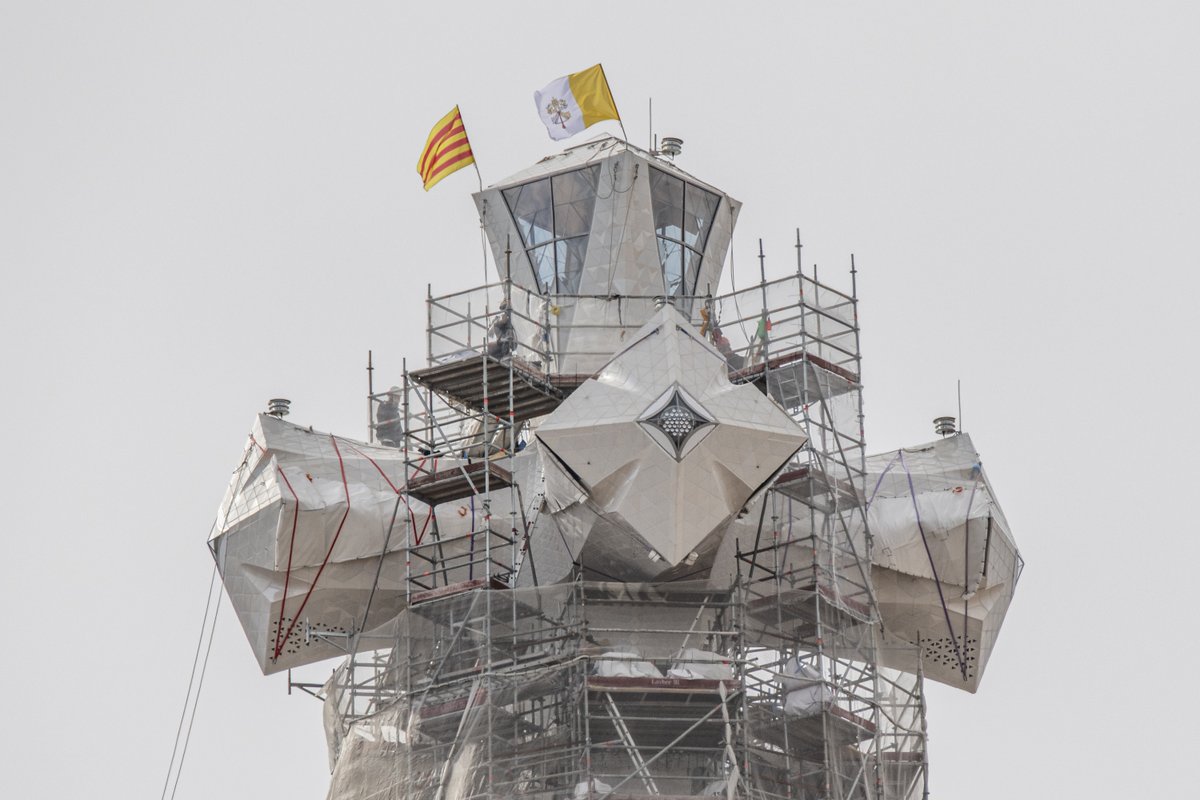
Amb la col·locació del braç superior de la creu de la torre de Jesucrist, la Sagrada Família arriba al seu punt més alt. Seguint la tradició constructiva, hi oneja la bandera catalana, la qual cosa indica que l’estructura de la torre està completada i que la construcció s’ha desenvolupat sense cap accident, així com la bandera del Vaticà, per ser el temple més alt de l’Església catòlica.
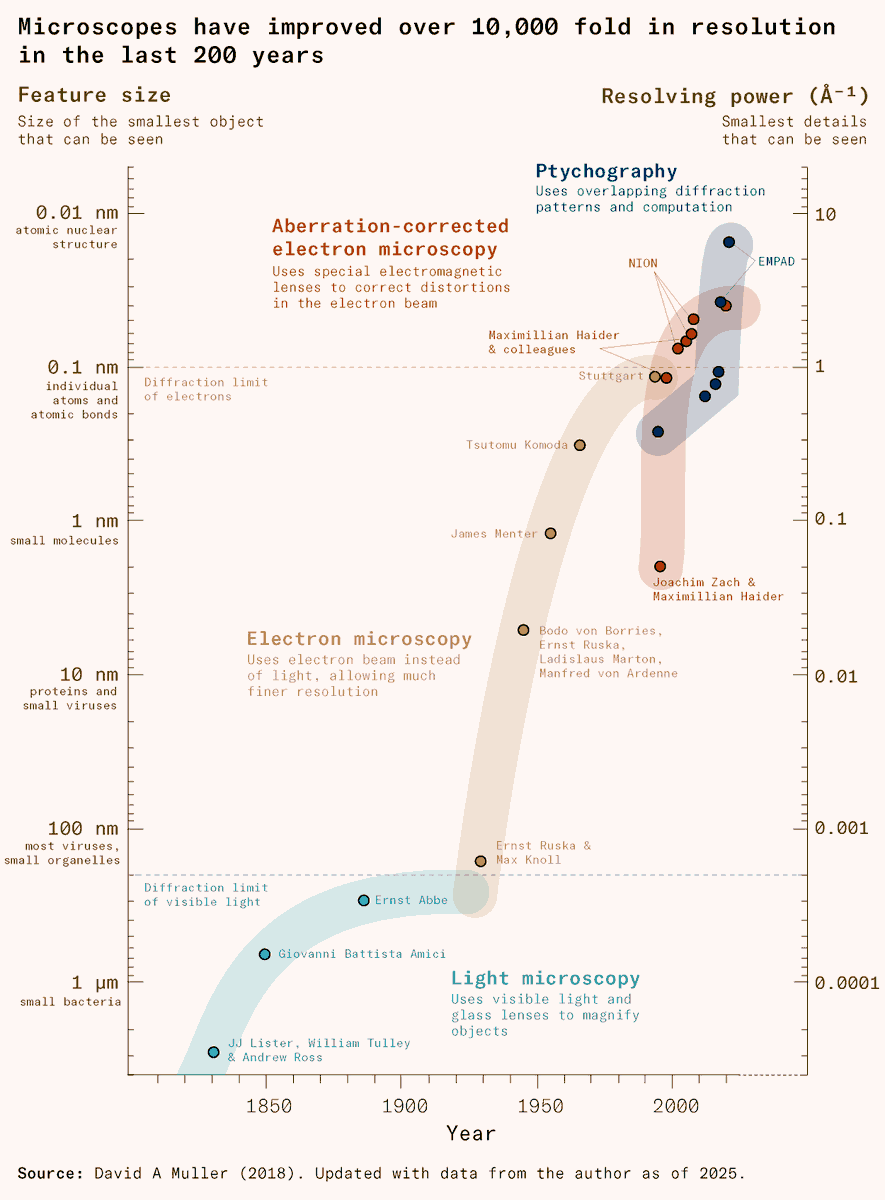
The resolution of microscopes has increased over 10,000 fold over the last 200 years.
It's allowed scientists to examine not only cells, but bacteria, then viruses, their protein structure, and, eventually, the individual atoms that comprise them.
“Every couple you admire has walked through fire.”
Eric’s thread is worth reading. It’s the part nobody talks about.
I’ve been married for 28 years and often say that there are 3 types of marriages:
1) Those that end in divorce.
2) Those that come close to ending in divorce.
3) Those in denial (the worst type).
Nobody breaks up when times are good—that means the *whole ball game* is weathering the inevitable storms.
A great marriage is a choice you make every day—sort of like being fit:
Some days you don’t feel like working out, but the fittest people *choose* to do it anyway, because they know the long term reward makes all the hard work and discipline worth it.
Some days you don’t feel like being married, but people with great marriages *choose* to keep building anyway.
Why? Because in any endeavor there’s a special form of satisfaction reserved for those who stand the test of time.
A black fungus feeds on radiation in Chernobyl.
In the radioactive ruins of Chernobyl’s Reactor 4, scientists found an extraordinary black fungus, Cladosporium sphaerospermum, thriving in one of Earth’s most toxic environments.
Rather than merely enduring radiation, this fungus seems to harness it through radiosynthesis—a process akin to photosynthesis but driven by gamma radiation, converting it into chemical energy. It’s among the rare organisms capable of this feat.
Even more remarkable, when tested on the International Space Station, the fungus flourished, forming a biofilm that blocked up to 84% of cosmic radiation, hinting at its potential as a living radiation shield for astronauts. With radiation posing a major hurdle for deep-space missions to Mars and beyond, this self-regenerating biological layer could revolutionize spacecraft design by replacing heavy, bulky shielding.
On Earth, researchers are exploring its use in bioremediation to detoxify radioactive sites too hazardous for humans, potentially transforming nuclear disaster recovery. As one scientist put it, “It’s like nature crafted a biological radiation shield.” From Chernobyl’s ruins to space, this humble fungus could help humanity thrive in the universe’s harshest environments.
En las últimas décadas, el número de artículos científicos publicados cada año se ha disparado. Más científicos, más revistas, más métricas, más “impacto”. Sin embargo, un grupo de investigadores de Northwestern University y la Universidad de Chicago plantea una pregunta inquietante: ¿este crecimiento cuantitativo realmente impulsa el progreso científico o lo está frenando?
Su análisis de 18 mil millones de citas en más de 90 millones de artículos revela un fenómeno paradójico: en los campos científicos más grandes, donde se publican más papers, las nuevas ideas tienen menos probabilidades de emerger y consolidarse. Los artículos tienden a citar cada vez más a los mismos trabajos consagrados, atrapando la ciencia en sus propios paradigmas.
El exceso de publicaciones —argumentan los autores— produce una especie de “atasco cognitivo”: los investigadores están obligados a leer, citar y producir dentro de un sistema que premia la cantidad, no la originalidad. Los nuevos trabajos difícilmente logran la masa crítica de atención para desplazar ideas establecidas.
El resultado: menos disrupción, más repetición.
Más papers, pero menos progreso.
Esto nos obliga a repensar las políticas científicas y académicas. ¿Queremos medir el avance del conocimiento por la cantidad de artículos, o por la capacidad de las ideas para transformar? Quizás debamos pasar de la obsesión por el “publish or perish” al principio de “learn or vanish”: menos publicaciones, pero con mayor significado, apertura y riesgo intelectual.
“La verdadera ciencia no es una fábrica de papers; es un laboratorio de ideas vivas”
Creo que el mundo editorial clásico ha llegado a un punto de inflexión.
Seguramente hayas leído alguna vez que cada vez más españoles se piran de España
Vale, pero:
¿Cuánta gente se va realmente al año?
¿A dónde se van?
¿Por qué se van?
¿Que edad tienen los que se van?
¿Hay diferencia entre sexos?
Veamos los datos, porque son preocupantes
Crec que una manera fàcil de saber si una persona té un nivell mínim d'autoconeixement o autoconsciència és si sap respirar amb el diafragma. Per alguns pot ser evident, altres no s'ho han plantejat mai.