Good versions and really bad versions of this will exist. Good versions is where the set up acts as an incentive for the human (near rather than in the loop), or their institution, to take seriously the quality of outputs and how they are arrived at (including ongoing improvement/iteration). The bad versions are accountability sinks on steroids.
They can coordinate (and arguably should) but very few current proposals for such coordination engage seriously with coalition dynamics / defection incentives and disincentives. The tweet Sam cites is pretty egregious in how little attention it pays to some fairly basic geopolitics.
Accidentally unlocked a new AI benchmark: which model can connect a bluetooth mouse to a Mac Mini with just a keyboard. Computer use failed both Claude and ChatGPT, but Claude (Opus 5.5) was the first to propose a solution that worked. Good effort all around.
We are looking for a research associate to join our team on the philanthropy side!!!
You’ll study how wealth from technology and AI could reshape scientific philanthropy, looking at new institutions and funding models and speaking with the people behind them :)
London-based, more info below!
https://t.co/ewC1poF89h
Absolutely – I would see that as the third dimension. I think the overall strategy that Sam describes (seat at the table via specialist state capacity) is a viable answer to a very hard question. Addressing the deficit is a must for us as it is for others, but it is not just expensive (solvable) – it’s not achievable overnight even with the best will. It must be pursued with urgency but also patience to create a less hostile operating environment.
In the meantime imo the strategic focus of the specialist institutions tilts towards risk (cyber, bio, safety) more than towards benefit (application, real-use evals, process reform), and is pushed along further that way by politics and prioritisation. I’d like to see more of a countervailing force there.
@dc_lawrence based on the London-Manchester part of the critique (“Avanti not good enough?”), was half-expecting the second part to end on a similar note (“taking a boat not good enough?”)
@PaulAtherton13 yes, 100% – not pretending otherwise, and AISI is fairly well funded overall compared to similar institutions elsewhere. But it's fascinating to see the bits-atoms divide in stark terms such as these.
I am often amazed by how cost-effective AI state capacity is, in the grand scheme of things. Here are some other things the UK government spent similar sums on in the past year to AISI’s compute budget:
🌉 A 50-metre bridge in Bury (completed on time and budget, apparently, kudos!) – £3.2m
🚇 Upgrades to underground tunnels in Liverpool – £3.5m
🚂 Strengthening a Victorian bridge over a railway in Leeds – £3.5m
🩻 Expanding musculoskeletal community care in the NHS (a Get It Right First Time programme, love GIRFT!) – £3.225m
⚓ Defence industry employment pilot for NEETs in Plymouth – £3m
All very worthy projects. But all quite... tightly focused, in comparison.
I covered the budget last week and it was noticeable how little discussion there was of AI in the aftermath. I brought it up on TV with a Tory MP who said she'd forgotten to mention it - of course i've done that many times so I am very sympathetic but it felt telling
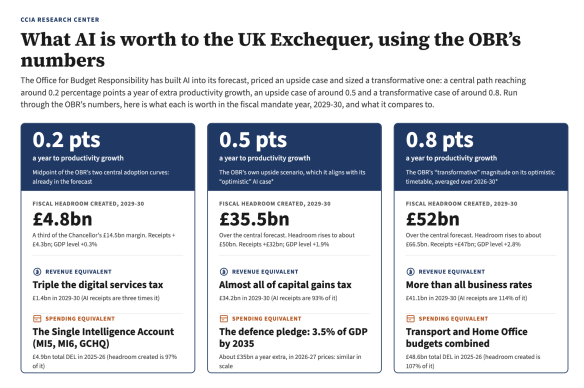
Anyway, @ccianet have looked in more detail at the OBR's AI figures and even in the most conservative central scenario, AI-related growth is responsible for a third of the Chancellor’s headroom
The Transport Committee of the London Assembly doesn’t think that driverless vehicles are safe for London’s streets.
But the actual evidence of driverless cars being deployed in the US is that they are significantly safer?