New paper suggesting more child welfare investigations for children at high risk for maltreatment would be beneficial. Data from Allegheny County DHS proving valuable yet again.
One thing this work has caused us to think more about: Investigations are front-loaded (most benefit is realized early). Is there a way to make investigations less labor intensive and help scale them for these marginal referrals?
Rewarding to see a project that started as an interview question end as a full-fledged paper. Congratulations to a great group of researchers @NataliaHEmanuel@pim_well@vbolotnyy for the call to improve targeting of these laws and strengthen supports for those w mental illness.
Around 1.2 million people are hospitalized involuntarily due to mental illness in the US each year. Policymakers are thinking of expanding such programs across the country. We conducted the first study to determine the causal effects of involuntary hospitalization.
Very thankful to @rSanti97 for this engaging conversation and opportunity to celebrate colleagues' work. I've been a longtime fan of him and @IFP --a real thrill to be on. Also - can't help but note that he promptly went on Ezra Klein's show right after we talked. Just saying.
In most states and counties, different "human services" systems aren't synced up. You can't easily cross-reference CPS calls with substance abuse databases, for instance.
In Allegheny County, you can. Here are the results. https://t.co/btBiNVyzvq
The economics community Pat Bajari created at Amazon was one of the most special groups I've ever experienced and completely changed my life. He had a knack for getting the big things right, including people and mentorship. RIP to an econ and tech legend. https://t.co/AMsC4PMOaX
Have been thinking a lot about this. With the promise of algorithms--scalability, low cost, lack of reliance on humans -- why aren't we seeing much more rapid adoption? Don't think it's all about data avail. Big opp. to figure out. Fed gov't is an obvious source of scale, too.
Are algorithms overhyped? New research from @HarrisPolicy's Jens Ludwig, @ChicagoBooth's @m_sendhil, & @asheshrambachan on the effectiveness of algorithms for addressing public policy problems suggests the opposite:
https://t.co/w9i1NSWyJg
Economists need to think like value investors in topic selection. Mental illness and addiction are incredibly understudied. Both areas have stagnated and the social returns to improving are enormous. You want better crime, child welfare, homelessness outcomes? Here's a path.
Last 24 hours: had to help the girls at Chipotle get a guy on drugs out the door as he yelled F this & racial slurs; two people passed out midday in different parts of a streetcar; a lady screaming at folks in a bus stop; another streetcar emptied b/c a man soiled the floor. 1/8
We have an incredibly ambitious roadmap this year dedicated to innovating on approaches to addiction and serious mental illness. Can't wait to share more as details are released.
Presentation slides here: https://t.co/f4zIVyDDAE
Belated but had the pleasure of talking with @NaomiSRiley@AEI last month alongside fellow panelists @RichterJCCACEO@slsatel on the role of addiction in child welfare and how we can make progress on this problem for kids and families
ICYMI we had a great event at AEI yesterday on the question of how to help parents who are dealing with substance abuse and who are involved in the child welfare system.
** New research release **
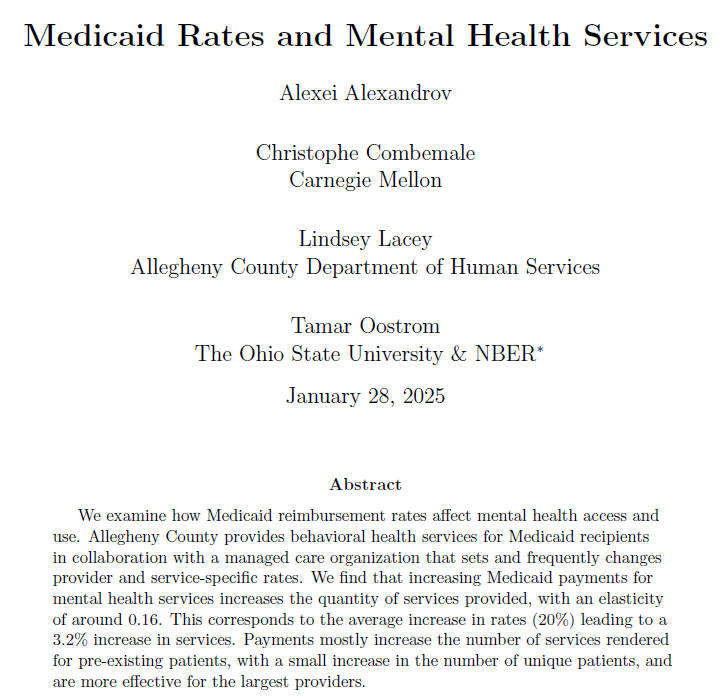
How do Medicaid reimbursement rates affect mental health access? New paper from colleagues/collaborators @TamarOostrom, Alexei Alexandrov, Christophe Combemale, & @lindseybuck95 digs into the data from Allegheny County.
This work is a great example of the type of academic research @jedkolko noted in @mattyglesias's Substack that is badly needed and often undersupplied (https://t.co/Zlc49ZJXge)