Manuscript submission is live on the special issue, "Advanced Metal Based Materials for Electrocatalysis and Electrochemical Environmental Remediation" in the journal, Processes. Submission deadline: 30th April, 2027. I.F. 3.4. For more information, https://t.co/HsPzaOOsHE
Happy to share the first publication from my lab
In this work we have developed a new concept of "pseudo-flexiblity" in a CP. The concept can be visualised by colourimetric sensing of water as well as DMA solvents. For more details,
@ACSPublications
https://t.co/3HFSwopC2x
Garbage papers are produced not by bad scientists.
It's the metrics-focused evaluation that creates them.
Can you imagine 400,000 fake research papers?
- 70,000 of them was published last year. This is 2% of ALL papers in 2023.
- Paper mills produce huge number of papers at speed and have special templates for that.
- For most journals, 2% come from paper mills. But for some, it is a whooping 40%.
And this is the lower boundary, according to Adam Day (director of scholarly data-services company Clear Skies). His software only sees paper mills that have a known template.
▫️
Paper mills feed on the existing reward system in academia. When everyone looks at citations and number of papers, some people turn to paper mills to become ‘successful’.
▫️
I see many scientists who:
- produce meaningless research.
- boast about the NUMBER of papers they publish per year
- and feel anxiety when they produce fewer papers/year than before
▫️
What can we do?
- Stop using the number of papers to measure success (it is used in many countries, including the EU)
- Stop giving grants based on the number of citations, awards and invited talks
- Include new criteria such as community service/contribution, publishing of codes, participation in committees, etc. Give them a big share of the total score.
- Include the “depth of research” as a crucial factor (reviewers should provide a thorough feedback on this).
▫️
#AcademicTwitter #AcademicChatter #researchpaper
Happy to share our recent publication on bioinspired molecules where designed labile group has major role to create catalytical activity.. change in coordinated atom was very effective to create not only catalytically active site but also dimensions..
https://t.co/IbiJZsAhKV
Atmospheric-Water-Induced Reversible Structural Transformation of a Two-Dimensional Ni(II)-Based Ferromagnetic MOF: A Highly Efficient Water Oxidation Electrocatalyst and Colorimetric Water Sensor https://t.co/ZjIitl2XYO
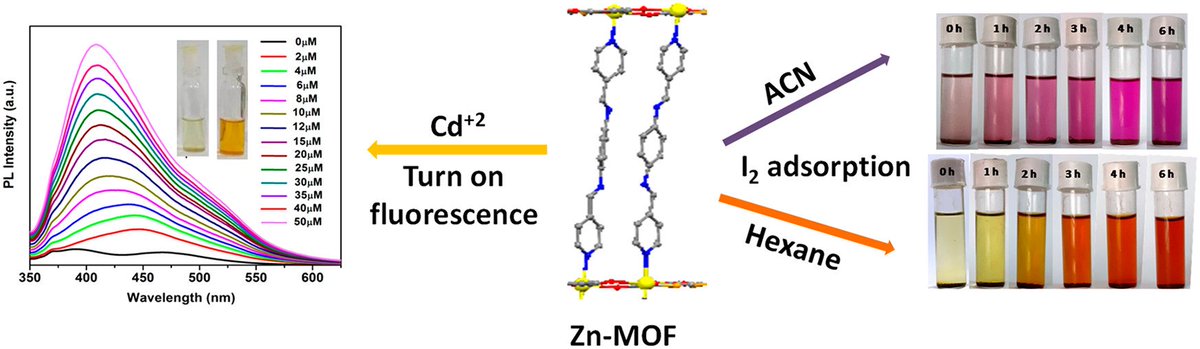
One of our latest from @InorgChem Adhikary, Das, and colleagues explore detection of Cd2+ ions by naked eye as well as reversible iodine uptake via a newly synthesized pillared-layered MOF. If you want to learn more, please have a look: https://t.co/VTGZMJQF2B