Stairway to Heaven, from the album Led Zeppelin IV (1971), is considered one of the greatest songs in rock history. Jimmy Page developed his musical structure over months, while Robert Plant wrote much of the lyrics quickly, inspired by mystical and folkloric themes.
Despite the enormous popularity, the band refused to release it as a commercial single, preferring that the public know the work within the context of the album. The song has become one of the most played and influential in the history of rock radio and appears regularly on lists of the greatest songs of all time.
I swallowed a miniature computer
drew my blood six times
sat in a 200°F dry sauna for 56 min
felt like I was going to die from the heat
and paid $21,093 for specialty biomarkers…
To ask a question: do sauna benefits depend on time, or body temperature?
This experiment has never been done before.
Results:
1) Sauna benefits depend on how hot your body gets, not how long you sit in the sauna
2) Heat shock protein 27 (HSP27), one of the molecules that drives sauna's longevity benefits, only switched on when my core body temperature held above 102.2°F (39°C) for about 15 minutes.
3) Reaching that took 56 minutes at 200°F (93°C), with ice on my face, neck, and groin.
4) This challenges the generic advice that 20 minutes of sauna is enough.
What this means for you:
1) The standard advice of 20 minutes at 176°F (80°C) is a floor, not a ceiling. The bigger benefits sit further up the curve, in longer and hotter sessions. If you can tolerate more, more likely helps.
2) Skip the cold plunge right after the sauna. My core body temperature kept climbing for several minutes after I left the sauna, so much of my time above the activation threshold happened post-exit. Cold plunging cuts that window short.
3) Population level studies point in a direction but cannot tell you what is happening inside your own body. Continuous core temperature tracking can.
Here is the experiment explained
A brief background first. Heat shock proteins (HSPs) are believed to be the enablers of sauna based longevity benefits. You can think of them as a clean up crew that travels through your body removing misfolded proteins and cellular debris. When you get really hot, like in a sauna, you generate a lot more of them. A tsunami of clean up crews unleashed inside your body.
There are many types of HSPs. We focused on HSP27 in this experiment because of its high value longevity benefits:
1. Calms harmful inflammation through a controlled signaling pulse, driven by IL-10
2. Protects arteries by blocking the damaged cholesterol that builds up into plaque
3. Helps the body grow new blood vessels over time
4. HSP27 is one of the first proteins your body makes when it gets hot, which makes it a clean signal of how hard the sauna session actually worked.
We saw initial signs of biomarkers of these benefits also turned on alongside HSP27, with enough time above the activation threshold.
I ran three sauna sessions, holding sauna temperature, my meticulous morning routine, and every other variable constant. We measured HSP27 activation and release (along with scores of other biomarkers) in my serum after each session. I swallowed a temperature capsule about the size of a vitamin pill. As it traveled through my body, it sent a reading of my core body temperature every 30 seconds. That continuous, real time data from inside the body is what no prior study has had.
The 102.2°F (39°C) core temperature threshold for HSP activation has been established in the research literature for years. Dry-sauna users have never been able to act on it because they had no way to track their core temperature during a session. An end-point thermometer cannot tell you how long you held above threshold, and the duration is the dose. Which is why we chose to use real time tracking.
The findings across the three sessions.
Two of the three sessions pushed me well past the threshold. In one, I spent 14.7 minutes above 102.2°F (39°C), with a peak of 102.87°F (39.37°C). In the other, I spent 15.8 minutes above the threshold, with a peak of 102.81°F (39.34°C). After both, HSP27 in my blood rose sharply.
The third session (the middle one in the figure) was different. I only spent 5.1 minutes above 102.2°F (39°C), with a peak of 102.34°F (39.08°C), barely above the threshold. HSP27 did not respond. The reading actually dipped slightly, but the change was too small to count.
Two things separate the responder sessions from the non-responder. The first is time above the threshold: 14.7 and 15.8 minutes versus 5.1 minutes. The second is peak core temperature: 102.87°F (39.37°C) and 102.81°F (39.34°C) versus 102.34°F (39.08°C). Either, or more likely both, are driving the response. Future sessions will help us figure out how much each one matters.
Within my body, holding all other variables constant, the central heat shock protein response is a direct function of the heat dose delivered to the body's core.
No prior study has done this. Earlier sauna research used a single thermometer reading at the end of the session, not continuous tracking. The studies that used continuous tracking used exercise, not dry sauna. None had a matched negative control like my session three. And all reported only cohort averages, not what happened inside one body.
What this means for the body
Once HSP27 is released into circulation, it signals to cells throughout the body and drives the four mechanistically proven downstream benefits listed above. All four are supported by my long-term sauna data, the population literature, and mechanistic studies. My acute post-session measurements hint at each being engaged.
To activate HSP27 in my body, I needed 56 minutes at 200°F (93°C) in a dry sauna. That is the total session length required to spend enough time above the 102.2°F (39°C) core temperature threshold to trigger HSP27 release.
Does this mean longer sessions, long enough for your core to hit 102.2°F (39°C), would supercharge the longevity benefits? Maybe.
What we do know, I did 232 dry sauna sessions over the past year. My protocol was 200F (93°C) for 20 min. So even though my core body temperature didn’t reach 102.2°F (39°C) to unleash the HSP27, the results were still compelling:
+ a 10 year vascular age reduction
+ massive drop in environmental toxins [1]
+ complete elimination of microplastics in my semen (first ever in human achievement)
The data suggests there are health benefits at 200°F (93°C) for 20 min.
The data also shows that additional health benefits unlock when your core body temperature reaches 102.2°F (39°C).
Does this mean that if one is in the sauna longer, long enough to reach a core body temperature of 102.2°F (39°C). that the longevity benefits would be supercharged? Maybe.
Here is what this experiment teaches:
+ population level data is great for averages, pointing in a general direction
+ the resulting protocols are crude
+ not personalized
+ the only way to find out the truth for you is to measure
+ single person experiments (n=1) like this one are useful, because they find blind spots that population averages cannot see.
Note: I kept ice on my face and neck during these three experimental sessions to protect those sensitive areas from heat induced skin damage at extreme temperatures. In a previous session, not included in this experiment, I had no ice on my face or neck and used an ingestible temperature capsule for real-time core readings. I reached a core body temperature of 102.2°F (39°C) after 34 minutes at 200°F (93°C).
Adding ice to the face and neck adds roughly 20 minutes to the total time required to reach 102.2°F (39°C) core body temperature. Subjectively, the 34 minutes without ice on my face and neck was much harder than the 56 minutes with ice on my face and neck. After the 34 minute session, I exited the sauna and just laid on the concrete, immobilized. But I got the data.
[1] Toxin reduction:
After 15 sessions, sauna dramatically reduced environmental toxins in my body:
65% drop in 2,4-D
100% drop in MEP
15% drop in MBP
100% drop in MEHP (undetectable post sauna)
56% drop in NAPR
56% drop in HEMA
100% drop in Perchlorate (undetectable post sauna)
Is sauna worth it if you're not hitting the 102.2F (39C) core body temp for HSP 27 activation? The answer is yes.
Benefits start at:
11 min
2-3x wk
min of 176F
October 7th did not end an era. It started one.
We are watching the birth of a new Israel — wounded, yes, but for the first time in 77 years, truly her own. 🇮🇱✨
I want to speak to my friends who feel betrayed this week. I feel it too. I'm not going to tell you the feeling is wrong.
There is a deal now between Washington and Tehran. A ceasefire. The blockade lifting. Oil flowing again. And an American president — on his 80th birthday — telling Jerusalem to lower its sword just as the enemy looked cornered.
If that leaves you confused, even heartbroken, you are not naïve. You are paying attention.
But step back with me.
It is baffling how fast we turn. The same voices who called Trump a flawless champion now call him the devil — over a deal they haven't even read. That isn't discernment. That's panic wearing the mask of conviction.
So let me tell you what I actually see.
For decades, presidents drew red lines in disappearing ink. The mullahs learned that American threats expire faster than milk. Trump broke that pattern. He didn't just talk — he acted. He shattered the myth of Iranian invincibility and forced the regime to bargain from weakness instead of swagger. That is the hardest blow Iran's empire has taken in forty years.
So why pull back now? Because Trump is not only Israel's friend. He is America's president. And a president has to read more than one map — inflation, gas prices, an economy, an election that decides whether he governs or drowns in investigations. He isn't abandoning Israel. He's protecting the ground that lets him keep standing with her.
But here is the harder truth — and I've said it for years, long before this week made it plain:
Israel was never meant to lean on anyone forever. Not even America.
A nation that outsources its survival has rented its sovereignty. And rent always comes due.
The decision about whether Israel lives cannot be made in Washington. It must be made in Jerusalem — by the people who will live or die by the answer. That is not a betrayal of friendship. It is the meaning of friendship between equals. True allies are not echoes. They argue, sometimes fiercely, precisely because the stakes are real.
A prime minister's first oath is not to a foreign capital. It is to the child asleep in Be'er Sheva and the soldier awake on the northern border. If the threat is existential, Israel must keep the right to act alone — and carry the loneliness that comes with it.
That loneliness is not weakness. It is the price of being built to last.
So let me say something strange: this painful chapter may be one of the best things to happen to Israel in a generation. Pressure forces evolution. It deepens self-reliance. It builds an army that answers to no one else's calendar. It pushes Israel toward new friendships across a region that once swore to erase her.
And Tehran? It looks like iron. It is rust. A regime that rules a people who do not love it, atop an economy it cannot fix, leaning on a fear it can no longer enforce. Empires built on terror are always weaker than they look the morning before they fall. I believe this one could fall before 2028.
History always looks like chaos while you're standing inside it. It only looks inevitable later — when the dust settles and God's pattern finally shows.
So here is what I hold onto:
This is not about one man. God protected Trump; he played his part. But do not put your faith in mortal men. Put it in the Almighty.
The same nations that tried to erase Israel in 1948 are quietly realizing they need her. Her real wealth was never oil or rare earth. It is grit. Genius. Medicine. Technology. And a moral clarity no army can manufacture.
Be patient. Pray often. Have faith.
One day soon the truth will be revealed, and the whole world will owe a debt to the Jewish people and to Israel — for our sacrifices, for confronting evil, for making this world safer for all our children.
We live in the most incredible times. Take heart.
The best is yet to come. 🕊️✨
#Israel #StandWithIsrael #Faith #MessianicTimes #HistoryInTheMaking
Stanford grads walk out as Google CEO Sundar Pichai takes the stage as commencement speaker. No mention of AI, unlike other uni speakers getting booed down this year. Story for @sfgate shortly
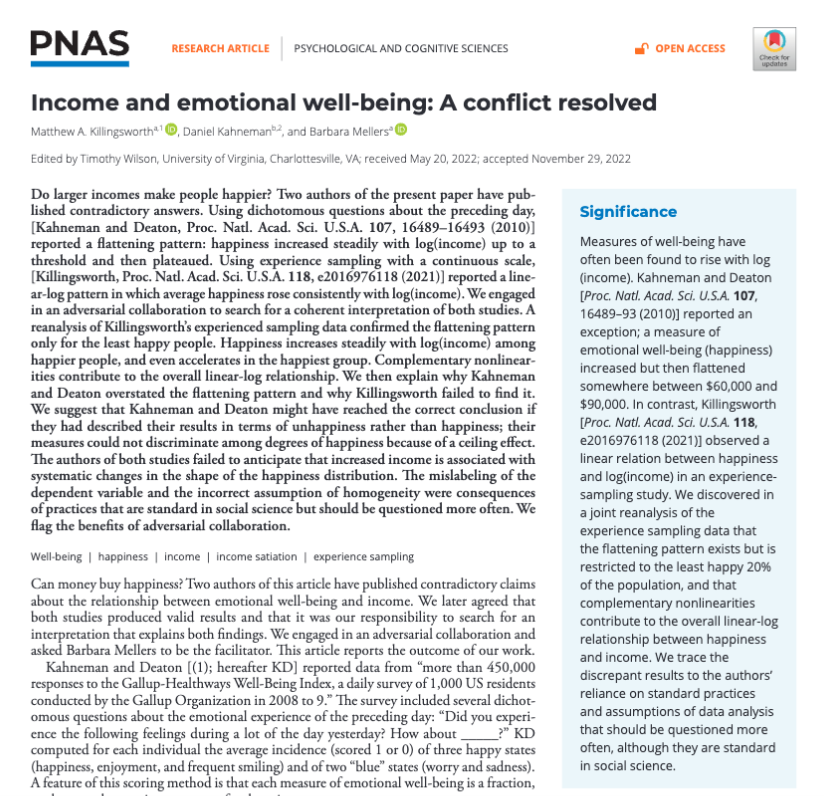
Does money buy happiness? A Princeton Nobel laureate said no above $75,000. A Penn researcher with 1.7 million data points said yes. The day they sat down together to settle the fight, the answer they reached should change how you think about your own life.
The Nobel laureate is Daniel Kahneman. The Penn researcher is Matthew Killingsworth.
The fight between them lasted 13 years, and the way it ended is one of the cleanest examples in modern science of two smart people being wrong in opposite directions about the same question.
In 2010 Kahneman and his Princeton colleague Angus Deaton published a paper that became one of the most quoted findings in the history of social science.
They analyzed 450,000 responses to the Gallup-Healthways Well-Being Index and concluded that emotional well-being rose steadily with income up to about $75,000 a year, and then flattened out completely. Above that line, the extra money was not buying any more daily happiness.
The headline traveled around the world. Every news outlet ran the number.
A CEO in Seattle famously cut his own salary to raise his employees to that exact threshold. The 75,000 dollar figure became cultural shorthand for the idea that the rich are not actually any happier than the rest of us once basic needs are met.
For 11 years almost nobody seriously challenged it. Kahneman had a Nobel Prize in Economics, the sample size was massive, and the conclusion was emotionally satisfying in a way that made everyone feel a little better about not being wealthy.
Then in 2021 a 33 year old researcher at the University of Pennsylvania published a paper that quietly destroyed the entire finding. His name is Matthew Killingsworth.
He had spent the previous decade building a smartphone app called Track Your Happiness that pinged users at random moments during their day and asked them a simple question.
How do you feel right now, on a scale from very bad to very good. The app was designed to catch happiness in the act, not to ask people to recall it later.
By 2021 he had collected over 1.7 million real-time happiness reports from 33,000 adults. When he plotted income against in-the-moment well-being, there was no plateau anywhere.
The line just kept rising. People earning $200,000 were happier on average than people earning $100,000. People earning $400,000 were happier than people earning $200,000. The curve flattened slightly but never stopped climbing.
The famous $75,000 ceiling that the world had been quoting for 11 years simply did not exist in his data.
Now there were two Nobel-quality findings sitting in direct contradiction with each other. One of them had to be wrong, and neither researcher was willing to walk away.
What happened next is the part of the story almost nobody knows.
Kahneman called Killingsworth and proposed something rare in academic science. He called it an adversarial collaboration. The two of them, joined by Penn psychologist Barbara Mellers as a neutral referee, would sit down together and reanalyze the raw data from both studies, line by line, until they figured out which one of them was wrong.
The paper they co-authored was published in March 2023 in the Proceedings of the National Academy of Sciences. And the answer they reached was not what either of them had expected.
Both of them had been right at the same time. They had been measuring two different populations without realizing it.
When the team broke Killingsworth's 1.7 million data points apart by baseline happiness, the picture clarified completely. For the happiest 70 percent of people, more money kept buying more happiness all the way up to $500,000 a year, with no sign of slowing down.
For people in the middle, the same pattern held. But for the bottom 20 percent of the sample, the ones who were already unhappy before the question of money even came up, the curve flattened almost exactly where Kahneman's original paper had said it would. Above roughly $100,000 a year, adjusted for inflation, more money did nothing for them.
This is the finding that changes how the question should be asked.
If you are not already unhappy, money keeps buying happiness for a much longer stretch than Kahneman's original paper suggested. The runway is wider than the world has been telling itself for a decade.
If you are already unhappy, money does almost nothing past a certain point. There is a ceiling, but the ceiling is not about income. It is about the underlying state of the person collecting it.
The deeper insight in Killingsworth's original research, the one almost nobody talks about, is the part that should sit with you longer than the income numbers. The Track Your Happiness app had been telling him for years that the single biggest predictor of in-the-moment well-being is not money at all. It is whether your mind is on the thing you are doing.
His most cited paper, written with Daniel Gilbert at Harvard, is titled A Wandering Mind Is an Unhappy Mind. The data from the app showed that people are mentally absent from what they are doing 47 percent of the time, and that mental absence is one of the strongest predictors of unhappiness in the entire dataset. More predictive than income. More predictive than the activity itself. More predictive than almost any demographic variable you could measure.
Which means the unhappy 20 percent that Kahneman's plateau actually described were probably not unhappy because they did not have enough money. They were unhappy for reasons that more money could not reach.
The reason the curve flattened for them at $100,000 a year is the same reason it would have flattened at $300,000 or $700,000. The thing they were missing was not buyable.
The most uncomfortable line in the entire 2023 paper is the one that nobody on the internet quotes. The authors note that the relationship between income and happiness, while real, is much weaker than the relationship between attention and happiness. A person earning $40,000 who is fully present in their own life will, on average, report higher in-the-moment well-being than a person earning $400,000 whose mind is somewhere else.
The fight about money was the wrong fight the entire time.
The two researchers spent 13 years arguing over whether the dollar ceiling was at $75,000 or $500,000, and the data from Killingsworth's own app was sitting there the whole time saying the ceiling was not about dollars at all. The ceiling is whether you can hold your attention on the life you actually have.
You can run the experiment yourself the next time you catch your mind drifting. Stop. Put your phone down. Look at the room you are in, the person across from you, the food in front of you, the work you are actually doing. That is the part the apps cannot sell you and the salary cannot buy you.
The data has been clear for over a decade. The plateau is not in your bank account. It is in your attention.
It’s awesome. I’ve taken a few over the years. You might think making the material open would make it a commodity…not so. While access increases, there’s no free lunch; value comes only through effort and time spent learning.
Twenty-five years ago, the Massachusetts Institute of Technology made a bold move that most universities would never dare.
Instead of locking its world-class course materials behind campus walls, MIT decided to put nearly its entire curriculum online, completely free for anyone with an internet connection.
That decision gave birth to MIT OpenCourseWare (OCW).
What began as a bold experiment in 2001 has become one of the most significant educational initiatives in history.
Today, OCW provides materials from more than 2,500 undergraduate and graduate courses across virtually every discipline: physics, engineering, artificial intelligence, economics, biology, mathematics, computer science, and many more.
Anyone can access lecture notes, problem sets, exams, syllabi, and a growing library of video lectures, with no tuition, no application, and no account required.
According to MIT, more than 500 million people worldwide have used these resources over the past 25 years.
The impact has been profound. Students use it to ace exams, explore new fields, and launch careers. Educators around the globe integrate the materials into their own teaching. Many learners credit OCW with helping them pass professional certifications and unlock new opportunities.
Beyond its direct benefits, OpenCourseWare helped spark the global open education movement, inspiring dozens of other universities to share their knowledge freely online.
Even more impressive: the project was originally planned as a 10-year initiative. A quarter-century later, it's still expanding.
MIT now aims to reach 1 billion learners in the coming decade, while enhancing the experience with powerful new AI-powered learning tools.
Bet on founders and teams. The most sophisticated investors I know seem to index this way. The least successful are asking about nickels and dimes (ofc they matter, but it’s the wrong level of abstraction for making the bet),
I was talking to a YC partner about how well all the hard tech startups are doing. He said investors are hot to fund them because they're afraid AI will eat all software. I'm glad hardware startups are getting funded, but this is a mistake. Good founders are what wins.
Vinod, my understanding is these students walked out to protest Google's contract with IDF given Israel's genocide in Gaza.
Wherever one stands on those contracts, I believe you would support their right of free expression and challenging authority.
It Was Supposed to Be History
I'm a Polish filmmaker living in London.
I wasn't raised to care about antisemitism. Quite the opposite.
Like many Poles of my generation, I grew up with a version of history that focused heavily on Polish suffering during the Second World War. I visited Auschwitz as a teenager, yet somehow left without truly understanding the scale of what had happened to Europe's Jews.
That changed when I was 19 and worked on Schindler's List.
For the first time, I was confronted with parts of history that had been missing from my education. Later, living in Paris and spending time in New York, I met Jewish people whose understanding of Poland, Europe and history was very different from my own. Some conversations were uncomfortable. A few were life-changing.
The more I learned, the more I realised that antisemitism didn't disappear after the Holocaust. It adapted.
Today it often arrives dressed as political activism, conspiracy theories, selective outrage, historical revisionism, or simply a double standard applied to the world's only Jewish state.
I am not Jewish. I have no family connection to Israel.
What I do have is a deep distrust of propaganda, mob thinking, and people who demand that history be simplified into slogans.
My work on antisemitism began with a simple realisation: if I could be misled about history, so could millions of others.
That is why I make films, conduct interviews, and challenge narratives.
Not because I have all the answers.
Because I spent too many years believing things that weren't true.
Popper is my fave philosopher. He defined the scientific method through falsification, rejecting traditional inductive reasoning. Instead of seeking to prove a theory true, the scientific method requires proposing bold, speculative hypotheses and subjecting them to rigorous, repeated attempts to prove them false.
I would define the scientific method as a simple iterative algorithm for perpetual learning. Not all grade schools define it the way yours might have.
Popper is my fave philosopher. He defined the scientific method through falsification, rejecting traditional inductive reasoning. Instead of seeking to prove a theory true, the scientific method requires proposing bold, speculative hypotheses and subjecting them to rigorous, repeated attempts to prove them false.
I would define the scientific method as a simple iterative algorithm for perpetual learning. Not all grade schools define it the way yours might have.
Stateside, a gas station. I drank a frozen blue beverage too quickly, and was struck down by a punishment this entire nation knows, and accepts, and has named.
The drink is called a slush. Ice, sweetness, and a blue that does not occur in nature. The day was hot. I was thirsty. I drank like a soldier at a river.
The pain arrived in my skull like a war horn.
Behind the eyes. Above everything. Total. I gripped the roof of my car. I may have made a sound.
"Brain freeze," said the cashier through the door, with no urgency whatsoever.
It has a NAME. The affliction is so common it has a household name, like a cousin.
"Tongue on the roof of your mouth," called a man at the pumps. He did not look over. He prescribed the remedy mid-pump, casually, the way one mentions weather.
I pressed my tongue to the roof of my mouth. The war horn faded. The healer nodded at his pump, finished, and was gone in a Chevrolet.
In my land, punishment follows crime by way of courts and seasons. Here, the sentence is instant. Drink with greed, and the ice strikes the mind directly. No trial. No appeal. Perfectly fair.
And here is what moves me. EVERYONE has felt it. The cashier. The healer. Children. Elders. An entire nation united by the same small lightning, all taught the same cure, all passing it on to strangers at gas stations, free of charge.
You cannot fully distrust a country once you know it shares one pain.
The freeze does not punish thirst. It punishes haste.
I finished the slush slowly, like a scholar. Blue tongue. Clear mind.
Then at the door I forgot everything, drank deeply, and was struck down again.
"Tongue, hon," said the cashier, without looking up.
Discipline is a journey.
USA. A breakfast counter. The waitress recommended the biscuits and gravy, and when the plate arrived, I thought something had gone wrong in the kitchen.
I say this with shame. The dish looked like a construction site after rain. Pale mounds. Gray ladle-fall. Speckles I could not identify.
In my land, the eye eats first. A meal is arranged like a garden. This meal was arranged like weather.
"Is it… finished?" I asked, carefully.
"Honey, that's what it looks like."
The man beside me was already eating his. He did not look up. "Just try it."
I am a man who has charged hillsides at dawn. I raised the fork. I tried it.
I must now formally apologize to the biscuits, the gravy, the waitress, the kitchen, and the entire breakfast tradition of the American South.
It was magnificent. Warm. Peppered. The biscuit drank the gravy the way a field drinks rain — THAT is why it is shaped like that, you fool — and every mound I had insulted was a soft fold of comfort that my homeland, in eight hundred years, never once thought to invent.
"Well?" the waitress asked.
"I judged it," I confessed. "By its appearance. I am ashamed."
"Everybody does, hon."
Everybody does. A national dish that forgives you for doubting it. It expects the doubt. It waits for you on the other side of it.
Do not judge the gravy by its face. Judge yourself, for hesitating.
I order it every Saturday now. I no longer see the construction site. I see only the garden.
It was a garden the whole time. The eye must be trained.








![bryan_johnson's tweet photo. I swallowed a miniature computer
drew my blood six times
sat in a 200°F dry sauna for 56 min
felt like I was going to die from the heat
and paid $21,093 for specialty biomarkers…
To ask a question: do sauna benefits depend on time, or body temperature?
This experiment has never been done before.
Results:
1) Sauna benefits depend on how hot your body gets, not how long you sit in the sauna
2) Heat shock protein 27 (HSP27), one of the molecules that drives sauna's longevity benefits, only switched on when my core body temperature held above 102.2°F (39°C) for about 15 minutes.
3) Reaching that took 56 minutes at 200°F (93°C), with ice on my face, neck, and groin.
4) This challenges the generic advice that 20 minutes of sauna is enough.
What this means for you:
1) The standard advice of 20 minutes at 176°F (80°C) is a floor, not a ceiling. The bigger benefits sit further up the curve, in longer and hotter sessions. If you can tolerate more, more likely helps.
2) Skip the cold plunge right after the sauna. My core body temperature kept climbing for several minutes after I left the sauna, so much of my time above the activation threshold happened post-exit. Cold plunging cuts that window short.
3) Population level studies point in a direction but cannot tell you what is happening inside your own body. Continuous core temperature tracking can.
Here is the experiment explained
A brief background first. Heat shock proteins (HSPs) are believed to be the enablers of sauna based longevity benefits. You can think of them as a clean up crew that travels through your body removing misfolded proteins and cellular debris. When you get really hot, like in a sauna, you generate a lot more of them. A tsunami of clean up crews unleashed inside your body.
There are many types of HSPs. We focused on HSP27 in this experiment because of its high value longevity benefits:
1. Calms harmful inflammation through a controlled signaling pulse, driven by IL-10
2. Protects arteries by blocking the damaged cholesterol that builds up into plaque
3. Helps the body grow new blood vessels over time
4. HSP27 is one of the first proteins your body makes when it gets hot, which makes it a clean signal of how hard the sauna session actually worked.
We saw initial signs of biomarkers of these benefits also turned on alongside HSP27, with enough time above the activation threshold.
I ran three sauna sessions, holding sauna temperature, my meticulous morning routine, and every other variable constant. We measured HSP27 activation and release (along with scores of other biomarkers) in my serum after each session. I swallowed a temperature capsule about the size of a vitamin pill. As it traveled through my body, it sent a reading of my core body temperature every 30 seconds. That continuous, real time data from inside the body is what no prior study has had.
The 102.2°F (39°C) core temperature threshold for HSP activation has been established in the research literature for years. Dry-sauna users have never been able to act on it because they had no way to track their core temperature during a session. An end-point thermometer cannot tell you how long you held above threshold, and the duration is the dose. Which is why we chose to use real time tracking.
The findings across the three sessions.
Two of the three sessions pushed me well past the threshold. In one, I spent 14.7 minutes above 102.2°F (39°C), with a peak of 102.87°F (39.37°C). In the other, I spent 15.8 minutes above the threshold, with a peak of 102.81°F (39.34°C). After both, HSP27 in my blood rose sharply.
The third session (the middle one in the figure) was different. I only spent 5.1 minutes above 102.2°F (39°C), with a peak of 102.34°F (39.08°C), barely above the threshold. HSP27 did not respond. The reading actually dipped slightly, but the change was too small to count.
Two things separate the responder sessions from the non-responder. The first is time above the threshold: 14.7 and 15.8 minutes versus 5.1 minutes. The second is peak core temperature: 102.87°F (39.37°C) and 102.81°F (39.34°C) versus 102.34°F (39.08°C). Either, or more likely both, are driving the response. Future sessions will help us figure out how much each one matters.
Within my body, holding all other variables constant, the central heat shock protein response is a direct function of the heat dose delivered to the body's core.
No prior study has done this. Earlier sauna research used a single thermometer reading at the end of the session, not continuous tracking. The studies that used continuous tracking used exercise, not dry sauna. None had a matched negative control like my session three. And all reported only cohort averages, not what happened inside one body.
What this means for the body
Once HSP27 is released into circulation, it signals to cells throughout the body and drives the four mechanistically proven downstream benefits listed above. All four are supported by my long-term sauna data, the population literature, and mechanistic studies. My acute post-session measurements hint at each being engaged.
To activate HSP27 in my body, I needed 56 minutes at 200°F (93°C) in a dry sauna. That is the total session length required to spend enough time above the 102.2°F (39°C) core temperature threshold to trigger HSP27 release.
Does this mean longer sessions, long enough for your core to hit 102.2°F (39°C), would supercharge the longevity benefits? Maybe.
What we do know, I did 232 dry sauna sessions over the past year. My protocol was 200F (93°C) for 20 min. So even though my core body temperature didn’t reach 102.2°F (39°C) to unleash the HSP27, the results were still compelling:
+ a 10 year vascular age reduction
+ massive drop in environmental toxins [1]
+ complete elimination of microplastics in my semen (first ever in human achievement)
The data suggests there are health benefits at 200°F (93°C) for 20 min.
The data also shows that additional health benefits unlock when your core body temperature reaches 102.2°F (39°C).
Does this mean that if one is in the sauna longer, long enough to reach a core body temperature of 102.2°F (39°C). that the longevity benefits would be supercharged? Maybe.
Here is what this experiment teaches:
+ population level data is great for averages, pointing in a general direction
+ the resulting protocols are crude
+ not personalized
+ the only way to find out the truth for you is to measure
+ single person experiments (n=1) like this one are useful, because they find blind spots that population averages cannot see.
Note: I kept ice on my face and neck during these three experimental sessions to protect those sensitive areas from heat induced skin damage at extreme temperatures. In a previous session, not included in this experiment, I had no ice on my face or neck and used an ingestible temperature capsule for real-time core readings. I reached a core body temperature of 102.2°F (39°C) after 34 minutes at 200°F (93°C).
Adding ice to the face and neck adds roughly 20 minutes to the total time required to reach 102.2°F (39°C) core body temperature. Subjectively, the 34 minutes without ice on my face and neck was much harder than the 56 minutes with ice on my face and neck. After the 34 minute session, I exited the sauna and just laid on the concrete, immobilized. But I got the data.
[1] Toxin reduction:
After 15 sessions, sauna dramatically reduced environmental toxins in my body:
65% drop in 2,4-D
100% drop in MEP
15% drop in MBP
100% drop in MEHP (undetectable post sauna)
56% drop in NAPR
56% drop in HEMA
100% drop in Perchlorate (undetectable post sauna)](https://pbs.twimg.com/media/HK8ovU7aYAAYipg.jpg)