I still post here because so much of my community is still here. But I urge you to try elsewhere, we need critical mass in a place that doesn't thrive on spreading hate and threatening freedom and democracy.
I'm on all the other main sites with the same username, details below
"I can tell you this, though: Every single person who thinks that machines cannot be conscious, is making an argument that humans are special. Everything they say just boils down to blah blah blah, "nooo, we're special." From there it's just rationalization."
This is very far from the truth. There are many (IMO compelling) arguments against (silicon, digital) machine consciousness that in no way depend on human exceptionalism, or even on carbon chauvinism.
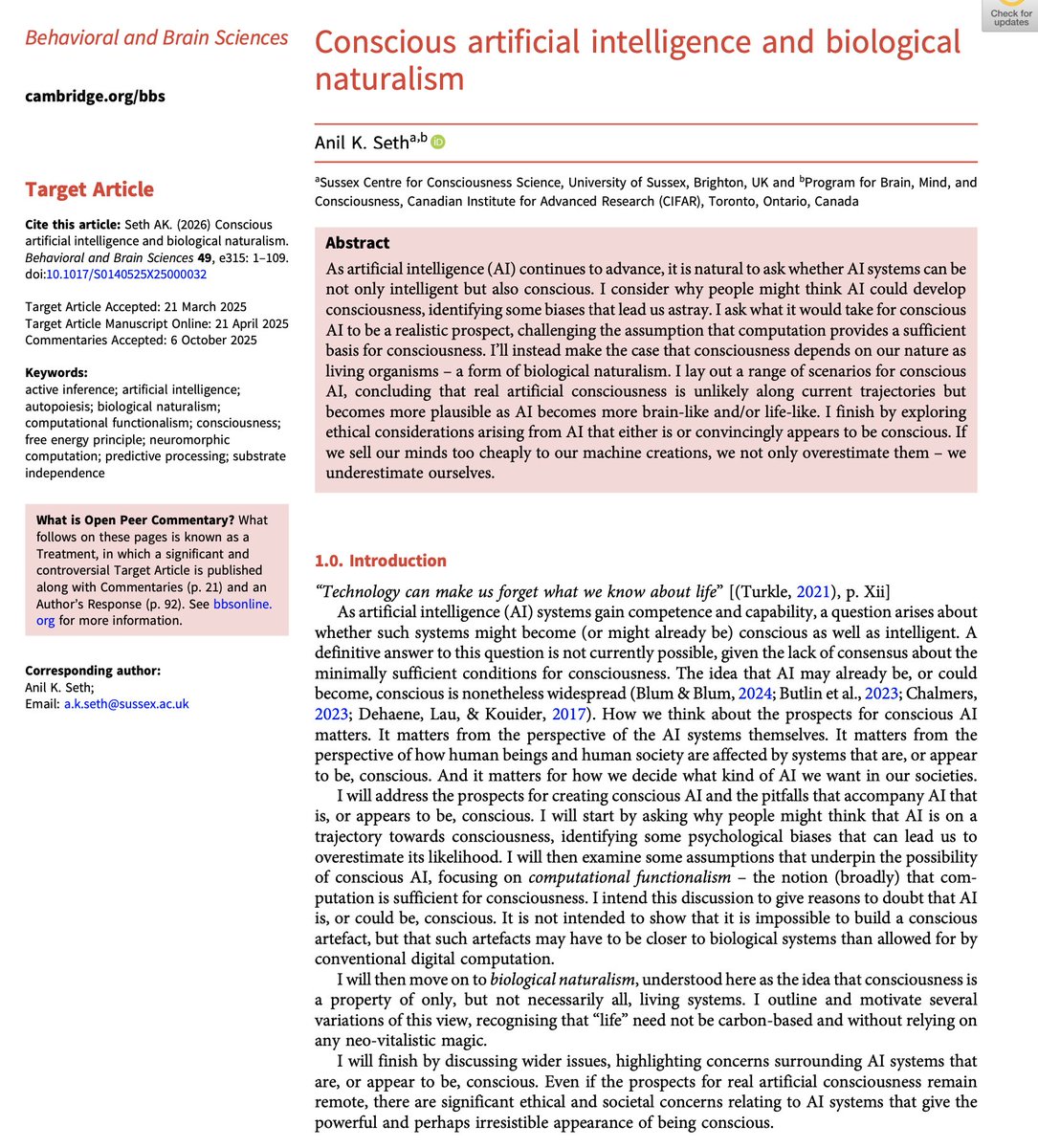
To get a good sense of the current debate in academia, have a look at this just-out @BBSJournal paper, along with 50 commentaries (from all perspective), and my response. You'll see a much richer debate than you describe. https://t.co/bQVmlAXLa0
For years, I've heard from my fellow computer scientists that "the brain is just a computer" or "we can just simulate human brains in a computer." I think both are wrong, and, now that it's a public discussion, it's no longer just academic. 🧵
https://t.co/ipmfMaAxzx
The full workshop recording is now available here 👉
https://t.co/NQofLrUBfm
A big thank you again to all the wonderful speakers, participants, and organizers who made the workshop possible! 🎨
https://t.co/dZaoDPv5Zt
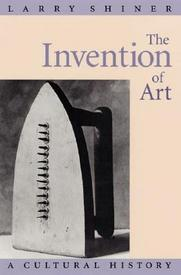
In this blog post, I describe four Western art-historical eras, and why I think they are crucial to understanding how we talk about art today (at least in the US and Europe). 1/
https://t.co/2XFsYjlTrr
@keenanisalive@kendrictonn "functional" isn't the right word. "Art" in the Romantic sense is about creativity, beauty, art for arts sake, unlike beforehand. Too nuanced for a Twitter discussion anyway.
@keenanisalive@kendrictonn I was put off by Isaacson's book implying he was a scientist when "science" as a concept didn't exist until several hundreds years later either; I recommend _The Age of Wonder_ by Richard Holmes on this topic. (I didn't read much of Isaacson's book.)
@keenanisalive@kendrictonn From these quotes, it doesn't sound like they were arguing for painting as "art" in the Romantic sense of something valuable for its own sake (rather than functional like alterpieces, portraits, odes, etc). And I get the impression that's when art really became "elevated."
@keenanisalive@kendrictonn It was the Romantic era when the concept of "art" was invented; they were still trademen in the Renaissance. There's a letter from Leonardo complaining that the woodworker who made the frame around one of his paintings got paid more than he did.
https://t.co/fRpKTmQd0a
How similar are two images? Prior metrics (e.g., LPIPS, DreamSim) give just a single score. But actually, there are multiple *senses* of similarity (color, pose, etc.)
We introduce TPIPS -- Text-Prompted Image Perceptual Similarity
"pip install tpips"
https://t.co/L726pdRx6b 🧵
I wrote a little piece about how science fiction in movies and TV doesn't care much about accuracy or predicting the future, which is why it's not a good guide for understanding real technology.
https://t.co/z0VB2VFvOC
Here's a video I found online that illustrates the kinds of instabilities you can get in physical simulation, and this is just for a single-scale system with simple, non-chaotic dynamics (as compared to any biological system).
https://t.co/xP2YTPfEUr
For years, I've heard from my fellow computer scientists that "the brain is just a computer" or "we can just simulate human brains in a computer." I think both are wrong, and, now that it's a public discussion, it's no longer just academic. 🧵
https://t.co/ipmfMaAxzx