The Yes Bank AT1 Judgment: What the Bondholders Actually Won https://t.co/eFtJ68py0G
A lot of buzz around this case but few understand what exactly it means for bondholders. My thoughts in the above link!
@bhargavizaveri Not yet, and fair catch. I meant the judgment is clear on reinstatement. The qn on coupons seems messier, since SC is silent on arrears. Yes Bank has till about 14 Nov to file a review, so I wouldn't expect anything on the books before then.
@kyleichan Know-how that sits with Chinese engineers can be recalled. In 2025 Foxconn pulled 300+ from its India iPhone plants, reportedly at Beijing’s nudging. On a railway that will work for decades, Beijing keeps this as a lever over Thai infrastructure. They want to remain irreplaceable
Great to see this proactiveness from the company to stop exploitation of the algorithm. How about we share the same level of concern when it comes to minimum wages and other workers' benefits?
The drivers are not classified as "workers" under the labour statute then. Dystopian.
The key reason of Gurgaon’s dysfunction is that it’s being managed by multiple bodies. Layers after layers.
Look at the overlap. One drain doesn’t talk to the other. Typical excess red tape.
The governance issue here seems to stem from family-owned businesses. Commonly seen in the giants of India or in S.Korea (chaebol).
Interestingly, the new-age startups coming up in India do not share the "family owned" ownership approach. Many have a very dispersed shareholding
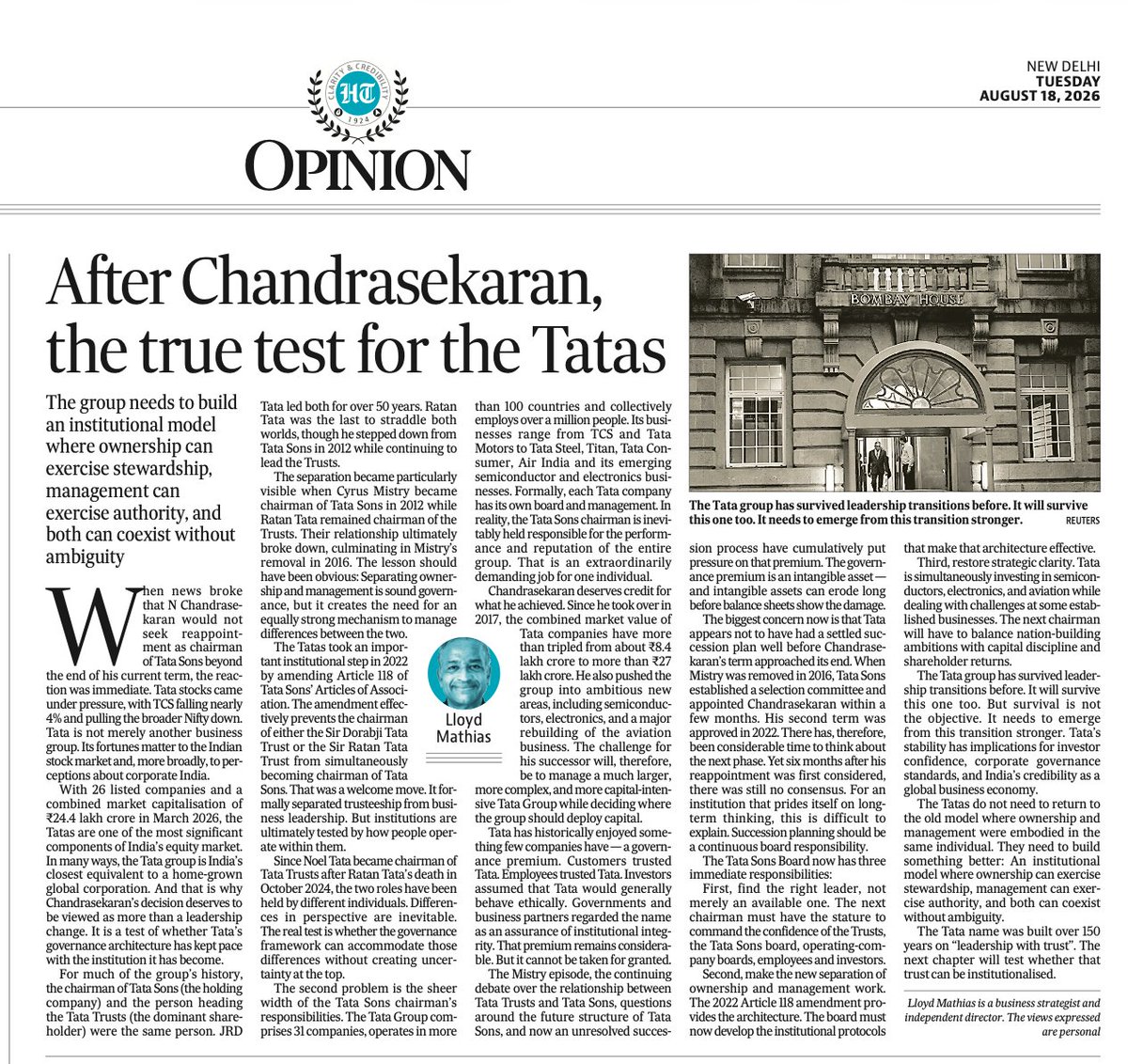
N Chandrasekaran' s decision not to seek another term as Chairman of Tata Sons goes beyond leadership change. It raises fundamental questions about corporate governance & stewardship in India's most trusted business group. When ownership and management are split between Tata Trusts & Tata Sons, how do you institutionalize alignment while navigating structural friction? My op-ed in today's @htTweets explores what this means for Bombay House & Indian Inc.
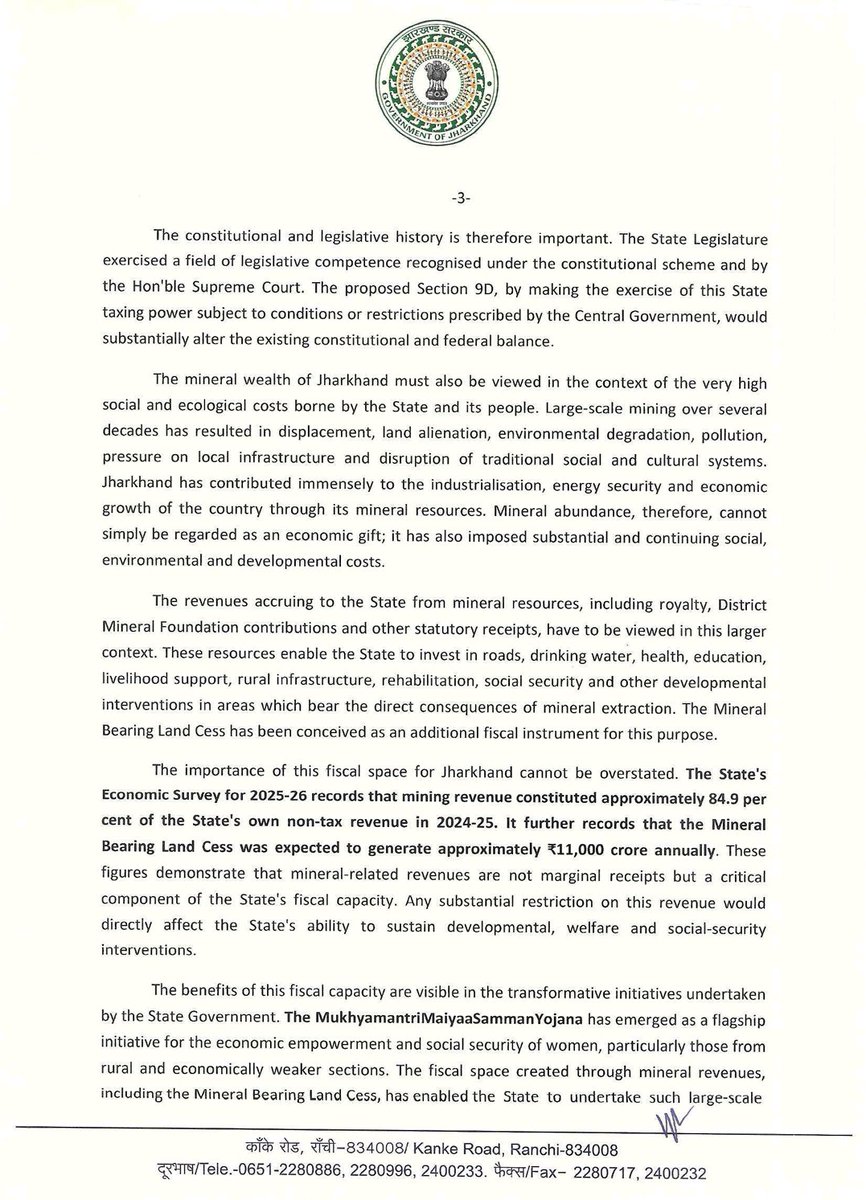
Whether the funds are being used properly is a valid concern here. However, for a state that is dependent on mining revenue, the power to levy taxes is important. Especially for a state that fares rather poorly in HDI. The phrase "mineral bearing land" is an ultra vires act.
माननीय प्रधानमंत्री आदरणीय श्री @narendramodi जी को पत्र लिखकर Mines and Minerals (Development and Regulation) Amendment Bill, 2026 पर पुनर्विचार हेतु आग्रह किया। प्रस्तावित प्रावधान झारखंड जैसे खनिज-समृद्ध राज्यों के संवैधानिक अधिकारों, राजस्व, विकास और संघीय ढांचे पर गंभीर प्रभाव डाल सकते हैं।
झारखंड के संवैधानिक एवं वित्तीय अधिकारों और राज्य की जनता के हितों को ध्यान में रखते हुए मैं विनम्र अनुरोध करता हूं कि केंद्र सरकार इन प्रावधानों पर पुनर्विचार करने की कृपा करें।
@MinhazMerchant@FinMinIndia There is no such thing as a free lunch, but I want to ask how this amendment helps. 10A of the PSS Act refers to "modes of payment". Txns above ₹2000 is not a "mode" 😭
Further, this section does not cater to merchants! Nothing is stopping the passing of costs to consumers!
Check out my new post! Will help clear things up for those following the UPI debate rn.
UPI: Will the genie now charge for the “free” wishes? https://t.co/ygeo7EdiLT
@ajaydgft 10A is a provision that refers to banks and system operators only, not merchants. The current amendment introduces nothing to stop merchants from passing on costs to the consumer. No RBI direction etc currently bars this from going to the consumer.
@ajaydgft What is also interesting is that 10A describes "modes of payment". Don't know how a threshold/class of transactions fit into this framework. The assurances in the press release given by the govt do not fit into the provision at all.
@deepakshenoy Don't think NEFT is the right precedent here. RBI owns, operates and regulates NEFT/RTGS, so making those free meant RBI giving up revenue it was collecting itself.
UPI has no equivalent lever. Probably why zero-MDR had a statutory bar and incentive schemes rather than a circular
India's FDI screening regime now defines "beneficial owner" by importing the definition from the Prevention of Money-Laundering Act.
Built to catch launderers. Now deciding which foreign investments need government approval. 🧵⬇️
Half the test got a number. The other half got a phrase nobody has defined.
A 7% investor with one veto right knows he's under the threshold. He has no way to know whether that veto counts as "ultimate effective control", and neither does his AD bank.