Test time inference is key to generalization but generative models have limited axis of scaling at test time. Diamond Maps introduce 2 methods that enable scalable test time inference which trade off between training and inference cost. Excited to see where this can go in science, robotics, and beyond!
This is my first released work and huge thanks to @peholderrieth, @LucaEyring, @ishin_shah, Giri Anantharaman, @electronickale, @zeynepakata, Tommi Jaakkola, @nmboffi, and @max_simchowitz for making this a great experience!
We release Diamond Maps💎 unlocking accurate and efficient guidance for diffusion models. Our experiments show that our methods scale incredibly well. Excited to see what people will build with this!
Accurate guidance has been a notoriously hard problem, but in this work, we’re bringing TWO (!) solutions to the table. The recipe for success:
1️⃣ Speed: Use distilled models (flow maps, mean flows, consistency models).
2️⃣ Exploration: Inject stochasticity to properly explore your search space.
Because this fundamentally improves anything using flow matching and diffusion, we see a lot of potential for applications across audio, robotics, molecules, and beyond.
Paper: https://t.co/wxtWWRrnw7
Code: https://t.co/WocPtT6orn
Huge thanks to an amazing team: Douglas Chen, @LucaEyring, @ishin_shah, Giri Anantharaman, @electronickale, @zeynepakata, Tommi Jaakkola, @nmboffi, and @max_simchowitz. It was awesome bringing this to life together!
There seems to be fear reasoning models will trivialize research on robot learning architectures, algorithms, etc...
I disagree. Innovation comes from constraints, and robotics imposes a ton of then. Our new paper, led by @DashoraNitish , suggests a really promising new direction for meeting the constraints of real robot deployment whilst capturing the "intelligence" of agentic reasoning models. Check it out!
There’s lots of buzz around agentic harnesses for robots, particularly for long horizon tasks that require complex reasoning and memory. But what will it really take to turn a reasoning agent into a reactive, reliable and low-latency robot policy?
In our new paper, workspace models, we design a new memory architecture that acts as a latent harness for stronger reasoning models. Here’s why we think this might be the way forward:
(1/9)
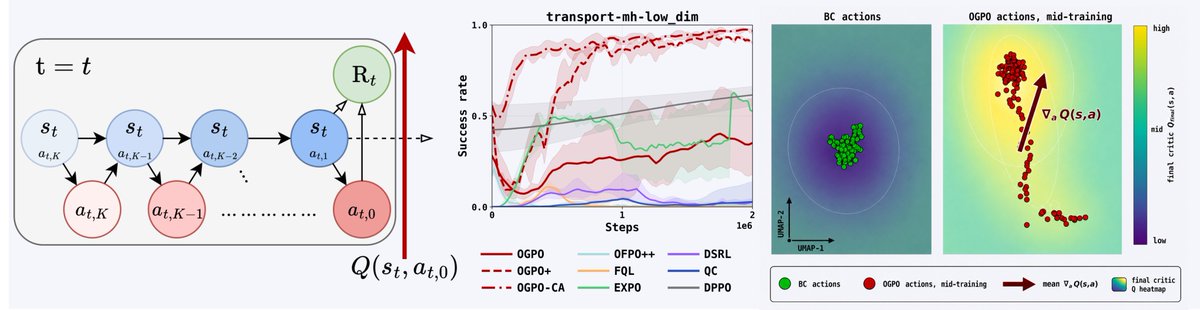
Interaction with the real world is the major bottleneck in robot learning. So what would robot RL look like if we didn’t need to limit compute per interaction? Our latest work, Off-Policy Generative Policy Optimization (OGPO, accepted to ICML26) embarks on answering this question (spoiler alert: when done correctly, it helps massively!).
🧵(1/N)
Diffusion planners are great for offline RL. But they need many steps to work well! Way too slow for real-time decision making!
Presenting RACTD at #ICLR2026: reward-aware distillation that plans in ONE step
🇧🇷 Today (4/23) P4-#4618 3:15-5:45 PM
https://t.co/80EM9aO0Nb 1/
Accurate reward guidance in diffusion models has been a long-standing challenge.
We propose Diamond Maps 💎, through stochastic flow maps we make reward guidance both accurate and scalable.
Unlocking test-time scaling and search in generative models has been a fundamental obstacle, and is increasingly important as these methods are deployed in science, engineering, and robotics.
It was a pleasure to work with @peholderrieth on a paradigm that finally makes this capability genuinely possible, and lets you trade off training time vs inference time according to your needs. Check it out!
super excited to finally publicize this work!
inference-time guidance and alignment of flows and diffusions is a really important problem, but unfortunately existing methods are full of hacks. here we show how to sample from the canonical reward-tilted density using a method based on flow maps, which we highlight are central for efficient alignment.
something really fun is that we give two ways to do this. one involves training a new kind of "stochastic flow map" that we call a diamond map. another shows how to repurpose samples from a standard, deterministic flow map, giving a purely inference-time algorithm that can leverage off-the-shelf models effectively.
some truly amazing work and amazing results by @peholderrieth and crew -- check it out!