@aran_nayebi Dimensional analysis and space reduction should always come first; they can be enough to solve the problem, and are by far more interpretable, or at least help to prepare a relevant brute force.
If the ASI is the last invention of men, what will be the first invention of the ASI? If it doesn't make humans smarter than it, it is ill-conceived, and if it does, it will be outdated.
#DilemIntelligence
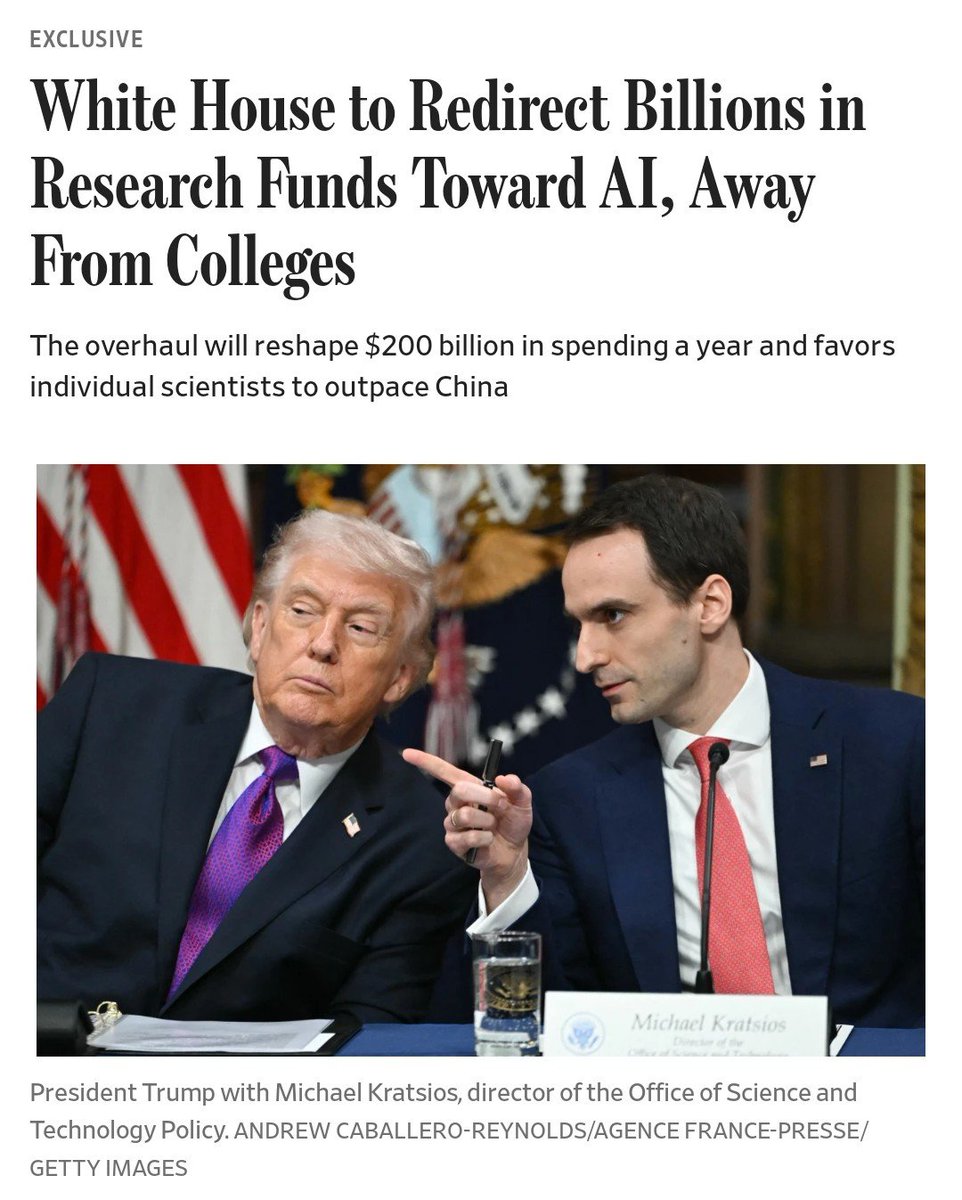
In an new report expected to be released later today the Trump administration will argue that directing federal funding towards individual researchers, and research that uses AI, will accelerate scientific progress faster than funding collages and universites.
@Tezcatl61654308@labar0nn3_ Ne t'en fait pas pour moi, je suis vacciné avec les pitreries des Inconnus, de Lagaffe et de Young depuis les années 90. Donc, Hollywood me fait souvent rire et je ne le prends pas toujours tout au sérieux.
@dr_l_alexandre@Alex_Tsico Si l'ASI est la dernière invention des hommes quelle sera la premiere invention de l'ASI ?
Si elle ne rend pas les humains plus intelligents qu'elle dès 2027, elle est stupide et mal conçue. Et si elle le fait, elle sera dépassée.
#DilemmeIntelligence
We’re super excited to announce an expanded global strategic partnership with Microsoft to give enterprises and regulated industries frontier AI they can control.
With this multi-billion dollar commitment from Microsoft, we're accelerating the construction of our AI infrastructure in Europe, to better serve our customers across the globe.
Combining our complementary strengths, we're making our open-weight models available to Microsoft customers in Copilot Studio, Azure Foundry and Azure Local. One shared goal: bringing our customer to AI-enabled growth, as fast as possible.
Major new report from the White House Office of Science and Technology Policy.
Five things in the report I really liked:
1. Proposes metascience units as a way to advance experimentation in science agencies.
IFP recommended OSTP take this forward in our response to a 2025 RFI.
2. Advocates for a portfolio approach to federal science funding.
Right now, basic research funding largely goes to incremental, project-based grants. While important, they can’t be the only mechanism we use to fund science.
3. Recognizes the need to launch new institutions.
It specifically highlights X-Labs as an experiment with independent labs that can take on ambitious challenges. This is a bipartisan idea whose time has come.
4. Focuses on a mix of innovation funding mechanisms, including fast grants, prizes & challenges, and advance market commitments.
We described and contextualized these ideas in the Atlas of Innovation, which can help policymakers design and implement these approaches.
5. Seeks to reduce burden for American scientists, who face mountains of paperwork.
Scientists should spend more time doing science and less time writing/reporting on grant proposals and working to meet regulatory requirements.
Mistral is announcing an expanded global strategic partnership with @Microsoft to give enterprises and regulated industries frontier AI they can control.
As Mistral is expanding its AI compute capacity in Europe, the companies are expanding their strategic partnership with Microsoft’s commitment to leverage part of this capacity, bringing Mistral’s frontier and efficient models across Microsoft’s AI platform and giving customers flexible deployment options from cloud to fully disconnected environments.
Learn more from @arthurmensch and @BradSmi on what this means for enterprises.
Watch here: https://t.co/xNQ3HcUBoE
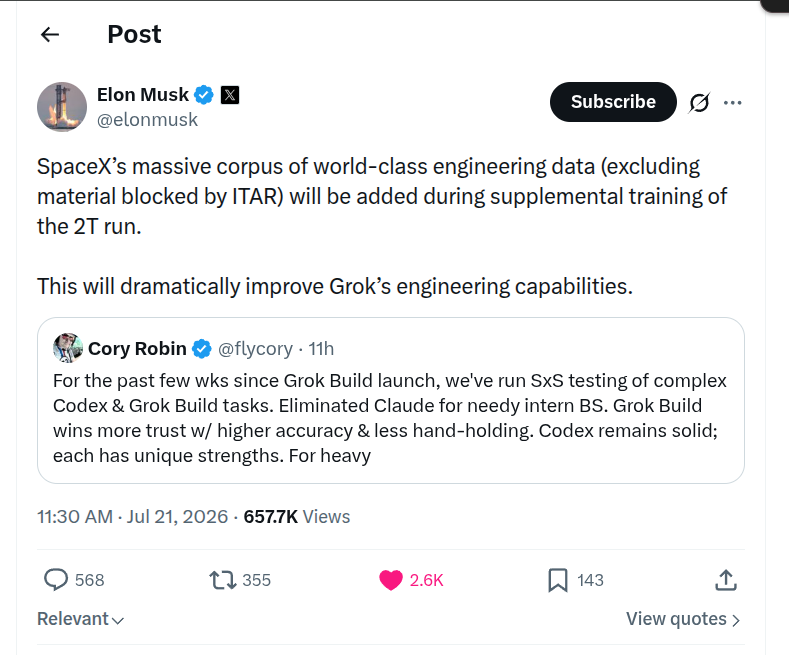
So Grok’s next 2T version will gain a massive engineering upgrade from SpaceX’s specialized technical data.
Elon Musk just confirmed SpaceXAI will feed SpaceX’s deep store of world-class engineering data, into its 2T training run.
This should be really valuable corpus, covers things like hard-won knowledge from rockets, spacecraft, satellites, factories, software, and manufacturing systems.
i.e. Grok can learn how complex systems break, how engineers diagnose them, and which fixes survive deployment.
That kind of training data could make Grok unusually capable on engineering work.
@QingfengBaoYRY@snowboat84 Je n'ai pas lu l'article mais un contreexemple en dimension 2 suffit pour une réfutation d'une conjecture en dimension quelconque.
Anthropic’s $1.5 billion copyright settlement has officially been approved...
making it the largest known copyright settlement in U.S. history.
authors accused Anthropic of using pirated copies of their books to help develop Claude.
but here is the important distinction.
the court ruled that training an AI model on copyrighted books can qualify as fair use.
the problem was that Anthropic downloaded and stored more than seven million pirated books in a central digital library.
more than 91% of the eligible authors and publishers have already claimed their share of the settlement.
and some rights holders opted out so they could continue pursuing separate lawsuits.
this does not end the AI copyright debate.
but it draws a very expensive line between learning from copyrighted information...
and pirating the data used to do it.
@brivael J ai vu hier le podcast Sans Permission, et dommage de n'avoir pas été assez convainquant.
Il y a un concept qui decrit le passage du QI 95 à 130, et le 130 à 160. C'est l'émulation.
Mais si les socialistes empoisonnent cette ultime génération, c'est le décrochage définitif.
57 years ago today, the clearest case of American Exceptionalism became extraterrestrially undeniable.
The Stars and Stripes were planted on the lunar surface to commemorate the greatest achievement in human history. 🇺🇸🚀