As part of the KCNA track of the @Andela Kubernetes African Developer Training program, I have successfully completed the Introduction to Linux(LFS101) course.
View my verified achievement from @linuxfoundation. https://t.co/FYOGLmc4cd via @credly
@Andela@linuxfoundation@credly Thank you.
I started LFS158 immediately after.
Looking forward to understanding the course material and gaining the credential.
As part of the KCNA track of the @Andela Kubernetes African Developer Training program, I have successfully completed the Introduction to Linux(LFS101) course.
View my verified achievement from @linuxfoundation. https://t.co/FYOGLmc4cd via @credly
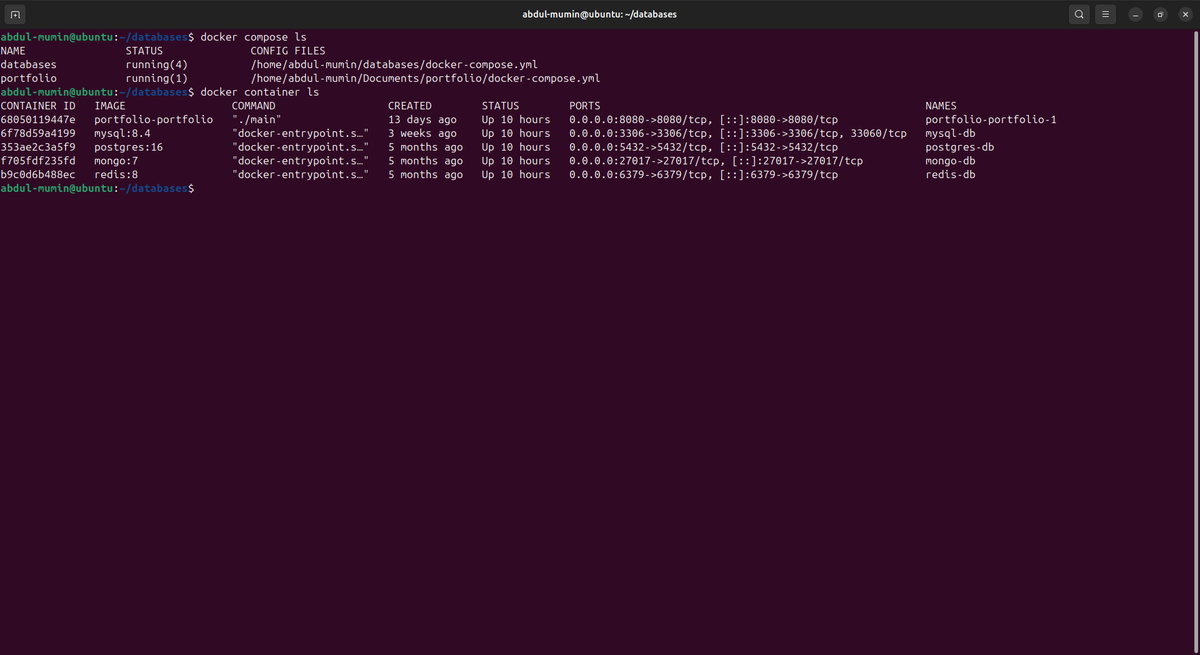
@EOEboh I use docker. I have set up multiple containers for the storage engines using docker compose. It runs PostgreSQL, MongoDB and Redis. I recently added MySQL.
@18thGrei@yehhmisi Same for me but with one addition, C.
C, Python, Go, Rust.
I already know C and Python to an extremely comfortable level. I am focusing on Go this year.
Let's connect.
How databases prevent double-booking: The last ticket problem
Imagine there's one last ticket left for a concert and two people tries to buy it at the exact same moment:
- Person A clicks "Buy Now"
- Person B clicks "Buy Now"
Both their requests hit your server, both check the database and see "1 ticket available", and both try to book it. Without protection, you would sell the same ticket twice.
So how do Postgres and similar databases solve this?
The core idea: The database makes sure only one person can change a specific piece of data at a time.
- when Person A tries to buy the last ticket, the database essentially puts a temporary "lock" on that ticket row - like saying "I'm working with this right now, everyone else wait"
- while Person A's purchase is processing (checking if it's available, marking it as sold, recording him as the buyer), Person B's request comes in and tries to do the same thing. The database says "hold on, someone else is already handling this ticket"
- by the time Person A's purchase finishes, it's already marked as sold. So when Person B's request finally gets to check, it sees the ticket is no longer available and shows him a "sorry, sold out" message.
The key insight: instead of trusting your application code to coordinate multiple requests, you let the database handle it... this solves one of the most common race condition problems that happens on the database
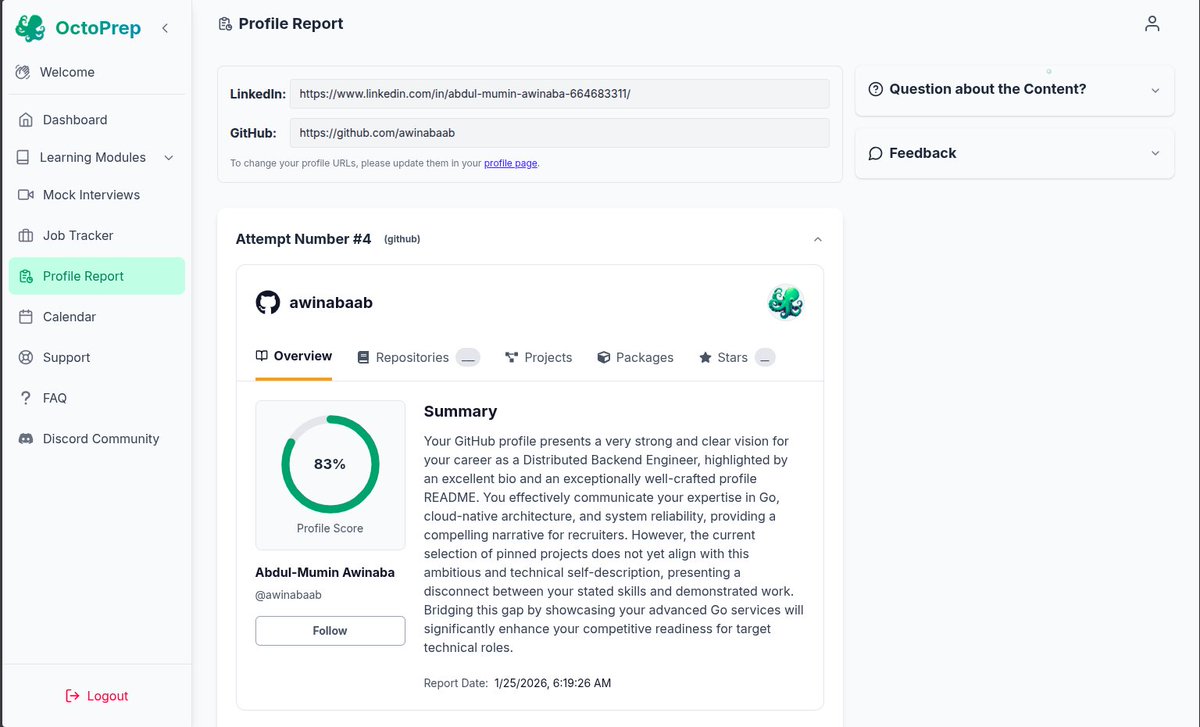
A few weeks ago at @OctoPrepAI, we were taught how to optimize our social media profiles to reflect our expertise and the kind of roles we want for our job search.
The AI Review tool walked me through every step of the way, giving me constructive feedback on areas where my profile was lacking.
After several attempts at optimizing my profile, the only thing left for me to do now is to build projects that demonstrate my ability.
Now that I know exactly what to do. All that is left is to do it!
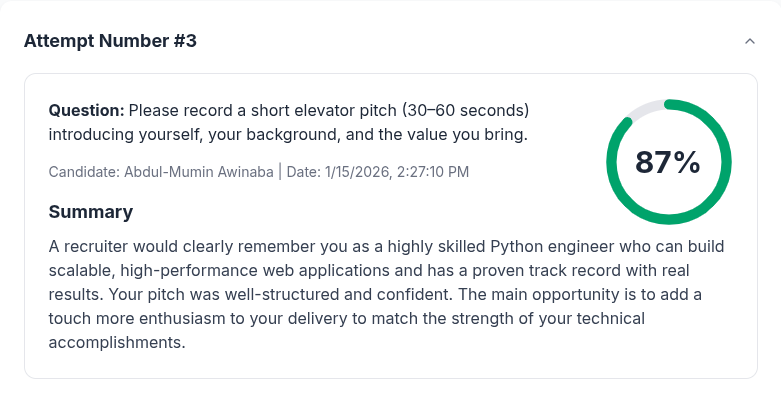
@OctoPrepAI's elevator pitch practice is amazing. Just record your elevator pitch and submit it for an instant performance analysis.
It not only tells you the strengths of your elevator pitch but suggests areas for improvement.
I like how it is not labeled "Weaknesses" but "Areas of Improvement".
It is only a weakness if you let it hold you back.
From 48% to 67% to 87%, that is massive improvement in just three attempts.
@coder_blvck This is the only goal I am committed to achieving this year.
To peel back the layers of abstraction and understand how the computer really works.
Quarter 1: The Hardware & The Virtualization
I’m starting where the code meets the metal.
• Month 1: Machine representation (Bits/Bytes), Assembly, and Processor Logic.
• Month 2: The "Process Illusion"—how the OS manages CPU and Memory.
• Month 3: Project Month – Building a low-level machine simulator.
@0xlelouch_ It seems we have the same goals for 2026.
OS -> Networking -> Distributed Systems -> Security -> Performance.
My systems programming language of choice is C.
What resources are you using?
It has been 5 years now with. What an amazing journey it has been.
My entire journey with Linux started with running @kalilinux using @virtualbox in my first year of university(2018).
In 2020, I running a dual boot system, but this time with @ubuntu.
2021 was the year I made @ubuntu main operating system. Never looked back since then.
I have gained a lot more knowledge about computers and operating systems that I do not consider the convenience of windows a loss.
@sysxplore It has been 5 years now. What an amazing journey it has been.
I have gained more knowledge about computers and operating systems that I do not consider the convenience of windows a loss.