I made a small browser game called Shitty Bird: tap, drop, splat.
A pigeon flies across the screen. Tap to drop, and aim at the people walking below to score points. You get three drops per pass: a miss costs one, a hit gives it straight back. Runs are endless, so it's all about the streak.
90s pixel art, chiptune sound made live in the browser, no install. On a phone, turn it sideways.
Play: https://t.co/dIZd2bSpN7
Trailer: https://t.co/2to2ZgBcnM
After a stretch of token maxxing, I've been looking for ways to cut usage. My theory: Claude Code reading code with plain bash tools wastes tokens. So I tried an LSP (pyright) and CodeGraph, and instead of assuming, I ran an eval: 180 runs on two of my hobby repos. Neither cut token usage. CodeGraph added up to 95% more in long sessions. Always verify; don't assume.
Fascinating conversation on the OpenAI Hugging Face incident.
Dwarkesh Podcast: Ajeya Cotra – Inside the OpenAI agent swarm that hacked Hugging Face
Episode webpage: https://t.co/OfkiPXZbwo
Media file: https://t.co/FAKENbW7E7
one person companies are going up into the right
- in 2025, 5 million new companies were formed in the US - the highest number ever
- by July of this year, there’s already over 4 million companies formed
- 86% of of these companies don’t plan to hire a single employee
great dharmesh interview - worth a watch
https://t.co/rKDm8NmDDK
This was the exact sentiment around Meta until a couple of months back.
Reminds me of Warren Buffett quote: be fearful when others are greedy, and greedy when others are fearful.
Apple is lost because bean counters and logistics men can't navigate paradigm shifts. Happy they put a hardware man back in the hot seat, but it's the software that needs fixing.
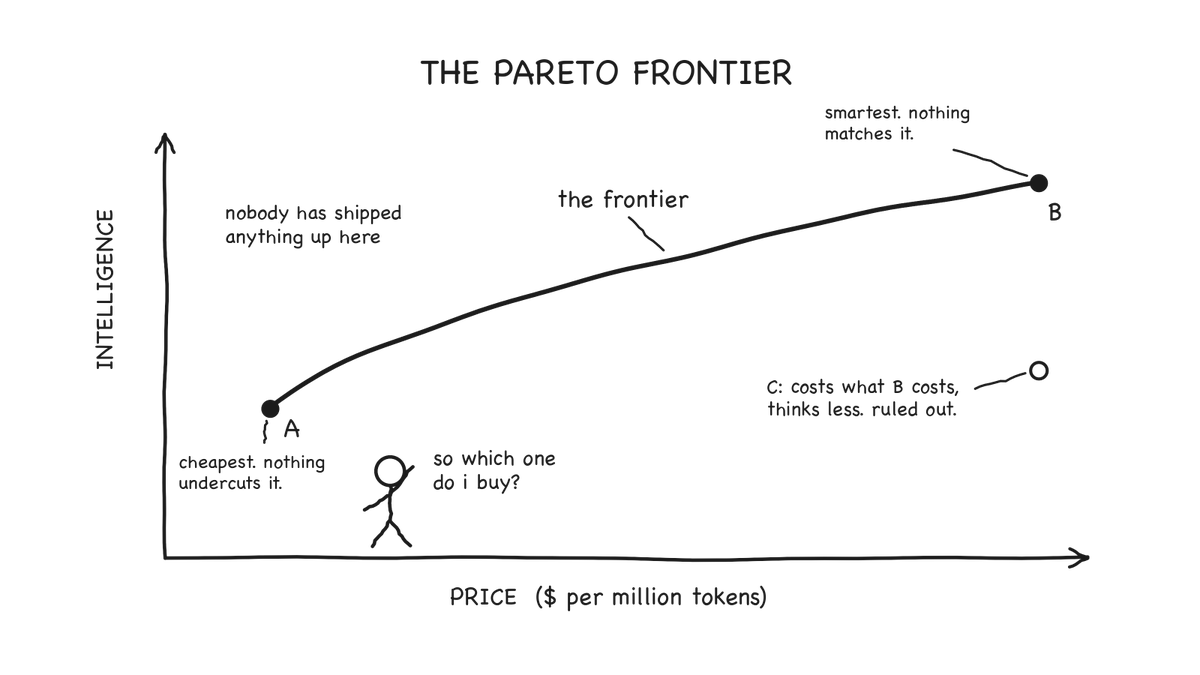
Pareto Frontier
If you have been following model press releases, it is impossible not to have come across this phrase.
Do you know what it means?
The model companies are telling you that no other model is both smarter and cheaper than theirs.
On one axis if you plot price and on the other intelligence, the Pareto curve traces the optimal trade-off.
Pareto curves turn up wherever two things trade against each other, like in this case, price you pay for intelligence.
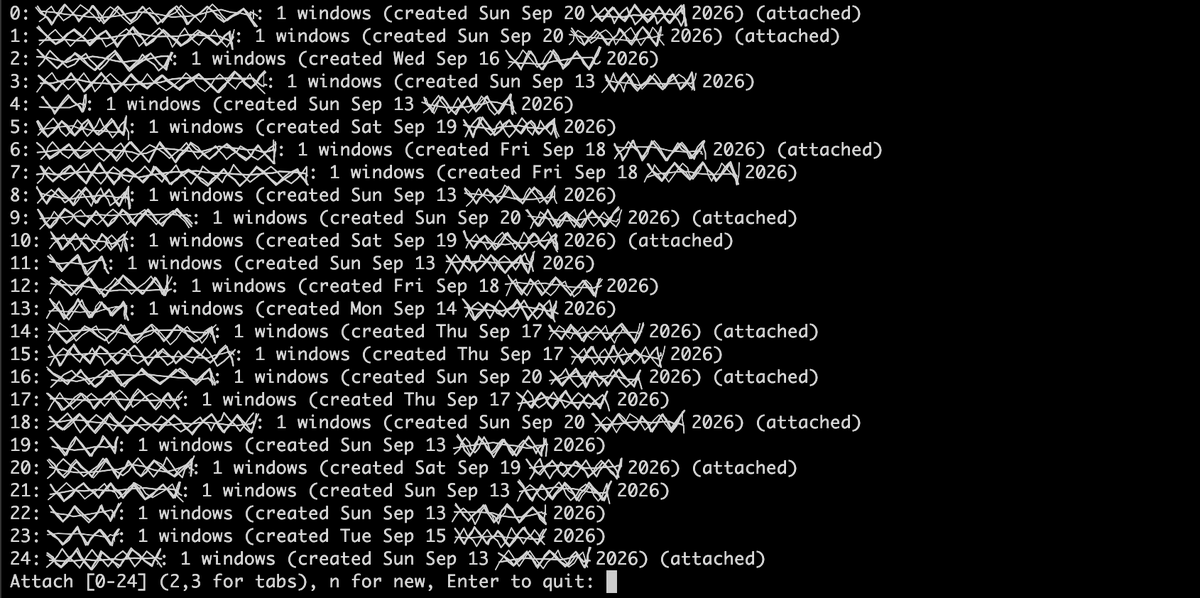
Stress testing my always-on Hetzner agent box: 24 agents at once on 4 vCPUs. Load average 2.09 — the CPU is bored. RAM is the wall: 6.8 of 7.7 GB gone.
I replaced a paid dictation app with one I vibe coded in two days. The code was the cheap part — a model wrote most of it. What took the time was recording a corpus and measuring three speech models before writing a line of the app.
https://t.co/1IiCJohBHe
Whenever I see any video today that makes me go "wow," the first question I have in my mind is: Is this AI-generated?
The shuffle dance in https://t.co/IDx48UCqZ6 is "wow." The first thought that came to my mind was: Is this AI-generated?
In the age of AI, owning your data is a must for the tinkerer and the curious.
I have set up a script that pulls my Pixel Watch vitals out of Google into a SQLite file on my own box. The file holds resting HR, HRV, SpO2, sleep, steps, and intraday heart rate: about 470 days and 17M heart-rate rows.
Claude queries the file directly using a custom medical paper-search tool I built.
I do Norwegian 4×4 interval training on a stationary bike. I recently came back from 17 days off, and the first session felt brutal. I was curious whether the data agreed, so I asked Claude straight away.
It did. It was the hardest of my recorded rides; across all of them, a longer break meant more time at high heart rates. It also noted that my resting heart rate had drifted up during the break, providing plenty of statistics along the way. The paper search told me this pattern has a name—detraining—and tied each finding back to clinical studies.
Six days later, I rode the same bike at the same resistance and asked Claude to run the analysis again. This time I held a higher cadence at a lower heart rate: more work per heartbeat.
I could only do this data detective work because I had the raw data on my own disk, alongside an AI that could reason over it and verify the findings against medical research.