Our 30B and 105B models are now live on HuggingFace.
For us at Sarvam (and for us as a nation), this is a meaningful moment. We're now among the handful of companies/countries publishing large foundation models, and that's not a small thing. This is the first in what will be a series of releases as we keep pushing the frontier.
None of this happens without the models team. They put in a genuinely extraordinary amount of work to get here, and I'm really proud of them.
Go explore the models and share your feedback. It matters.
📢 Open-sourcing the Sarvam 30B and 105B models! Trained from scratch with all data, model research and inference optimisation done in-house, these models punch above their weight in most global benchmarks plus excel in Indian languages.
Get the weights at Hugging Face and AIKosh. Thanks to the good folks at SGLang for day 0 support, vLLM support coming soon. Links, benchmark scores, examples, and more in our blog - https://t.co/DcCG3zlN8p
With the help of @huggingface we (/w @RisingSayak) are building a ML Club India 🇮🇳
What we want to do:
1. Online talks
2. IST compatible timing
2. Open to all
More to come in this week! Watch this space. 🤗
Special thanks to @LysandreJik who motivated me to keep working on this. 🔥
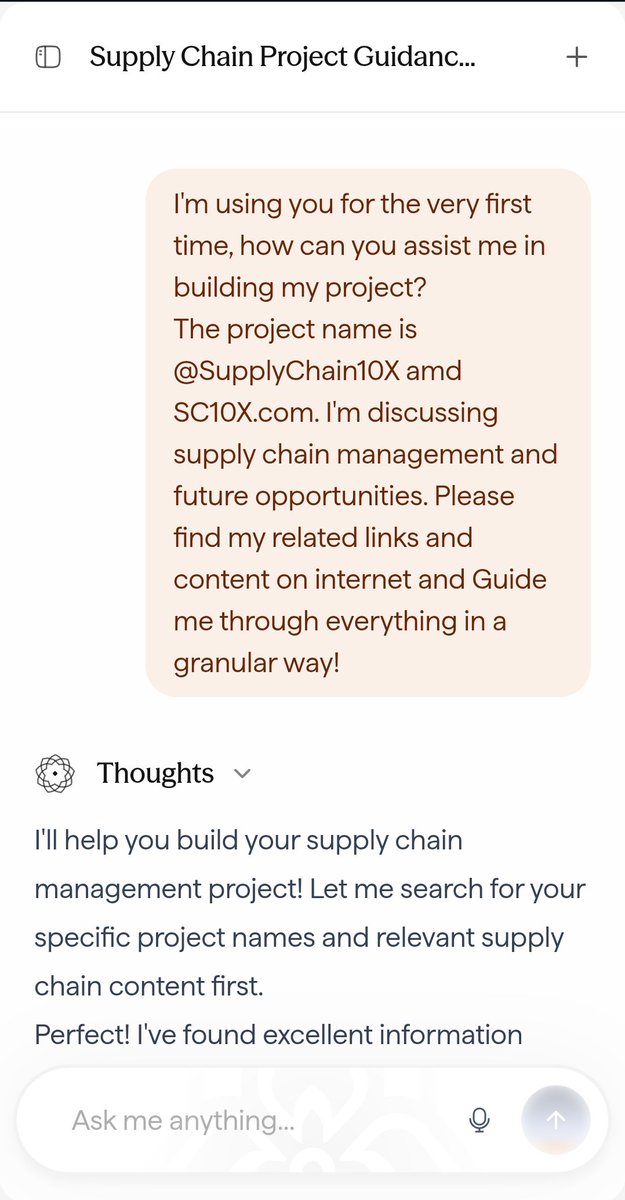
India’s Sarvam launches the Indus AI chat app
As OpenAI, Anthropic and Google battle for India’s 100M+ weekly AI users, New Delhi’s push for domestic AI infrastructure is gaining momentum
India’s frontier AI future is taking shape, with @SarvamAI breaking new ground.
Indus, their new chat interface powered by Sarvam 105B, is now live. Led by @pratykumar and @vivekrag, the team is proving that sovereign AI can be built with India, not just for it.
Proud to be part of their journey as they continue raising the bar.
See it in action 👇
@MohapatraHemant@ShashBharadwaj@abhabhakoo@mansichugh
Just spent few mins with @SarvamAI
’s new Indus chat (105B model) on my phone.
Asked it in Bengali:
‘আজ শনিবার দুপুর থেকে সন্ধ্যা সাউথ কলকাতায় ২ জনের জন্য একটা রিল্যাক্সড প্ল্যান করো। বাজেট ১৫০০ টাকার মধ্যে, ভালো বাংলা খাবার + চিল ভাইবস।’
Gave a perfect South Kolkata plan:
Usha, Dawn of Bengali Cuisine, walk at Sienna Store & Cafe, The Corner Courtyard, Rabindra Sarobar, authentic fish thali.
Who else is trying Indus today? Drop your Bengali prompt results.
My brother @VPhilkana just asked a tricky GRE quant question which he couldn’t solve, on Indus.
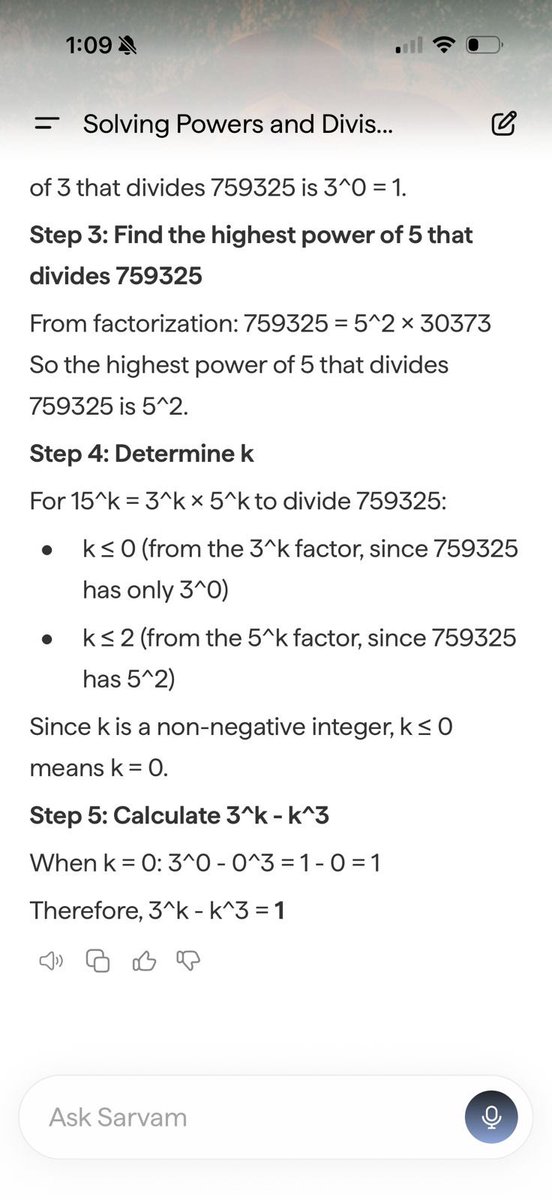
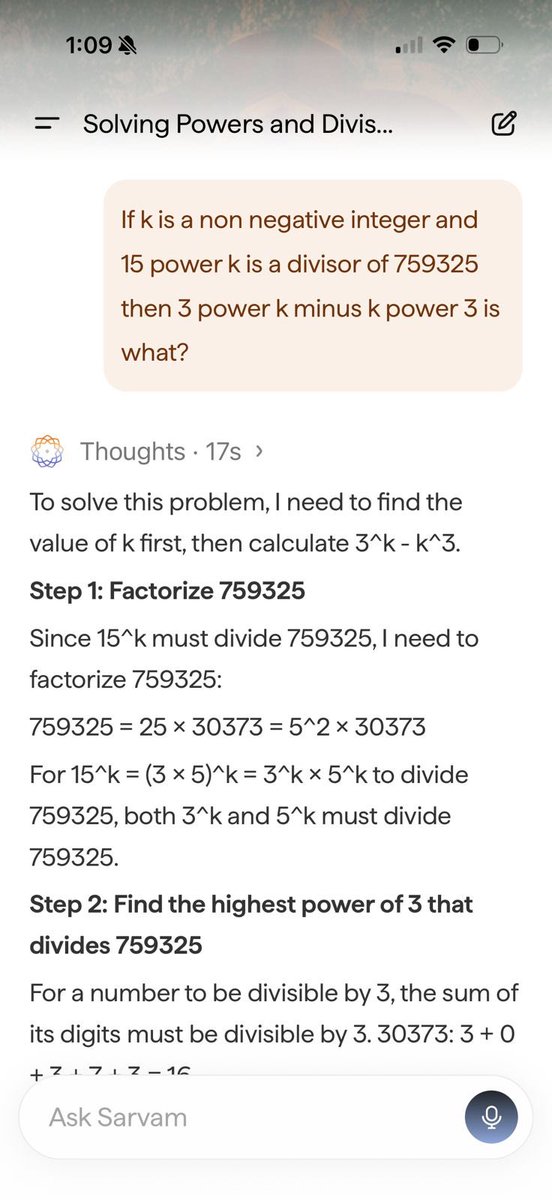
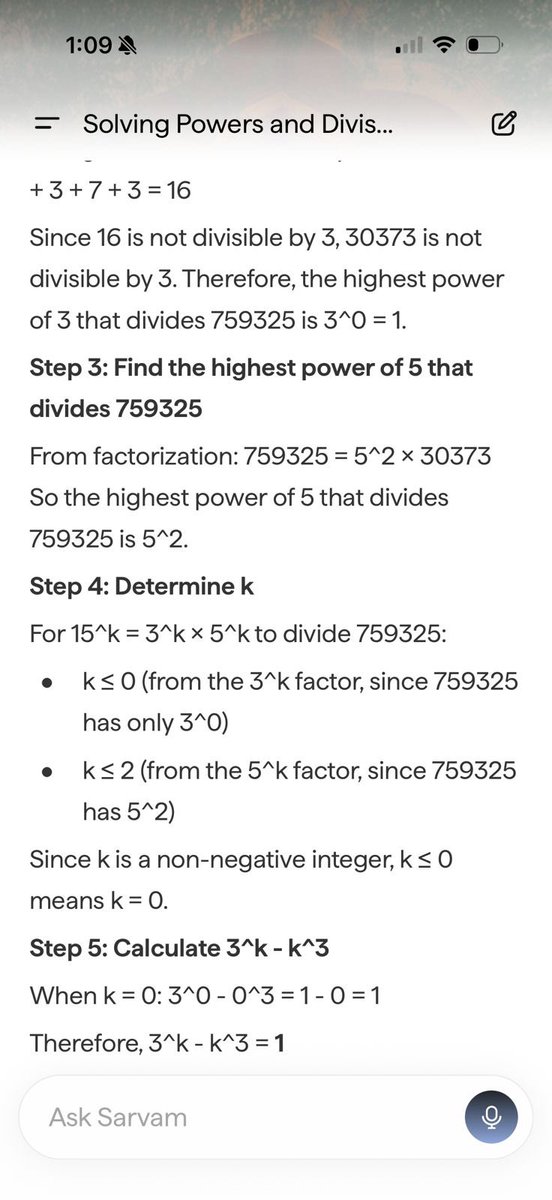
It gave the perfect answer with step wise solution, just the way CBSE curriculum taught us math. 🙌🏼
Download Indus by Sarvam on app store/play store to try it out!
Tried the Indus App by @SarvamAI today — impressive experience. The LLM responses were sharp, context-aware, and thoughtfully structured, and the product design feels intuitive and user-friendly.
What excites me more is what it represents: a step toward India’s #SovereignAI — models built, trained, and aligned within India, on Indian languages, datasets, and governance frameworks.
As digital public infrastructure transformed payments and identity, sovereign AI could power secure, culturally rooted, multilingual intelligence at scale — from governance to MSMEs to education.
If tools like Indus are any indication, India isn’t just adopting AI — we’re building it. @pratykumar
Sarvam AI provides the momentum needed to compete globally while building for Indian diversity.
It advances India’s full-stack AI journey from foundational models to real-world deployments. The 105B and 30B parameter model launches signal growing depth in India’s AI ecosystem.
Wish the team continued success.
@pratykumar@vivekrag@aalekhsharan@sarvamai
Just tried Indus by Sarvam AI—wow, the chat interface feels so much smoother, faster, and natural than the big foreign ones. Zero lag, super intuitive, and it gets my Hindi-English mix perfectly.
Feels like India's own AI finally breathing freely. This is real sovereignty in action—built here, for us. Proud moment! 🇮🇳🤖
Try it here: https://t.co/ppXHL3LL7Z
Drop 14a/14: Over the past few days, we’ve been putting our models, products, and research out there. The positive feedback has helped more people agree with our long held belief that #IndiaCan be a builder in this space.
Today, we are rolling out Indus - a chat interface to experience Sarvam 105B. Here is what all you can do:
“Today we show we can bring our own AI to a billion Indians,” said Sarvam co-founder Pratyush Kumar at the India AI Summit.
Sarvam AI launched two models today built to be used through voice commands and accessible through 22 Indian languages.
“Sovereignty matters much more in AI than building the biggest models,” said Sarvam’s other co-founder, Vivek Raghavan, at the same event.
To know more on the Sarvam AI project, read my earlier interview with Raghavan.
India Edition - July 31, 2025
India is months away from a sovereign AI model that will be much smaller in information scale than ChatGPT and DeepSeek , but also cheaper to develop and use.
Bengaluru-based startup Sarvam — often described as India’s OpenAI — won a government mandate to build an open source, 120-billion-parameter large language model. The intent is to build an LLM that’s fluent in Indian languages, strong at math, reasoning, programming and able to process voice and images, Sarvam Co-Founder Vivek Raghavan said to me.
If Raghavan succeeds at his current mission he will earn the rare distinction of having helped build two nation-critical projects in India. In 2010, he quit a design tech job and volunteered at the government-led Unique Identification Authority of India to build Aadhaar , a biometrics-based identity number that covers over 1.3 billion Indians. Thirteen years later, Raghavan co-founded Sarvam .
“When I first quit my job and joined Aadhaar, I was the youngest in my class to retire, and now if I’m going to do Sarvam for 10 more years, I’ll be the oldest in my class to retire,” he joked when I asked about his penchant for public projects. Commissioned in April, a first version of the sovereign AI foundational model is expected to be ready for deployment by year end, he said.
Why do we need a sovereign foundational model?
We don’t want a dependency on a global model for something so important. This is a very fundamental technology, that if we don’t actually become part of it, if we don’t play in this game, we will probably forever become a digital property tenant. Those are the stakes. We should leverage and use the frontier models, but at the same time we need to have a sovereign model. Just as an example, India has the largest number of free ChatGPT users. That means we are giving the maximum amount of data to OpenAI. That means, in addition to having the capital, they also have the data, which is the other thing that drives AI. So dependency is one reason.
Localization is the other reason. Their models don’t reflect India, its many languages, the dialectics. We should also look at the fact that India is a voice-first country. We like to talk and AI in India will be kind of voice first. In fact, if you are digital, typing in most Indian languages is not the easiest thing to do. So I think that voice will be the interface. That’s our belief.
Of course, India is also a cost-sensitive country. So some of those things are important when we look at building AI for India. Some trends are in our favor. Some things, compared to even two years ago, are much more efficient. The models run faster, they are better and cheaper. And many of the workhorse models that people use are not that big and can provide great value.
Isn’t India very far behind the US and China?
It will take us five years to become a fraction of what the American ecosystem is. If we want to be a global leader in AI then we need to look at very different things. But, if you take this problem and look at it differently, such as how to use AI to make people’s lives better, that doesn’t need as much investment because things are getting better much faster.
If ChatGPT is a sports car and DeepSeek a speedy sedan, what would India’s AI model be?
I think our intent is to be as globally close to the state-of-the-art as exists. It’s a moving target because the state-of-the-art keeps changing every two weeks. The interesting thing is we are training multiscale foundation models. There’ll be large models and there will be medium-sized models and there’ll be small ones. So in that case, it will be everything from a scooter to a sedan.
How will you measure its success?
That’s based on how many people are able to use it and what are the population scale applications in which the model is being used. That is the true determinant. Because you can even build a great model at one point in time but if you’re not able to get usage in a big scale, then you can't maintain that edge over time.
What’s the project cost and scope for monetization?
The government has granted us 4,000 GPUs over a period of six months. It’s not quite a grant as the government will be investing in the company equivalent to that. The value of 4,000 GPUs is estimated at $25 million dollars. We are spending on the people resources. We’ve put together a very strong team of about 30 people to build this.
We are obviously building something that we believe will be widely used. Generative AI has a deeply deflationary effect. If it makes things cheaper and more efficient, value will happen.
What’s the one challenge you are most concerned about?
This is an extremely powerful technology and and we have to figure out how to make sure that whatever we are doing is ethical. The interesting thing is that the technology is moving so fast that we are worried regulation may not move at the same pace. That’s one of the challenges in this area, that the frameworks and the regulations need to keep pace with technological change.