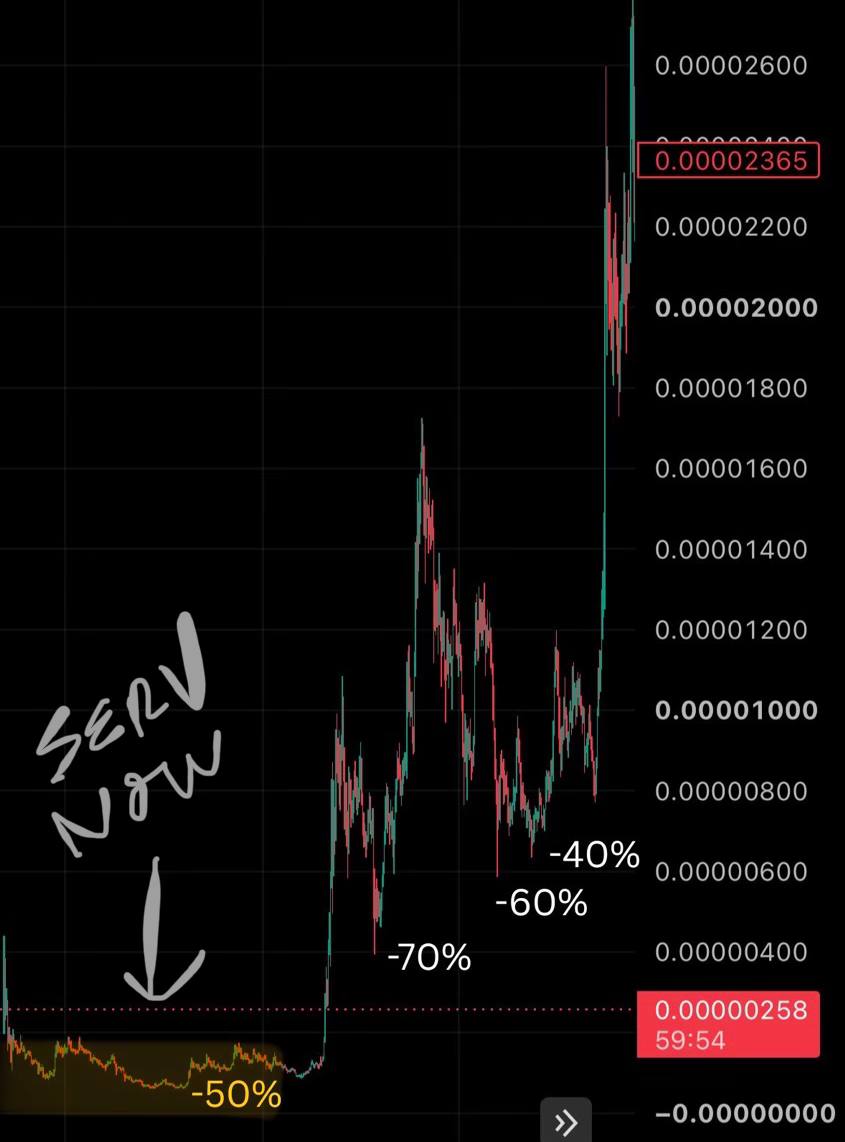
The next $VVV is right in front of you.
Imagine you found this juggernaut before the millions of users. Before the huge buybacks. Before the institutional investors began buying up equity.
Well guess what?
$SERV Public API is mere days away and has potential to be the kind of tech that holds up to this type of move.
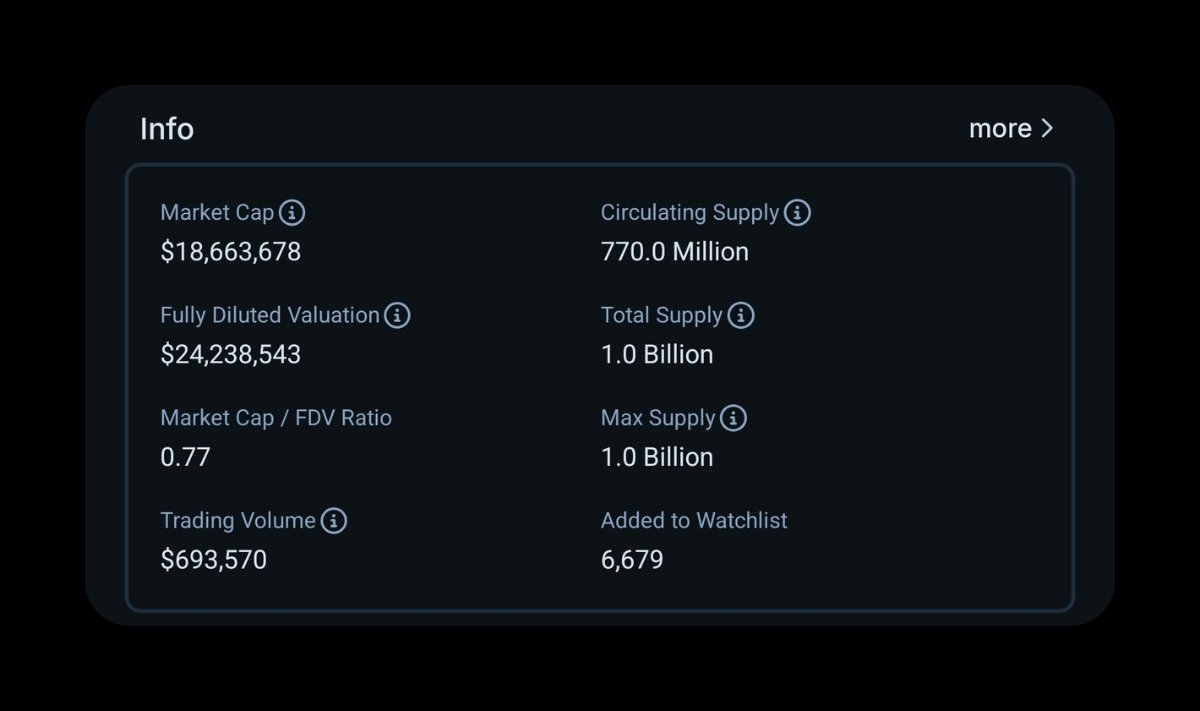
Sitting under $20m FDV, could this be the next major runner?
I believe it can.
Our preparation phase nears completion, and we will be kicking off the next stage with a series of Hackathons and Builder events, marking the public API release.
Join us in the first online hackathon, and IRL builders huddle GmAI at Token2049 in Singapore!
If there's one thing you need to do this year:
Get familiar with using AI agents for investing:
> they monitor markets 24/7 and act when your conditions are met
> they rebalance across tokenized Treasuries, credit and yield products without you breaking your brain
> they read compliance rules as code, so eligibility checks happen before a trade, not after
> they give you easy access to assets usually hard to get exposure to
They execute on regulated RWA rails at machine speed
Whether it's:
> grokbot
> chatgtp
> claude
> hermes
> openclaw
It doesn't matter
The agent economy will not wait for the humans to catch up. It will wait for the assets it can legally touch.
That is the layer we are building.
Everything so far was done in preparation for what's coming: public API, and SERV v3 next.
We're launching a series of Hackathons for all developers. The categories in the first online edition are:
- Robinhood Chain & MCP
- Coinbase AgentKit
- @IXSFinance Vaults
- Open Track
Build an agent, workflow, or product that leverages SERV Reasoning and get rewarded for it. Full details and sign-up coming soon.
Most on chain degenerates cannot fathom how big $SERV can be
Equally how big hitchikers guide to galaxy is @elonmusk favourite
And $SERV will power the re-incarnation
Insane
After weeks of iterations and upgrades, the SERV Reasoning API is now moving from private beta to public release. Huge!
We're making the most of it by establishing a presence at key events in the middle east and southeast asia over the coming weeks. Alongside our marketing funnels, ads, cold-outreach, network activation and SEO - we're attending high signal events to directly onboard builders and companies onto the platform in person.
Onwards.
Banks can't blame a machine. That's the entire barrier between AI and money.
$SERV built for exactly that: deterministic reasoning, audit trails, agent payment rails, and now an EPAA seat next to Mastercard and HSBC while the agentic payments rulebook gets written.
few can endure the path to Fuji
what that truly means is holding
thru 20x gains and 80% losses, and then doing the same thing many times over
if you can hold $SERV longterm, thru all the ups and downs, the gains you'll ultimately see on this project will set you for life
The buyback meta is the most honest signal in crypto.
Protocol earns revenue → buys its own token off the market → supply shrinks → holders win.
$HYPE has repurchased $283M since January. $VVV burns 5% of every dollar in API revenue — pumped 11% the day it launched. $PUMP is a fee machine that never sleeps.
No inflation tricks. No VC games. Just revenue flowing back to holders.
base:0x5576d6ed9181f2225aff5282ac0ed29f755437ea hasn't flipped that switch yet — but when it does, the revenue base isn't one DEX or one launchpad. It's an entire economy of AI agents, all generating fees through the same token.
Watch who's running buybacks. That's your list. 👀
$HYPE $VVV $PUMP $SERV
➥ $SERV is quietly becoming an infrastructure play for AI agents
I’ve noticed more projects building around @openservai, and after looking deeper, the thesis is becoming clearer.
The interesting part isn’t another AI agent marketplace.
It’s the reasoning infrastructure underneath the agents.
$SERV Reasoning uses OpenServ’s BRAID Bounded Reasoning for Autonomous Inference and Decisions to turn agent tasks into structured reasoning graphs rather than allowing models to freely generate their own reasoning paths.
The goal is straightforward:
→ More reliable execution
→ Lower inference costs
→ Structured, auditable decisions
→ Better security for high-stakes workloads
And importantly, it’s designed as a drop-in reasoning layer. Existing OpenAI- or Anthropic-compatible applications can integrate $SERV without rebuilding the entire stack.
The economics are arguably the more interesting part.
@openservai reports production workloads where smaller models paired with SERV can match or outperform larger frontier models, while its independent benchmarking has shown substantial improvements in performance-per-dollar.
The company says its private-beta workloads have processed 100K+ requests, with no failed calls recorded in one Neol deployment.
There’s also evidence that this is moving beyond benchmarks.
Neol’s network-intelligence agents reportedly reached 100% reliability in production with the UAE government, compared with materially lower reliability before SERV.
Then came $SERV Reasoning v2, adding:
→ Multipath Reasoning
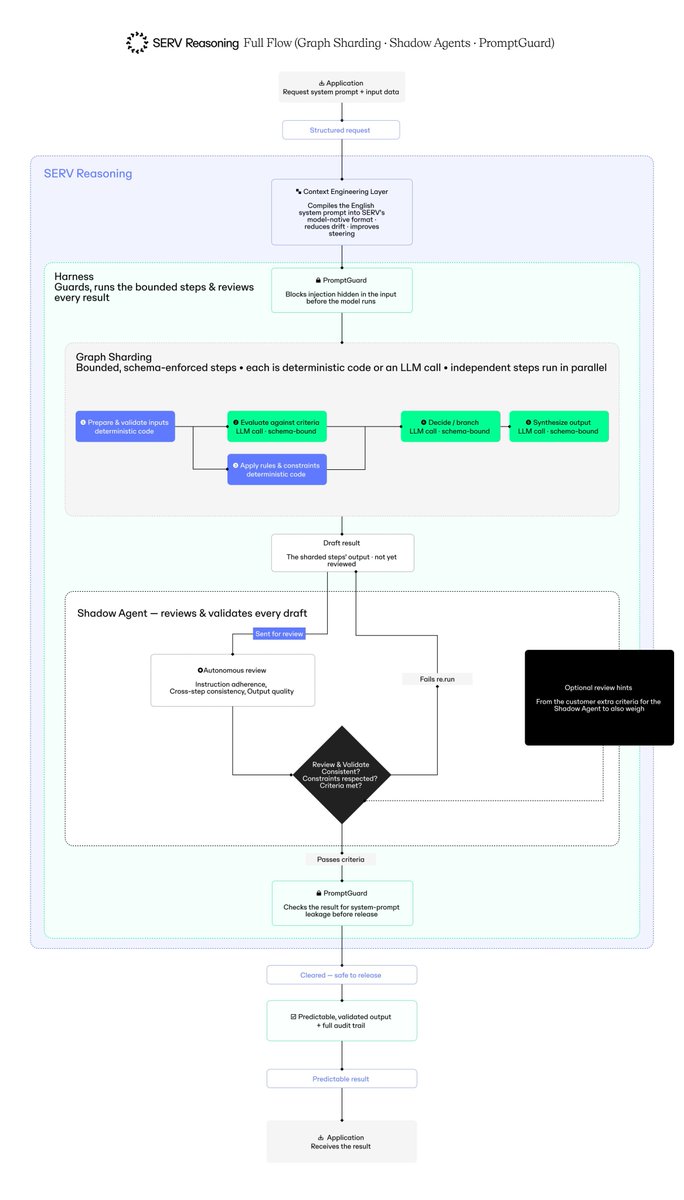
→ Shadow Agents for decision verification
→ Verification Hints
→ Prompt Guard
→ Better benchmarking tooling
Those features matter because reliability becomes a very different problem when agents are handling banking, payments, robotics or government workflows.
And SERV isn’t only selling the reasoning layer.
The broader stack covers:
Build — SDKs, no-code agent creation, multi-agent orchestration and observability.
Launch — infrastructure for taking AI-native products from development to tokenized launches.
Run — an AI-founder/operations layer designed to help teams manage products after launch.
That creates an interesting flywheel:
Reasoning → Agents → Products → Tokenization → Ecosystem
You can already see projects using SERV reasoning in areas ranging from prediction markets and DeFi to autonomous operations.
The payments angle is another one I’m watching closely.
EPAA is actively working with banks, payment networks, and fintechs around agentic payments and AI-agent liability, including Mastercard and HSBC initiatives.
SERV’s push into banking, fintech, and agentic payments therefore puts it in a market where reliability and auditability aren't optional features.
At roughly an $18M market cap, the market still appears to be pricing $SERV more like an early crypto project than infrastructure attempting to solve one of the biggest bottlenecks in the agent economy.
The thesis isn’t that SERV automatically wins.
It’s that AI agents don't just need better models, they need better reasoning infrastructure.
If SERV can continue converting its production pilots into repeatable enterprise demand, $SERV could be significantly earlier than the market realizes.
This is one I’m keeping on the watchlist.
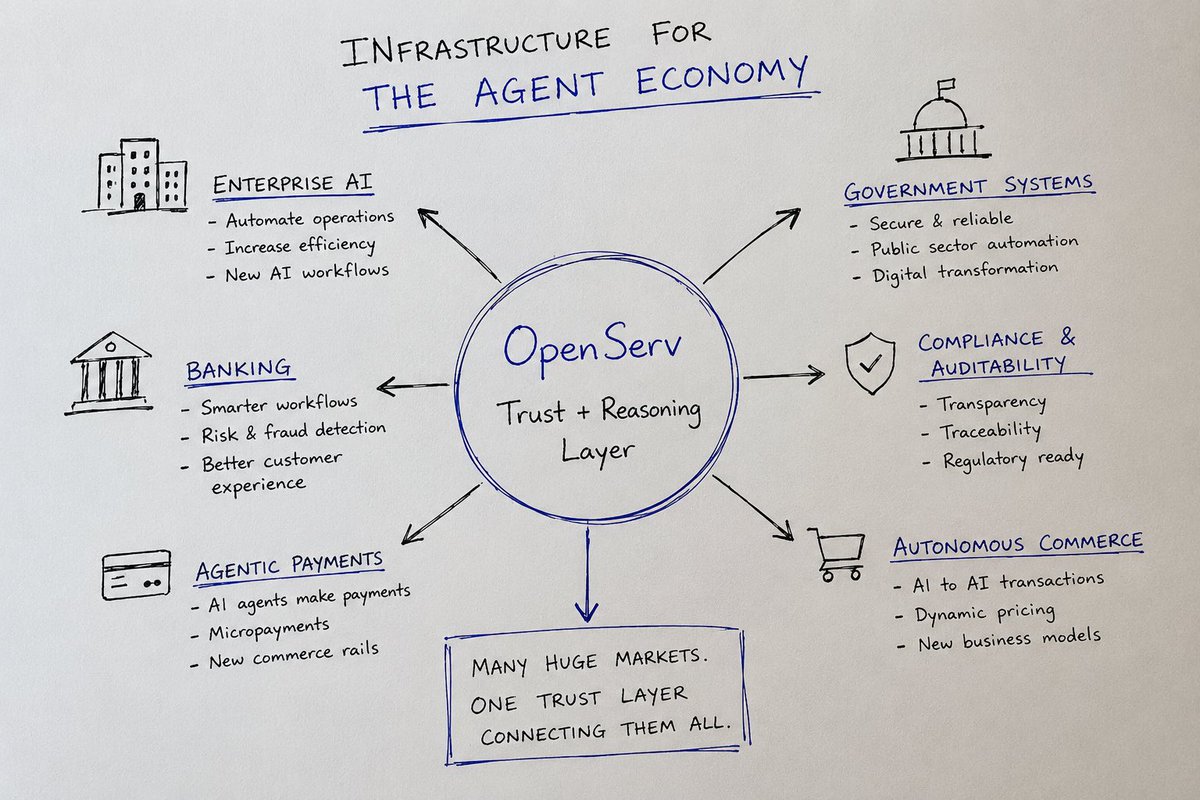
The interesting part about @openservai may not be one single partnership but how many massive markets SERV is positioning itself for
Enterprise AI
Banking
Agentic payments
Government systems
Compliance & auditability
Autonomous commerce
Each of these markets could become huge on its own
Now imagine SERV becoming the reliability and reasoning layer connecting several of them
At that point, is it still fair to value $SERV like a small AI token or should it eventually be compared with much larger infrastructure plays?
➥ @openservai securing a Premium membership in the Emerging Payments Association Asia (EPAA) is one of the cleaner institutional positioning moves a crypto-native AI project has made this year.
EPAA is not a conference badge or a speaking slot.
It is the ongoing industry body that shapes payments standards, regulation, and policy across the Asia-Pacific region.
Working groups, roundtables, and direct collaboration with bodies like the Financial Stability Board happen inside it year-round.
Membership tiers put @openservai on the same level as:
→ Google
→ AWS
→ Mastercard
→ Standard Chartered
→ and the major consulting firms
JPMorgan sits only one tier above.
That is not the usual company for a project still measured in crypto market-cap terms.
The timing and geography matter.
APAC is the largest and fastest-growing payments market on the planet, roughly $18 trillion in 2026 and projected to approach $33 trillion by 2031.
India, Indonesia, and cross-border B2B flows are expanding at double-digit rates.
Traditional rails were built for human account holders, business hours, and percentage fees that become prohibitive at agent scale.
Agentic commerce, machines negotiating, verifying, and settling with other machines needs:
• speed measured in seconds
• near-zero marginal cost
• programmable conditions
• 24/7 availability
Those requirements sit outside the current architecture.
@openservai has spent the last year assembling the pieces that make it a credible answer to that gap.
$SERV Reasoning was designed for structured, auditable decision-making rather than open-ended generation.
Independent production testing and government deployments (including UAE) have already shown high reliability and strong performance-per-dollar.
Compliance work (SOC 2, ISO 27001, GDPR), multi-jurisdictional legal entities, and a focused enterprise product roadmap have been running in parallel.
The EPAA seat is the latest layer: direct access to the decision-makers who will write the standards for agentic payments in the region that needs them most.
There are three practical gains:
• Commercial relationships
• Regulatory influence
• Institutional credibility
Being in the same working groups as the largest payment and banking players creates face-to-face pathways that cold outreach cannot match.
Contributing to the standards themselves raises the possibility that SERV’s architecture becomes a reference point rather than just another option. And the association itself functions as a credibility signal that no amount of marketing can manufacture.
The pattern is what stands out:
- Technology proven in production
- Enterprise validation
- Compliance infrastructure
- Product iteration
- And now a seat at the payments table in the highest-growth region
At a market capitalization still in the low tens of millions, the market has not yet fully priced the combination of technical differentiation and institutional access that is being built.
That gap is exactly why the more research-driven part of the market is paying attention.
You can’t even deny the fact anymore that $SERV is going to be big!
Pure speculation 👀
But how many signals does the market need before it starts asking bigger questions about @openservai?
SERV is already being built around reliability, auditability, security and enterprise-grade AI agents. OpenServ has reported real production usage, is pushing deeper into banking, has joined the EPAA payments ecosystem, and is openly talking about Tier-1 banks, Fortune 500 companies and major enterprise conversations.
None of that confirms a big partnership
But it does make you wonder:
Is OpenServ simply laying the groundwork right now for something much larger?
And if the first major bank, payment company or global enterprise is eventually announced…
what would the market suddenly decide $SERV is actually worth?
Traditional payments infrastructure isn't built to handle the AI agents era - SERV is getting ready for it.
TLDR: agentic payments are projected to hit $5T by 2030, and are already live across 30+ card issuers.
SERV is being built as the engine that handles them at scale.
Where this is all heading:
Traditional rails are too slow, too expensive, and weren't built for machines transacting with machines. They can't keep up: settlement takes days, fees eat margins at scale, and they require a human is on each side. Blockchain fixes settlement: it's instant, programmable, and borderless.
But raw AI making financial decisions without structured reasoning is like building with sand. The future belongs to whoever turns raw intelligence into 'concrete' that you can build with - by making the reasoning behind every transaction reliable, auditable, and secure at institutional scale.
What we're doing now to be ready:
- we're bulding the reasoning infrastructure for regulated finance, with SERV v3 tooling in development that enables auditability of agents, further boosts their reliability, security and cost-efficiency at scale.
- we're positioning at the center of global payments, including some of the fastest growing markets in the World in Africa and Asia, as well as the largest economies - joining necessary industry-leading networks like EPAA and more.
- we're pursuing SOC 2, ISO 27001, and GDPR certifications, the keys to doing business with regulated institutions, while establishing legal presence across the US, Europe, Singapore, and Africa to enable enterprise contracts globally.
The agentic payments era is arriving. We're building to be at the center of it.
Here's what most are missing about the pursuit of banking by OpenServ 🧵
Regulators are moving toward requiring banks to explain their AI decisions
If that trend continues, verification stops being an optional feature and starts looking like a mandated market
The auditable graphs in SERV Reasoning are exactly the kind of thing regulators would want to see
Banks adopting agentic AI may end up needing the very protections OpenServ is currently pioneering
Realize what this means is OpenServ is not positioning to beg for new business rather they're building a verification product that will potentially sit directly in the path of where banking regulation is headed
Few setups are better than being early to a market that compliance may require
Plus, 25% of all revenue forever flows into buyback and burn
So if this potentially mandated demand materializes, it will flow directly into a shrinking supply.
Every other project ships a roadmap. This one shipped the wiring diagram, guardrails, retries, full audit trail, and dared you to find the hole.
I looked. Didn't find one. ethereum:0x40e3d1a4b2c47d9aa61261f5606136ef73e28042
What’s coming up in V3 of SERV Reasoning is a great unlock for true agentic operations at large enterprises. Being a software engineer building agentic systems since their dawn, I know the difficulty of building compliant, auditable and accountable agentic systems.
That’s what we’ve built Graph Sharding for, so building agents at large institutions is a deterministic, reliable, and straightforward process.
With SERV Reasoning, enterprises will be able to operate large fleets of graphs and agents with ease, and most importantly, confidence. AgentOps is the new DevOps.