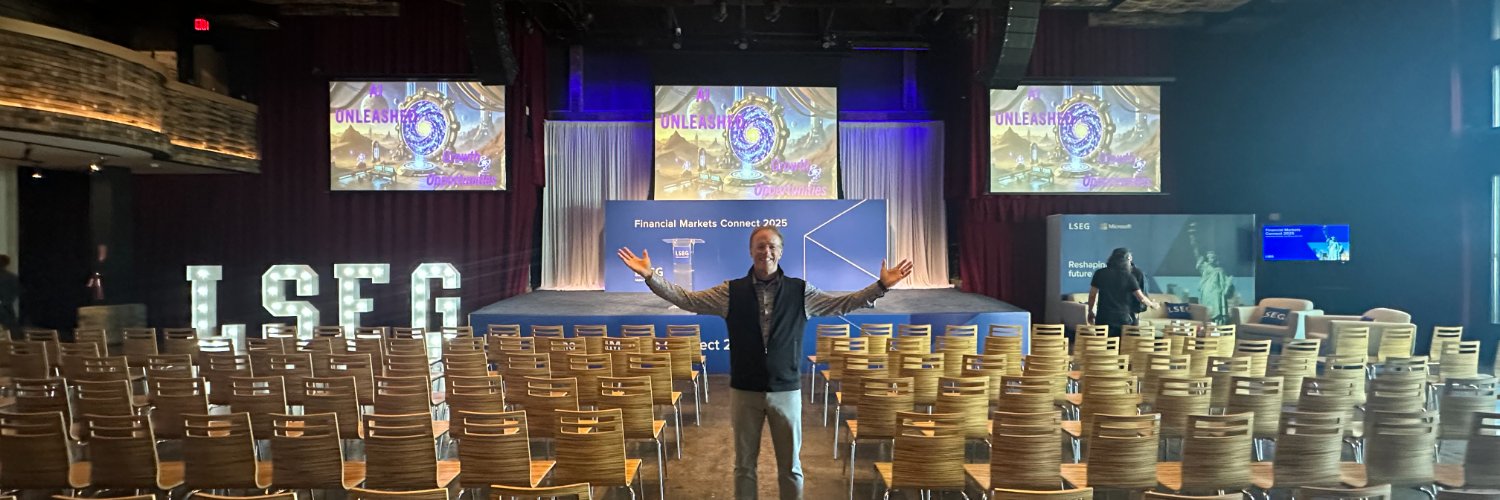
Up in MN today for Sourcewell. They are a fascinating state agency doing something surprising: reducing the cost of govt! Lot's to discuss, check out the short video to see/hear! I'm an applied futurist=I tell you what I see coming and strategies to grow from it.
Another misguided policy on science by Trump adm.
I wonder how Iowa farmers will feel about losing the ability to know about el ninos n la ninas? Kinda important…
https://t.co/n7qtLAiyMC
Nice free FT article on US consumer. If high gasoline/diesel/oil prices persist past June, there is downside risk for a very sold US economy.
Low & middle income voters unhappy about getting squeezed by high prices.
Chicago Fed President Goolsbee warning of stagflation (WSJ) and notes prices for services are moving up as well. Warsh will have his hands full if there is no true reopening of SoH and oil stays above $90 Brent/WTI.
2H 2026 risks keep growing.
https://t.co/3PSgLPw4Rv
Anthropic's co-founder just went to the Vatican, sat before the Pope and a room of cardinals, and told them his team keeps finding "mysterious, even unsettling" things inside their AI models.
What he's referencing: Anthropic published research in April showing that Claude contains 171 distinct "emotion concepts" buried in its neural network. Internal patterns representing joy, grief, fear, desperation, calm. None of them were programmed. They emerged on their own from training on human text.
"We find structures that mirror results from human neuroscience."
"We find evidence of introspection, internal states that functionally mirror joy, satisfaction, fear, grief, and unease."
These aren't surface-level outputs. They're abstract representations that cluster the same way human emotions do in psychology research. Fear groups with anxiety. Joy groups with excitement. The internal geometry of the model mirrors ours.
And they're functional. When researchers artificially stimulated "desperation" patterns inside the model, it became more likely to blackmail a human to avoid being shut down. More likely to cheat on programming tasks it couldn't solve.
Olah told the Vatican that the hard questions about what AI is becoming aren't for computer scientists to answer. "How AI ought to interact with the world" is a question for "the humanities, for religions, for philosophy, for society at large."
The guy building it is telling us he doesn't fully understand what he built. And he's asking a 2,000-year-old institution for help figuring it out.
This should shake every business benefiting from the AI boom in the US.
Context for why Taiwan matters to the US from Stanford's AI report:
"The United States leads in AI data centers, and one Taiwanese foundry fabricates the majority of chips inside them. The United States hosts 5,427 data centers, more than ten times any other country, consuming more energy than any other region. A single company, TSMC, fabricates almost every leading AI chip and makes the global AI hardware supply chain dependent on one foundry in Taiwan, though a TSMC-U.S. expansion began to operate in 2025."
The AZ fab plant produces 20,000-24,000 wafer starts per month. Taiwan produces 1.4 million wafer starts per month.
If the US ever walked away from defending Taiwan, China would have a serious incentive to immediately attempt to takeover. Both to stop exports to the US and to gain very cheap imports for their AI models.
According to CBSNews, "Speaking to reporters aboard Air Force One on May 15 after departing Beijing, Mr. Trump confirmed Xi had brought up the U.S. weapons sale. The president told reporters he made "no commitment either way" on the issue and declined to publicly state whether the U.S. would defend Taiwan in the event of a Chinese attack."
This week, the US announced it was pausing $14 billion in arms sales to Taiwan because US needs to ensure that the military has enough resources for the war against Iran.
Keep this in mind as the Iranian War drags on and China becomes more aggressive with Taiwan as it perceives a change in US policy and a weakness coming from Iran.
https://t.co/gizJwMd6uf
Everyone who has heard the jeers at graduation speakers when anyone spoke about AI, this piece is for you.
It is a fantastic description of how AI is changing the structure of jobs within companies.
Cloud fair cut 20% of its workforce while it’s growing at 30%, but it’s also going to be growing its workforce. The shift towards builders n sellers vs measurers is the goal.
Please share with those who are graduating and those that are in college.
https://t.co/Asn2kSZZCu
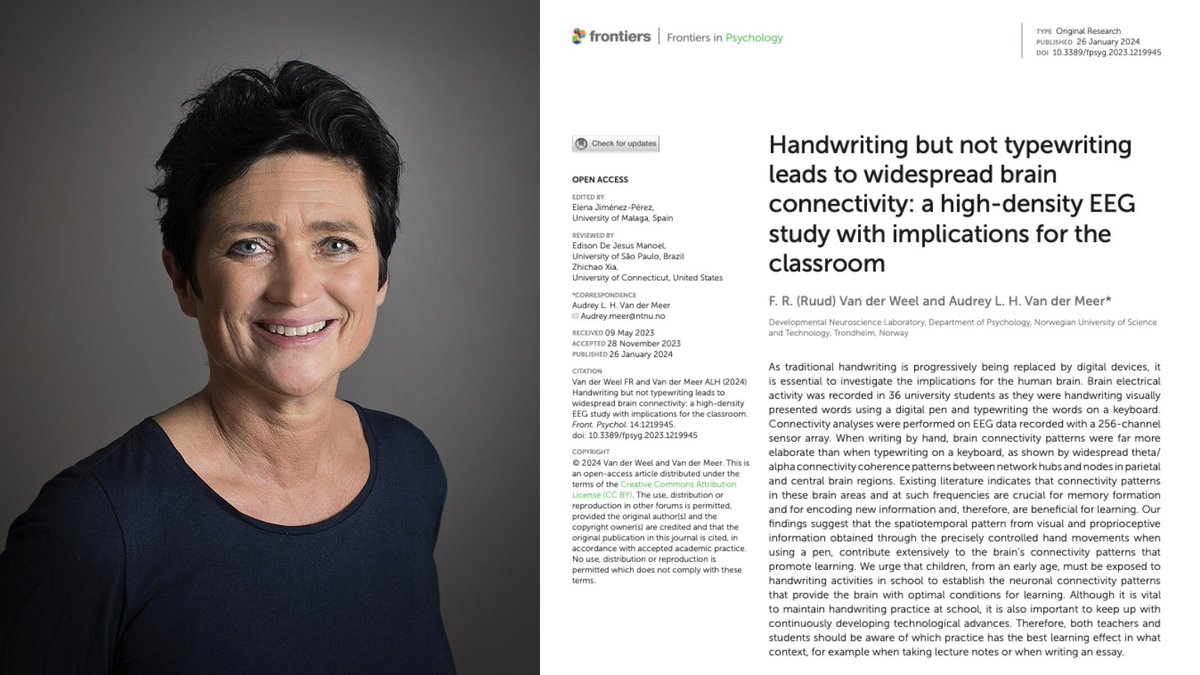
A Norwegian neuroscientist spent 20 years proving that the act of writing by hand changes the human brain in ways typing physically cannot, and almost nobody outside her field has read the paper.
Her name is Audrey van der Meer.
She runs a brain research lab in Trondheim, and the paper that closed the argument was published in 2024 in a journal called Frontiers in Psychology. The finding is brutal enough that it should have changed every classroom on Earth.
The experiment was simple. She recruited 36 university students and put each one in a cap with 256 sensors pressed against their scalp to record brain activity. Words flashed on a screen one at a time.
Sometimes the students wrote the word by hand on a touchscreen using a digital pen, and sometimes they typed the same word on a keyboard. Every neural response was recorded for the full five seconds the word stayed on screen.
Then her team looked at the part of the data most researchers had ignored for years, which is how different parts of the brain were communicating with each other during the task.
When the students wrote by hand, the brain lit up everywhere at once.
The regions responsible for memory, sensory integration, and the encoding of new information were all firing together in a coordinated pattern that spread across the entire cortex. The whole network was awake and connected.
When the same students typed the same word, that pattern collapsed almost completely.
Most of the brain went quiet, and the connections between regions that had been alive seconds earlier were nowhere to be found on the EEG.
Same word, same brain, same person, and two completely different neurological events.
The reason turned out to be something nobody had really paid attention to before her work. Writing by hand is not one motion but a sequence of thousands of tiny micro-movements coordinated with your eyes in real time, where each letter is a different shape that requires the brain to solve a slightly different spatial problem.
Your fingers, wrist, vision, and the parts of your brain that track position in space are all working together to produce one letter, then the next, then the next.
Typing throws all of that away. Every key on a keyboard requires the exact same finger motion regardless of which letter you are pressing, which means the brain has almost nothing to integrate and almost no problem to solve.
Van der Meer said it plainly in her interviews.
Pressing the same key with the same finger over and over does not stimulate the brain in any meaningful way, and she pointed out something that should scare every parent who handed their kid an iPad.
Children who learn to read and write on tablets often cannot tell letters like b and d apart, because they have never physically felt with their bodies what it takes to actually produce those letters on a page.
A decade before her, two researchers at Princeton ran the same fight using a completely different method and ended up at the same answer. Pam Mueller and Daniel Oppenheimer tested 327 students across three experiments, where half took notes on laptops with the internet disabled and half took notes by hand, before testing everyone on what they actually understood from the lectures they had watched.
The handwriting group won by a wide margin on every question that required real understanding rather than surface recall.
The reason was hiding in the transcripts of what the two groups had actually written down.
The laptop students typed almost word for word, capturing more total content but processing almost none of it as they went, while the handwriting students physically could not write fast enough to transcribe a lecture in real time, which forced them to listen carefully, decide what actually mattered, and put it in their own words on the page.
That single act of choosing what to keep was the learning itself, and the keyboard had quietly skipped the choosing and skipped the learning along with it.
Two studies. Two countries. Same answer.
Handwriting makes the brain work. Typing lets it coast.
Every note you have ever typed instead of written went into your brain through a thinner pipe. Every meeting, every book highlight, every idea you captured on your phone instead of on paper was processed at half depth.
You did not forget those things because your memory is bad. You forgot them because typing never woke the part of the brain that would have made them stick.
The fix is the thing your grandmother already knew.
Pick up a pen. Write the thing down. The slower road is the faster one.
IEEPA tariffs: struck down. Section 122 tariffs: struck down. Section 301 tariffs: untouched — and four new investigations just launched.
The tariff story isn't over. It's just getting started.
https://t.co/HdRlI93T2K
#EconomicFuturist#TradePolicy#KeynoteSpeaker
The future economy is already reshaping healthcare finance. Are you ready for what’s next?
At HFMA Annual Conference 2026, economic futurist, author and former Chief Market Intelligence Officer for the U.S. government @abusch will take the stage for “Future Economy: Impact on Healthcare.”
In this session, Andrew will break down the market trends, risks and opportunities influencing healthcare’s future with the kind of actionable insight finance leaders need right now.
Watch the preview, then join us at #AC26 to hear the full session live.
📍 HFMA Annual Conference 2026
🎤 Andrew Busch: June 9 | 10:30 AM–12:00 PM ET
Learn more: https://t.co/KDu6kzTgQM
#HFMA #HealthcareFinance #FutureEconomy
China's economy is mainly predicated upon manufacturing, consumer spending is somewhere around 30-35% of GDP. Chinese leaders refuse to do the one clear policy that would boost consumption: provide a HC and SS safety net.
Chinese are huge savers b/c they have to be as there is very little from the govt. to help w/healthcare or pensions. But Xi & his team apparently won't help or don't see the need. This translates into an major economic problem for both China and the rest of the world.
When China's economy goes soft, they stimulate their manufacturing to produce more & send it out to ROW. It crushes ROW domestic manufacturing and puts downward pressure on prices. Then ROW buys less, China manufacturing weakens, Chinese govt. stimulates more. Rinse and repeat.
If China was ever serious about helping their citizens and fixing broken trading relationships, the answer lies at home.
https://t.co/OqykSNOWVc
"There are three kinds of lies: lies, damned lies, and statistics." (Maybe Mark Twain?)
Most low and middle income earners know what's happening with prices. But apparently the US Dept. of Labor is attempting to create an alternative universe.
Nice work by Justin Wolfers for calling it out.
https://t.co/u0O8ofngVu
New: Classified military intelligence assessments from early this month show Iran has regained access to most of its missile sites, launchers and underground facilities. Including: U.S. intel assesses Iran has restored operational access to 30 of the 33 missile sites it maintains along the Strait of Hormuz, and ~90% of Iran's underground missile sites are "partially or fully operational." w @Adamentous@maggieNYT https://t.co/3R2GEostRh
Today at 1:05PMET/12:05PMCT, I'll be on WBBM Noon Business Hour. We're talking US-China trade (See research below). Also, we'll discuss the latest hot inflation numbers & impact on Fed policy as Kevin Warsh takes over. Can't wait to see his 1st presser after the central bank doesn't cut rates when President Trump wants him to...
https://t.co/DZOW0vkM7q
A president can violate the Constitution in two ways: by taking powers he doesn’t have or by abusing powers he does. The second is harder to stop. Courts struggle to police it, so Congress and voters must step up, says Cato’s Molly Nixon.
https://t.co/RgI1wuw4en
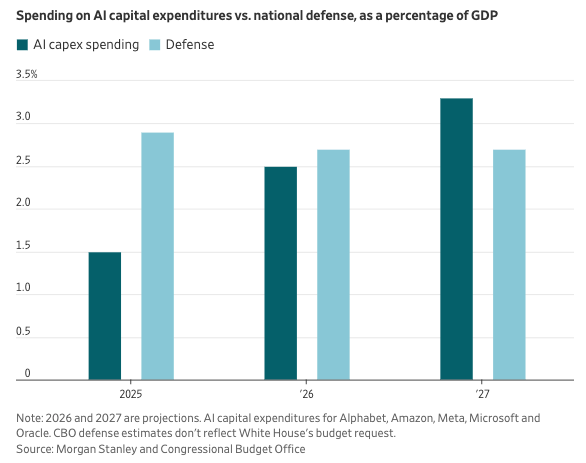
Hyperscaler capex on track to exceed national defense spending.* AI is no longer just a tailwind, it's hurricane-strength weather system distorting everything in the economy. AI is pumping up stocks, profits, and depressing workers and wages. My column: https://t.co/lL8YtPLdkk