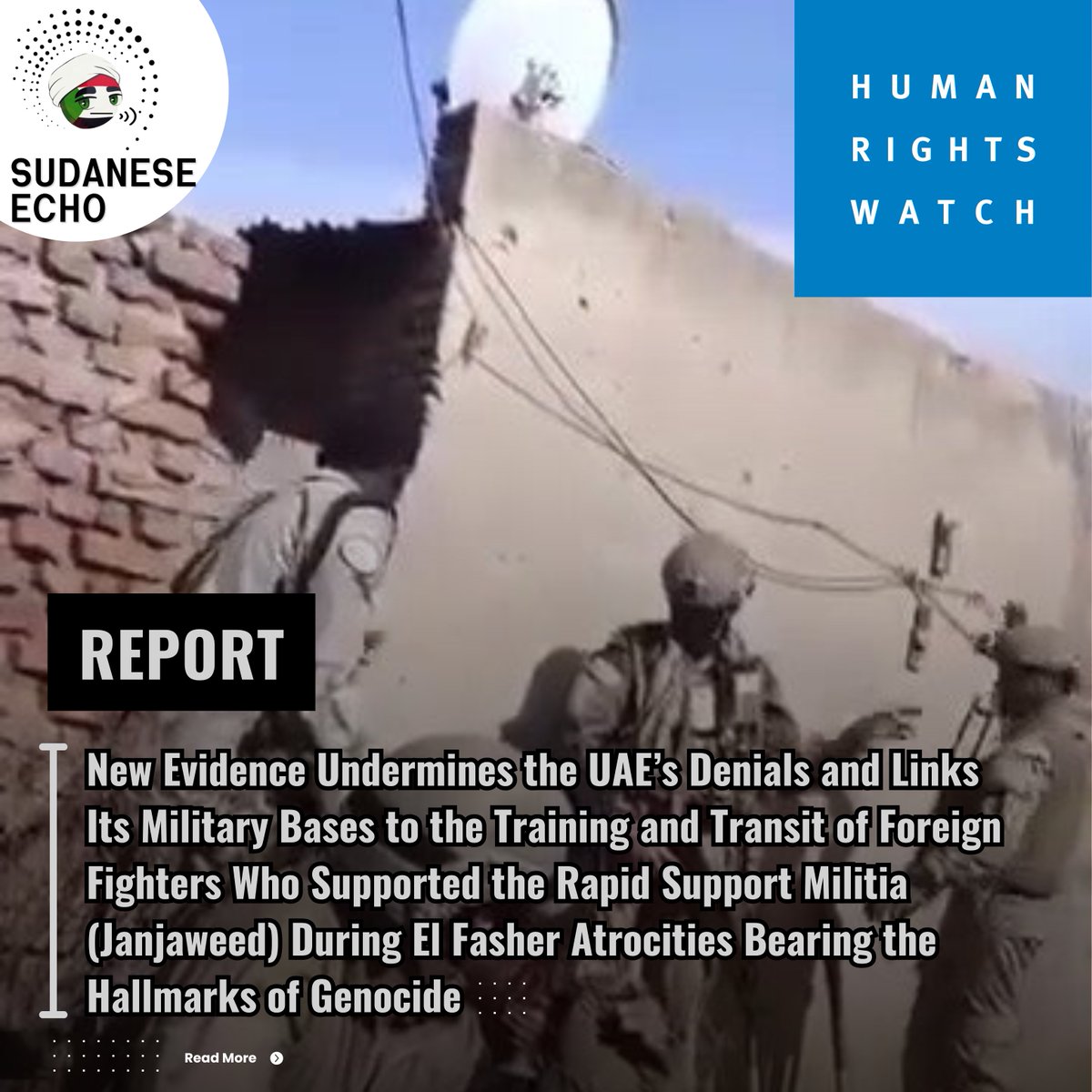
Human Rights Watch: New Evidence Undermines the UAE’s Denials and Links Its Military Bases to the Training and Transit of Foreign Fighters Who Supported the Rapid Support Militia (Janjaweed) During El Fasher Atrocities Bearing the Hallmarks of Genocide
Human Rights Watch has released a new report, titled “From Bogotá to El Fasher,” presenting evidence that Colombian private military contractors, allegedly recruited by a security company based in Abu Dhabi, passed through UAE military facilities before being deployed to Sudan to fight alongside the UAE-backed Rapid Support Militia (Janjaweed). The organization described this as further evidence that the UAE has helped sustain the militia’s ability to commit grave crimes in Sudan.
According to the report, Global Security Services Group, an Abu Dhabi-based company, recruited hundreds of Colombian private military contractors starting in 2024 before they were deployed to Sudan to support the militia in its war against the Sudanese Armed Forces. Human Rights Watch also documented the presence of some of these contractors in El Fasher in October 2025, during the period in which the militia seized the city and carried out widespread killings and rape. The UN Fact-Finding Mission on Sudan said the events bore “the hallmarks of genocide.”
Human Rights Watch said its findings were based on interviews with two Colombian contractors who were sent to Sudan, a former employee of the UAE-based company, eight residents of El Fasher, and seven other sources, including former Colombian military officers. The organization also reviewed company records and official documents, verified and geolocated photos and videos posted online, including material published by the contractors themselves. Some of these materials showed contractors fighting alongside the Rapid Support Militia (Janjaweed) in Sudan, while others showed them training at military facilities inside the UAE.
The evidence gathered by the organization indicates that recruits passed through the UAE’s Ghayathi military base and what is believed to be a military facility in Al Wathba, both in Abu Dhabi, before being sent to Sudan. One contractor said that when he arrived in the UAE, he bypassed immigration procedures, explaining that their passports were not stamped. He said he and other contractors were then taken directly to the Ghayathi base, where they received training from Emirati nationals. Human Rights Watch also identified four other contractors whose verified photos and videos showed that they stopped in the UAE before being deployed to Sudan.
The first public evidence of Colombians in Sudan emerged in November 2024, through videos posted on social media roughly 19 months after the war began. The footage was filmed by the Joint Force of Armed Struggle Movements, an alliance of armed groups aligned with the Sudanese Armed Forces, after it intercepted a convoy of Colombians who had entered Sudan from Libya.
According to the report, the Colombians were carrying Bulgarian-made 81mm mortar rounds. France 24 reported that the rounds had been withdrawn from UAE Armed Forces stockpiles. Human Rights Watch said those rounds were among several types of military equipment that ended up in the hands of the Rapid Support Militia (Janjaweed) in violation of end-user agreements, according to research by Human Rights Watch, Amnesty International, and France 24.
The report connects this military pipeline to the battle for El Fasher, where civilians were subjected to killings, rape, starvation, and targeted attacks, including against people with disabilities. Human Rights Watch verified and geolocated videos showing foreign military contractors, believed to be Colombian, fighting in El Fasher as the militia took control of the city in the fall of 2025.
Six witnesses told Human Rights Watch they saw “white-skinned” foreign fighters at sites of mass killings carried out by the Rapid Support Militia (Janjaweed). The witnesses said the fighters were wearing protective equipment similar to what appeared in the videos, including helmets, body armor, and knee pads. These testimonies place the presence of foreign fighters at the center of one of the bloodiest phases of the war in Darfur.
The report also said one Colombian contractor stated that he trained militia recruits in camps near Nyala, which the Rapid Support Militia (Janjaweed) uses as a major base in South Darfur, around April 2025. The contractor said many of the recruits were “small children.” The Colombian news outlet La Silla Vacía also reported that some contractors had trained child soldiers belonging to the militia.
Human Rights Watch noted that international law prohibits the recruitment or use of children in armed conflict, and that it is a war crime when the children are under the age of 15. The UN Secretary-General verified 16 cases of child recruitment by the Rapid Support Militia (Janjaweed) in 2024 and listed the armed group in the UN’s “list of shame” for grave violations against children in armed conflict.
The report also examined the background of the UAE company accused of recruitment. Human Rights Watch cited a 2025 report by The Sentry stating that Global Security Services Group was founded in 2016 by Ahmed Mohammed Al Humairi, secretary-general of the UAE Presidential Court. The report added that Al Humairi serves under UAE Vice President Sheikh Mansour bin Zayed Al Nahyan, the brother of UAE President Mohammed bin Zayed Al Nahyan and chairman of the UAE Presidential Court, placing the company close to the highest levels of power in Abu Dhabi.
The report further said that in 2017, Al Humairi transferred his shares in the company to his long-time business partner, Mohammed Hamdan Al Zaabi, while continuing to work with him afterward. A former company employee told Human Rights Watch that senior members of the UAE ruling family were likely among the company’s clients, a claim the organization said was supported by a set of leaked emails it reviewed.
Until recently, the company had advertised itself as the first private security company in the UAE to receive an armed security license. It had also claimed that major UAE ministries were among its clients and that it was the “sole provider of private armed security services to the UAE government.” These details raise serious questions about the nature of the company’s relationship with UAE state institutions, especially given the report’s findings that contractors passed through UAE military facilities before being deployed to Sudan.
The UAE has repeatedly denied providing military support to the militia. But Human Rights Watch argues that the passage of contractors through UAE military facilities, their training inside the country, and the company’s links to figures connected to the Presidential Court and the ruling family place those denials under mounting pressure. The organization also said UAE authorities should know, and be expected to know, about activities taking place on Emirati soil, especially on government property and military bases.
The report added that the UAE is a highly centralized authoritarian state, making it difficult to imagine operations of this scale moving through military bases and sovereign facilities without the knowledge of senior authorities. Human Rights Watch also noted that UAE law requires private security companies to coordinate their activities with the authorities and ensure that their operations do not conflict with other security measures.
Human Rights Watch said it wrote to Global Security Services Group, UAE authorities, and other parties allegedly involved in recruiting private military contractors, sending them to Sudan, or providing other military support to the Rapid Support Militia (Janjaweed), but received no response. The lack of response adds further weight to the questions raised by the report about the role of UAE-linked companies and institutions in supporting the militia.
The organization called on the UN Security Council to instruct its Panel of Experts on Sudan to investigate Global Security Services Group, including Mohammed Hamdan Al Zaabi, over its alleged role in supporting the Rapid Support Militia (Janjaweed), which may violate the arms embargo imposed on Darfur since 2004. It also called for investigations into other actors, including private companies that may have assisted the militia, and for sanctions against individuals and entities providing such support.
Human Rights Watch also urged governments, the European Union, and the African Union to investigate the company and Al Zaabi with a view to imposing targeted sanctions. It called on states to suspend all forms of military cooperation with the UAE, halt arms sales to Abu Dhabi, and use bilateral negotiations with the UAE to pressure its authorities to end support for the Rapid Support Militia (Janjaweed).
The report offers a broader picture of the foreign support fueling Sudan’s war, from security companies and military bases to foreign fighters and international supply routes. These findings show that the Rapid Support Militia (Janjaweed) operates within a cross-border support network that has helped prolong the war and enabled the militia to commit widespread crimes against Sudanese civilians. They also strengthen calls to designate the militia as a terrorist organization and hold accountable every state, company, and individual involved in financing, training, or arming it.
#Sudan
#RSFisTerroristOrganization
#UAEKillsSudanesePeople
#UAESponsorsTerrorism
Colombian private military contractors, apparently hired by a United Arab Emirates-based company, transited through UAE military bases before being deployed to Sudan to support the genocidal Rapid Support Forces. https://t.co/35Po66gvf8