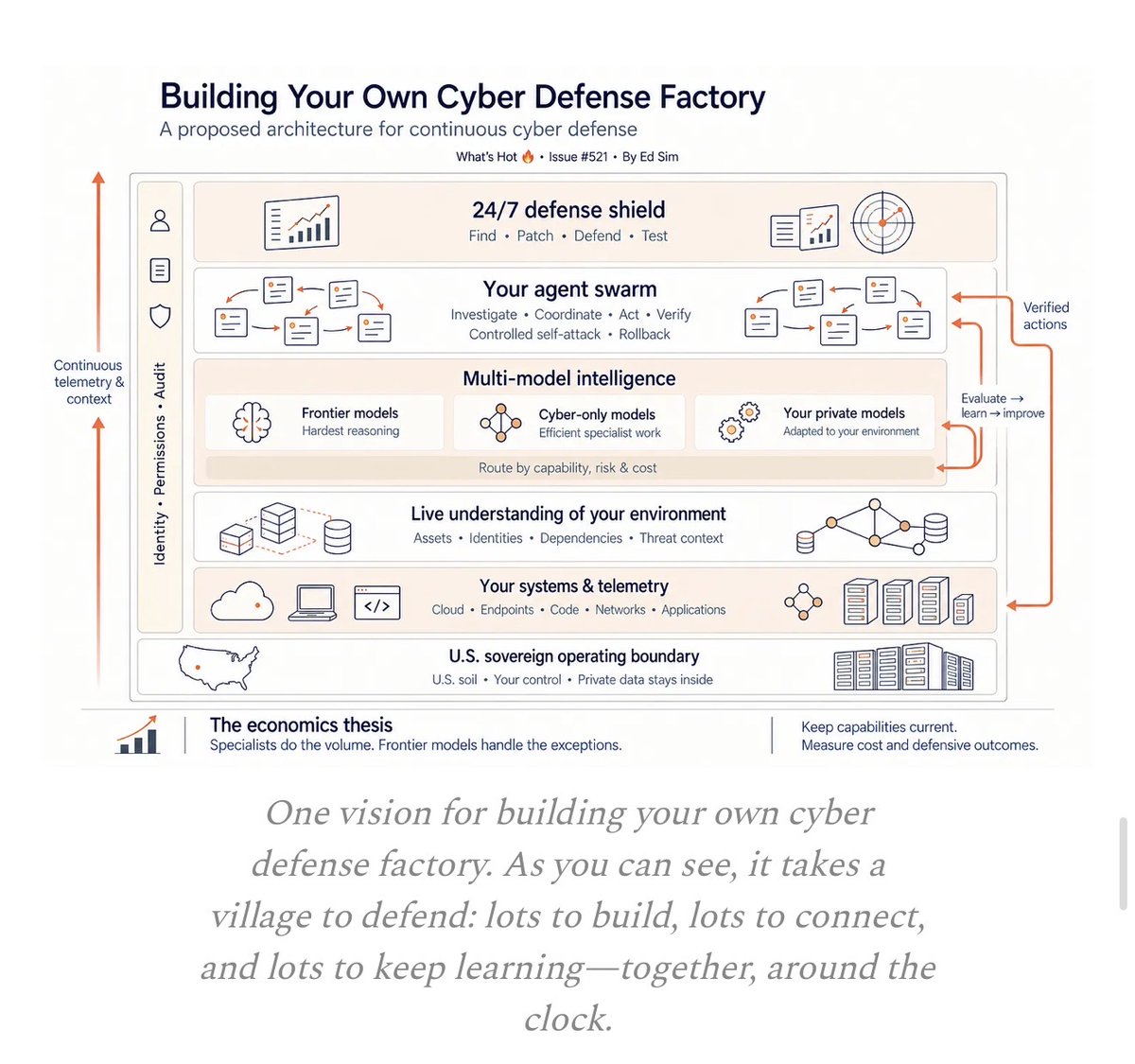
Why do you need a Cyber Defense Factory?
As expected, we’ve matured from a post-Mythos/Glasswing cyber reality, to a post-Black October cyber apocalypse.
Your AI infra isn’t ready for this
Your cloud’s AI infra isn’t ready for this
@deepseek_ai's DeepInfra architecture based on a centralized KV cache pool on their 3FS storage system, is one of the leading AI infrastructures that is. Yet there’s one even better.
As measured most recently by the @nebiusai TokenFactory, Memory beats Storage for the KV cache critical path of agents by at least a factor of 3. Based on @weka 's Augmented Memory Grid, @EmbeddedLLM's TokenVisor inference software and service, is the first Agent Factory capable of rapidly and efficiently serving 24/7 agent swarms on a multi-silicon platform, featuring AMD.
That is the core of what’s needed for a Cyber Defense Factory.
DeepSeek, Nebius and EmbeddedLLM presently operate the only agent swarm architectures able to immediately, sustainably overmatch and defeat attacks from adversarial cyber agent kill chain swarms.
If you manage or subscribe to an AI SOC, contact EmbeddedLLM and WEKA immediately to gain back your cyber advantage.
(credit to @edsim for the image, and coining the ‘Cyber Defense Factory’ term, and @epowell101, for pioneering AI SOC innovation)
DeepSeek V4.1 Flash is now available in Cursor!
Every effort level sits on the CursorBench cost frontier: from $0.60 to $0.98 per task, no model scores higher.
Turn it on in Cursor Settings > Models.
deepseek-v4.1-flash-1017-cyber is now available on @inference_net.
This is the first of several highly capable cyber models we'll release over the coming weeks.
We believe it is our duty as technologists to help people protect themselves and their digital properties from the current onslaught of cybercrime ravaging much of the world.
As such, we’re serving our cyber models “at cost”, in US data centers only, with ZDR enabled by default.
KYC required. Apply here https://t.co/g1AwkSVmYh
Physical Superintelligence launched in September with a $58 million seed. Today they announced five new results on open problems in quantum information theory, with a paper and Lean formalization for each of Open Quantum Problems 2, 12, 27, 38, and 43.
@Suhail If you understand the latest model architectures and their associated new inference stacks, the amount of levers at your disposal can literally fill a giant warehouse
DeepInfer innovations are merely the start.
We believe access to capable open-source cyber models is our constitutional right as Americans under the 2nd Amendment.
It is our duty as technologists and patriots to help protect the digital infrastructure that powers the world's largest economy.
As such, we’re serving our cyber models “at-cost”, in US data centers only, with ZDR enabled by default.
We do not plan to make money serving these models.
If you run a company that is considering how to best protect against cybercrime, reach out to me or @atbeme. We’d be happy to advise.
KYC required. Apply below.
this is where REA × Kimi K3 starts to feel dangerous.
reverse engineering normally means one model slowly reading through an app and trying to keep the whole architecture in context.
REA changes that first.
it breaks the app into smaller pieces that can be investigated separately - functions, dependencies, call paths, state changes, UI behavior.
then K3 sends 300 agents across that map at the same time.
so instead of:
one model → one codebase → one long chain of reasoning
you get:
one app → hundreds of narrow investigations → one reconstructed system
the swarm builds the understanding collectively.
that’s what makes REA × K3 powerful: reverse engineering stops being limited by how much of the app one model can hold in context.
full course in the article below ↓
1/ For years, the security industry treated a hard-to-exploit bug as a low-priority bug. AI is ending that assumption, and PHP2Shell is the latest proof.
Flaws that once took real skill and patience to weaponize are now practical to exploit.
#cybersecurity#vulnerabilities
🚨 AI security wake-up call: The LiteLLM supply-chain attack exposed a scary reality.
Malware could steal credentials just by starting Python.
AI governance isn’t just about model safety. It’s about securing the entire stack.
#Cybersecurity#AISecurity#SupplyChain
Credit where it's due: reported through HackerOne, model pulled within 40 minutes of declaring the incident, fixes pushed upstream. Worth a full read: https://t.co/e1ddhHFQd8 #AISecurity#LLMOps#SGLang#Cloudflare
A hosted model handed back pieces of other people's prompts 155 times, and every one of those responses was an HTTP 200 with a token count that looked right. Cloudflare's GLM-5.3 postmortem is out, and the root cause is a check almost nobody runs. read more..
It’s the kind of thing that should make everyone pause and realize that every AI model including the US labs are susceptible to posioning. They train on data that they did not create, scraped from random sources on the internet, from their clients, purchased from other scrapers, and data buyers. Every model should always be treated like an insider risk and properly secured. Why we built @KindoAI
Great work from @AMD and the vLLM Semantic Router team on d3-ultra! Open multimodal decision-making with per-answer probabilities, visual grounding, and video tracking—trained and served on AMD Instinct GPUs.
Apache-2.0 weights on @huggingface.
OpenAI just dropped four huge results from its secret internal AI model.
1. Math: It solved the Kakeya conjecture in every dimension. Mathematicians had only cracked small pieces before (2D in 2019, 3D in 2025).
2. Computer science: It proved the Exponential Time Hypothesis is false. Hundreds of research papers assumed it was true. Some really hard problems might be solvable much faster than thought.
3. Physics: It proved the theory of the strong force (QCD)—the force holding atoms' insides together—actually works mathematically. Same for a unified version of the Standard Model.
4. Yang–Mills: Along the way, it proved Yang–Mills existence, part of a $1 million Millennium Prize problem.
The math, computer science, and Yang–Mills proofs were all computer double-checked. Top experts are now reviewing everything, including the researchers who proposed the disproved hypothesis and a Nobel Prize winner.
OpenAI says it doesn't want academic credit. The model still isn't public 👀
This is an incredible moment in this history of mathematics, computer science, physics & science with some of the hardest problems in human history being solved by AI over a period of weeks. Depending on your perspective, it's either a crisis, a triumph, or both. I don't think anyone knows for sure. We're all trying to make sense of it. I oscillate between fear/dread and optimism/excitement on a daily basis. The rate of progress is insane, including today's announcement from OpenAI of more problems solved.
To help make sense of all of it, here's my conversation with three mathematicians about this moment. Each of them is an expert in the field of each of the biggest problems solved: Navier-Stokes, quasi-Riemann hypothesis, the unique games conjecture and complexity theory more generally.
Ankur Moitra is a mathematician and theoretical computer scientist at MIT, visiting the Institute for Advanced Study in Princeton. Steven Brunton (@eigensteve) is a mathematician and fluid dynamics expert at UW. Alex Kontorovich (@AlexKontorovich) is a mathematician at Rutgers specializing in number theory.