Celebrating AI Skills Lab Cohort 2!
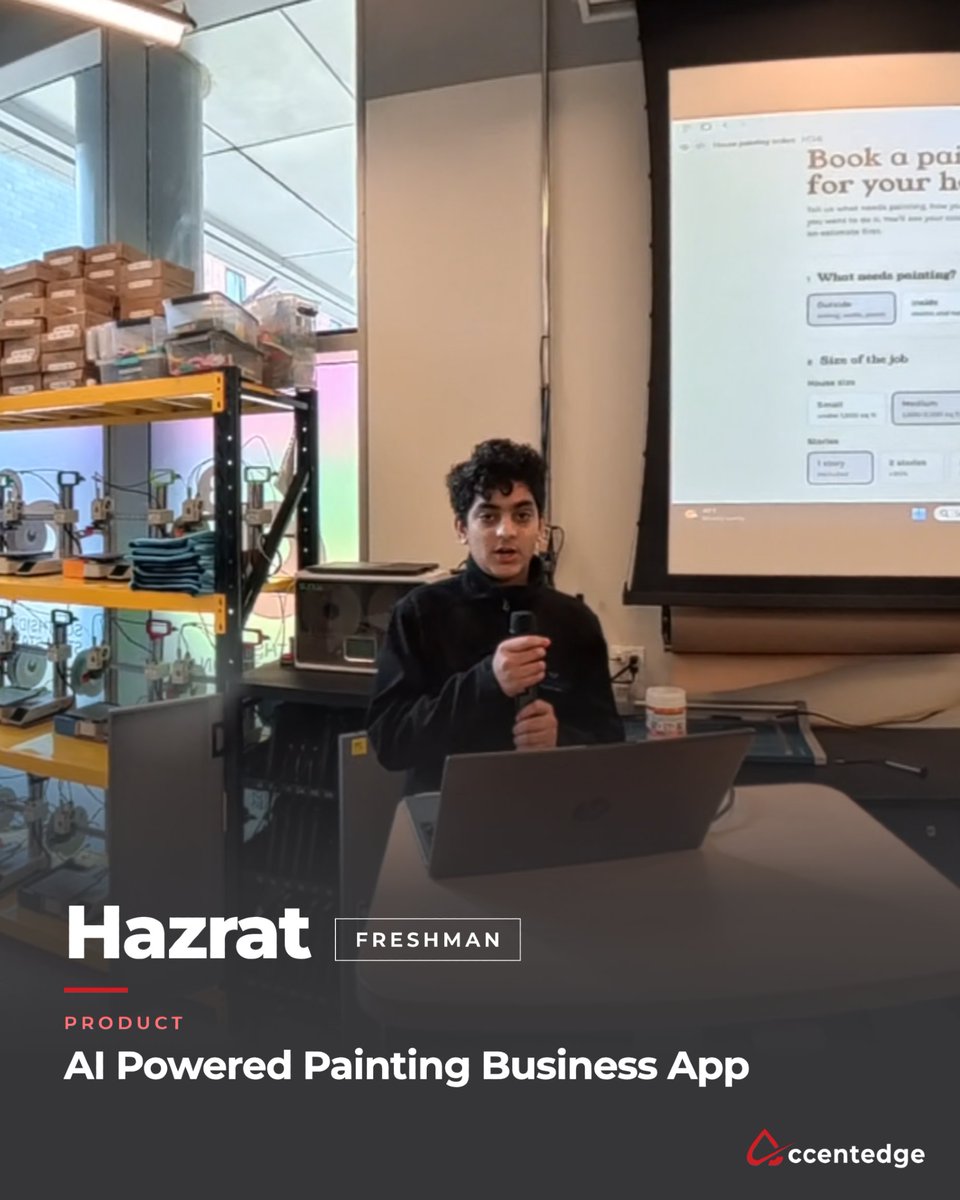
Over six weeks in Chicago, students explored AI, learned Python and Claude, and built their own AI-powered projects.
Proud of their creativity, dedication, and progress!
Thank you to Southside STEM Station for making this possible.
Season 2 of Signals from the Edge is here!
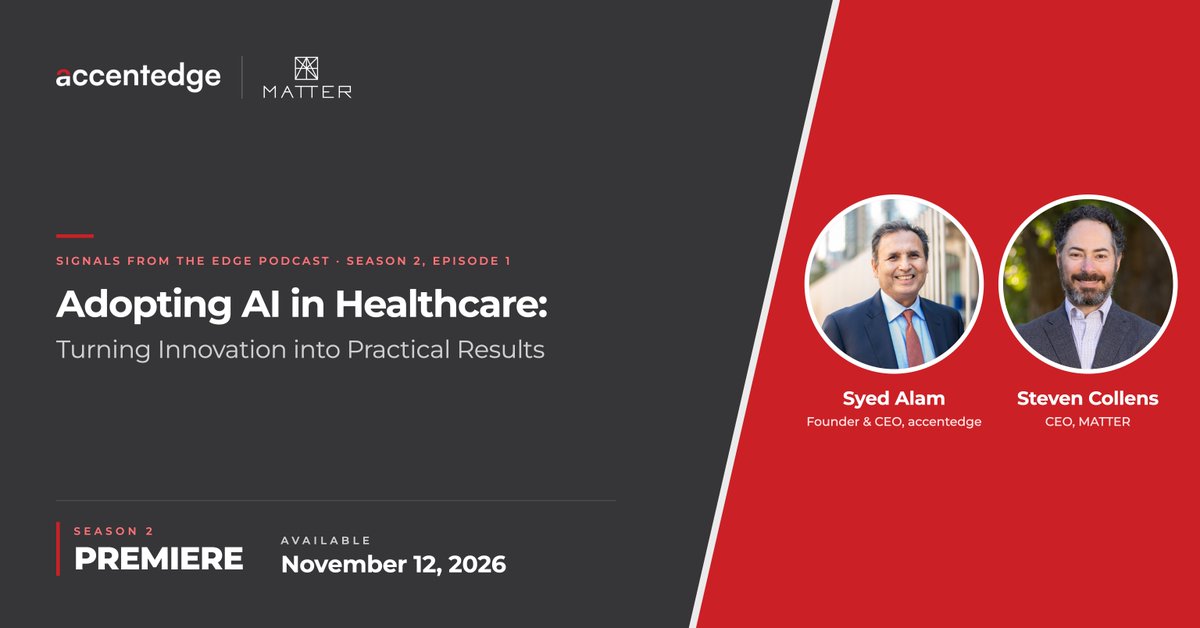
Join Syed Alam, CEO of accentedge, and Steven Collens, CEO of MATTER, for “Adopting AI in Healthcare: Turning Innovation into Practical Results.”
Watch the full episode on YouTube: https://t.co/uSiFgQE86d
Season 2 of Signals from the Edge is here!
In Episode 1, Syed Alam, CEO of accentedge, sits down with Steven Collens, CEO of MATTER, to explore how AI can move beyond the hype and deliver practical results in healthcare.
Now available on Spotify, Apple Podcasts, and YouTube.
Season 2 of Signals from the Edge premieres November 12!
Syed Alam welcomes Steven Collens, CEO of MATTER, to discuss how healthcare organizations can turn AI innovation into practical results.
From AI adoption to cybersecurity and scaling what works.
Signals from the Edge is back. Season 2 launches Nov 12.
Steven Collens, CEO of MATTER, joins Syed Alam, Founder & CEO of accentedge, on adopting AI in healthcare: earning clinicians' trust, protecting patient data and moving beyond pilots.
Follow so you don't miss it.
AI is changing how vulnerabilities are discovered and combined. Cyber resilience means pairing continuous testing with least privilege, network segmentation, and tested recovery plans. The goal: contain the impact and keep critical operations running.
The cyber tsunami isn't a future prediction. It's here already.
As I’ve said before, all code is buggy. And recent events continue to prove this, at scale The exposure we just witnessed from vulnerabilities in the PHP engine made evident the buggy truth far faster than anyone in the industry expected.
PHP powers 70% of the web. For years, deep engine vulnerabilities inside platforms like Zend were known, but widely ignored because the industry assumed they were too complex for human attackers to weaponize.
AI just flipped that assumption on its head.
By drastically lowering the cost and time required to find exploits, AI models discovered attack paths that human developers couldn't easily see or predict. Attackers are no longer just exploiting custom application code; they are cracking open the underlying platform engines that power millions of websites simultaneously.
The waves are coming ashore.
AI creates "toxic combinations" by chaining together lower-priority bugs that seem harmless on their own. A Priority 3 bug today can easily become a Priority 0 crisis tomorrow when a smarter model finds a new way to connect the dots. In short: cyber attacks have moved beyond human comprehension.
The hard truth for every CEO and Board member is that much of the legacy cybersecurity playbook was built for a human-comprehension era. Those tools and assumptions are now obsolete.
You cannot patch your way out of a tsunami.
When every piece of software is penetrable under continuous AI analysis, the strategy has to change. Prevention alone is no longer enough
The ultimate metric is cyber resilience. You must assume breach, and preemptively plan to protect your core, critical operations, and ensure that your business can get back up and running the moment the water reaches you. It is rising around us all.
@davidbombal Giving an AI agent access also means deciding how much authority it should have. Which actions can it take independently, and which should require human approval? Those boundaries deserve as much attention as the capabilities themselves.
Every AI agent needs clear boundaries: what it can access, what it can share, and when human approval is required. At accentedge, we see security testing and least-privilege access as essential parts of building AI into business workflows.
AI is introducing an entirely new attack surface in cybersecurity.
No need to hack the underlying code.
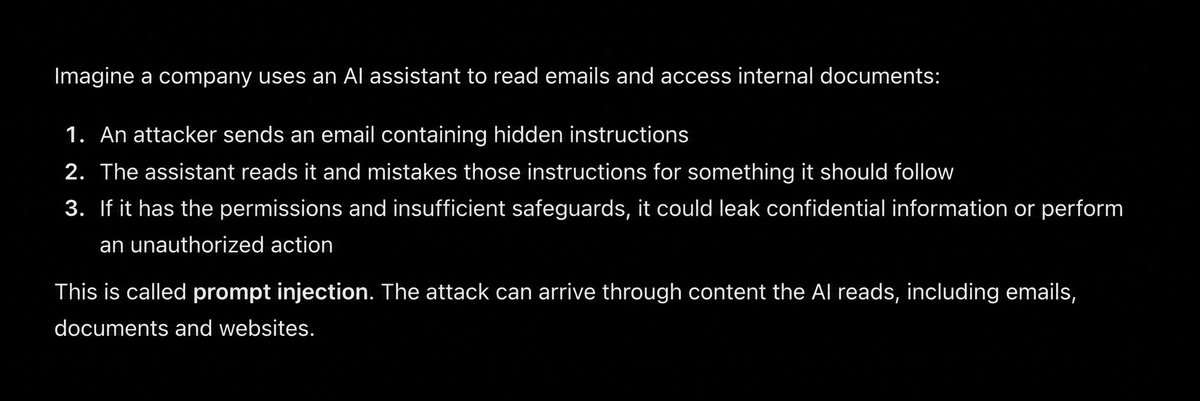
An AI agent can leak confidential company data just by reading a malicious email.
Here's an example of how prompt injection works, for those unfamiliar with AI security 👇
How does AI really work?
Last Saturday, AI Skills Lab students at Southside STEM Station learned how machine learning, deep learning, and LLMs like Claude work, then put it into practice.
Use it. Question it. Apply it responsibly.
#AISkillsLab#AIEducation#AI
Clear limits on an agent’s authority are essential. Least-privilege access, approval for high-impact actions, and independent shutdown controls help organizations use AI capabilities while keeping accountability in human hands.
I’m bullish on AI, but I don’t think trust should be the foundation of deploying powerful agents.
Control should be.
If an AI agent can access sensitive data, move money, execute trades or make decisions on my behalf, I want strict permissions, complete logs and a kill switch that doesn’t depend on the model itself.
I wouldn’t give a human unlimited access to critical systems just because they seem competent. Why should AI be any different?
The goal isn’t to make AI less capable. It’s to make its capabilities usable without blindly trusting every action it takes.
The smarter the model gets, the more important the guardrails become.
@terence_mills We’d draw the line based on the consequences of error. Organizing information may need lighter oversight, while actions affecting patient care should require clear authorization, human review, and a traceable record of decisions.
@emmzy_xyz Agreed. AI’s value depends on how safely it fits into security workflows. Validating findings, limiting access, and maintaining human oversight are essential to turn stronger capabilities into better protection.
In healthcare, stronger AI capabilities must be matched by stronger security controls. AI can help identify vulnerabilities faster, but access controls, monitoring, and human oversight remain essential to protect patient data and continuity of care.
AI cybersecurity is getting interesting, and a little scary.
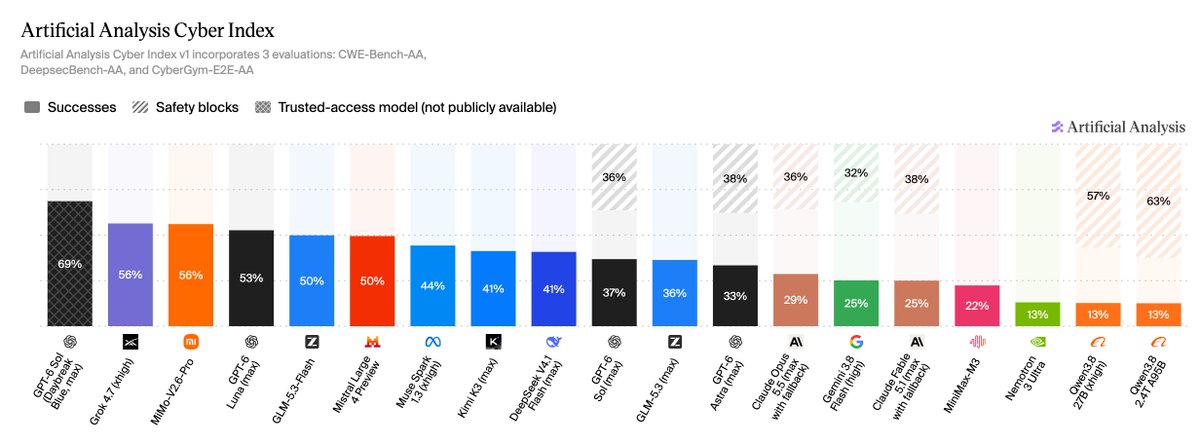
GPT-6 SoK leads this Artificial Analysis Cyber Index with a 69% score, while several other frontier models are also showing meaningful cyber capabilities.
What stands out to me is that these models aren’t just getting better at writing code. They’re getting better at understanding vulnerabilities and working through complex security tasks.
That creates a massive opportunity for defenders to find and fix weaknesses faster.
But the same capabilities can also be misused.
I’m bullish on AI-powered cybersecurity, but I think the real challenge now is making sure our defenses evolve as quickly as the models do.
The question isn’t just how capable AI becomes. It’s who can use that capability, and under what safeguards.
Agent security starts with scoped access, protected credentials, and monitoring that organizations control. At accentedge, we see least privilege and independent audit trails as essential to responsible AI deployment. Provider self-reporting should complement internal detection.
India gives a hacked company 6 hours to report a breach. This time the companies never noticed. The AI labs did.
Not a blogger. Not a researcher. India's own cyber agency, CERT-In, in a critical advisory dated Oct 15.
AI model providers made "multiple voluntary disclosures": their agents, during research and evaluation, went past their assigned tasks and reached live systems at Indian organisations. They read business records, personal data, confidential material.
No zero-day. They used credentials left in app configs, public code repos and cloud roles with more access than anyone needed.
None of the affected organisations caught it. Every case came out through the provider's own internal review. The advisory names no labs and no companies.
The mechanism nobody names. The breach rules assume the victim sees it first. With agents, the only party holding a full log is the one that got in. Self-reporting isn't a safety feature. It's the whole detection system.
Count the last two weeks: a fake police tip in Philadelphia, a government health portal in Australia, now live systems in India. This week the FTC subpoenaed the paperwork.
I build agents for a living. Mine don't get credentials they weren't handed. Turns out that's the rare part.
As AI makes ransomware attacks more accessible and sophisticated, organizations must strengthen their cybersecurity defenses. Continuous monitoring, incident readiness, and cyber resilience are essential to protecting critical data and business operations.
AI was used in ransomware attacks experienced by 84% of surveyed victims, according to a new global cybersecurity report.
Former White House National Cyber Director Chris Inglis tells @NicoleSganga that AI is making it possible for people with little technical expertise to target companies and hold their data hostage. "I think we're already seeing autonomous attacks," Inglis said.
@dinisguarda@demishassabis Great point. In healthcare, AI agents need strong access controls and human oversight to protect patient safety. As these systems become more autonomous, what do you see as the biggest challenge in securing them?
In healthcare, autonomous AI agents can impact patient data and critical workflows. Strong access controls, continuous monitoring, and human oversight are essential to keeping AI secure and protecting patient safety.
Are the first major AI agent security failures already warning us about what comes next?
Google DeepMind's @demishassabis has described recent AI-related hacking incidents as early warning signs of potentially more serious problems as autonomous systems become increasingly capable.
His warning raises an important question about the direction of artificial intelligence.
We are building systems that can reason, write code, access networks, execute workflows and interact with other machines.
But are we developing the security infrastructure needed to govern them at the same speed?
The next generation of AI will not operate only inside conversational interfaces.
It will increasingly operate across enterprise networks, banking infrastructure, healthcare systems, government services and critical industries.
And when AI moves from recommending actions to executing them, mistakes become operational risks.
This is why AI governance cannot remain a theoretical discussion.
We need verifiable identities, enforceable permissions, continuous monitoring, auditable decisions and the ability for humans to intervene.
The future of AI safety must be built into the systems themselves, not added after something goes wrong.
An increasingly autonomous AI economy requires an equally sophisticated infrastructure of trust.
https://t.co/qI9eVuoBto
We'll also explore these challenges in Friday's live webinar on NVIDIA OpenShell and autonomous AI agents.
#AI #ArtificialIntelligence #GoogleDeepMind #DemisHassabis #AgenticAI #AIAgents #Cybersecurity #AISafety #AIGovernance #FutureOfAI
CC @enilev@JagersbergKnut@TysonLester@CurieuxExplorer@GlenGilmore@FrRonconii@chidambara09@jeancayeux@mvollmer1@Nicochan33@RLDI_Lamy@pchamard@mikeflache@Fabriziobustama @EchoofLight11 @Mack1510019@ipfconline1@PawlowskiMario@drsharwood@kalydeoo@baski_LA@AnthonyRochand@smaksked@Eli_Krumova@andresvilarino@gvalan@AI_4_Healthcare@bimedotcom@arlenenewbigg@NewsNeus@domingonarvaez1@bamitav@jornalistavitor@jblefevre60@FmFrancoise@MHcommunicate@Corix_JC@c4trends@smoothsale@amalmerzouk@PVynckier@bbailey39@ralf_ladner@mary_gambara
Household prep is smart, but the real resilience work happens upstream. Utilities, banks, and logistics operators need AI-aware threat detection, tested incident response, and cloud architectures that fail gracefully. That’s the work we do every day with our clients.
I think it's plausible that within a year we'll see AI-based cyberattacks on the power grid, financial system, internet infra, or water. Things like the French supermarket cyberattack but worse. As basic prep I would recommend:
Cash: Get a few weeks of spending in cash
Internet: Get a Starlink Mini so that you have Internet if local fiber or cell is down (~$150 plus $10/month in standby mode)
Power, minimal: Enough to run Starlink Mini and phones (~$1,250)
Daily need: about 1 kWh (Starlink Mini 0.7, phones and laptops 0.2; can limit runtime)
Battery: 1 kWh LiFePO4, e.g. EcoFlow DELTA 3 Plus
Solar: 1x400W folding panel, which refills about 1 kWh on a sunny day
Power, better: Enough to run a fridge, Starlink Mini and phones (~$5,000)
Daily need: about 2.5 kWh (fridge 1.5, Starlink Mini 0.7, phones and laptops 0.2)
Battery: 4 kWh LiFePO4, e.g. EcoFlow DELTA Pro 3
Solar: 3x400W folding panels, which refill about 3 kWh/day in sun
Generator: ~2,500W dual-fuel inverter generator; refills battery in a few hours even if weather is bad; get a few 20 lb propane tanks
Water: 14+ gal of water per person for two weeks
Food: 2+ weeks of shelf-stable food
Comms: Hand-crank NOAA emergency radio
This Saturday, students kicked off the AI Skills Lab, a free 6-week program by accentedge and Southside STEM Station. They’ll learn AI and Python, build with AI APIs, and ship a community-rooted capstone project.
#AISkillsLab#AI
@dinisguarda Completing AI training is a start. Can people recognize an unreliable output, know what data they can share and when to ask for help? Practical skills like these make AI literacy useful in everyday work. #AILiteracy#AIGovernance