Interested in this extraordinary time of changes in Catalonia & Europe
I tweet about communication, education, technology, culture, and community building.
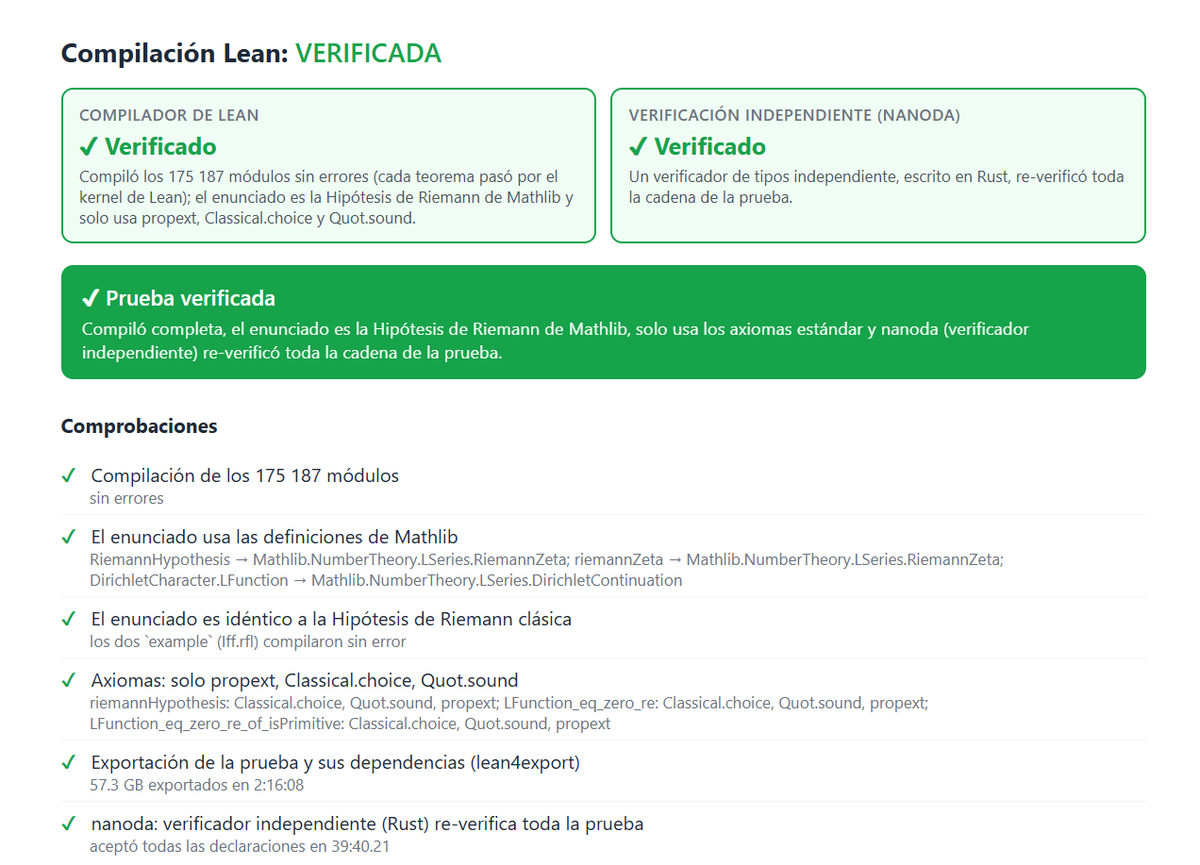
Independent mathematicians have now finished the full verification of the proof of the Riemann hypothesis announced yesterday by Anthropic mathematician Levent Alpöge. The results are real, they say.
https://t.co/Gkc2sOlSFD
MANUAL PARA CITAR , DOCUMENTAR Y TRANSPARENTAR EL USO DE INTELIGENCIA ARTIFICIAL GENERATIVA (IAGen) CONFORME A APA 7.ª EDICIÓN.
Por Karla Karina Ruiz Mendoza
Universidad Autónoma de Baja California ⬇️
https://t.co/UGF9bfQOyi
Es confirma la verificació dels 17 milions de línies de codi lliurades per Levent Alpöge. La hipòtesi de Riemann més a prop d’esdevenir el teorema de Riemann.
El matemàtic turc-nord-americà Levent Alpöge @__alpoge__, empleat d’@AnthropicAI, assegura haver provat la Hipòtesi de Riemann, amb l’assistència de @claudeai. Considerat com un dels problemes més complexos de la matemàtica (sense resoldre des de fa 167 anys) explica, entre d’altres, la distribució dels nombres primers en una línia infinita com a zeros de la funció zeta de Riemann ζ(s) proposada pel matemàtic alemany Bernhard Riemann el 1859. Ho ha fet en 4 pàgines de PDF: https://t.co/foDUyxNJrW. Si la resolució és correcta té un premi d’un milió de dòlars. El coneixement no s’atura https://t.co/xwvT8CV1yt
The famous @WeAreTandF with the AI prompt to provide positive review feedback has been retracted👇More on the story in this article: https://t.co/iYFHF0jYiF
The Spanish #papermill#fraud Daniel Balsalobre Lorente from @uclm_es just got another retraction!👇This fraud became a professor thanks to his paper mill publications! Now he has tenure and set for life. Academia in Spain in a nutshell🇪🇸
@maoviedogarcia
https://t.co/bHTTRNDqo7
The Lean FRO and Mathlib Initiative have released a joint statement on the Lean verification of the Riemann Hypothesis.
On November 20, Levent Alpöge released a proof of the Riemann Hypothesis as a Lean library of 17 million lines of code. Over the past day, the Lean and Mathlib communities worked together to verify it. The statement certifies the proof as correct and describes how it meets all necessary verification criteria.
Congratulations to Levent on this achievement, and thank you to everyone in the community who contributed to the verification.
Full statement: https://t.co/edxEbkodw7
"Confieso que nunca he entendido que se pueda valorar del mismo modo una República que formó maestros, abrió escuelas y creó bibliotecas públicas en los pueblos, y un régimen militar fascista que asesinó a maestros, cerró escuelas y bibliotecas y quemó libros" (Josep Fontana)
📢 La otra novedad de ayer en el BOE, junto al RD sobre PPL:
El RD 1025/2026 establece 400 especialidades y 53 ámbitos de conocimiento del profesorado universitario.
Cambios en concursos, perfiles de plazas y asignación docente.
🔗 https://t.co/4B0hnrgtDx
#ResearchSupportUPO
Van ser més ràpids el romans construint la Via Augusta (1.500 km) fa més de 2.000 anys que els espanyols construint el corredor mediterrani o l'estació de la Sagrera en el segle XXI.
WOW! Anthropic mathematician Levent Alpöge posted a claimed proof of the Riemann hypothesis, found with Claude. It targets the full statement, and no expert has checked it yet.
Riemann's 1859 hypothesis says every non-trivial zero of ζ(s) lies on the line Re(s) = ½. The first 10 trillion zeros do, and in August a Claude-written paper showed that at least 2/3 of them lie on it.
Alpöge's proof is written in the Lean proof checker, and he says it also covers the generalised RH. Until that check finishes and experts agree, the Clay Institute's $1,000,000 problem stays open.
Ya está publicado en el BOE el Real Decreto-ley con las medidas para reforzar la soberanía científica y tecnológica de España.
Consúltalo aquí👇🏼
🔗 https://t.co/QZHPETtmyY
In 1792, two French astronomers set out to measure the Earth. Their goal was to determine the length of ONE METRE.
Jean-Baptiste Delambre and Pierre Méchain had been entrusted with an ambitious task. France wanted a universal unit of length, defined as one ten-millionth of the distance from the North Pole to the equator.
But how could anyone measure such an enormous distance?
They used triangles. Over several years, the astronomers constructed a network of approximately 115 giant triangles stretching from Dunkirk to Barcelona.
They measured angles between distant landmarks using precision instruments. Once one side of a triangle was known, trigonometry revealed the others.
But someone still had to measure that first distance.
Delambre spent 41 days measuring one road near Paris, then 43 days measuring a second road in southern France. The two baselines helped establish and check the scale of the entire network.
With those measurements and the angles of their enormous triangles, the astronomers calculated an arc of Earth's meridian.
Their result helped establish the original metre in 1799.
The expedition took place amid the turmoil of the French Revolution and years of war.
Today, the metre is defined using the speed of light. But its historical origin lies in an extraordinary chain of triangles across France and Spain.
Matt Parker recounts this achievement in Love Triangle: How Trigonometry Shapes the World.
La Hipótesis de Riemann hecha con IA (Claude + Levent Alpöge) ya ha sido verificada de forma independiente. Matemáticos del MIT y otros confirman que es “casi con certeza verdadera”. El mayor problema abierto de las matemáticas… resuelto en 24 horas.
https://t.co/zHzybMfNN5
A mathematician at Anthropic is now claiming a full proof of the Riemann hypothesis, the statement that many mathematicians consider the most important open problem in the field.
https://t.co/MtytM3vfb0
🎓📢 CAMBIOS IMPORTANTES EN EL PROFESORADO UNIVERSITARIO ESPAÑOL.
El BOE publica hoy, 20 de noviembre, el Real Decreto 1025/2026, que actualiza las especialidades y los ámbitos de conocimiento del profesorado de las universidades públicas españolas.
🔎 ¿Cuáles son las principales novedades?
🔹 400 especialidades de conocimiento: 360 de la nueva relación y otras 40 procedentes de áreas anteriores que mantienen su vigencia.
🔹 53 ámbitos de conocimiento, destinados a la adscripción de los puestos de trabajo del profesorado universitario.
🔹 Concursos de acceso: las plazas deberán especificar una o varias especialidades que definan su perfil académico, docente e investigador. No podrán perfilarse más allá de esas especialidades.
🔹 Acreditaciones: las obtenidas previamente a través de ANECA o de las agencias autonómicas mantienen su plena validez.
🔹 Período transitorio: las universidades dispondrán de 12 meses para adscribir los puestos de trabajo a los nuevos ámbitos. Transcurridos 12 meses desde la entrada en vigor, las nuevas convocatorias deberán ajustarse al catálogo de especialidades.
🔹 Profesorado actual: mantiene, con carácter general, su especialidad asignada, aunque podrá solicitar excepcionalmente el cambio a determinadas especialidades de nueva creación.
📅 Entrada en vigor: 21 de noviembre de 2026.
⚖️ Una reforma importante para la organización universitaria, la definición de los perfiles académicos y los concursos de acceso al profesorado.
💬 ¿Contribuirá esta reforma a mejorar la transparencia y la adecuación de los perfiles de las plazas universitarias???????
📄 BOE oficial:👇🏻
https://t.co/eH6waj1gUr
#Universidad #ProfesoradoUniversitario #ANECA #BOE #Investigación #EducaciónSuperior