public statistics; geometry of longitudinal population coverage; the quantitative epistemic #dataethics Much better on trains than in real life #SARS2recidivist
Yesterday I understood the Royal Society would publish its report Bodmer 2.0: science for society. They did not. And we await the launch of the year of trustworthy information...
Come and work @downingstreet as a data scientist! We're hiring for a data scientist working on health and education. You'll be right at the heart of UK policy making and (IMO) working with the best tech stack in the UK public sector. Link:
https://t.co/eAlaZYE8su
@Lawrence__Kay Inference from a group level to propensity to individuals is a form of confounding. But the fallacy is how people see place as significant and associate place with the character of people (not ethnicity per se but the difference is not wide). The principle is just about groups
From Palantir to rolling out digital ID, the Science, Innovation and Technology Committee’s new report finds major barriers to the Government’s plans for digital transformation.
Find out more: https://t.co/Bz7uuqESyj
The UK Knowledge Exchange Hub is seeking an outstanding academic to become its next Scientific Director. to shape the national agenda for mathematical sciences knowledge exchange with business, industry, charity and government.
Click for more details 👇
https://t.co/ruFV72Hbjz
And the statistics regulator has published a prospectus to evaluate its strategic commitments, a sort of registered report, with the caveat that some data is not ready. Some of it is just about monitoring activity, which will help with stakeholder mapping
https://t.co/AwYsZclmWs
A bit surprised to see the DG ESE at ONS is being advertised. Obviously things have been tought with the LFS, but I thought that predated Mike Keoghan's tenure. Progress has been slow on resolving that and the focus on mandatory response as a solution odd
https://t.co/POkdxxuXzC
Two 'independent' members (both have a recent connection to the work of UKSA) have been appointed to the regulation committee which oversees the work of OSR, to add technical expertise / resilience while they prevaricate about appointing new non-executives
https://t.co/nMJF2FKHqW
I’m hosting a hackathon with @ElevenLabsDevs and the UK Government @i_dot_ai.
We will spend two days building with the actual people in central government deploying AI for everything from Education to the Prime Minister himself.
Don’t miss it.
We publish comprehensive searchable data on our grants on Gateway to Research, as is only right for a public funder.
But might there be merits to also publishing a thematic list of funded projects?
A quick post from me about transparency and scrutiny.
https://t.co/KxwQYlJLFK
@lakens It is genuinely testable. And a low cost intervention. So I do not understand why this has not been done on larger samples? If people like you can point to specific shortcomings in methods now, it is still possible
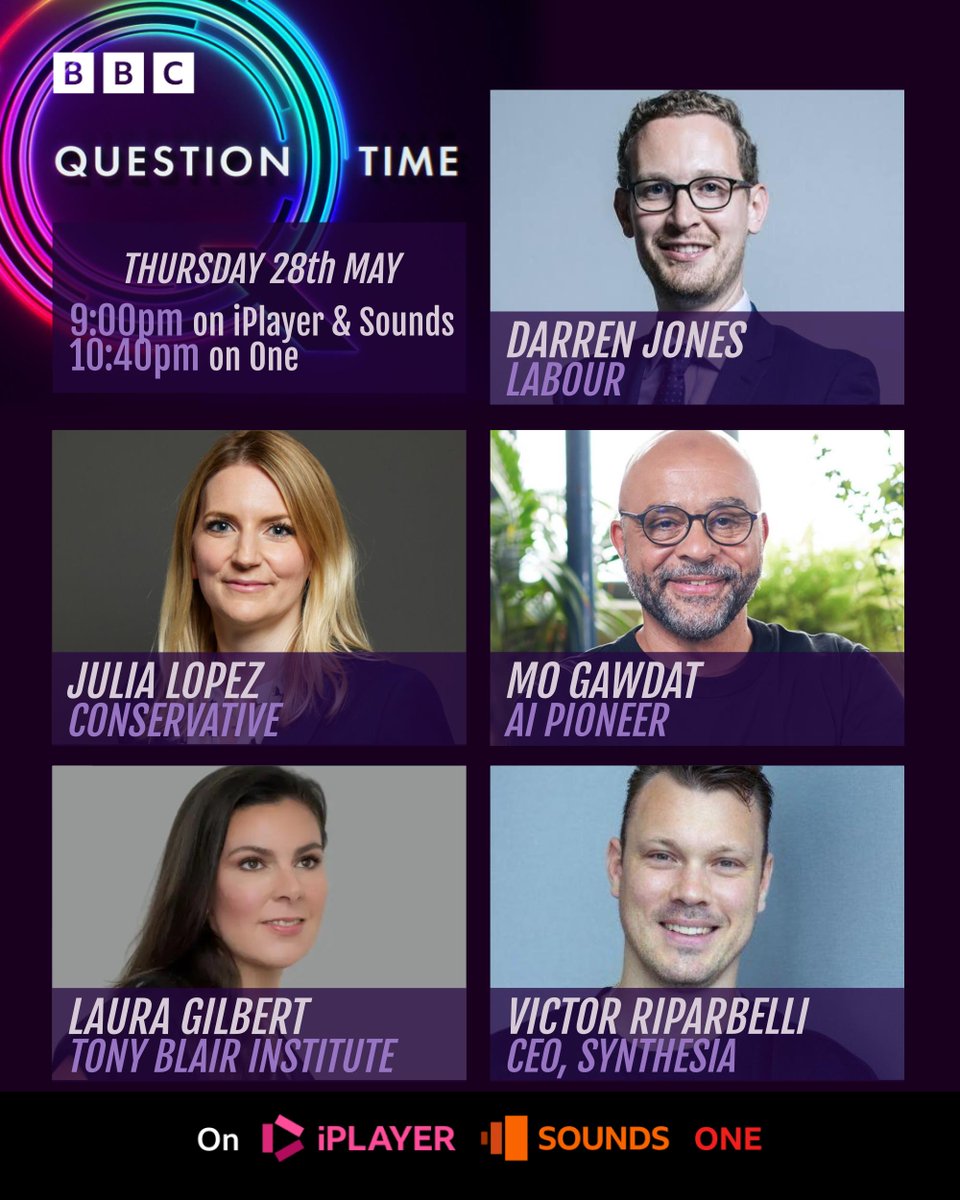
Tomorrow, Question Time is in Dulwich for an AI special
Joining Fiona on the panel are Darren Jones, Julia Lopez, Mo Gawdat, Laura Gilbert, and Victor Riparbelli
Join #bbcqt, 9pm on @BBCiPlayer, @BBCSounds, and @BBCNews, 10:40pm on @BBCOne
Apply to be in the audience here: https://t.co/TBI2uL9hrp
This feels very strange as they insist on staying in London but record no engagement with UK institutions (beyond the ill-feted NHS projects soon after the https://t.co/VKGIsmzLnC fiasco). Although the achievement is significant there is hard work and a lot of failure
Some of the more recent friction is familiar but I had not realised that was the start of actual action despite so many words before then. So government is first mentioned as the Bletchley AI Summit is planned in 2023 (and the Alan Turing Institute not at all)