👀 Democratic Sen. Michael Bennet on the SALT cap debate: "The benefit of SALT goes to the wealthiest people in these very blue states in the east and west coasts. I don't understand why Colorado's firefighters and teachers should be financing that"
Any scholars doing recent research on the negative societal economic impacts of high rates of income inequality? Bonus if the research focuses on a need for more affordable housing.
We're seeing a lot of misinformation across Connecticut this election season re: housing, zoning, and local control, so I wrote for the CT Mirror about rhetoric vs. reality. Check it out.
https://t.co/TGRGmu01JR
I was just the Under Secretary for Economic Affairs at the U.S. Commerce Department. Here's the economic research that was really helpful to us.
(Thank you @mattyglesias for the opportunity to guest-post!)
https://t.co/u3qbrTpM2O
This is a 🧵on the most expensive housing markets in the US right now based on current home price data, interest rates, and the prevailing wage in these states.
Here are the 5 most unaffordable housing markets:
1) California
2) Hawaii
3) Montana
4) Colorado
5) Utah
1/
Burlington’s new Zoning is mostly unprecedented in New England.
Really only comparable to ambitious reforms like Minneapolis and Sacramento.
Two buildings now allowed on every parcel, multifamily along major bus routes, 4-plexes allowed everywhere.
The Affordable Housing Land Use Appeals Procedure allows homes affordable to low- & moderate-income families to be built when a town fails to approve the proposed housing despite it meeting local zoning regulations.
Learn more: https://t.co/2HZy84svHX
#HereForHousing
"The Affordable Housing Land Use Appeals Procedure is an appeals procedure, not a housing creation policy. So when we say things like '8-30g has failed to produce housing' 8-30g is not a policy to create housing. It's a remedy for when towns are not creating affordable housing.."
WE HAVE A BILL NUMBER!!
Work Live Ride, now HB #5390, will help local governments create a post-sprawl future for CT that's more prosperous, equitable, and sustainable for everyone. Check out the link below and help us make it law!!! 👇
https://t.co/qHP1tHYRZ3
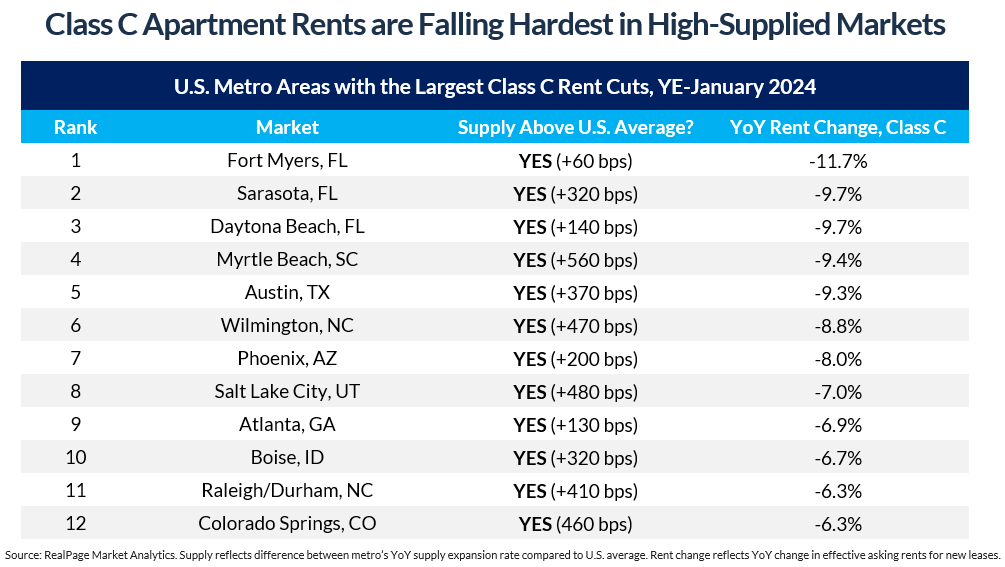
When you build "luxury" new apartments in big numbers, the influx of supply puts downward pressure on rents at all price points -- even in the lowest-priced Class C rentals. Here's evidence of that happening right now:
There are 12 U.S. markets where Class C rents are falling at least 6% YoY. What is the common denominator? You guessed it: Supply. All 12 have supply expansion rates ABOVE the U.S. average.
There's no demand issue in any of these 12 markets. They're all among the absorption leaders nationally -- places like Austin, Phoenix, Salt Lake City, Atlanta and Raleigh/Durham, Boise, etc. But they all have a lot of new supply.
Simply put: Supply is doing what it's supposed to do when we build A LOT of apartments. It's a process academics call "filtering." New pricey apartments are pulling up higher-income renters out of moderately priced Class B units, which in turn cut rents to lure Class C renters, and on down the line it goes.
Less anyone still in doubt, here's another factoid: Where are Class C rents growing most? You guessed it (I hope!) -- in markets with little new supply. Class C rent growth topped 5% in 18 of the nation's 150 largest metro areas, and nearly all of them have limited new apartment supply.
Most new construction tends to be Class A "luxury" because that's what pencils out due to high cost of everything from land to labor to materials to impact fees to insurance to taxes, etc.
So critics will say: "We don't need more luxury apartments!"
Yes, you do. Because when you build "luxury" apartments at scale, you will put downward pressure on rents at all price points.
Spread the word.