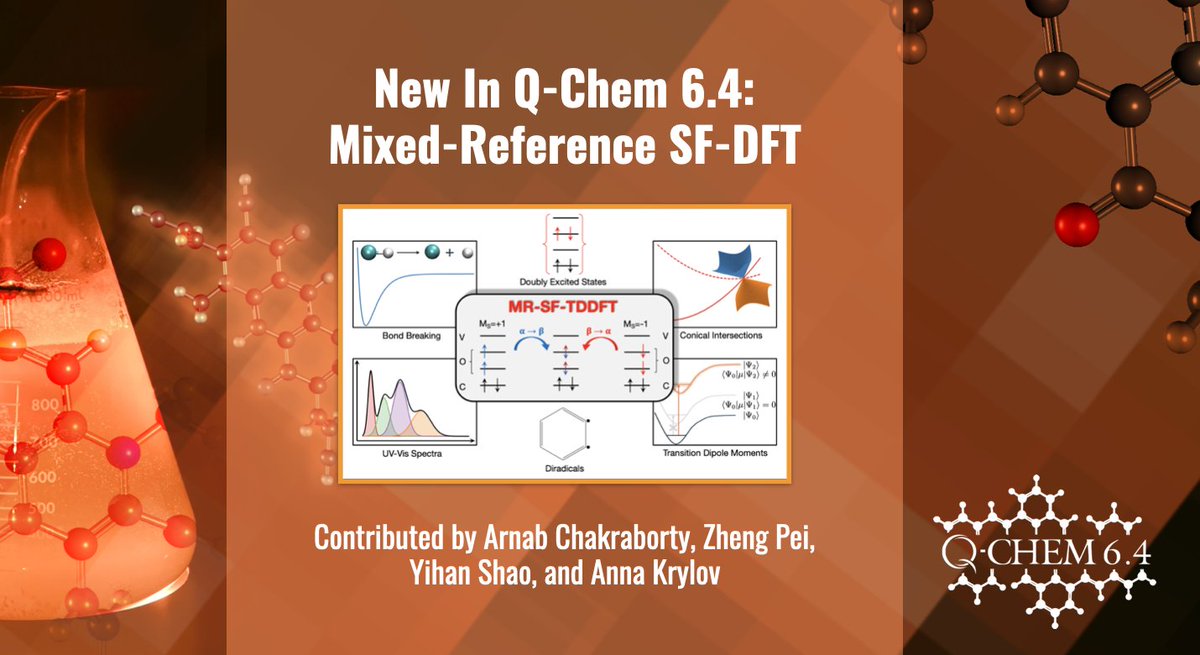
Excited to share that our preprint on MRSF-TDDFT is now available on ChemRxiv.
We implemented MRSF in Q-Chem and applied it to doubly excited states, systems with variable diradical character and conical intersections. SOC is also available.
Preprint: https://t.co/C3zm7azxUK
Our latest release, Q-Chem 6.4, has mixed-reference SF-DFT (MR-SF-DFT) energies! This approach provides improved accuracy and solves the spin-contamination problem in the original SF-TD-DFT.
Try Q-Chem 6.4 for free: https://t.co/DKMgNYqOMT
A couple reflections on the quantum computing breakthrough we just announced...
Most of us grew up learning there are three main types of matter that matter: solid, liquid, and gas. Today, that changed.
After a nearly 20 year pursuit, we’ve created an entirely new state of matter, unlocked by a new class of materials, topoconductors, that enable a fundamental leap in computing.
It powers Majorana 1, the first quantum processing unit built on a topological core.
We believe this breakthrough will allow us to create a truly meaningful quantum computer not in decades, as some have predicted, but in years.
The qubits created with topoconductors are faster, more reliable, and smaller.
They are 1/100th of a millimeter, meaning we now have a clear path to a million-qubit processor.
Imagine a chip that can fit in the palm of your hand yet is capable of solving problems that even all the computers on Earth today combined could not!
Sometimes researchers have to work on things for decades to make progress possible.
It takes patience and persistence to have big impact in the world.
And I am glad we get the opportunity to do just that at Microsoft.
This is our focus: When productivity rises, economies grow faster, benefiting every sector and every corner of the globe.
It’s not about hyping tech; it’s about building technology that truly serves the world.
Start your weekend off with an inside look at how MSU researchers are discovering new sources for H3+, better known as the-molecule-that-made-the-universe' ☀️
More stories about our @NatureComms paper https://t.co/deKKzVKMjl with Prof. Marcos Dantus’s and Ben Levine’s groups on H3+ formation from doubly ionized organic molecules:
https://t.co/oaqhmHZNa8
https://t.co/GRyAaLxfUf
Thank you, @ConnorYeck, for talking to Marcos and me.
Great article by Bethany Mauger and Connor Yeck about our recent @NatureComms paper with Professor Marcos Dantus’s and Ben Levine’s groups on H3+ formation from doubly ionized organic molecules. Take a look! @MSUNatSci @MSUChem https://t.co/V98w6mcz4c
I have accepted a position of Associate Editor of @TheorChemAcc (https://t.co/NgEhdjtzoM). I have joined a wonderful team consisting of Prof. Juan-Carlos Sancho-García (Editor-in-Chief) and 2 other Associate Editors, Profs. Chao-Ping Hsu and Weitao Yang. Send us your best papers!
@PiecuchPiotr Thank you so much Professor Piecuch @PiecuchPiotr for your guidance, advice, and support. I really enjoyed the long discussions we had on various topics. I was fortunate enough to have you as my PhD advisor. Thank you for always being so caring and helpful.
Thanks very much, Arnab. Once again, warmest congratulations!!! I’m impressed by your QMC-driven CC/EOMCC work and other results obtained during your PhD studies with us. Best wishes for your postdoc with Prof. Anna Krylov. A couple of pics from your graduation ceremony attached.
@KatharineLCHunt Thank you so much Professor Hunt. I was lucky to have tou as a second reader in my committee. I also had the great opportunity to serve as a teaching assistant under your supervision twice. Thank you so much for always being so supportive! Thank you!