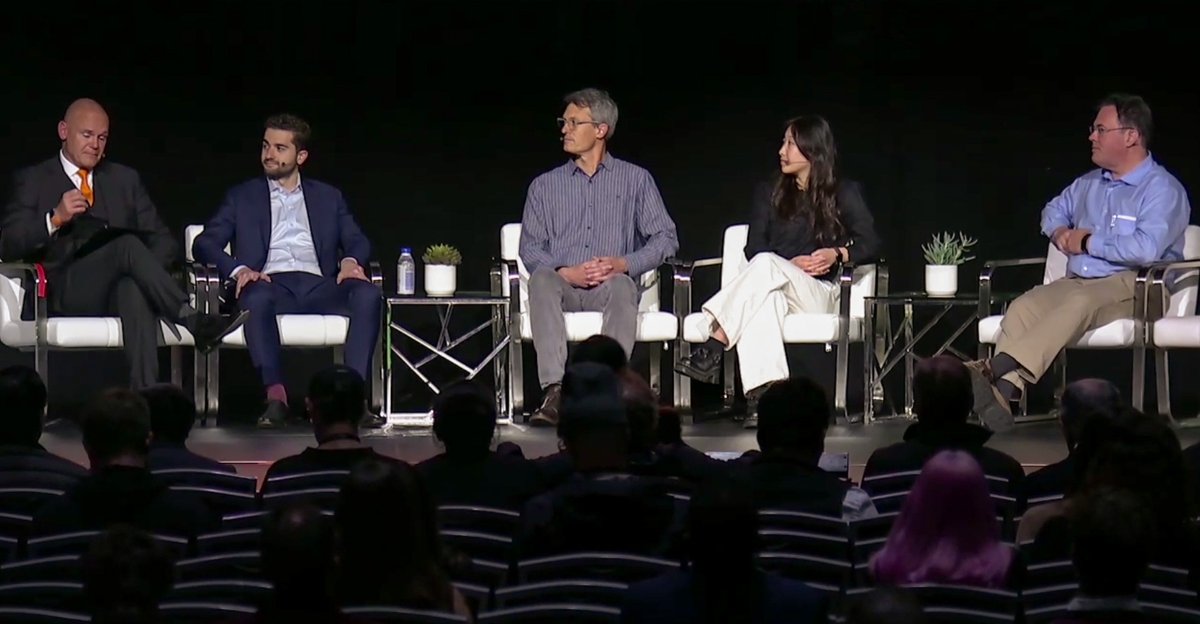
"What keeps me up at night is the fast pace of acceleration of open weight models in the ecosystem. They do not prioritize the same type of safety refusals." - Yunyun Wang, @OpenAI
We just ran a biosecurity panel at @SynBioBeta today. Here's what you missed:
AI is making it easier to design dangerous biology. The design-build-test cycle is compressing so fast the panel debated whether it's still a cycle at all.
The screening tools mostly work. Kevin Flyangolts from @aclid said even heavily AI-redesigned sequences still conserve key functional residues, so current systems catch most of them... for now.
But nobody wants to pay for screening. Jake Beal from @Raytheon said plainly that biosecurity is a pure cost center for every DNA provider. If you refuse to synthesize a flagged sequence, the customer goes to your competitor. Now, it's a race to the bottom.
OpenAI deliberately downweighted biology training in their open weight models to reduce misuse risk. The problem is that the people building drug therapies and medical countermeasures need those same capabilities. The defenders lose too.
Know-your-customer matters as much as computational screening. Scott Fay from @AnsaBio made this case. We've been talking about a passport system for legitimate users of risky sequences for years. Still doesn't exist.
The Sequence Biosecurity Risk Consortium is trying to shift screening from "does this match a known pathogen" to "does this do something harmful to human cells." It's the right direction, but the speed needs to pick up.
We love talking about what synthetic biology can build. We're less excited about what it takes to keep it safe. So who exactly is going to fund the defense side of this equation before something goes wrong? Something to think about.
@DARPA@mkoeris
#SynBioBeta2026 #SyntheticBiology #Biosecurity #Biotech
Ongoing advances in AI for protein design mean sequence-similarity screening may one day no longer be enough to flag biosecurity risks.
With an eye on trends and futures, we explore possibilities and pathways toward function-based screening in our new perspective:
“Beyond Sequence Similarity: Toward Function-Based Screening of Nucleic Acid Synthesis.”
https://t.co/cLge2oYbvn
@TwistBioscience@aclid@Microsoft@DHSgov@IBBIS_bio@RANDCorporation@BulletinAtomic@RadicalNumerics
Join us for a night of apps and drinks to kick off SynBioBeta on May 5th from 6:30 pm to 8:30 pm. We're excited to host you all with our friends at @IBBIS_bio
Register today! https://t.co/oAWgqzH0cW
Identifying & mitigating an AI-enabled biosecurity vulnerability. Confidential effort on biosecurity red-teaming leads to distrib. of "patches" that bolster DNA synthesis screening. Article: https://t.co/zwI1hOK9xL Work continues. @MSFTResearch@TwistBioscience@aclid@EngBioRC
Check out this new paper by on testing the performance of various DNA synthesis screening tools--including @IBBIS_bio's Common Mechanism and tools from @aclid , @Battelle and Raytheon @nwheeler443 @jdiggans @sarahcarter1 https://t.co/NC8hEADfGb
On the RISKGAMING PODCAST:
🦠The impending risk of designer bioweapons
🔬The tails side of the long-awaited Centry of Bio
The NEED for new approaches to BIOSECURITY
Hosted by @DannyCrichton and our guest @kevfly16
#23 Kevin Flyangolts: Aclid: This week we speak with Kevin, the founder of @aclidbio: a security and compliance automation platform for biotechnology. Aclid is growing the bioeconomy by making genetic engineering more accessible and safer.
#MedTwitter
https://t.co/ugB9Gxszmg
Up today: CEO and Founder of @aclidbio, Kevin Flyangolts, spoke with our team and covered safety, compliance, and biosecurity in the biotech. We also touched on bioinformatics and LLM solutions for biosecurity.
Read the interview on our substack:
https://t.co/hivQW6XPWS
🧬 We're pleased to announced @aclidbio closed an over-subscribed $3.3M seed funding round to advance our biosecurity and compliance platform for gene and oligo synthesis! Thanks @2048vc and @iaventures for your support.
https://t.co/nBzspgG524
Our team is hiring! We're looking for a founding engineer to help build one of the first security and safety platforms for synthetic biology.
https://t.co/liIc8WBDV7
@AFWERX selected Aclid to identify opportunities for transitioning its commercial biological threat screening technology to address @usairforce needs. We're proud to work with the @DeptofDefense in advancing biosecurity and biodefense capabilities.
We're working with @sigsci, @RiceUniversity, and @aclidbio to create a Biosecurity Sequence Screening Training Course for Bioengineers that will increase awareness of the proactive safety measures needed to grow the bioindustrial manufacturing sector: https://t.co/Inf7bgURYn