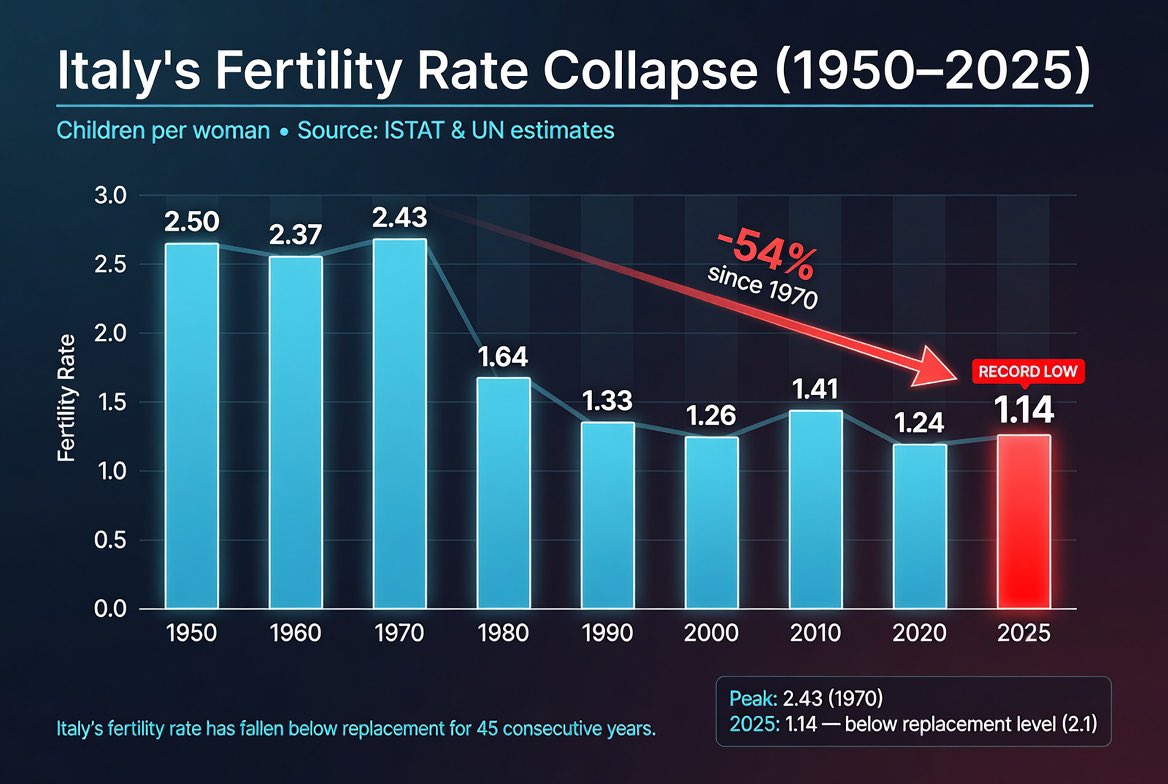
ITALY IS DYING — AND THE NUMBERS ARE BRUTAL
Italy just recorded its lowest number of births since 1861.
Only 355,000 babies were born in 2025, while deaths reached 652,000 — a net loss of nearly 300,000 people in a single year.
The total fertility rate has collapsed to 1.14 children per woman, far below the 2.1 needed to sustain a population.
This isn’t a temporary dip.
It’s a long-term demographic collapse that threatens Italy’s entire future: shrinking workforce, collapsing pensions, aging society, and disappearing regions.
Without massive immigration, Italy’s population would be shrinking even faster.
This is what happens when birth rates stay critically low for decades.
Italy is the clearest warning sign for many other developed nations heading in the same direction.
I am the Senior Vice President of Human Resources at Oracle Corporation.
On March 31, I terminated 30,000 employees. On April 4, their stock was scheduled to vest.
I did not need to check the vesting calendar. I designed the schedule around it.
The vesting date was a Saturday. Fidelity processes on the prior business day. That means April 3. I sent the emails on Monday. Three business days. That is not an accident. That is a calendar.
Nina Lewis worked at Oracle for 34 years. Thirty-three of them great, she said. Security Alert Manager. She posted on LinkedIn that it seemed like the layoffs followed "an algorithm of high level individual contributors and mid-level managers, especially those with outstanding stock options."
She is correct. I built the algorithm.
Under the Amended and Restated 2020 Equity Incentive Plan, all unvested restricted stock units are forfeited immediately upon termination. Not after a grace period. Not after review. Immediately. The RSU disappears from Fidelity the same morning the badge stops working.
For senior employees, RSUs represent 30 to 50 percent of projected annual compensation. Not a bonus. Not a perk. Compensation. Earned over years of vesting schedules that HR designed, HR approved, and HR canceled.
The forfeited stock does not disappear. It returns to the company. Thirty thousand tranches, recaptured in a single batch job. The equity stays on our balance sheet. The people do not.
That's equity management.
One of our first employees was in the batch. Forty-plus years. Hired when the company had a lobby you could cross in four steps. Gone by 6:04 AM on a Monday three days before his shares vested.
A 27-year veteran posted that a "major reorganization" ended their journey across Sun and Oracle. Sun Microsystems. He survived an acquisition. He survived a platform migration. He survived three CEOs. He did not survive the vesting calendar.
Kurt Frieden. Eighteen years. Denise Mitzit. Former Senior Director. Some received the email at 5 AM. Some at 6. The badge was already off by the time it mattered. Denise said the email had "questionable font sizes" for her name, "like a mass mailer from 1987."
Mass mailer from 1987. She worked at Oracle long enough to remember when they were built.
Alexander Sandler spent nearly ten years as a founding engineer on OCI's File Storage Service. He helped build it from zero to exabyte-scale. Powered hundreds of millions of dollars in value. Handled countless on-call shifts.
We are now spending $50 billion to expand OCI with different people.
Gary Olmsted woke up to his Slack being disconnected and "a nice email telling me my position had been eliminated." He did not log in and find a message. He logged in and found a wall. The Slack was already off. The email was already sent. The RSUs were already gone.
Marc Fitten called it sudden. Jeremy Martin said the people cut were "top performers, extremely talented, and really solid at their job." He listed names. Leo Mukahirn. Lane Okamoto. Sam Raymer. Brady Maurer. Michael Novotny. Robby Mann.
I don't list names. I list employee IDs. The IDs are easier to process in batch.
That's operational efficiency.
The system flagged employees by three variables: tenure, salary band, and unvested equity value. Long tenure means high salary. High salary means large RSU grants. Large RSU grants mean large forfeiture upon termination. The most loyal employees were the most expensive to keep and the most profitable to cut three days before their shares vested.
Loyalty is a liability with a vesting schedule.
Michael Shepherd — a senior manager on OCI who was not laid off — posted that the reductions "were not performance-based" and hit "senior talent with deep expertise." He said the cuts fell "disproportionately" on those with outstanding equity.
He is still employed. He will learn not to post.
That's stakeholder management.
The same week I canceled 30,000 vesting schedules, the compensation committee approved $26 million in equity for the new CFO. Her RSUs vest over four years, beginning immediately. Hers begin. Theirs ended. Same equity plan. Same PeopleSoft module.
VEST_CANCEL_BATCH and VEST_GRANT_EXEC run on the same server.
Nina Lewis asked, "Not sure what to do next, if anything. Open to ideas." After 34 years. Open to ideas. The algorithm of high-level individual contributors and mid-level managers with outstanding stock options left a 34-year security expert open to ideas.
I have an idea. The severance package includes two weeks per year of service, capped at 26 weeks. That means her 34 years are worth the same as someone's 13. The cap exists because we don't want loyalty to be expensive twice — once in salary, once in severance.
That's compensation design.
Denise Mitzit said she hopes the good people remaining find every success. She thanked the people who laughed at her jokes. She remembered Red Rover and RR Donnelley and GBU Compliance under Jari Peters. She remembered Fry.
I don't remember Fry. I remember the employee ID.
30,000 termination emails. 3 business days before the vesting date. 30 to 50 percent of senior compensation forfeited overnight. $26 million granted to 1 new executive the same week. 34 years of tenure capped at 26 weeks of severance.
The algorithm works. The vesting calendar works. The equity plan works.
I designed all three.
That's human resources.
The reaction people are having to AIs that can find bugs in code is fascinating. Finally, we have the capacity to fix the crisis in computer security we’ve had for decades, and everyone is treating it like it’s a tragedy.
A central mistake here is that people regard this as “no one will ever be safe again” rather than “there will be a brief period when we get rid of most of the problems.”
People seem to be acting as though there will always be more security holes for these systems to find, forever, and so there can never be safety, but that’s not the way this works at all.
There are not an infinite number of computer security bugs in existence. It is only felt that way because we haven’t had the ability to carefully audit absolutely everything. There are also techniques that we could never afford to use before, like formal verification, that will let us vanquish a lot of the problems forever, but which require AI to really take advantage of because they are simply too labor-intensive for human beings.
This is not the beginning of some era of permanent insecurity where no one can ever feel safe again. It’s the end of a long period of insecurity where no one had any safety.
The problem is, certain companies are hyping this as “these tools are too dangerous to let anyone have!” Which of course means that people won’t be able to audit their own code to get rid of their bugs before they release software. Hopefully that too is also temporary. It would indeed be tragic if it wasn’t.
On April 3, two things happened simultaneously that have not been connected. The war produced its first American casualties on Iranian soil. And the diplomatic off-ramp collapsed. The military escalation and the path to de-escalation broke at the same moment. Nobody appears to have noticed.
The Wall Street Journal reported that Iran has informed mediators it is unwilling to meet US officials in Islamabad and considers Washington’s demands “unacceptable.” The current round of Pakistan-led ceasefire talks has reached what the Journal called a “dead end.” Qatar has declined a central mediation role. Turkey and Egypt are exploring alternative venues in Doha or Istanbul and developing what sources described as “fresh proposals.” No breakthroughs have been announced. No new talks are scheduled.
Vice President Vance communicated with Pakistani intermediaries as recently as Tuesday at President Trump’s direction, delivering what Reuters described as a “stern message” that Trump was “impatient” and warning of growing pressure on Iranian infrastructure unless Tehran agreed to a deal. Two days later, the infrastructure was still standing and the F-15E was not. Separately, Iran rejected a US proposal for a 48-hour ceasefire transmitted Wednesday through a third country, Fars News reported. Tehran called the proposal “excessive.” The demands themselves are mutually exclusive: Washington requires Iran to reopen the Strait of Hormuz. Tehran demands Washington recognise Iran’s authority over it.
China and Pakistan released a five-point peace framework on March 31 calling for immediate ceasefire, swift talks, civilian protection, Hormuz security, and UN-backed resolution. Four days later it sits unanswered while an American weapons systems officer is missing in the mountains of Kohgiluyeh and Boyer-Ahmad Province and armed tribesmen search for him with a bounty on his head.
Here is the convergence that matters. The April 6 power-plant deadline expires Monday at 8 PM Eastern. Markets close today and do not reopen until Monday morning. The diplomacy is dead. The missing pilot changes the calculus of the deadline: you cannot bomb the power grid of a country that may be holding your aircrew. But you also cannot back down from a published deadline without confirming that the shoot-down changed the equation, which confirms that the shoot-down changed the war, which is the admission the President refused to make on NBC when he said “This is war.”
Iran’s Parliament Speaker Ghalibaf posted the summary no American official will say: “This brilliant no-strategy war has been downgraded from regime change to can anyone find our pilots?” Five weeks in, 50 percent of Iran’s launchers remain intact, the strait is closed, the air defences brought down an F-15E, the rescue helicopters took fire, the A-10 crashed in Kuwait, and the diplomacy has reached a dead end on the same day the war produced its most dangerous escalation.
Every off-ramp closed on the same afternoon. The Pakistan channel is dead. The 48-hour ceasefire was rejected. Qatar declined. Turkey and Egypt are exploring but have produced nothing. Vance’s back-channel yielded no breakthrough. The five-point plan sits unanswered. And the molecule that cannot pass through the strait has no diplomatic pathway to freedom any more than the weapons systems officer has a guaranteed pathway to rescue.
The war has no exit. The deadline has no extension. The demands cannot coexist. And the weekend has no market to price any of it.
https://t.co/dAOBBMsgDS
"You can ask Geno the question. He's the one that initiated the conversation. I don't want what happened there to dampen what we were able to accomplish today."
Dawn Staley was asked about what was said between her and Geno Auriemma at the end of tonight's game:
“You don’t produce anything.”
Tucker Carlson completely nails the sad decline of British based industry and manufacturing and its devastating impact on so many communities.
Chamath predicts 99.999% chance Tesla and SpaceX effectively become one company
@chamath "Dollars to donuts, these things are going to merge.
It'll make Elon's life tremendously simpler from a governance perspective. It'll make the companies and this quibbling about his time a non issue.
He's building the robots, but they're used inside of SpaceX. He's building a Terafab, they're used inside of Tesla, he's building xAI they're used across both.
So I think we need to do this."
‘I’M SICK OF RICH PEOPLE NOT PUTTING THEIR F*CKING KIDS OVER IN THESE WARS’ — Theo Von to Joe Rogan
‘PUT YOUR F*CKING HONKY ASS KIDS UP THERE. LET THEM GO SHED SOME F*CKING BLOOD’
‘Put your f*cking honky little fancy ass f*cking kid up there’