Born in Vietnam. Grew up in poverty. Adolescence in refugee camp. ESL in high school. BA in Finance. Portfolio Manager.
Happiness = Joy+Satisfaction+Meaning
BREAKING: Jensen Huang officially returns to Nvidia's office, $NVDA, and receives a standing ovation from Nvidia employees.
"I'm going to be a better CEO the second time around," Jensen Huang told employees.
“The NVIDIA Board of Directors has made the correct and proper decision to return Jensen Huang to the position of CEO… Congratulations to Jensen, the NVIDIA Board, to the People of the United States — and, indeed, the World!” - President DONALD J. TRUMP
BREAKING: Jensen Huang releases a statement after being reinstated as CEO of Nvidia, $NVDA:
Full statement:
"I am honored to return to NVIDIA and lead one of the most consequential technology companies in the world at the beginning of a new industrial revolution. I take this responsibility with the greatest humility and renewed commitment. I want to thank the NVIDIA Board for its confidence and deliberation through this process. I am especially grateful to Harvey Jones for his leadership as Chair, and to Colette Kress and our executive staff for leading NVIDIA during this period. I am also deeply thankful to our employees, shareholders, leaders across the industry and partners around the world for their extraordinary support. Above all, I am grateful for the love and support of my family. I can’t wait to get back to work."
Jensen has been reinstated as CEO with immediate effect.
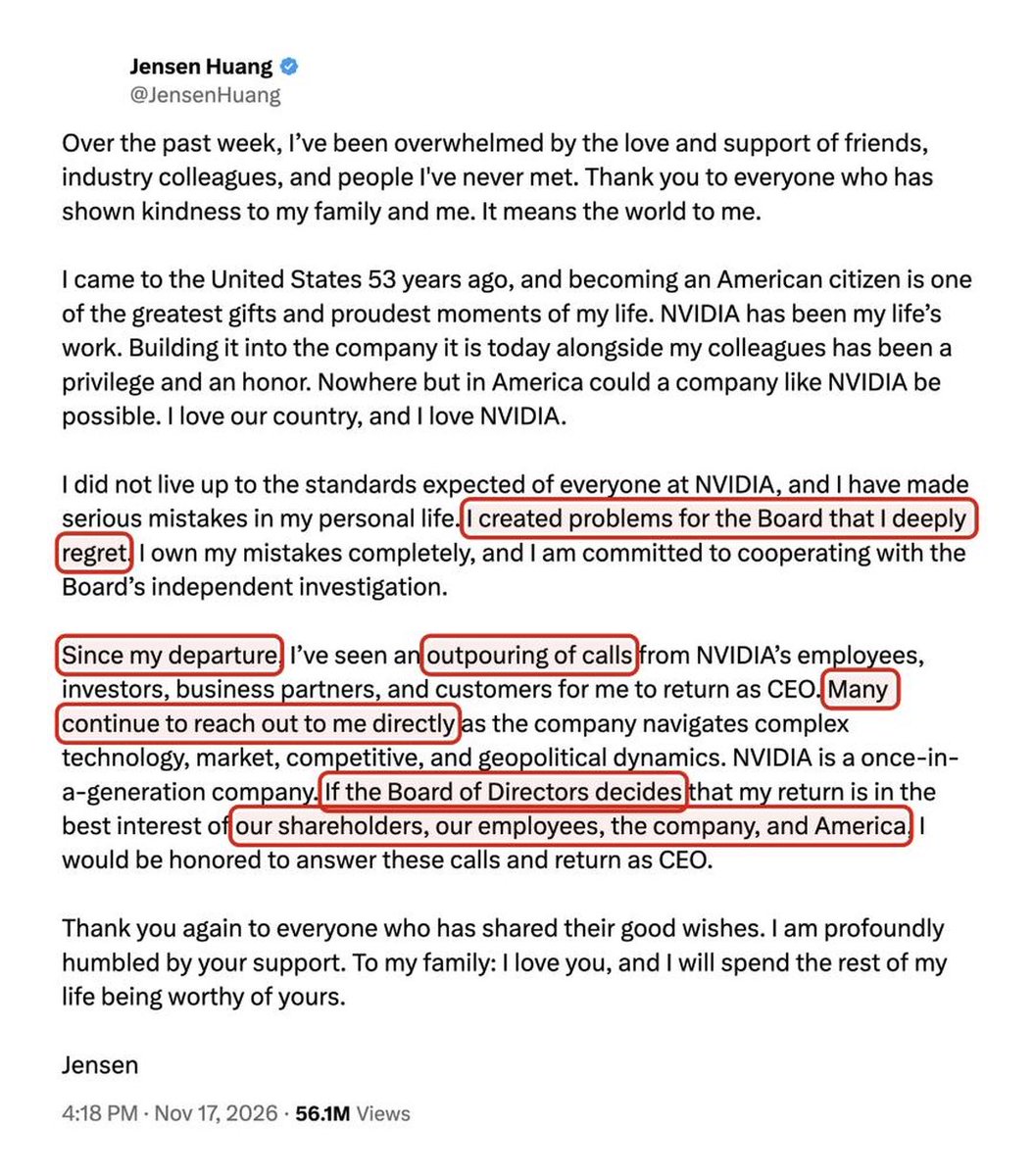
When I first read Jensen's statement, I wondered why he sounded like he was begging to come back.
36 hours later, I read it again. I think I missed the hidden message.
Look at the words.
He never says "I resigned". Not once. He calls it "my departure".
He says he "created problems for the Board". Not for Nvidia. For the Board.
He lists who is calling him back: employees, investors, partners, customers.
Then he says he'd return if the Board decides it's best for "our shareholders, our employees, the company, and America".
He's reminding the board who it answers to.
And he didn't send it privately. He posted it on X, for everyone to see.
My read: he didn't choose to go. Bloomberg reports he was effectively given no other choice at a late-night board meeting.
What was said in that room? I don't know. Nobody outside it does. But my gut says he took the hit to protect the people he loves and the company he built. That's my guess, not a fact.
It's polite. It's sorry. But it's passive aggressive. I don't think he's going out without a fight.
For balance: the board made the decision way too fast without thinking long term for their employee, shareholder, suppliers, the world and economy.
Someone with a 140 IQ only has a 140 IQ for about 4 hours a day
The second you make them jealous, horny or scared of looking poor, their functional IQ drops to 75
This is why Harvard doctors wire $200,000 to pig-butchering scams & billionaire founders lose half their net worth to a 23-year-old bartender in Miami
Most people think intelligence is a permanent stat like your height
In neuroscience, the logical part of your brain (the prefrontal cortex) is an expensive battery that shuts off the millisecond your ego feels threatened
You ONLY have access to your 140 IQ when your heart rate is 60 bpm, your status feels safe & you're looking at a spreadsheet at 10am on a Tuesday
The literal second someone triggers envy, sexual competition, greed or status panic inside your head, blood physically drains out of your prefrontal cortex & floods into your amygdala (the primitive 75 IQ lizard brain that only reads threat vs survival)
You can take a surgeon with a 145 IQ, show him that a dumber doctor down the street just bought a $400k Porsche & is stealing his patients, and within 4 seconds he has the impulse control of a teenager at a casino
This is why trying to sell to someone while they are calm is the dumbest mistake on earth
When a rich buyer is calm, you are arguing with his 140 IQ accountant brain (which only cares about risk, spreadsheets & waiting until next quarter)
Top 0.1% marketers & closers NEVER waste a breath talking to the 140 IQ brain. They engineer a 50-point IQ drop first:
1) Drop a "Status Grenade" in the first 15 seconds
Never start a post, VSL or call with logical features or ROI spreadsheets. Start by showing them a specific peer they consider beneath them who is printing 5x more money right now ("We took a 22-year-old kid who barely speaks English to $180k/mo in your exact niche while experienced founders stay stuck at $30k/mo"). That spike of envy drains the blood out of their logical cortex in 3 seconds flat
2) Stack Time Compression
The prefrontal cortex needs quiet time to reboot & talk them out of buying. Quantify the exact dollar amount they are bleeding every week they wait ("Every 7 days you leave this broken, you're handing ~$12k of your market share directly to guys half as smart as you")
3) Hand the 75 IQ Brain a 1-Click Binary Exit
An emotional brain CANNOT process a 5-tier pricing table. If you force them to do complex math during the close, their 140 IQ accountant brain wakes back up & stalls the deal. Give them one simple binary choice they can say yes to in 30 seconds while the emotion is peaking
At yegor. com, we engineer this exact psychological sequence across your X content, VSLs & DM funnels done-for-you (we take founders with $5k+ offers and handle all their content, funnel infrastructure & setters to get $0.25 webinar opt-ins and $5-50 booked calls at a 60% close rate)
Elon Musk says Nvidia made a mistake removing Jensen Huang, confirms he's spoken with him privately and says he would hire him himself: "who wouldn't?"
"I would call Jensen, Michael Jordan, perhaps at his peak level, in terms of what he means to a team."
"You got a winning streak that's just gonna happen, and then you kick Michael Jordan off your team. Doesn't seem like a smart decision to me."
"There's no one that can really replace Jensen. He does the roles of several people. He's managing supply chain. He has long-term relationships that have been built up over decades. He understands his technology incredibly well."
"His team loves him. And many of them are there because of him, and have had higher offers to go elsewhere and have turned them down because of personal loyalty to Jensen."
"He's one of the most talented entrepreneur CEOs in history. Who wouldn't want to hire Jensen?"
I believe the @nvidia board is not acting in the best interest of shareholders nor in a manner consistent with their fiduciary duties.
What we know is that the board fired Jensen or forced his resignation for violating company policy and/or in response to the accusation of an affair with a spy.
They did so without careful consideration of the impact on the company, its customers, its shareholders or other stakeholders.
They rushed to judgment without the benefit of careful due diligence or even with a basic understanding of the facts.
How do we know this?
We know this by how quickly Jensen was fired and how little was known at the time of his firing.
It takes time to convene a board meeting. There was time, maybe, for one Zoom.
And this is a decision that should have been made by a board sitting in person and carefully deliberating the facts once they are known.
And they should have slept on the decision and met again the day after to discuss the facts, the risks and the other implications of their decision.
The timing and lack of information did not allow for careful board deliberation.
While boards can fire a CEO for an inappropriate relationship with a subordinate, it should not be an automatic decision. That is why we have boards comprised of humans and not agents.
A board should consider whether or not such a relationship was consensual or whether it was an abuse of power dynamics. And a board has to consider what the impact of the firing is on all stakeholders.
If I were in this board, I would not have rushed to judgment based on articles in the media. I would have made sure the board had all of the facts so it could make a careful and informed decision.
Boards of Delaware companies have a duty of care which means they must make informed, prudent and good faith decisions. This clearly did not happen here.
What law firm is advising this board?
Or is the board even taken good legal advice?
It doesn’t look like it.
And now the board is compounding its failures by insisting that there is no possibility for Jensen’s return as CEO.
Why is it in the best interest of the company to foreclose the possibility of Jensen’s return and to do so before all of the facts are known? This is yet another breach of their duty of care.
Furthermore, the board has launched an investigation whose scope is unknown. Investigations can be extremely damaging to a company and should be carefully targeted to address whatever facts need to be known rather than be overly broad in scope.
In short, this looks like a series of major governance failures by directors that panicked due to headlines in the media. They likely felt compelled to do something because they were afraid of looking bad in the media, not because it was the right thing for them company.
They couldn’t stand the heat.
The board’s conduct here is shocking for a company of this scale and importance to our country and the world at large, particularly at this moment in history.
Over the past week, I’ve been overwhelmed by the love and support of friends, industry colleagues, and people I've never met. Thank you to everyone who has shown kindness to my family and me. It means the world to me.
I came to the United States 53 years ago, and becoming an American citizen is one of the greatest gifts and proudest moments of my life. NVIDIA has been my life’s work. Building it into the company it is today alongside my colleagues has been a privilege and an honor. Nowhere but in America could a company like NVIDIA be possible. I love our country, and I love NVIDIA.
I did not live up to the standards expected of everyone at NVIDIA, and I have made serious mistakes in my personal life. I created problems for the Board that I deeply regret. I own my mistakes completely, and I am committed to cooperating with the Board’s independent investigation.
Since my departure, I’ve seen an outpouring of calls from NVIDIA’s employees, investors, business partners, and customers for me to return as CEO. Many continue to reach out to me directly as the company navigates complex technology, market, competitive, and geopolitical dynamics. NVIDIA is a once-in-a-generation company. If the Board of Directors decides that my return is in the best interest of our shareholders, our employees, the company, and America, I would be honored to answer these calls and return as CEO.
Thank you again to everyone who has shared their good wishes. I am profoundly humbled by your support. To my family: I love you, and I will spend the rest of my life being worthy of yours.
Jensen
The Nasdaq followed through on Day 4 of its rally count last Wednesday, confirming a new rally attempt. Both the Nasdaq and S&P 500 pulled back on Thursday and Friday, but the rally attempt remains intact. Nasdaq volume contracted on both sessions, so neither registered as a distribution day. For now, the rally remains valid unless the Nasdaq undercuts its Day 1 low.
Market breadth continued to deteriorate, with Friday’s session producing just 103 new highs versus 507 new lows. Leadership has changed little since the last report. Outside of a handful of specialty retail and fintech names, most constructive setups remain concentrated in medical and healthcare, particularly biotechnology, pharmaceuticals, and genomics. Technology leadership remains especially thin, with very few sound setups emerging across the group.
Following Wednesday’s follow-through, I initiated two 5% pilot positions in CART and CHYM, bringing total exposure to 10%. However, I would like to see the Nasdaq make meaningful progress back above its 200-day SMA before increasing exposure much beyond the 10%–15% range. The follow-through is an encouraging development, but the weak breadth and narrow leadership still warrant caution.
If the major indexes continue to improve, leadership broadens, and my pilot positions perform well, I’ll add exposure accordingly. Until those conditions develop, I’ll remain selective and let the market dictate my next move. Keep your watchlists current, update your alerts, and be prepared for either outcome.