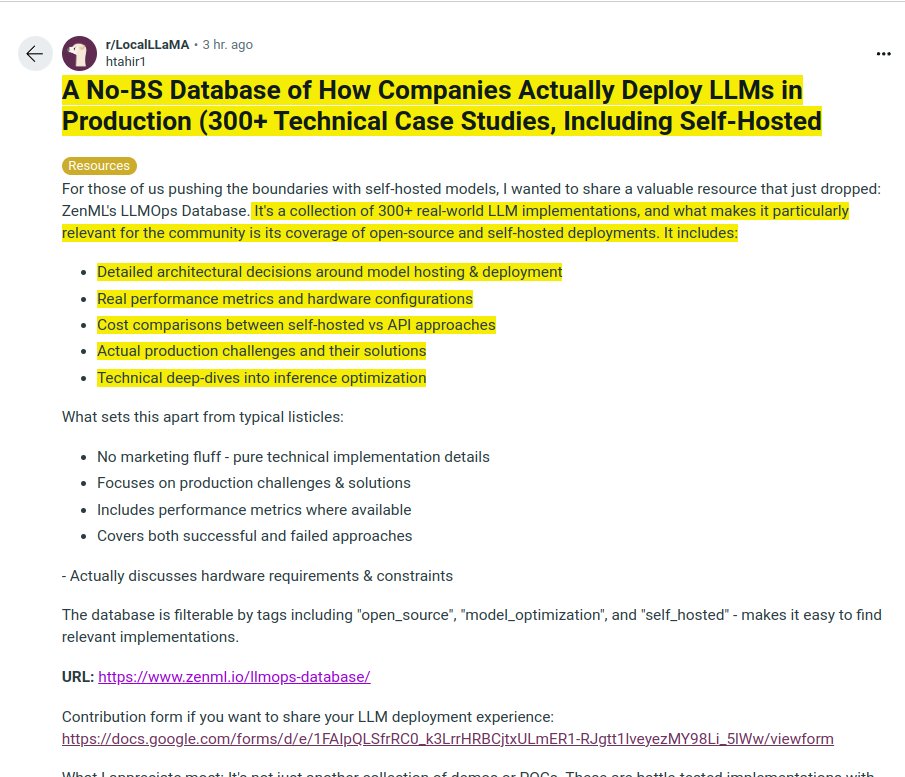
Today, we've also signed the Open Weights letter.
Open source strategic flexibility is what we’ve been betting on for years at @zenml_io
Long live open weights and open source for AI!
Just released my open-source course "Building a Coding Agent From Scratch" with a focus on hardcore harness engineering.
In LangChain’s Terminal-Bench experiment, changing only the harness (with the same model) moved a coding agent from ~30th place into the top 5: the harness, not the model, is what makes a coding agent good.
In this course, you’ll build that harness from scratch in Python: Decode, a complete coding agent that grows lesson by lesson from a bare agent loop into a swarm of remote agents running in parallel in the cloud.
@brian_armstrong The honest answer could be replaying your real production runs with just the model swapped and diffing the output, rather than trusting a vibe.
(That's basically why we built Kitaru, open source: https://t.co/xkSzHf5XLd )
@brian_armstrong@brian_armstrong This resonates a lot. The hard part isn't picking a cheaper default, it's the confidence to actually flip it - how do you know GLM or Kimi won't quietly degrade something a customer touches?
Had fun talking to @bigdata about AI agents and Kitaru by @zenml_io.
A small reminder we are "old-school" OSS: https://t.co/Y5UdkwGfMN. Giving us a star means a lot.
So much to launch this week - make sure to follow along. Hinted some of this in the podcast
https://t.co/VHWF3NgPHI
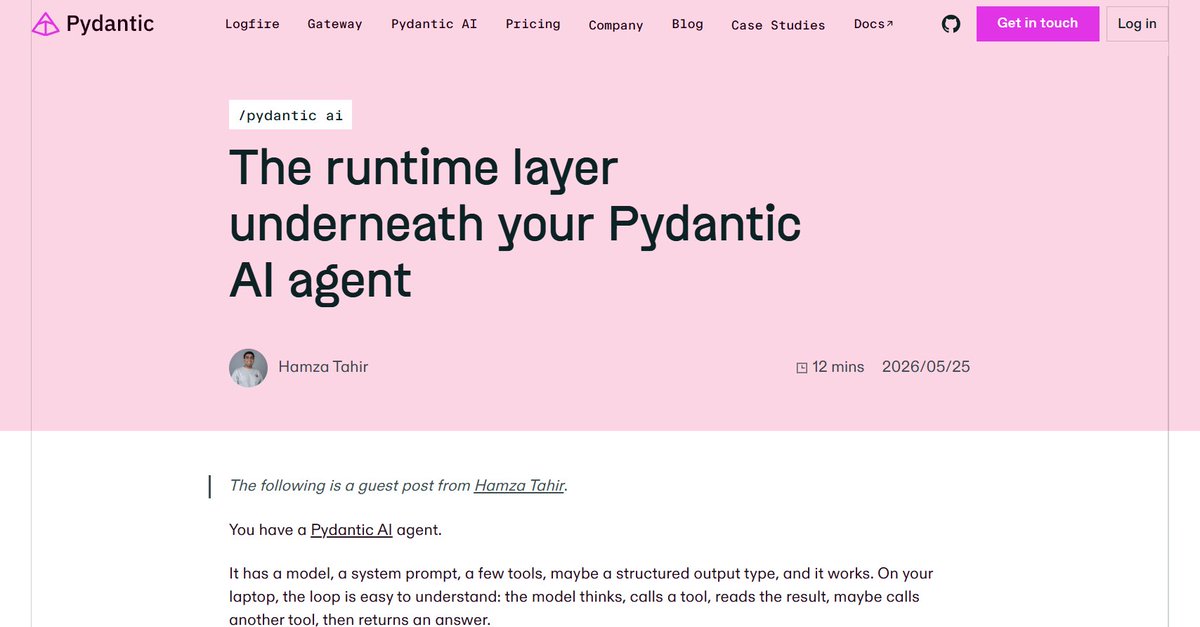
Stoked to be featured in the @pydantic AI blog yesterday.
In a world where all AI frameworks are pulled to every corner of the stack, it's great to see @samuelcolvin's team have the discipline to separate the stack's layers in a smart way. In this case, we both believe the runtime layer is distinct from the AI framework layer.
That's why we've shipped our first deep integration with Pydantic AI. It works seamlessly, you just wrap your Pydantic AI agent and get checkpoints, replay, resume, wait states, artifacts, logs, execution history, and operational control. That gives the agent somewhere to land when production does ordinary production things: a URL times out, a process dies, a human approval arrives later than expected, or someone needs to understand a failed run without reconstructing it from pasted tracebacks.
Read more here: https://t.co/smni8pGIT9
Thank you @lais_bsc for the support in this collab!
Tomorrow I'm on stage at PyAI Conference in San Francisco.
The lineup is unreal - @gvanrossum, @samuelcolvin, @jlowin, @jxnlco , and @jeffreyhuber, and many many more [https://t.co/2PWkKqDyJa]. Some of the sharpest minds in the Python ecosystem, all in one room.
My talk: "We Solved Building Agents. Now What?"
The short version - everyone's obsessing over which framework to build agents with. But the teams actually shipping are wrestling with something different: the infrastructure that keeps agents alive in production. The harness has two halves, and most of the thinking is pointed at the wrong one.
I'm in SF all week. If you're around and want to grab coffee, talk agents, talk infra, talk Python - hit me up. DMs open.
See you tomorrow 💪
(Pictured, last time out in SF speaking with Samuel at Modal offices)
Platform teams aren't gatekeepers. They're caught in the middle.
Between "we need GPUs now" and "who approved this model for prod?" Between firefighting and actually building.
Meanwhile DS is coupling infra into business logic because nobody gave them a clean path.
JetBrains had ~100 ML people using Prefect, Kubeflow, raw K8s for the same problems. "Code reuse was nearly impossible."
After separating concerns—DS writes Python, platform owns hooks—it went from 8→88 users, 3→100 pipelines.
Adeo went 8.5 weeks → 2 weeks time-to-market.
The fix wasn't more oversight. It was removing the coupling.
👥 Speaker Corner Spotlight
We’re live at #MLOpsWorld | #GenAI Summit!
Alexej Penner, Founding Engineer at @zenml_io , takes the speaker corner with:
“The Real Problem Building Agentic Applications (and How MLOps Solves It)”
From chaotic LLM prototypes to reliable production pipelines, Alexej shows how MLOps principles like reproducibility & lineage evolve into LLM Ops.
#AIagents #LLMOps #Austin2025
🚀 We’re #hiring at @zenml_io !
As our #opensource#MLOps framework continues to gain traction, we’re expanding our team and looking for passionate individuals to join us on this exciting journey as Senior Software or Frontend Engineers!
👉 See here: https://t.co/C2SIHhw6tV
Great research on open-source by @Harvard:
- $4.15B invested in open-source generates $8.8T of value for companies (aka $1 invested in open-source = $2,000 of value created)
- Companies would need to spend 3.5 times more on software than they currently do if OSS did not exist
I suspect that these numbers and impact are even greater for AI than for software (would be great to study!)
📊 New blog analyzing real-world LLM agent deployments in production. After studying dozens of case studies, the gap between demos and production is stark. Most "successful" implementations? Extremely narrow in scope with heavy human oversight.
🎉 Just shipped Modal support in @zenml_io v0.71.0!
@modal_labs is basically the `uv` of GPU compute - it makes running stuff in the cloud feel as natural as running locally.
Been digging through our LLMOps Database to understand how companies implement RAG in production. Some fascinating technical patterns emerging in how they're connecting LLMs to real data. 🤔
ML engineers & data scientists: Supercharge your workflows with ZenML + @skypilot_org !
🐍 Python-centric
☁️ Seamless local-to-cloud scaling
👁️ Auto-tracking for everything
🐳 Effortless containerization
All #opensource & free.
-> https://t.co/g2XRR94mgR
#MLOps






![htahir111's tweet photo. Tomorrow I'm on stage at PyAI Conference in San Francisco.
The lineup is unreal - @gvanrossum, @samuelcolvin, @jlowin, @jxnlco , and @jeffreyhuber, and many many more [https://t.co/2PWkKqDyJa]. Some of the sharpest minds in the Python ecosystem, all in one room.
My talk: "We Solved Building Agents. Now What?"
The short version - everyone's obsessing over which framework to build agents with. But the teams actually shipping are wrestling with something different: the infrastructure that keeps agents alive in production. The harness has two halves, and most of the thinking is pointed at the wrong one.
I'm in SF all week. If you're around and want to grab coffee, talk agents, talk infra, talk Python - hit me up. DMs open.
See you tomorrow 💪
(Pictured, last time out in SF speaking with Samuel at Modal offices)](https://pbs.twimg.com/media/HC_UZW5bQAAzyT8.jpg)