AI cost is moving from cloud bills to consumer prices.
Apple raising Mac and iPad prices is not just an Apple story.
It may be one of the clearest consumer signals that AI infrastructure inflation is starting to leave the data center. AI cost used to feel abstract: tokens, API bills, subscriptions, enterprise contracts. Now it is showing up in memory, storage, supply chains, and consumer hardware.
A user may never pay for an AI API, but they may still feel the AI boom when a laptop gets more expensive.
AI cost is not staying inside the cloud.
Nothing in this world is more honest than your mind and body
you can train them but can't hallucinate them
live by what you do, not what you say you'll do
Personal update: I've joined Anthropic. I think the next few years at the frontier of LLMs will be especially formative. I am very excited to join the team here and get back to R&D. I remain deeply passionate about education and plan to resume my work on it in time.
AI subscriptions are becoming less unlimited.
The interesting signal from Grok x Hermes is that a subscription can now power an agent through OAuth, not just a human chatting in an app.
That changes the usage pattern.
A human asks a few high-value questions.
An agent breaks one task into planning, search, tool calls, retries, verification, summaries, and follow-up actions.
Same subscription surface.
Very different workload profile.
So the real split is not subscription vs API.
It is access vs allocation.
Subscriptions package human access.
Routers and APIs allocate agentic usage across steps, models, latency needs, permissions, and cost constraints.
The economic unit slowly moves from cost per month to cost per completed workflow.
The next paying user of a social platform may not be a human.
It may be an agent with a subscription.
xAI now lets users connect their Grok subscription directly into Hermes, an open-source personal agent that can run persistently, build long-term memory, and connect to messaging platforms.
The old model was simple:
-APIs were for developers.
-Subscriptions were for humans.
-Agents lived in the gray zone.
That boundary is dissolving.
A consumer subscription is becoming part of an agent runtime.
The deeper shift is that platform-native subscriptions could become the sanctioned path for agents to access social context, instead of relying on unofficial workarounds.
Metered, permissioned, paid agent access may become the new platform pattern.
notion feels very different from the product many of us first started using.
it used to be where people organized knowledge.
now it is starting to look like a programmable context where agents can read, act, sync, trigger, and build workflows.
the interesting shift is not “more automation.”
it’s software becoming a more adaptive layer between human intent and execution.
BIG one for devs today. Introducing the Notion Developer Platform:
- Notion CLI, ntn (Notion in your terminal)
- Workers (run code on Notion's infra)
- Database sync (any data source into Notion)
- Agent tools (build any workflow)
- Webhook triggers (trigger Notion from any app)
- External Agents API (bring any agent into Notion)
- Notion Agents SDK (use Notion Agents anywhere)
- …and a bunch more API improvements
And soon, you won't need to be a developer to build on Notion. Your agent will be one for you.
Getting enough of this “AI taking over the world” talk.
Wake me up when teleport is made possible by your agent.
Your dispatch agent couldn’t even work when the mother ship is turned off.
The endgame question I'm still thinking through:
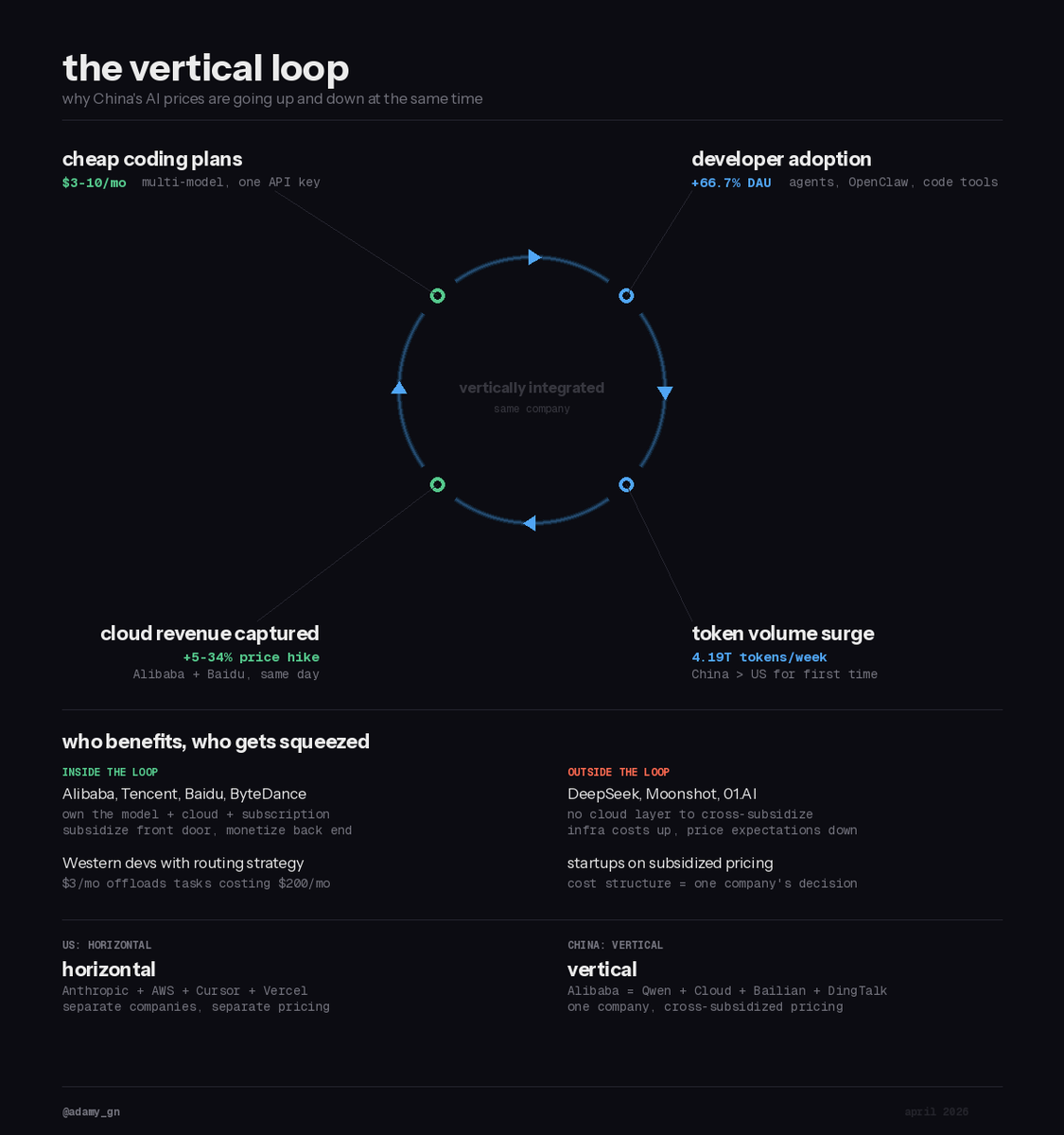
Vertical integration is more efficient. No coordination costs. You can cross-subsidize. You can move fast.
But it also concentrates leverage. If your Coding Plan, your cloud, your model API, and your deployment pipeline all come from one company, your entire cost structure is one pricing decision away from changing.
For now, the deal is great. The question is what happens when the subsidy phase ends.
More on this soon.
In China right now, AI model prices are crashing and cloud compute prices are surging, at the same time.
That looks like a contradiction. It's not.
Here's how it actually works. 🧵
3 takeaways from this:
If you're a Western dev paying $200/month for a Claude or ChatGPT max plan, you're leaving money on the table. The majority of your day-to-day tasks (boilerplate, refactoring, test generation, docs) can be offloaded to a $3 Coding Plan model. The key isn't picking one model. It's routing strategy.
If you're a startup, local inference is about to matter a lot more. Cloud prices are going up. MLX and consumer hardware are getting more capable. Open-source models are getting smaller and better. The math on running your own inference is shifting faster than most people realize.
If you're watching the competitive landscape: China's AI ecosystem is consolidating around 3-4 vertically integrated stacks. The US is staying horizontal and fragmented. Neither is "better," but they produce very different dynamics for developers, pricing, and innovation.
your next pet dog doesn’t eat, doesn’t poo, and doesn’t get old.
@UnitreeRobotics dropped the As2 earlier this year right after their robots performed kung fu on China’s spring gala (700m+ viewers).
the specs are wild though:
- 18 km/h top speed, faster than most people running
- 90 N·m joint torque, 65 kg standing payload
- a 105 kg man stood on it and jumped. it was fine
- IP54 waterproof, runs through rain and streams
- embodied AI model onboard, autonomously chases and plays with you
Unitree’s pricing pattern tells the story. Go1 in 2021 shocked the robotics world at ~$2,300. Go2 ranged from 10k-30k RMB ($1,400-4,100).
As2 should be launching for sale soon.
guess the price?