As engineering, product, design, DS, etc. melt into a new kind of role, I was reflecting on what roles might look like in the future. For example, when I look at the Claude Code team I see what I think is five archetypes:
1. Prototyper: comes up with brand new ideas; churns out many ideas, most of which don't ship
2. Builder: quickly turns a prototype/idea into production-grade product/infra
3. Sweeper: cleans up the UI, simplifies the code and system, unships, optimizes performance
4. Grower: takes a product that has been built and iterates on it to improve Product-Market Fit
5. Maintainer: owns a mature system to make it secure, reliable, fast, and efficient as it scales
Many people span across 2 roles, and sometimes 3 roles. I also notice that these roles are not really tied to job function -- eg. across Anthropic, some designers match category 1, some 2, some 3; same for engineers, PM, DS.
A healthy team needs a mix of these, depending on the product:
- A product that is new and pre-PMF needs people that are strong at 1+2+3
- A product that is growing and has found PMF needs 2+3+4 and some 5
- A product that has strong PMF needs 3+4+5 and some 2
Maybe product roles of the future will look more like this, and less like the domain-specific roles of today?
“LLM coding will split up engineers based on those who primarily liked coding and those who primarily liked building.”
Fantastic framing for how engineers are reacting to agent-assisted coding today.
A few random notes from claude coding quite a bit last few weeks.
Coding workflow. Given the latest lift in LLM coding capability, like many others I rapidly went from about 80% manual+autocomplete coding and 20% agents in November to 80% agent coding and 20% edits+touchups in December. i.e. I really am mostly programming in English now, a bit sheepishly telling the LLM what code to write... in words. It hurts the ego a bit but the power to operate over software in large "code actions" is just too net useful, especially once you adapt to it, configure it, learn to use it, and wrap your head around what it can and cannot do. This is easily the biggest change to my basic coding workflow in ~2 decades of programming and it happened over the course of a few weeks. I'd expect something similar to be happening to well into double digit percent of engineers out there, while the awareness of it in the general population feels well into low single digit percent.
IDEs/agent swarms/fallability. Both the "no need for IDE anymore" hype and the "agent swarm" hype is imo too much for right now. The models definitely still make mistakes and if you have any code you actually care about I would watch them like a hawk, in a nice large IDE on the side. The mistakes have changed a lot - they are not simple syntax errors anymore, they are subtle conceptual errors that a slightly sloppy, hasty junior dev might do. The most common category is that the models make wrong assumptions on your behalf and just run along with them without checking. They also don't manage their confusion, they don't seek clarifications, they don't surface inconsistencies, they don't present tradeoffs, they don't push back when they should, and they are still a little too sycophantic. Things get better in plan mode, but there is some need for a lightweight inline plan mode. They also really like to overcomplicate code and APIs, they bloat abstractions, they don't clean up dead code after themselves, etc. They will implement an inefficient, bloated, brittle construction over 1000 lines of code and it's up to you to be like "umm couldn't you just do this instead?" and they will be like "of course!" and immediately cut it down to 100 lines. They still sometimes change/remove comments and code they don't like or don't sufficiently understand as side effects, even if it is orthogonal to the task at hand. All of this happens despite a few simple attempts to fix it via instructions in CLAUDE . md. Despite all these issues, it is still a net huge improvement and it's very difficult to imagine going back to manual coding. TLDR everyone has their developing flow, my current is a small few CC sessions on the left in ghostty windows/tabs and an IDE on the right for viewing the code + manual edits.
Tenacity. It's so interesting to watch an agent relentlessly work at something. They never get tired, they never get demoralized, they just keep going and trying things where a person would have given up long ago to fight another day. It's a "feel the AGI" moment to watch it struggle with something for a long time just to come out victorious 30 minutes later. You realize that stamina is a core bottleneck to work and that with LLMs in hand it has been dramatically increased.
Speedups. It's not clear how to measure the "speedup" of LLM assistance. Certainly I feel net way faster at what I was going to do, but the main effect is that I do a lot more than I was going to do because 1) I can code up all kinds of things that just wouldn't have been worth coding before and 2) I can approach code that I couldn't work on before because of knowledge/skill issue. So certainly it's speedup, but it's possibly a lot more an expansion.
Leverage. LLMs are exceptionally good at looping until they meet specific goals and this is where most of the "feel the AGI" magic is to be found. Don't tell it what to do, give it success criteria and watch it go. Get it to write tests first and then pass them. Put it in the loop with a browser MCP. Write the naive algorithm that is very likely correct first, then ask it to optimize it while preserving correctness. Change your approach from imperative to declarative to get the agents looping longer and gain leverage.
Fun. I didn't anticipate that with agents programming feels *more* fun because a lot of the fill in the blanks drudgery is removed and what remains is the creative part. I also feel less blocked/stuck (which is not fun) and I experience a lot more courage because there's almost always a way to work hand in hand with it to make some positive progress. I have seen the opposite sentiment from other people too; LLM coding will split up engineers based on those who primarily liked coding and those who primarily liked building.
Atrophy. I've already noticed that I am slowly starting to atrophy my ability to write code manually. Generation (writing code) and discrimination (reading code) are different capabilities in the brain. Largely due to all the little mostly syntactic details involved in programming, you can review code just fine even if you struggle to write it.
Slopacolypse. I am bracing for 2026 as the year of the slopacolypse across all of github, substack, arxiv, X/instagram, and generally all digital media. We're also going to see a lot more AI hype productivity theater (is that even possible?), on the side of actual, real improvements.
Questions. A few of the questions on my mind:
- What happens to the "10X engineer" - the ratio of productivity between the mean and the max engineer? It's quite possible that this grows *a lot*.
- Armed with LLMs, do generalists increasingly outperform specialists? LLMs are a lot better at fill in the blanks (the micro) than grand strategy (the macro).
- What does LLM coding feel like in the future? Is it like playing StarCraft? Playing Factorio? Playing music?
- How much of society is bottlenecked by digital knowledge work?
TLDR Where does this leave us? LLM agent capabilities (Claude & Codex especially) have crossed some kind of threshold of coherence around December 2025 and caused a phase shift in software engineering and closely related. The intelligence part suddenly feels quite a bit ahead of all the rest of it - integrations (tools, knowledge), the necessity for new organizational workflows, processes, diffusion more generally. 2026 is going to be a high energy year as the industry metabolizes the new capability.
Using Notebook LM for sometime now and it has completely changed how I consume long form content. Podcast format is highly engaging and preserves the essence. Would be interesting to have a live listener mode that lets me ask follow-ups to the AI hosts mid-podcast.
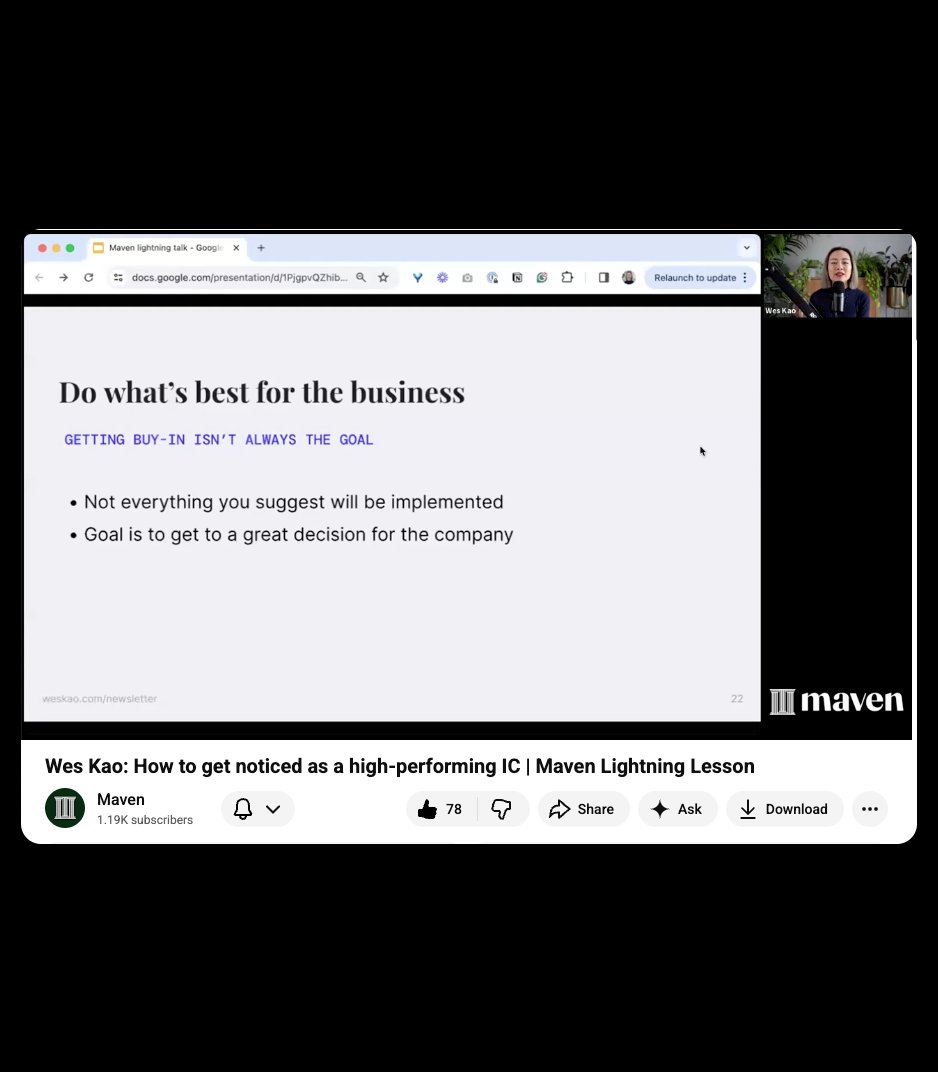
every PM who thinks their manager ignores them should watch this Wes Kao talk (30 mins)
she said the quiet part out loud about managing up
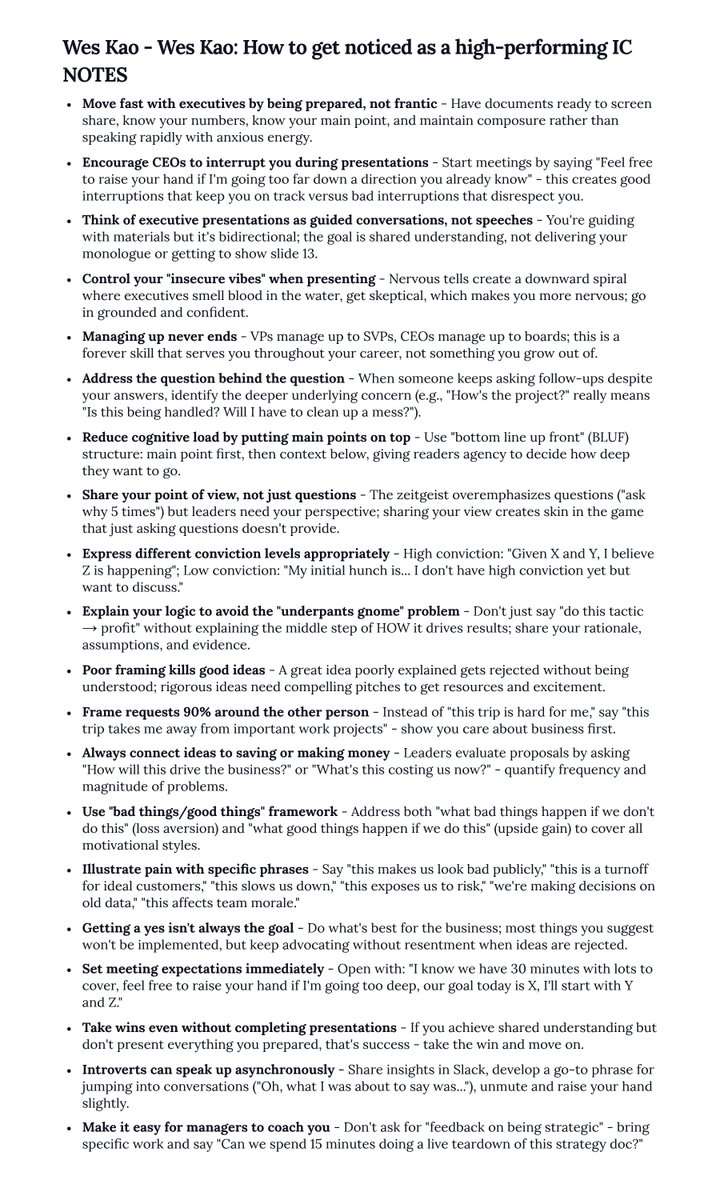
This is the framework your manager uses on THEIR manager (and never taught you)
I distilled her contrarian frameworks, but watch the whole thing:
My biggest takeaways from @stewart:
1. Product design is about creating understanding, not removing friction. Teams obsess over reducing friction and removing steps, but 70% to 80% of product design challenges are actually about helping people *understand* what your product does and what to do next. Users arrive barely interested and confused about what you offer. If they can’t quickly grasp what they’re looking at, they’ll leave. Making confusing things faster just gets users to the exit quicker. The mantra should be “Don’t make me think,” not “reduce friction.”
2. You’re not selling features—you’re selling outcomes. Nobody wants a saddle; they want to go horseback riding. Nobody wants a hammer; they want something built. People understand cars and beer without explanation, but new software needs an explanation of both what it is and why people should want it. Slack wasn’t selling messaging features—it was selling better team coordination and reduced email chaos. If you can’t articulate the transformation your product creates in people’s lives, you’re just listing features.
3. Organizations naturally fill with fake work that looks exactly like real work, what Stewart calls “hyper-realistic work-like activities.” Meetings to preview deck slides, analysis of tiny feature differences, elaborate processes around insignificant decisions. People aren’t stupid or lazy; they’re responding to having more workers than valuable work to do. Leaders must continuously ensure there’s enough clearly valuable work and explicitly say no to projects that can’t possibly generate meaningful impact.
4. The value of a feature exists on a "utility curve." There’s the initial flat zone where a feature is too weak to matter, then a steep rise where it brings users to the "aha" moment, then the value levels off where improvements don’t matter much anymore. Teams often give up in the first flat zone or waste resources in the third. The key question isn’t whether you have a feature, but whether you’ve invested enough to reach the steep part of the curve where it becomes genuinely valuable.
5. Small conveniences create emotional connections that drive word-of-mouth growth. No one switches products because of a good time-zone picker or smooth password recovery, but these details make users love or hate your product. Slack grew largely because people who used it at one company would join a new company and advocate strongly for adopting it. That advocacy came from accumulated small delights, not major features.
6. The “owner’s delusion” explains why bad experiences persist everywhere. Restaurant owners create terrible websites even though they’ve experienced the frustration of visiting other terrible restaurant websites. Business owners assume visitors care deeply about their product, when in reality people arrive distracted, in a hurry, just above the threshold of caring at all. The solution is to regularly step back, pretend you’re a normal person with limited time and patience, and honestly evaluate if your product makes sense.
7. Only pivot after exhausting all reasonable ideas. The right time to pivot isn’t when things get hard—it’s when you’ve genuinely tried every non-ridiculous approach and can coldly, rationally assess that the expected value has dropped below alternatives. Pivoting is humiliating because you’ve convinced investors, employees, and users of a vision you’re now abandoning. That emotional cost means most people either pivot too quickly or wait until they run out of money.
8. Treating customers and employees with extraordinary generosity creates a competitive advantage. Slack pioneered fair billing (not charging for unused seats), gave free credits during Covid, and automatically refunded customers for downtime without their asking. This wasn’t just ethics—it helped attract better employees, created positive stories, and built long-term customer loyalty. The mantra was “In the long run, the measure of our success will be the amount of value we create for customers.”
It’s been 12+ hours with no Airtel signals or WiFi.
If we delay even 1 day in paying bills, Airtel fines us without fail. But when services are down, what do we get? Nothing but silence.
In the last 2 months, your service has become horrible. As working professionals, how are we supposed to manage?
Airtel was once a trusted brand. Now, it’s losing its value because of the pathetic service.
@airtelindia
@Airtel_Presence@airtelindia@airtelnews My Wi-Fi has been non-functional for last 2 days. Despite repeated escalations (Req ID: 11017418155), no technician has even visited. This is UNACCEPTABLE. Airtel is by far worst service in Bangalore! #airtel#AirtelDown