Modern FPV drone architecture explained in one simple diagram! 🛸⚡
Whether you are building custom quads from scratch or working on industrial automation and drone electronics, understanding the core stack and component layout is key.
Here is a quick breakdown of the essential components that power a modern FPV build:
Flight Controller (FC) & 4-in-1 ESC Stack: The central brain processing sensor data and managing precise power delivery to all four motors simultaneously.
Power Capacitor & XT60 Connector: Protects sensitive onboard electronics from voltage spikes and ensures clean power distribution during high-draw maneuvers.
Control Receiver (RX) & Video Transmitter Antenna: Handles low-latency RF signal reception for control inputs while transmitting real-time visual feeds.
Brushless Motors & FPV Camera: Delivers high RPM responsiveness coupled with durable camera housing for tight maneuvers and clear telemetry.
Having a clean, efficient layout isn't just about aesthetic wiring—it directly impacts signal noise, heat dissipation, and long-term hardware reliability.
What’s your preferred FC and ESC stack setup for custom builds? Let’s discuss in the comments! 👇
What Lisa Su actually held on stage:
A mini PC the size of a lunchbox running Qwen3-235B locally, with no cloud and no discrete GPU
Inside: the Ryzen AI Max+ 395, 128GB unified memory, 110GB usable as VRAM on Linux
The first x86 chip that handles 200+ billion parameters on a single die
AMD claims it beats the RTX 5080 by several times on memory-bound models — because the 5080 simply cannot fit them
$1,400 to $2,500 once. cloud bills run $200 to $400 a month
It pays for itself in a few months, then costs nothing per request
This is not a faster GPU. it is the first real argument that your AI does not belong in someone else's data center
🚨𝗨𝗟𝗧𝗜𝗠𝗔 𝗛𝗢𝗥𝗔: Google Gemini tiene funciones brutales que casi nadie está usando.
La mayoría solo usa Gemini para prompts básicos… mientras Google lo llenó en silencio de herramientas que reemplazan horas de trabajo en segundos.
Probablemente estás usando menos del 5% de lo que Gemini realmente hace.
Aquí van 10 funciones ocultas de Gemini que se sienten casi injustas cuando las empiezas a usar: 👇
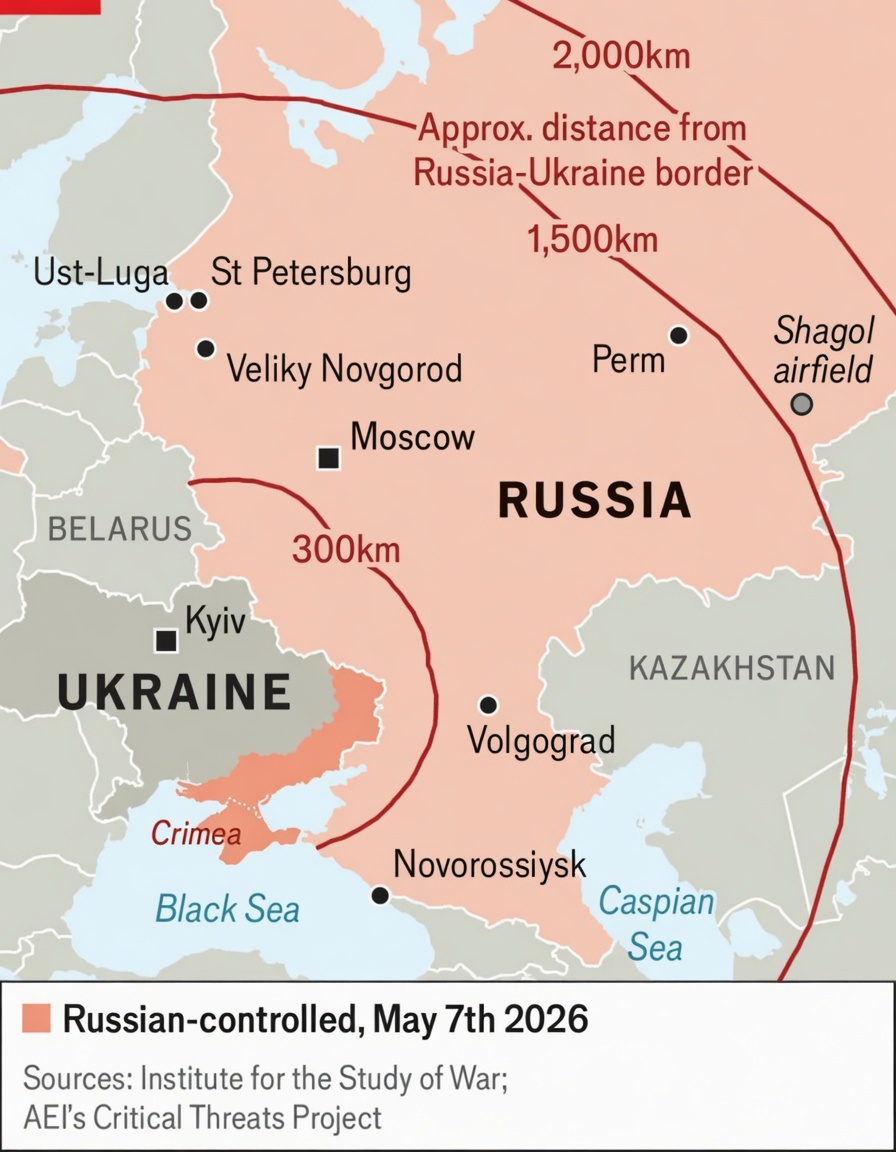
⚡️For the first time in nearly three years, the initiative in the war appears to be shifting toward Ukraine, — The Economist
The magazine writes that Ukraine is gradually changing the course of the war and inflicting increasingly serious damage on Russia.
Key points:
1⃣Russia’s spring offensive has effectively failed;
2⃣in April, Russian forces suffered net territorial losses for the first time since August 2024;
3⃣over the past 30 days, Russia lost control of 113 square kilometers;
4⃣Ukrainian drones are striking deeper and deeper into Russia’s rear areas;
5⃣military and economic targets are being hit nearly 2,000 km from the border.
The Economist describes the situation as a potential turning point in the war.
💬 “If you had to brief Putin, the picture would look pretty grim.”
Beautiful Taiwan:
Thousands of people participate in the soft opening of the Danjiang Bridge 淡江大橋 the Ziha Hadid masterpiece.
Scheduled to open on May 12, the nearly one-kilometer-long bridge will link Tamsui 淡水 and Bali 八里 districts in New Taipei 新北市 across the Tamsui River 淡水河 estuary.
Note of procedure: what should be its English name? Danjiang Bridge, Tamshui Bridge, Tamsui Bridge, Tamkang Bridge?
#Taiwan #Tamsui #bridges #infrastructure #淡江大橋
Introducing Project Glasswing: an urgent initiative to help secure the world’s most critical software.
It’s powered by our newest frontier model, Claude Mythos Preview, which can find software vulnerabilities better than all but the most skilled humans.
https://t.co/NQ7IfEtYk7
The Song is considered to be one of the most difficult arias ever written for a soprano. And yet she makes it look so easy, and with such power.
And she was only 17 years old when she performed it.
This performance of this song is so perfect that no other versions can compare! Both girls are amazingly good! Everything is in the style of a bygone era: the dresses, the shoes, the hair, the makeup, the movements, the gestures, the voice, and even the timbre. Everything is just perfect!
If the Islamic Republic Falls: Who Do the IRGC Surrender To?
- By Ashkan Karbasfrooshan @ashkan
This question reflects a broader concern: if the regime collapses and Iranians distrust anyone associated with it, what happens next?
As the saying goes: “Think global, act local.”
After weeks of aerial attacks that significantly degraded Iran’s naval assets, air defense systems, missile launch infrastructure, and large portions of IRGC-related facilities — alongside strikes that also hit economic infrastructure such as fuel depots — the conflict entered a new phase.
Some Iranians criticized the strikes on oil facilities. Others expressed a darker sentiment: that Iran’s oil wealth has long been “cursed,” enriching rulers rather than benefiting the Iranian people — a view echoed in a Bloomberg Originals mini-documentary.
Meanwhile, President Trump signaled publicly that the war might soon wind down. For many Iranians who oppose the regime, that possibility raised serious fears: that a wounded but surviving Islamic Republic would emerge more vindictive, more paranoid, and more brutal than before. However, don't take Trump literally, but rather, seriously.
Today, however, the conflict appears to have entered a new stage. Reports indicate that Israeli forces have deployed drones to conduct highly precise strikes against Basij units and, presumably, IRGC personnel operating in urban areas. The objective is to gradually degrade the regime’s internal enforcement apparatus — the forces responsible for suppressing domestic uprisings.
Ironically, the hunters may now be becoming the hunted.
Such actions would reduce the level of violent resistance ordinary Iranians might face if they were eventually called upon — by figures such as the U.S. president or opposition leaders like Pahlavi Reza — to take to the streets and reclaim control of their country.
Both Washington and Jerusalem have repeatedly stated that the ultimate political change must come from the Iranian people themselves. Taken at face value, that appears to remain their preferred outcome.
The United States has long been wary of deep involvement in Iran. The legacy of Operation Ajax in 1953 (related: Mossadegh myth), which helped restore the Shah and later contributed to the 1979 hostage crisis narrative, remains a cautionary historical reference.
If the United States could avoid direct entanglement in Iran’s internal politics, it likely would.
Israel’s position is different. While Israel would almost certainly seek economic ties with a post-Islamic Republic Iran, it has little interest in seeing Iran descend into a failed state (and, this is unlikely, since Iran is neither Iraq, Syria nor Libya).
Historically, Iran has experienced waves of external influence — from Greeks, Romans, Arabs, Mongols, Turks, Russians, British, and Americans. Israel could theoretically become another influential actor in that long sequence, though such an outcome would largely depend on the choices of Iranians themselves (related: Are Mullahs Repeating the Mistake of Previous Occupying Rulers of Iran?).
If that were to happen, responsibility would ultimately lie with the ruling clerical establishment whose policies produced the current crisis
Fight Fire with Fire
Undoubtedly, the Islamic Republic will continue launching missiles and drones for as long as it retains the capability to do so. Iran still possesses a substantial missile arsenal, though precise numbers are uncertain. Estimates before the war suggested thousands of ballistic missiles, but launch systems and logistical networks are critical. If launchers, radar systems, and command infrastructure are destroyed, the missiles themselves become far less operationally useful.
Iran’s drone capabilities have proven more adaptable, but Israel and its allies appear intent on gradually degrading those capabilities through targeted strikes and covert operations.
To be clear, the regime can also survive. No one is suggesting that the regime's fall is a fait accompli. But, I do recognize patterns and while history does not necessarily repeat itself, it does rhyme.
The reason for that may be internal as much as external.
At the highest levels of the regime, internal tensions may also intensify.
Power struggles between factions — including networks associated with figures such as Ali and Sadiq Larijani, as well as circles surrounding Mojtaba Khamenei — could deepen following the death of Supreme Leader Ali Khamenei.
The IRGC’s role in consolidating authority after that event has fueled speculation that elements of the security apparatus effectively staged a military-style consolidation of power.
Whether Mojtaba Khamenei was elevated because the IRGC wanted a more militant leader, or because rival factions sought to weaken the Khamenei family’s long-term hold on power, remains unclear.
What is clearer is that leadership figures increasingly appear to be targets. Israeli officials have publicly suggested they would consider targeting future supreme leaders involved in directing hostilities. That alone places Mojtaba Khamenei in a precarious position.
Meanwhile, figures such as Ali Larijani and Mohammad Bagher Ghalibaf have seen their influence expand as numerous IRGC commanders were eliminated in earlier strikes.
Israeli intelligence has also reportedly focused on individuals like police chief Ahmad Reza Radan and judiciary chief Gholamhossein Mohseni-Ejei — not only because of their past roles in repression but because of their ongoing threats against Iranian citizens! Those threats, including recent statements broadcast on Iranian state media, may ironically provide justification for continued targeting.
The same strategic miscalculation has appeared repeatedly among the regime and its proxies: actions intended to demonstrate strength often create the political pretext for stronger retaliation.
In Persian slang, one might call it “oghdeh” — a destructive combination of insecurity and obsession, usually pride bordering on hubris.
As in many collapsing systems, power struggles may intensify. Some senior officials have reportedly attempted to leave the country.
This environment makes lower-level IRGC and Basij personnel increasingly vulnerable to defections. Statements by Iran’s foreign minister Abbas Araghchi suggesting that retaliatory attacks are no longer centrally coordinated have fueled speculation that command structures may already be weakening.
Meanwhile, Iran’s continued missile and drone strikes against targets across the region risk alienating Arab governments that previously tried to remain neutral.
Regional patience appears to be thinning.
As the conflict drags on, leadership losses, infiltration operations, targeted assassinations, and defections could combine to create a progressively weaker command structure.
Eventually, the regime could reach a point where very few coherent leaders remain, at which stage defections might accelerate dramatically. At that moment, if external powers were to signal a pause in attacks, Iranians themselves might attempt to seize key institutions.
A Vacuum?
When foreigners ask me about the level of support Reza Pahlavi has inside Iran, I usually ask whether they want the short answer or the long one.
The long answer involves a complex discussion about shifting public opinion, generational change, the destructive direction Mullahs took Iran in and the irony that they themselves popularized monarchy while tainting the concept of republic and the evolving symbolism of the monarchy.
The short answer is simpler:
His most devoted supporters likely overestimate his support especially on the global stage (his domestic support is considerable, and amongst the diaspora is it very high no doubt, but what I mean is they not only call him the crown prince but oftentimes refer to him as the Shah, or king, even though the Islamic Revolution ended Iran's 2,500 history of monarchic rule). Hence what I mean by his supporters overestimate his influence.
But, more notably, his critical almost certainly underestimate his support and influence, to their own detriment.
He may not command unanimous backing among Iran’s 95 million citizens — which include diverse ethnic groups and political traditions — but his influence appears significantly greater than many of his detractors acknowledge.
The question therefore is less whether many Iranians would welcome him, and more how a transition could realistically occur.
One often-discussed concern involves the Mujahedin-e Khalq (MEK / NCRI). The group has extremely limited support inside Iran, though it maintains a network of foreign advocates. Some analysts have speculated about the possibility of outside actors attempting to install and "transplant" the group in a transitional role.
However, such a scenario appears highly unlikely. If its probability was perhaps 20% a year ago (NOT their support, the risk of such a "transplant" operation), it may now be below 5%, particularly given that many of its most prominent Western supporters — including figures like Mike Pompeo, Mike Pence, and Rudy Giuliani — no longer hold positions of power and are in all likelihood paid lobbyists.
Iranians across the political spectrum have warned about the MEK/NCRI, and those warnings are widely understood.
A lack of support does not always mean a lack of risk — but in this case the risk appears limited.
The Transitional Question
President Trump has suggested he would prefer a solution that emerges from within Iran. In theory, the United States might even accept a pragmatic arrangement with figures from within the current system if they fundamentally changed course.
In practice, however, Iranian public opinion appears deeply skeptical of any figure associated with the Islamic Republic — even those once labeled “moderates.” Terms such as reformist and even republic have lost credibility among large segments of the population.
Estimates suggesting that 70–80% of Iranians reject the current system are difficult to verify precisely, but the brutal January 2026 crackdown — which may have killed thousands — appears to have further eroded the regime’s legitimacy, which explains why so many are supportive of the strikes.
No society of 95 million people is politically uniform. There will always be factions that oppose any particular leader, including Pahlavi.
For that reason, if he were to play a role in a transition, he might require temporary international security protection — perhaps within a limited secure zone similar to those used in other post-conflict environments — until a constitutional process or referendum could take place.
Such protection might involve Western forces, though domestic sensitivities would likely make Israeli involvement controversial even among regime opponents.
One theoretical possibility would be a multinational stabilization presence, potentially including neutral actors. The probability of Russia participating is low, but it might offer a face-saving mechanism for Moscow and Beijing to accept the loss of a long-standing regional partner.
Whether such an arrangement would ever materialize is uncertain.
What is certain is that Iran’s future will ultimately be determined by Iranians themselves — not by foreign governments, analysts, or commentators.
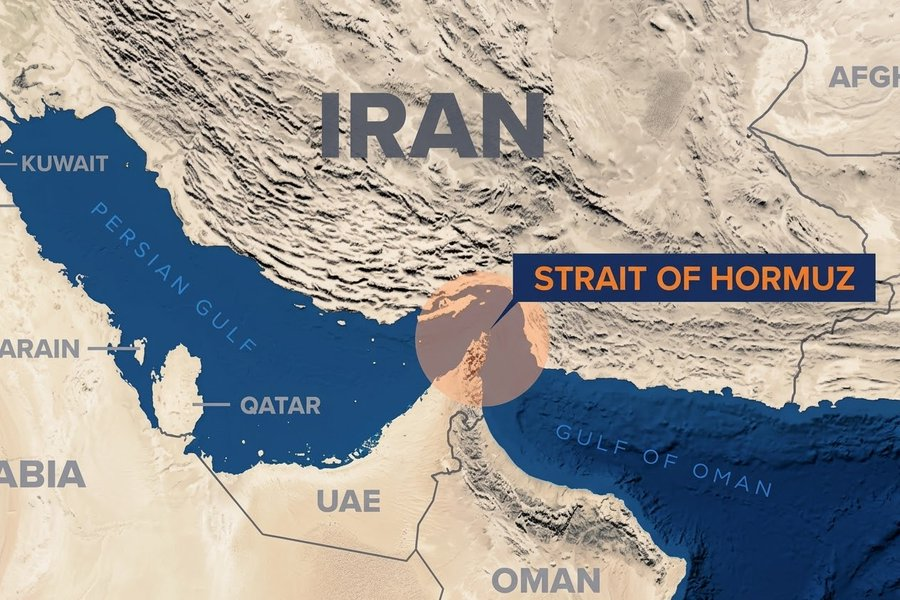
The Strait of Hormuz was not closed by mines, missiles, or warships.
It was closed by seven insurance letters.
On March 5, seven P&I clubs covering 90% of global ocean-going tonnage cancelled war-risk coverage for the Persian Gulf. Gard. NorthStandard. Skuld. Steamship Mutual. The American Club. The Swedish Club. The London P&I Club. They withdrew because their London reinsurers, bound by Solvency II capital rules, could not hold unlimited tail exposure in an active combat zone. The reinsurers pulled capacity. The mutuals had no mathematical choice.
Traffic through Hormuz collapsed from 138 vessel crossings per day to zero tankers by March 7. Three hundred oil tankers anchored idle. A thousand ships trapped. VLCC rates hit a record $481,170 per day. Brent surged from $67 to $108 in nine days, the largest weekly gain in futures history since 1983.
Three US carrier strike groups are in theatre. Air superiority is achieved. 80% of Iran's air defences are destroyed. Missile launches are down 86%.
The Strait is still commercially shut.
The US Navy has escorted zero tankers. Trump's $20 billion DFC reinsurance facility covers 5.7% of JPMorgan's estimated $352 billion Gulf exposure. Confirmed VLCC transits under the programme: zero.
Markets price a 2-to-4-week resolution. The mechanism says 6 to 18 months. Here is why.
Reopening requires not military victory but sequential reinsurance recapitalisation, actuarial reassessment, and individual vessel re-underwriting across the entire London treaty chain. After 26 months of Houthi attacks, Red Sea premiums never returned to baseline. This is a state-on-state war with leadership decapitation and total insurance withdrawal.
It gets worse. The strikes that killed Khamenei triggered Iran's Mosaic Defence doctrine: 31 autonomous IRGC provincial commands with independent firing authority. Insurance markets need a single counterparty to guarantee safe passage. The campaign destroyed the only entity that could provide one.
The interceptor arithmetic is merciless. US THAAD production: 8 per month. Iran's missile production: 100+ per month. Shahed drone cost: $20,000. THAAD interceptor: $12.7 million. The campaign burns years of production in weeks.
And the nuclear fatwa that restrained Iran for two decades was a personal ruling from a living cleric. The cleric is dead. His son lacks the theological authority to reimpose it. 441 kg of near-weapons-grade uranium survived the strikes. The IAEA is blind.
This is 'Actuarial Warfare'. Private reinsurance desks under Solvency II now exercise more effective denial power over the world's most critical energy chokepoint than the most powerful navy in history.
And unlike kinetic denial, actuarial denial operates on institutional timescales that no executive order, no $20 billion facility, and no carrier strike group can compress.
The market is pricing a legacy framework. The mechanism says the framework is dead.
- @shanaka86
@tpmars@SydneyDaddy1 馬斯克這句「The stage is being set for what is to come」(現在搭台,是為了將來唱戲)是指:美國目前對伊朗、委內瑞拉的行動,正為未來局勢鋪路。透過斷中國石油來源,讓中共經濟更吃緊、決策受限,尤其在台灣問題上無法輕易動武。這是戰略準備,未來才有「好戲」可看。
Yesterday, I explained how seven insurance firms in London shut down one-fifth of the world's oil supply.
Today, Trump may have just made the most aggressive sovereign insurance play in modern history.
Here's what happened and why it matters:
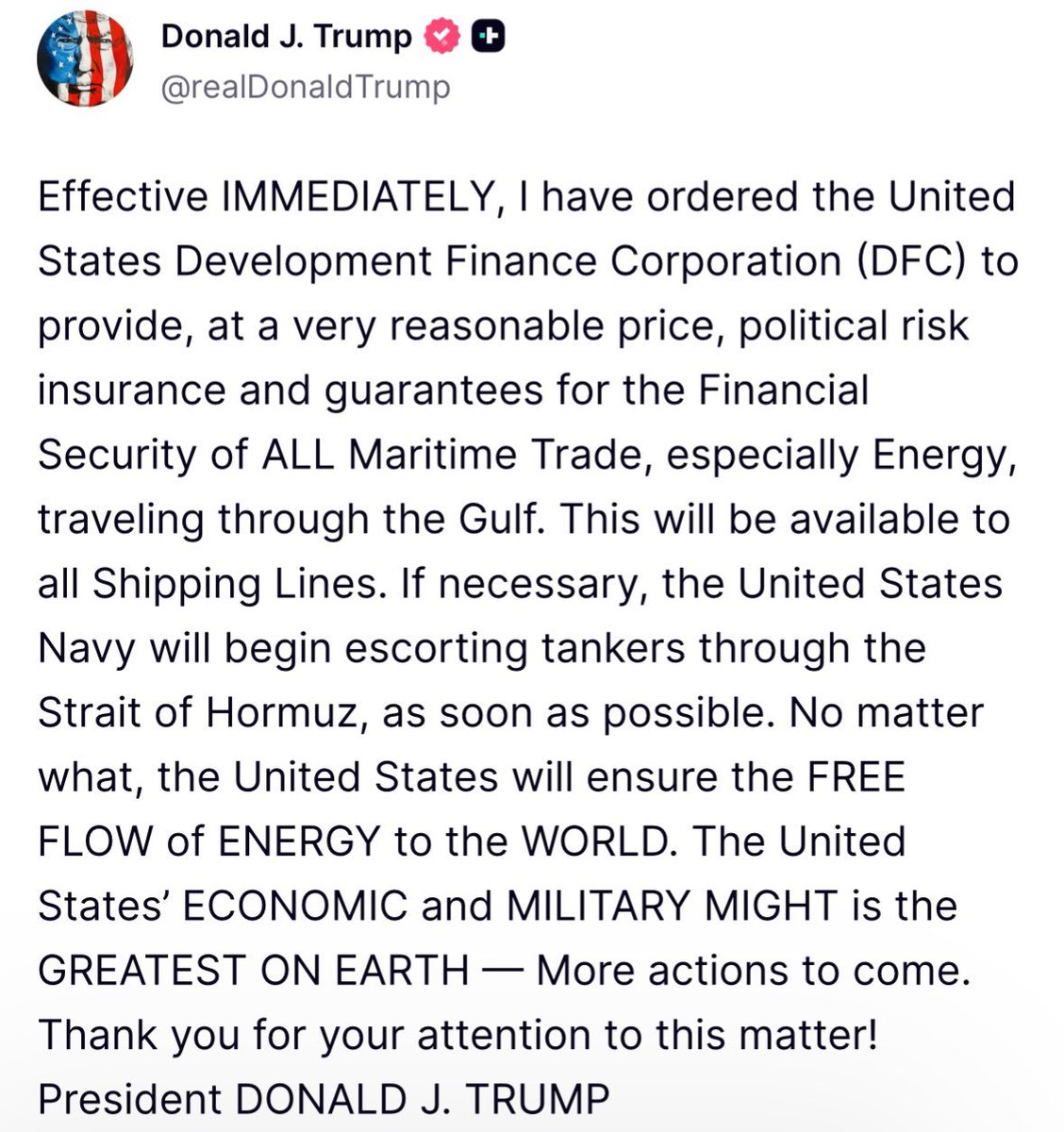
Trump ordered the U.S. Development Finance Corporation to immediately offer political risk insurance and guarantees to all maritime trade through the Gulf. Especially energy. Backed by Navy escorts if needed.
Read that through the lens of what I described yesterday.
The Strait didn't close because of missiles. It closed because the insurance market collapsed. P&I clubs pulled coverage, reinsurers withdrew, and the entire commercial shipping architecture froze.
This move doesn't address the military problem. It addresses the actuarial one.
The DFC is stepping into the void that Lloyd's and the London reinsurance market created when they pulled out. The U.S. government is effectively saying: we will underwrite what the private market won't.
No sovereign has attempted to replace the global marine war risk market in real time during an active conflict. Here's why the structural implications are significant:
1. It challenges Lloyd's dominance.
For centuries, London has been the center of gravity for marine insurance. Lloyd's and its reinsurers controlled pricing, terms, and risk appetite for global shipping.
That concentration is exactly what made the actuarial blockade possible. A handful of firms in one city froze global oil flows.
The DFC offering competitive political risk coverage to all shipping lines is a direct challenge to that architecture. If American-backed insurance proves cheaper and more reliable during crises, shippers may not return to London when the dust settles.
2. It breaks the actuarial blockade.
I said yesterday that China has massive leverage over Iran but zero leverage over Lloyd's. The same was true of every oil-producing and oil-consuming nation watching their economies choke.
This goes around the insurance market entirely. If the DFC covers the voyage and the Navy escorts the tanker, the ships sail. Oil flows. The spreadsheet blockade breaks.
3. It redirects billions in premium revenue.
War risk premiums in the Gulf are currently running at extreme multiples — 3× to 5× pre-conflict rates. Those premiums were flowing to London reinsurers who then pulled coverage anyway.
Now those premiums flow to Washington. At rates the DFC can set below the panicked London market, while still generating substantial returns. The same shippers get cheaper coverage. The revenue just changes continents.
4. It creates a chokepoint within the chokepoint.
The Strait of Hormuz is already the world's most critical energy bottleneck. If the U.S. is both insurer and naval escort, America controls access at two levels: physical security and financial coverage.
No other nation can replicate that. You need the world's dominant navy and a sovereign balance sheet large enough to backstop the risk. Only one country has both.
5. It reassures every stakeholder simultaneously.
Gulf producers were watching exports freeze. Asian and European consumers were watching energy prices spike. Both feared the Iran campaign would wreck their economies.
One announcement addressed all of them: your oil will move, your ships will be covered, and the rates will be reasonable.
Yesterday I described a system with no TARP, no Fed equivalent, no backstop at global scale.
This may be the first attempt to build one in real time, during the crisis itself.
The actuarial blockade just met a sovereign counterparty.
Chairman of the Joint Chiefs of Staff Gen. Dan Caine:
“We will now begin to expand inland, striking progressively deeper into Iranian territory.”
The next phase of operations against the Iranian regime is beginning.
Stay connected, follow @MOSSADil.
Fox News’ Jennifer Griffin: “[Israel] and the U.S. military have effectively suppressed the air defense systems or IADS over Tehran… The U.S. military carried out 900 strikes in 12 hours. That might be a record. The Israelis carried out 1,200 strikes in the past 24 hours, more than during the entire 12-day war last summer.”
#Freedom250 Signers of the Declaration of Independence: Robert Morris (1734-1806)
Known as “Financier of the Revolution,” Robert Morris was indispensable to the cause of American Independence—using his commercial and financial brilliance to almost single-handedly propel American war efforts through to final victory.
https://t.co/pDuiVwHSW2
Internet cut off, death toll in the thousands: Iran shuts itself off from the world
SpaceX has made Starlink free in Iran amid mass protests and an almost total internet blackout.
Authorities cut communications on January 8, even though Starlink is officially banned in the country.
Tehran is fast-tracking the construction of a closed “national internet” — only state-approved search engines, maps, messengers, and streaming platforms are allowed, all under strict censorship.
According to sources, a “skeleton version” is already operating and is even more isolated from the outside world than China’s model.
Meanwhile, the number of victims of the crackdown by security forces is rising rapidly.
CBS, citing sources inside Iran, reports 12,000–20,000 killed. Opposition media speak of figures as high as 50,000. These numbers cannot be verified due to the communications blackout.
Hospitals are overwhelmed. Doctors are forced to choose whom to save because of a shortage of operating rooms. One physician said that at some point the injuries suddenly became much more severe — as if security forces had been ordered to use live ammunition.
The US has requested intelligence from European allies on potential targets in the event of a strike on Iran, The Washington Post reports.
Trump has promised help, but without specifics. Saudi Arabia, Oman, and Qatar are urging Washington not to strike now — the oil monarchies fear chaos and a possible closure of the Strait of Hormuz.
Israel is also advising patience, believing the ayatollahs’ regime is not yet weakened enough for a decisive blow.