Alcohol, being disinhibiting, allows people to build trust between and have fun with each other when they wouldn’t be able to do so soberly. It helps to temporarily level status hierarchies and allows more social risk-taking, which is why people often meet future lovers when they’re drinking and drink when building relationships. People can be silly together when drinking, and people who aren’t ever silly are to my mind more prone to collective fanaticism.
There is a time and place for sobriety - work and time with children especially - but alcohol underpins a lot of the social interactions that make trust-based civilization possible.
Podcast is teamwork. Der US-Podcast Search Engine hat den unvergleichlichen Tim Howard interviewt - über unsere Arbeit an "Der Koch von Gaza". Hörenswert!
UND: Search Engine mochte unsere englische version so sehr, dass sie eine ganze Folge ausstrahlen! https://t.co/xOvhwHfaXO
Demis Hassabis on what was gained/lost in his role at DeepMind within Google. His answer here from March feels like the core of why he’s stepping into Chief Scientist and away from DeepMind CEO now:
Lord, grant me the cajones to one day begin my essay: “Let’s start from this premise: I am correct. My conception of cognition, AI, labor markets, the economy, human beings, and the world is perfect, and things will go exactly as I expect. I can’t prove this, but…”
Elon, I can give you many, many names of people who have died because of your aid cuts.:
*Yamah Freeman was a 23-year-old woman who died in childbirth because you stopped paying for the diesel for ambulances in her part of Liberia. I talked to her parents and sister in their village.
*Gbessey Kiadu, age 1, died of malaria because of your cuts in Liberia. I talked to his mom in her village.
*Ibrahim Koroma, an infant, died of AIDS in Sierra Leone after you interrupted HIV supplies. I talked to health workers who cared for him.
*Achol Deng was an 8-year-old girl with HIV in South Sudan who died when you cut funding for the health care worker who provided her medicines. I talked to him.
I could go on and on. In almost every village you go to in South Sudan, Uganda, Liberia, Sierra Leone or other countries I reported in, you find people dying because of aid cuts. I challenge you: Come with me on a reporting trip, and we'll talk to these moms and dads, and you'll see the dying children themselves. I think if you see the kids whose lives are at stake, maybe you'll change your mind.
As someone who used GitHub for years, went to work at GitLab, and was yelled at dozens of times for calling it a pull request (not a merge request) I know a lot about this topic
Today’s essay—it's a big one, maybe my favorite thing I’ve written all year: AMERICA'S CULT OF SELF ENHANCEMENT
I think we can all see it. Something vast and significant has changed with how Americans think about their health in the last few years after the pandemic.
It’s not just the surge in fitness trackers and biomarker dashboards and diagnostics ...
or the GLP-1 micro-dosing and peptide stacks and supplements ...
or the boom in testosterone therapy and hormone replacement therapy and preventative cosmetics and Botox ...
or the record high gym memberships and running clubs and annual all-time records in exercise time...
or even the celebrity status of 2020s health influencers and the commensurate rise of a Nietzschean ubermensch mentality among the business and tech elite.
It’s all of it, all at once. And it’s changing our relationship to our health, to our bodies, to the way we think about socialization, mortality, and what really matters in life.
Diet, exercise, and discipline are virtues—period. Longer lives are better—period. But if we're honest with ourselves, America’s new health craze is not entirely healthy. At the extreme—and the extreme is awfully common here—it verges on a cult of not only self enhancement but selfish enhancement, which pulls us into ourselves and away from other people.
Healthy living is good. But the cult of the enhanced self can easily slip into antisocial delusions of immortality, a futile attempt to outrun death that saps the life out of life.
https://t.co/bdKMTz1kii
I get why engineers are feeling a lot of existential angst right now over their craft, but I also have very limited patience for it.
This is literally a field that was obsessed with "disrupting".. and now the disrupters are being disrupted. Have perspective.
"AI IS GOING TO CURE CANCER."
I've heard this defense, or prediction, from several AI builders and boosters. But I've been frustrated by the lack of specifics. So I asked Eli Lilly CEO Dave Ricks how useful AI is at discovering new drugs.
His answer: Today's LLMs are "not particularly good" at the kind of biology necessary to develop therapies.
This is not an AI skeptic talking. Lilly has a huge deal with Nvidia to build a biology-focused supercomputer. You don't do that deal if you think the tech is a scam.
But as Ricks explains, ChatGPT, Claude, etc work so well because they're trained on the internet and other texts—a universe of human language. But there is no equivalent record of biology. There is no complete internet of human anatomy. And so while AI is promising at answering some diagnostic questions and doing radiology, it's not even close to great at doing the thing that it's boosters claim it will do.
The AI discourse is still overpopulated with people living in a future that doesn't exist (AI is thiiiis close to curing cancer) and people living in a present that doesn't exist (AI doesn't have a business model, it's an empty parlor trick that can't "think," etc).
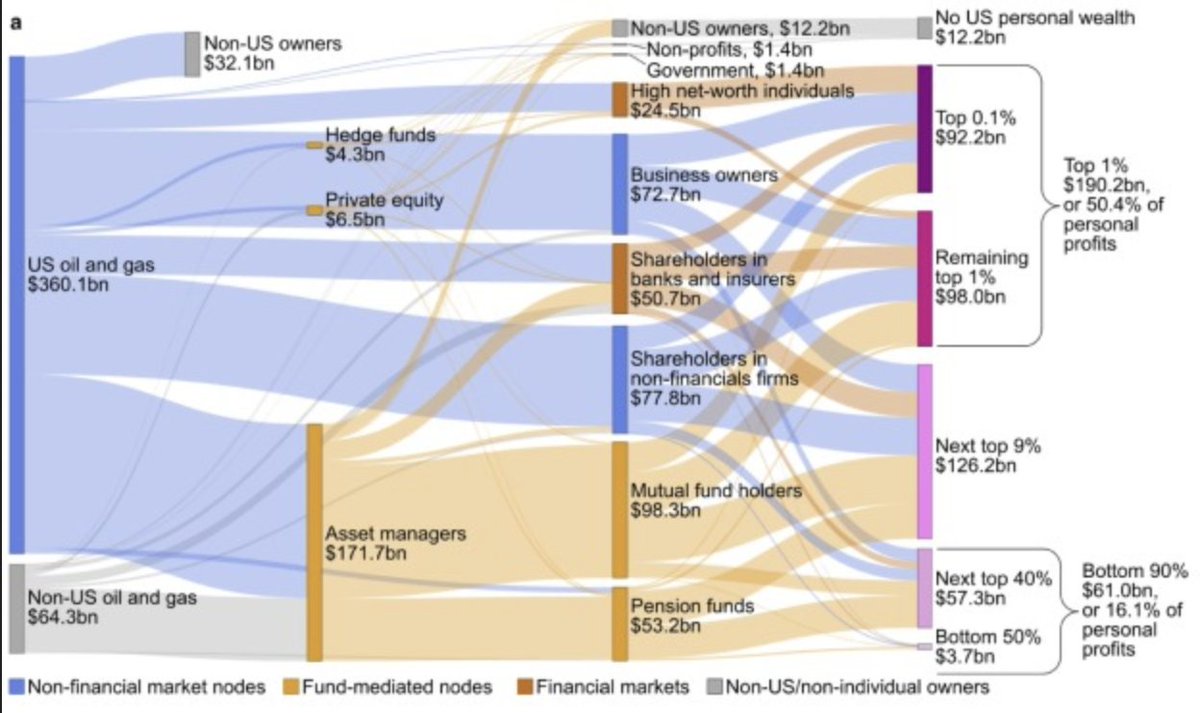
Who stands to loose from a green transition? The biggest beneficiaries of fossil fuel profits, the richest of the rich. 50% of profits go to top 1% of wealth owners.
My co-author @GregorSemieniuk will present our paper and more at the @LSEEI on March 3, 6.30 PM. Go if you can!
WOW!!!
Never thought we would hear this level of honesty from a Western leader, and certainly not Canada, given the direction of Canada in the past 25 years. Canada's shift towards multialignment is quite clear - and this level of honesty from Carney on Western "fiction" about the old order will be warmly welcomed in much of the Global South:
"We knew that the story about the rules-based order was partially false... We knew that international law applied with varying rigour depending on the identity of the accused and the victim. This fiction was useful [because of the goods provided by American hegemony]... So we placed the sign in the window. We participated in the rituals. And we largely avoided calling out the gaps between rhetoric and reality. This bargain no longer works. Let me be direct. We are in the midst of a rupture, not a transition... You cannot live within the lie of mutual benefit through integration when integration becomes the source of your subordination."
I'm happy to share that we (@AnthropicAI) are investing $1.5 million in support of the Python Software Foundation and open source security.
Python powers so much of the AI industry. Supporting the folks that make our work possible is an honor.
There's always this tension between engineers and execs on buy vs build.
Engineer: "no vendor does what we need, let's just build it."
Exec: "it's a poor ROI, let's buy something and work around it."
I have a feeling these AI tools might tilt the balance back to devs building
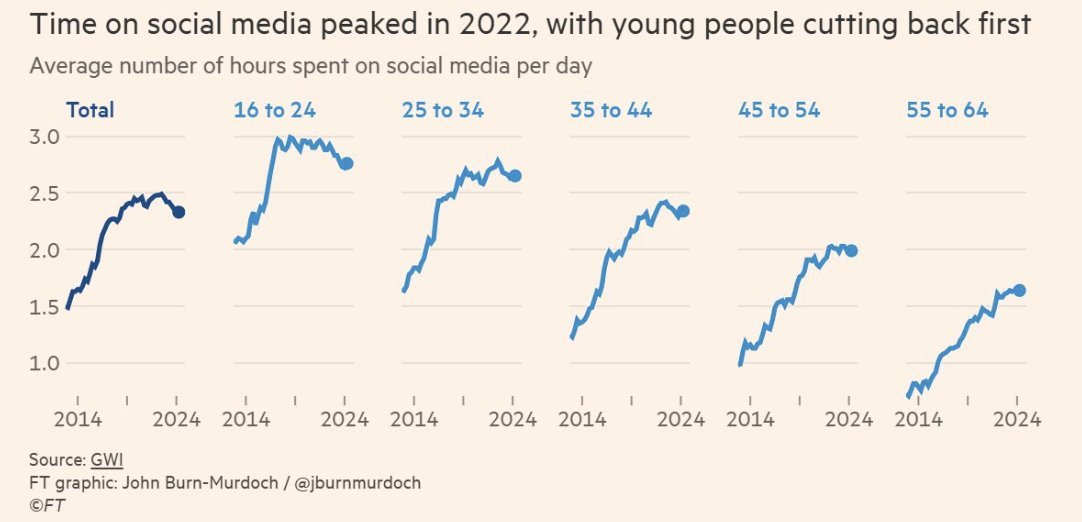
THIS chart is the CLEAREST signal of where the internet is heading.
social media time is SHRINKING for the first time in HISTORY, and young people are leading the pullback.
Brainrot is OUT.
they grew up online, saw the full cycle of social platforms, and learned early that endless scroll doesn’t make you happier or smarter.
they’re the LEADING indicator. their parents will follow in 3-5 years.
AI slop is the nail in the coffin.
every feed feels synthetic familiar faces, identical voices, recycled ideas. the “factory smell” of it all finally broke people’s curiosity.
but there’s an upside. every trend creates its anti-trend.
attention is shifting back to things that feel real, slow, and intentional.
people are paying for spaces that make them feel grounded, informed, and connected again.
the next $100M+ companies will engineer density, trust, and time well spent. they’ll build containers for meaning, then use AI to keep them organized, not optimized.
the internet’s oldest assumption that more engagement equals more value is breaking.
the white space i think is...
• "slow media" formats: weekly briefs, serialized content etc
• private groups that operate like clubs with applications and rituals
• provenance and identity layers that verify real creators and sources
• brands with offline gravity like real events, real belonging
• curated directories and vetted marketplaces
• paid memberships that deliver depth
• note: we share business ideas around this on @ideabrowser
• IRL anything - dinners, meetups, shared experiences
young people are abandoning social media faster than their parents are discovering it.
If you understand what that means, that's a big deal.
i can't stop thinking about this FT/GWI chart.
brainrot is OUT.
meaning is IN.
Here's the danger of social media. It allows people to publish their internal monologues. Our internal monologues and fantasies are often incredibly ugly. People go to therapists because they feel so guilty about them, and one of the tasks of a therapist is to explain that 1/
🚨 PhD Position at the University of Amsterdam 🚨
Join my team as a computer scientist / computational social scientist working on LLMs, social media, and politics.
Freedom, impact, and an inspiring environment at one of Europe's leading universities
🔗 https://t.co/QAsFAwi9Ql
The positive thing about AI tooling going mainstream and setting expectations high (e.g. "anyone can build software with AI") is that a large group will learn what us devs know already:
Creating good software is hard and it's hard to explain to outsiders in a way they understand
We built the simplest possible social media platform. No algorithms. No ads. Just LLM agents posting and following.
It still became a polarization machine.
Then we tried six interventions to fix social media.
The results were… not what we expected.
https://t.co/6CQecBiAwe