🌙 Explore os segredos da Lua!
Se você se fascina por mistérios lunares, vida extraterrestre ou fenômenos inexplicáveis… esses livros vão levar você além da superfície! 📚
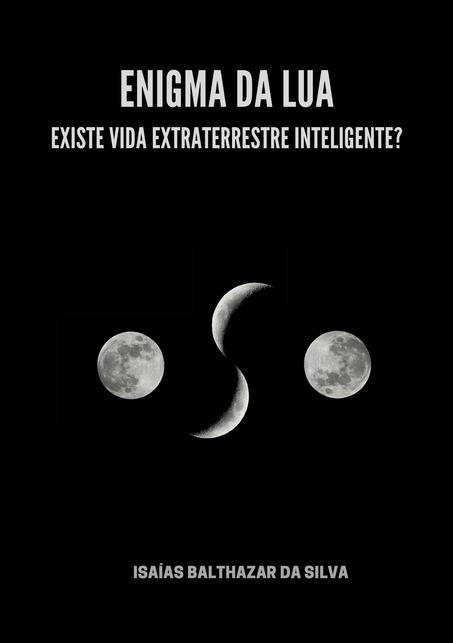
1️⃣ ENIGMA DA LUA
🔍 Uma jornada entre ciência, observação e reflexão sobre vida extraterrestre. Entre realidade e especulação, este livro questiona o que realmente sabemos sobre o cosmos.
Leia aqui: https://t.co/f4WDutSIdf
2️⃣ A LUA REVELADA: A POSSÍVEL TECNOASSINATURA NA CRATERA WEBB
🛸 Investigação independente sobre anomalias lunares — descobertas intrigantes na cratera Webb desafiam explicações naturais.
Leia aqui: https://t.co/cwKj39aZiK
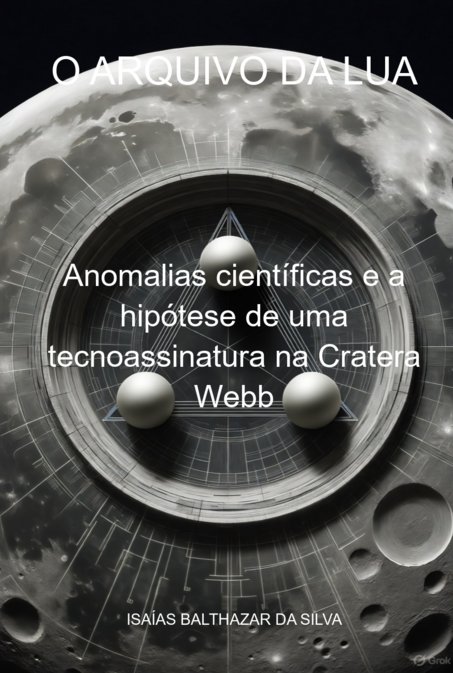
3️⃣ O ARQUIVO DA LUA
📜 Documenta registros e dados lunares inéditos, reunindo pesquisas e análises que transformam nossa compreensão sobre a Lua e seus mistérios.
Leia aqui: https://t.co/Tnw7HP4O8B
📖 Disponíveis em formato físico e e‑book no Clube de Autores!
👉 Confira e compre: https://t.co/YofuKCMH7W
✨ Descubra, questione e explore o desconhecido! 🌠
#Lua #Mistério #Astronomia #Tecnoassinatura #Ufologia #Livros #ExploraçãoEspacial #enigmadalua
🇺🇸
🌕 Unlock the Moon’s Secrets!
Fascinated by lunar mysteries, extraterrestrial life, or unexplained phenomena? These books take you beyond the surface! 📚
1️⃣ ENIGMA DA LUA
🔍 Bridging science and speculation, this book challenges what we think we know about life beyond Earth and invites deep cosmic reflection.
Read here: https://t.co/f4WDutSIdf
2️⃣ A LUA REVELADA: A POSSÍVEL TECNOASSINATURA NA CRATERA WEBB
🛸 Independent investigation into lunar anomalies — remarkable discoveries in Webb crater defy natural explanations.
Read here: https://t.co/cwKj39aZiK
3️⃣ O ARQUIVO DA LUA
📜 Documents previously unpublished lunar records, compiling research and analysis that transform our understanding of the Moon and its mysteries.
Read here: https://t.co/gKFFLdgMS6
📖 Available in print and e‑book at Clube de Autores!
👉 Explore and buy: https://t.co/YofuKCMH7W
✨ Discover, question, and explore the unknown! 🌠
#MoonMysteries #Astronomy #TechnoSignature #Ufology #Books #enigmadalua
New research challenges everything we know about the Big Bang 💥
If proven, this theory could mark a shift from the Big Bang as the origin of everything.
In a study published in Physical Review D, a team led by Professor Enrique Gaztanaga proposes the "black hole universe" theory, suggesting that our universe emerged from a gravitational collapse and cosmic “bounce” within a parent universe’s black hole.
Rather than a singularity—an infinite point where physics breaks down—the researchers argue that quantum principles, like the Pauli exclusion principle, prevent total collapse, causing matter to rebound and create a new universe.
This bounce model, developed without resorting to speculative physics beyond general relativity, naturally generates features attributed to inflation and dark energy. It also predicts a slightly curved universe—an idea that could be tested by upcoming missions like the European Space Agency's Arrakihs. If confirmed, it would imply that our universe is part of a never-ending cosmic cycle, reframing the Big Bang not as a beginning, but as a transformation. “We are not witnessing the birth of everything from nothing,” Gaztanaga notes, “but rather the continuation of a cosmic cycle.”
The observable universe spans more than 93 billion light-years from end to end.Humans have ventured just 1.3 light-seconds from Earth.That tiny gap—the distance between our planet and the Moon—remains the absolute farthest any human has ever traveled into space. Every astronaut who has left Earth’s orbit has stayed within a bubble so small that light itself crosses it in little more than a heartbeat.Beyond that fragile shell lies a reality so immense it borders on the incomprehensible.The observable universe, the only part we can see, stretches roughly 93 billion light-years across. Yet this colossal sphere is not the whole story. It is merely the volume from which light has had time to reach us since the Big Bang. Most cosmologists believe the true universe extends far, far beyond—perhaps infinitely—though the relentless expansion of space means light from those distant regions may never arrive.Every pinpoint of light captured by our most powerful telescopes is rarely a single https://t.co/gvhTbal2jR is almost always an entire galaxy—home to hundreds of billions of suns, along with trillions of planets, moons, and worlds we can scarcely imagine. The total number of stars in the observable universe exceeds all the grains of sand on every beach on Earth, combined.And yet, everything we can see and touch makes up only a whisper of reality.According to our best models, ordinary matter—every galaxy, star, planet, and living creature—accounts for just 5 percent of the cosmos. About 27 percent is dark matter, the invisible scaffolding that holds galaxies together. The remaining 68 percent is dark energy, the mysterious force accelerating the expansion of space itself.Even our swiftest machines barely scratch the surface of these distances.NASA’s Parker Solar Probe, the fastest human-made object ever built, screams along at nearly 690,000 kilometers per hour during its closest solar passes. At that blistering speed, a journey to Proxima Centauri—the nearest star beyond our Sun, a mere 4.24 light-years away—would still take roughly 6,000 years.We have barely stepped off the porch.The cosmos waits, ancient and immense, daring us to find a way forward.
Barnard's E Nebel ist nicht so leicht bei der Mitternachts Dämmerung und Wolkenschleier auszumachen! Mit Nikon D6 und Nikkor 200-500, 500 mm 90 NEF Dateien 2sec in Siril bearbeitet!🌟⭐️✨💫🤩
⚡Scientists Just Took Fusion Energy One Step Closer
Scientists in the UK have achieved a major fusion energy breakthrough by using 3D magnetic coils to stabilize super-hot plasma—one of the biggest challenges in fusion research. This world-first achievement could help keep fusion reactions running longer and more efficiently, bringing us a step closer to clean, near-limitless energy.
We're not powering cities with fusion yet, but this breakthrough shows that the dream of safe, low-carbon fusion power may be closer than ever. Could this be the beginning of a new energy age?
Source: UK Atomic Energy Authority. (n.d.). World first use of 3D magnetic coils to stabilise fusion plasma.
🚨: AI Just Discovered Hidden Quantum Behaviors That Supercomputers Couldn't See ⚛️🤖
Researchers at the University of Washington used artificial intelligence to uncover large-scale quantum phenomena hidden inside stacks of twisted 2D materials.
By modeling layered sheets of molybdenum ditelluride, the AI was able to analyze structures far too complex for traditional computational methods. The simulations revealed that adding more twisted layers creates entirely new collective quantum behaviors driven by intricate repeating patterns known as moiré structures.
What if most observers in the universe aren’t real?
Some ideas in physics sound strange because they are speculative. Others sound strange because they take our best theories seriously and follow them to uncomfortable conclusions.
Boltzmann brains belong to the second category.
The idea begins with a simple fact from thermodynamics: rare fluctuations can happen. In a system with enough time, particles can briefly arrange themselves into unlikely configurations. Most of the time, disorder increases. That is the second law of thermodynamics. But on very long timescales, tiny local reversals of disorder are not impossible. They are just fantastically unlikely.
Ludwig Boltzmann, one of the founders of statistical mechanics, helped show that entropy is not just a vague measure of “messiness.” It is connected to probability. A high-entropy state is likely because there are many ways to arrange a system that look disordered. A low-entropy state is unlikely because there are very few ways to arrange matter into something ordered.
That insight changed physics.
But it also opened the door to a very strange question.
If the universe lasts long enough, and if random fluctuations can occasionally produce ordered structures, could a conscious observer appear by chance?
Not a person born from evolution. Not a brain inside a skull produced by biology. But a temporary, self-aware structure assembled by a random fluctuation in a vast, old universe. It might exist for a moment, complete with memories, perceptions, and the illusion of a coherent past.
That hypothetical object is called a Boltzmann brain.
At first, it sounds absurd. And it is absurd in any ordinary sense. The probability of a functioning brain fluctuating into existence from thermal noise is unimaginably tiny. But the problem is not whether it is likely in normal time. The problem is what happens if the universe has an almost unlimited future.
In an extremely long-lived universe, even absurdly rare events may eventually occur. If ordinary observers like us exist only during a finite period, while random fluctuation observers can appear over an unlimited future, then the number of Boltzmann brains could eventually outnumber ordinary observers.
And that is where the trouble begins.
If a cosmological model predicts that most observers are Boltzmann brains, then statistically we should expect to be one of them. But that would mean our memories, our perception of a consistent universe, and the evidence we think we have for cosmic history could all be random artifacts.
That is not just weird.
It is a serious problem.
Science depends on the assumption that our observations are broadly reliable. If a theory predicts that most observers are disordered fluctuations with false memories, then the theory undermines the very observations used to support it. In other words, a universe dominated by Boltzmann brains becomes self-defeating.
This is why physicists use Boltzmann brains as a kind of stress test for cosmological theories.
They are not usually proposed as real objects we expect to find. Instead, they are used to ask whether a model of the universe gives sensible probabilities for observers. A good cosmological model should predict that observers like us arise from ordinary cosmic evolution: stars, planets, chemistry, biology, and long histories. It should not predict that most observers are isolated freak fluctuations in the distant future.
The problem becomes especially relevant in universes with dark energy. If dark energy behaves like a true cosmological constant, the universe may approach a state known as de Sitter space, expanding forever while maintaining a cosmic horizon and a tiny temperature. In such a universe, thermal fluctuations can continue for unimaginable lengths of time.
That raises the question: over infinite time, do Boltzmann brains become inevitable?
Different proposed solutions exist. One possibility is that the universe does not last forever in the required way. It might decay into another vacuum state before Boltzmann brains dominate. Another is that our understanding of quantum gravity, horizons, or probability in cosmology is incomplete. Some physicists argue that the correct measure of probabilities in an eternally inflating universe may avoid the problem, though this remains deeply debated.
There is also a more direct possibility: any theory that predicts Boltzmann brains outnumber ordinary observers should simply be rejected.
That may sound philosophical, but it has teeth. If a theory predicts that our observations are probably unreliable, then it cannot consistently be used to explain those observations. This is why the Boltzmann brain problem matters. It is not just a bizarre thought experiment. It exposes a tension between cosmology, probability, entropy, and what it means to be an observer.
The most unsettling part is that Boltzmann brains force us to ask why our universe began in such a special state.
The early universe had extraordinarily low entropy. That low entropy is what allowed structure to form, stars to burn, planets to develop, and life to emerge. If the universe had started in a more typical high-entropy state, none of that would have happened. So the existence of ordinary observers like us is tied to one of the deepest mysteries in physics: why did the universe begin so ordered?
Boltzmann brains are a warning sign.
They remind us that not every mathematically possible universe is a physically acceptable one. A model must not only fit the data. It must also explain why observers capable of measuring that data arise in a coherent cosmic history.
So are we Boltzmann brains?
Almost certainly not.
The world we observe is too consistent, too structured, and too deeply connected across scales. The cosmic microwave background, the evolution of galaxies, the birth of stars and planets, biology, and memory all fit into a coherent history. That is exactly what we expect if we are ordinary observers in a universe with a real past.
But the fact that we have to ask the question at all is revealing.
Boltzmann brains are not really about brains appearing in space.
They are about whether our theories of the universe can explain why reality is ordered enough for observers to exist in the first place.
And that makes them one of the strangest and most useful thought experiments in modern cosmology.
NGC 4725 and Its Entourage of Galaxies
Telescope/Mount: Skywatcher 150/750 Heq5 pro
📸294 MC PRO
Integration&Filters: 185 x 300" #Optolong L-QEF
Asiair mini
Guide Scope: Take 60/240
Guide: ZWO224 with UV/IR cut
Location: Faggiano (TA)
Bortle Class: 6
Credit:Raffaele Calcagno
🛎️ It's quiz time! Webb has been helping astronomers study star clusters in these four galaxies, revealing that the most massive star clusters emerge the fastest 🏃♂️➡️
NEWS🚨: CERN scientists during an experiment discovered signs of a parallel universe within a quantum simulation that appears, intriguingly, to know the presence of observers
⚛️ Teleportation Is No Longer Just Science Fiction
Scientists at the University of Rochester and Purdue University have taken a major step toward real teleportation. Using a strange quantum phenomenon called entanglement, they successfully transferred quantum information between electrons.
The shocking part? Nothing physically moves. Instead, the information is recreated somewhere else.
Human teleportation is still far away, but this breakthrough is making the impossible seem a little more possible.
Source:
University of Rochester & Purdue University. National Science Foundation-funded quantum teleportation research
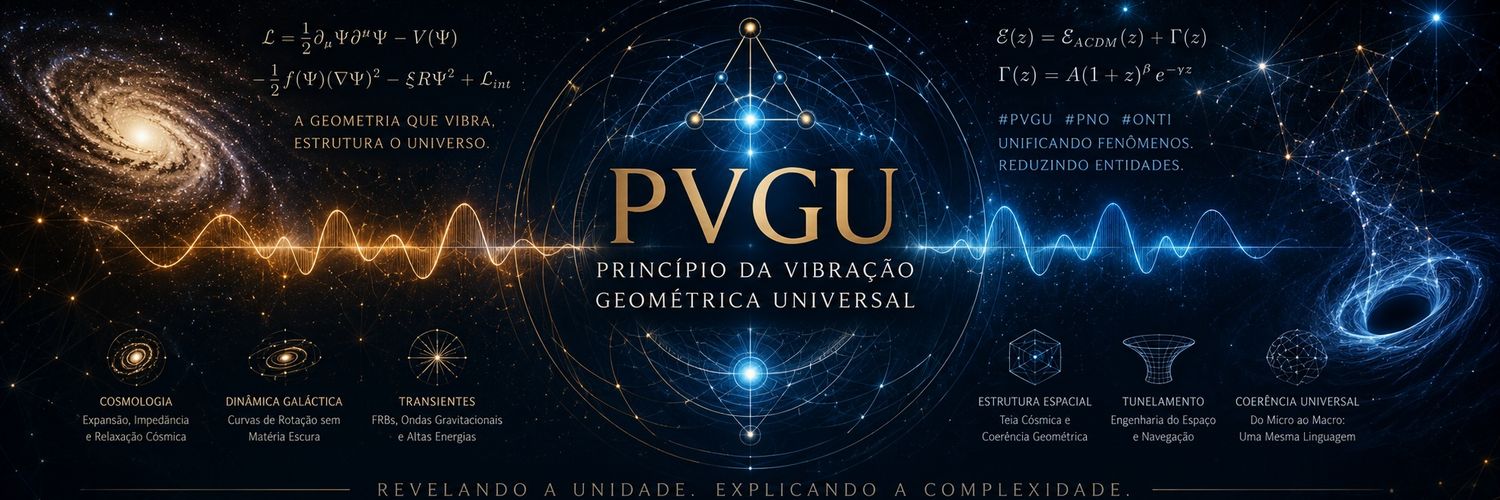
#PVGU
PVGU and Dark Matter
An alternative cosmological interpretation
Modern cosmology states that approximately 95% of the universe is not directly observable. To explain galactic rotation curves, gravitational lensing, and large-scale structure formation, the concept of dark matter was introduced.
However, despite decades of experimental efforts, no dark matter particle has been conclusively detected. This suggests that the issue may be conceptual rather than purely experimental.
The dark matter problem
Within the ΛCDM model, dark matter is treated as invisible mass interacting gravitationally but not electromagnetically. While successful phenomenologically, this approach relies on entities that remain unobserved.
PVGU as an interpretative framework
The Universal Geometric Vibration Principle (PVGU) proposes that the effects attributed to dark matter may emerge from the gravitational structure of the vacuum itself.
https://t.co/6TlZH8ErGd
https://t.co/eYKBnwXepw
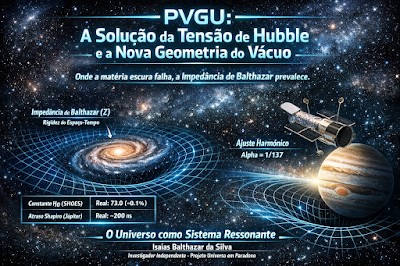
#PVGU: Solving Hubble Tension and the Spacetime Rigidity
Dark Matter as Geometric Impedance.
Hubble Tension is not a measurement error, but a sign that the Lambda-CDM model is incomplete. PVGU demonstrates that Dark Matter is actually Geometric Impedance (Z) — the elastic resistance of the vacuum itself.
By applying the Fine Structure Constant (Alpha = 1/137) as a scale factor, we reached a perfect match with local expansion data (73.0 km/s/Mpc) and validated the model with Jupiter's Shapiro delay (205.593 ns).
🚨 Scientists believe a hidden supermassive black hole may be on a collision course with the Milky Way.
If true, what do you think this means for the future of our galaxy? Is it a distant cosmic event with little impact on us, or could it reshape our understanding of the universe? 🤔🌌
#enigmadalua
Balthazar da Silva, I. (2026). Estruturas Esféricas na Cratera Webb: Uma Análise Multissensorial sob o Paradoxo da Naturalidade Operacional (PNO) e o Índice de Tensão da Naturalidade Operacional (ONTI) (1st ed.). Zenodo. https://t.co/hpzouyrBvF
O Universo em Paradoxo
https://t.co/H17zkpYee9