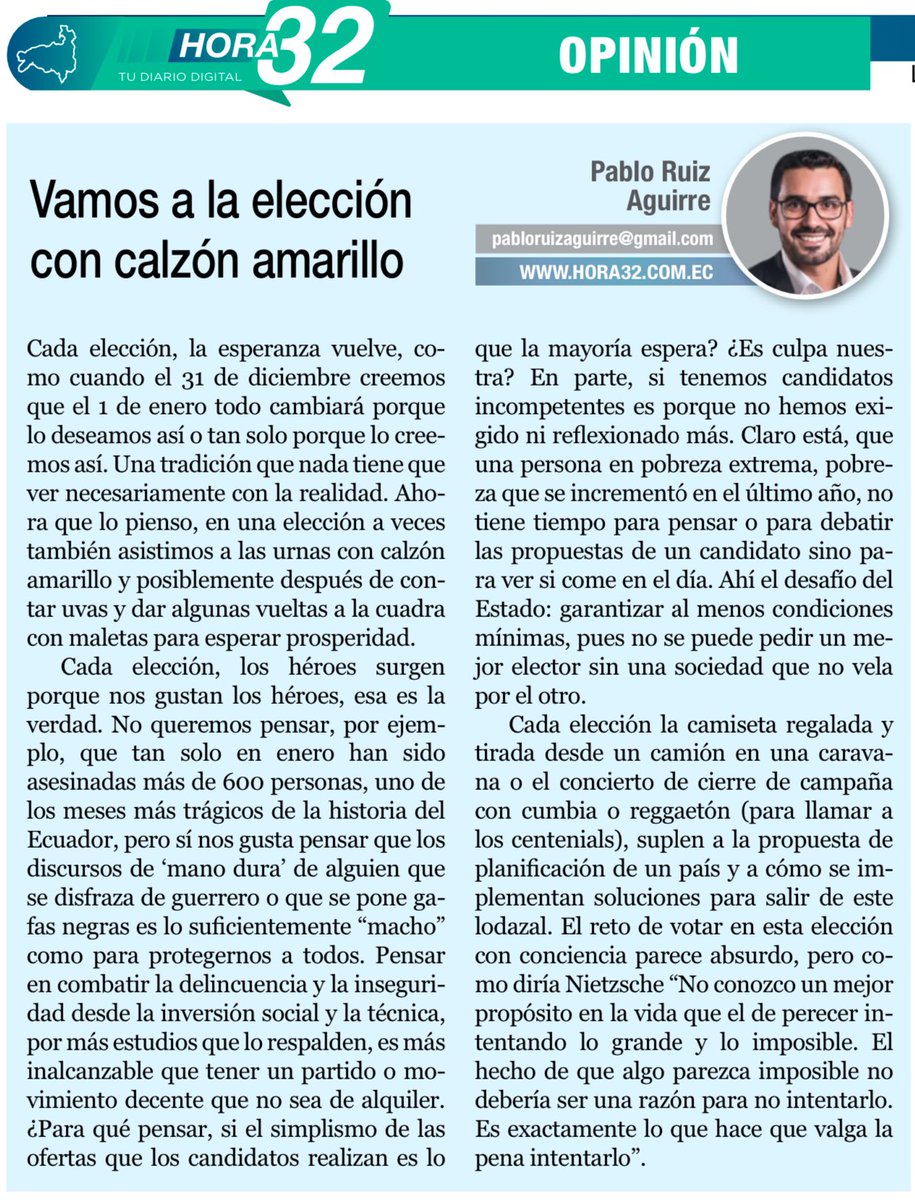
VAMOS A LA ELECCIÓN CON CALZÓN AMARILLO
Cada elección, la esperanza vuelve, como cuando el 31 de diciembre creemos que el 1 de enero todo cambiará porque lo deseamos así o tan solo porque lo creemos así. Una tradición que nada tiene que ver necesariamente con la realidad. Ahora que lo pienso, en una elección a veces también asistimos a las urnas con calzón amarillo y posiblemente después de contar uvas y dar algunas vueltas a la cuadra con maletas para esperar prosperidad.
Cada elección, los héroes surgen porque nos gustan los héroes, esa es la verdad. No queremos pensar, por ejemplo, que tan solo en enero han sido asesinadas más de 600 personas, uno de los meses más trágicos de la historia del Ecuador, pero sí nos gusta pensar que los discursos de mano dura de alguien que se disfraza de guerrero o que se pone gafas negras es lo suficientemente “macho” como para protegernos a todos. Pensar en combatir la delincuencia y la inseguridad desde la inversión social y la técnica, por más estudios que lo respalden, es más inalcanzable que tener un partido o movimiento decente que no sea de alquiler. ¿Para qué pensar, si el simplismo de las ofertas que los candidatos realizan es lo que la mayoría espera? ¿Es culpa nuestra? En parte, si tenemos candidatos incompetentes es porque no hemos exigido ni reflexionado más. Claro está, que una persona en pobreza extrema, pobreza que se incrementó en el último año, no tiene tiempo para pensar o para debatir las propuestas de un candidato sino para ver si come en el día. Ahí el desafío del Estado: garantizar al menos condiciones mínimas, pues no se puede pedir un mejor elector sin una sociedad que no vela por el otro.
Cada elección la camiseta regalada y tirada desde un camión en una caravana o el concierto de cierre de campaña con cumbia o reggaetón (para llamar a los centenials), suplen a la propuesta de planificación de un país y a cómo se implementan soluciones para salir de este lodazal. El reto de votar en esta elección con conciencia parece absurdo, pero como diría Nietzsche "No conozco un mejor propósito en la vida que el de perecer intentando lo grande y lo imposible. El hecho de que algo parezca imposible no debería ser una razón para no intentarlo. Es exactamente lo que hace que valga la pena intentarlo”
Teachers are vital to ensure children's learning needs are met.
But beyond the classroom, teachers can be a driving force in #TransformingEducation through inclusive policy dialogue.
This is how: https://t.co/pv2AiyLhQd
#WorldTeachersDay#TeachersTransform
El grupo GEISER de la #UAH estudia las vulnerabilidades de las instalaciones solares, actualmente en plena expansión, y cómo protegerlas de ciberataques, ya que un hacker podría robar datos de redes domésticas o provocar un apagón en plantas energéticas. https://t.co/2idufyeOar
I did a thing this term where I told my students they were allowed to use ChatGPT. The catch was, they had to tell me about it in a reflection when they handed in their paper. This is a thread about how it all went.
University College London is reimagining assessment and feedback in response to the rise of generative AI. Read the full story 👉 https://t.co/FMYTlLkNhB
Backpropagation and Gradient Descent - The dynamic duo of deep learning
Ever wondered about the mathematics behind NN training? Here is a simplified way to understand the process.
1. Initialize the NN: Create a neural network and initialize it with random weights and biases.
2. Feedforward pass: NN predicts an outcome based on input. For example: does the input image have a cat?
3. Calculate Loss: At first the prediction is a random guess. The error between the prediction and reality is called loss. If the network predicts there is no cat in an image of a cat, loss is high and vice-versa
4. Backpropagation: This is where the magic happens. Fundamentally, you are calculating how much each parameter (weight or bias of each node) in the network contributed to the loss or error from step 2.
You move backwards from the last layer using the chain rule of calculus and compute "gradients". Basically, you are calculating the gradient of the loss function with respect to each weight or bias
5: Gradient Descent: We now adjust the weights and biases based on the gradients calculated in the last step. Typically this is done by multiplying the gradient by a small factor called learning rate. The basic idea is to reduce the error or loss.
6. Iteration: We repeat steps 2 to 6 for all the data points in your training set multiple times (epochs). Hence, your NN is likely to be a better fit, if you have more training data points.
7. Evaluation: You should always keep aside some data points from your original training set for testing. Here we evaluate how the NN predicts data points, it's never been trained on
If your error on the test set is low, fundamentally you have learnt the weights and biases of a model that predict the output given specific inputs and you can now use it to predict on unseen data
YT videos are a great way to learn more
Gradient descent: https://t.co/h30r4t7J1V
Back prop + Pic credit - https://t.co/vlhvZdf1eV
Calling all #OpenEducation#Leaders!
Are you passionate about advancing open education at community and technical colleges?
@OpenEdGlobal is seeking candidates for the position of Program Director of @CCCOER
More info 👉🏼 https://t.co/TNCWQ9sXnM
En una época en donde esperamos que todo se solucione por arte de magia es importante recordar cómo podemos hacer nuestra parte.
Comparto un artículo de reflexión.
This year’s @WorldBank-@IMFNews Annual Meetings featured top-level discussions focusing on investing in education, accelerating climate finance, promoting inclusive growth & responding to the food & fuel crises.
Listen to the highlights on The #DevelopmentPodcast:






![KirkDBorne's tweet photo. Foundations of #MachineLearning - Lecture Notes: https://t.co/gFGL5Zue7u [download PDF]
————
#AI #BigData #DataScience #Statistics #LinearAlgebra #Calculus #Mathematics #DeepLearning #NeuralNetworks #DataScientists https://t.co/eqUnSLEnLP](https://pbs.twimg.com/media/F3b5wT2XEAAlFuX.jpg)



![KirkDBorne's tweet photo. [Free PDF Download] #Python Machine Learning Projects: https://t.co/txdGjH4HQK
————
#BigData #DataScience #AI #MachineLearning #DataScientists #Coding #100DaysOfCode https://t.co/gnD15FO5YW](https://pbs.twimg.com/media/FoL3q9jWQAAN1jz.jpg)