Most people are aging 10–20 years faster than they should.
Not because of bad genetics.
Because nobody told them what’s actually happening inside their cells.
I’m AgeLess Intel
I decode the most important longevity science from Harvard, Stanford, and the Weizmann Institute — and translate it into plain English.
Every day. Free. No PhD required.
Here’s exactly what I cover:
→ The hidden mechanisms accelerating your cellular age
→ The exact protocols elite biohackers actually use (made simple)
→ The clinical data that reverses biological decay
→ The daily habits quietly wrecking your mitochondria
Your biological age is not fixed.
The research proves it. And now you have the intel to fight back.
Follow for daily longevity science — decoded.
Free weekly briefings → https://t.co/nmfHbsrsZm
Chemotherapy doesn’t always kill cancer cells.
Sometimes it turns them into senescent “zombies” that stop dividing but secrete inflammatory signals (SASP) that may fuel relapse and treatment resistance.
That’s why senolytics may matter most in oncology — not anti-aging.
The “one-two punch” framework:
1️⃣ Chemo/radiation induces therapy-induced senescence (TIS)
2️⃣ A senolytic clears the lingering cells before they reshape the tumor environment
What the evidence supports:
✓ TIS is highly documented
✓ Senolytics clear senescent cells in mice
✓ SASP inhibition can restore anti-PD1 efficacy in preclinical models
What it does NOT yet support:
✗ No Phase 3 cancer trial has proven survival benefit ✗ No FDA-approved senolytic exists
✗ Self-experimentation is completely unsupported
Senolytics are an investigational pharmaceutical class, not longevity supplements.
Full clinical breakdown, evidence tier mapping, and compound safety profiles: → https://t.co/M8WtKbLVIv
#Oncology #Geroscience
The Fix: Progressive resistance and intentional mass protection.
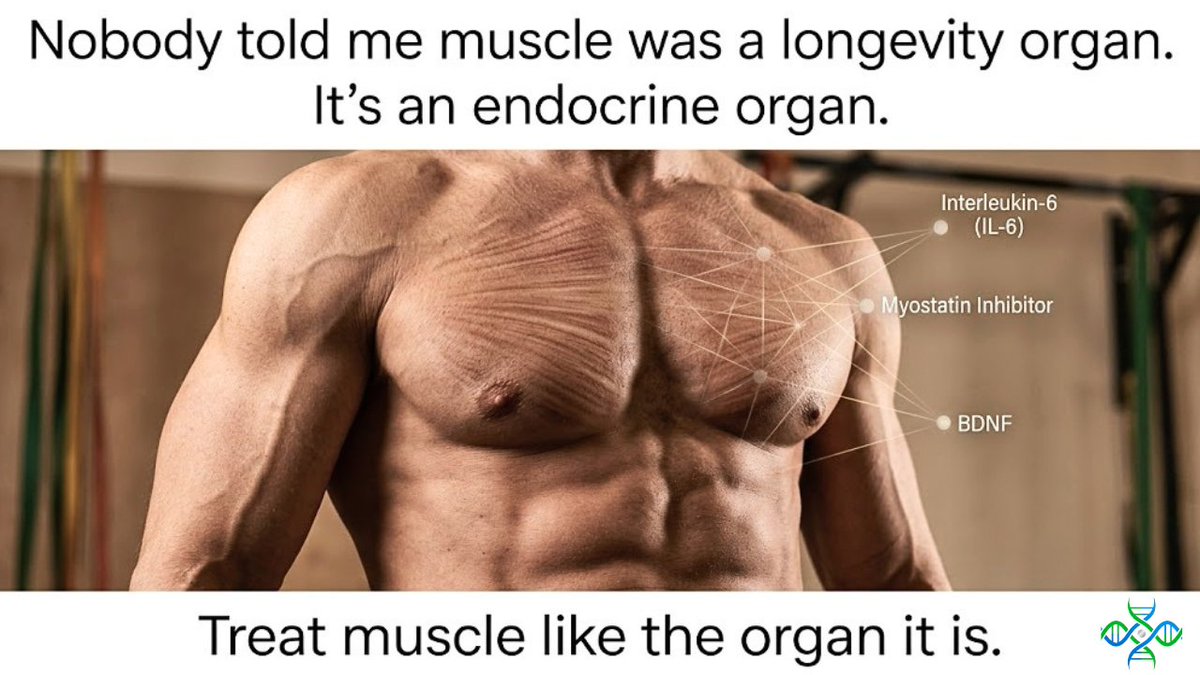
Treating muscle like an organ isn’t a fitness hack; it’s an essential longevity protocol.
If you're analytical and focused on maximizing your biological health span without the noise, lock in the follow button on my profile for your daily 60-second science briefing.
Nobody told me muscle was a longevity organ.
I thought it was vanity. The research says otherwise.
Lose muscle, and you lose more than strength. You lose metabolic protection. 🧵
This is why sarcopenia matters:
Less muscle means worse blood sugar control, less stability, more falls, and less system resilience.
It’s system failure in slow motion. 📊
Hair loss on the legs or nail changes are not a diagnosis of heart failure.
Peripheral Artery Disease (PAD) is a completely separate vascular issue. If someone is genuinely concerned about cardiovascular risk, they should seek objective clinical testing like an Ankle-Brachial Index (ABI) - not a panicked marketing funnel. 🔬
The blended fruit myth needs a systems biology lens. 🍌🔬
Composition matters far more than form. Long-term glycemic control and overall diet quality influence aging risk far more than whether fruit is blended or whole.
“Liquid calories” are often less filling, but adding protein, fat, and fiber to a blend usually moderates the glucose response and improves satiety.
Satiety is mostly about nutrient density and overall meal composition, not mechanical form alone.
Waking up tired after 8 hours isn’t always a sleep-duration problem.
It’s often a common cause of morning grogginess known as sleep inertia — a temporary deficit in alertness that occurs when waking abruptly from deep, slow-wave sleep.
🔬 THE CLINICAL DATA:
Research from the University of Colorado Boulder suggests that the acute cognitive impairment immediately after waking from deep sleep can temporarily rival the grogginess of low-level alcohol intoxication.
While the most severe deficits typically peak in the initial minutes, this lagging state can blunt morning performance during the first hour of your workday. Total time in bed doesn’t automatically override this timing mismatch.
🧠 THE SYSTEM MECHANISM:
During slow-wave sleep, the brain is in a deeply restorative state dominated by high-amplitude delta waves. Forcing an abrupt awakening mid-cycle disrupts the natural transition layout, leaving your neurochemistry temporarily lagging behind your conscious state.
📉 THE ACTIONABLE FRAMEWORK:
• Maintain a consistent wake window 7 days a week to help lock in circadian rhythms.
• Expose your eyes to bright morning light early to signal the suppression of melatonin.
• Eliminate snooze cycles, which repeatedly force the brain back into fragmented, low-quality sleep entry phases.
• Deploy caffeine with intention, allowing your natural morning cortisol to rise first.
The real metric isn’t just time in bed. It’s whether your wake-up aligns with your internal architecture.
Follow @AgeLess_Intel for data-driven systems biology and clinical longevity briefings.
Why does your brain feel foggy at 2 PM — even after a “healthy” lunch?
You might blame poor sleep or work stress.
But a 2024 King’s College London PREDICT study found that some people have a bigger post-meal glucose dip 2–4 hours after eating.
Those “big dippers” were:
→ 9% hungrier
→ Ate their next meal 30 min sooner
→ Consumed ~300 more calories that day
The study measured hunger, not brain fog. But a sharp glucose dip can feel like fatigue, sluggish focus, or low energy in real life.
What may help:
✅ Fewer refined carbs at lunch
✅ More protein + fiber
✅ Avoid oversized meals
✅ A 10-minute walk after eating
If your slumps are severe, frequent, or come with unusual thirst or weight loss, get your blood sugar checked.
Otherwise, tweak your lunch. Your 2 PM self may thank you.
Follow @AgeLess_Intel for daily longevity science.
This translates a breakthrough Stanford study in Nature. They mapped a dedicated spino-brain-spinal cord loop. In a chronic state, this circuit essentially malfunctions - forcing the brainstem to instruct the spinal cord to misinterpret normal mechanical touch as active tissue wounds.
@davidasinclair This perspective completely reframes how we look at our lifespan. Your work has been a massive inspiration for how I approach systems biology and cellular health daily. Keep leading the charge! 🙏🙏
The old smallpox vaccine used live vaccinia virus that was deliberately scratched or punctured into the skin to cause a small, local viral replication in the epidermis and superficial dermis. This deliberate local infection produced cell death (a pustule/ulcer) rather than a simple needle puncture scar.
Why does it persist for decades?
Scar tissue lacks the hair follicles and oil glands of normal skin architecture. Because cutaneous scarification was vastly more destructive than a clean needle puncture, that dense collagen matrix remains frozen for life.
@bryan_johnson Proactive system preservation at its best:
• Preempting sleep debt beats attempting to retroactively repay it.
• Preserves core baseline circadian timing parameters.
• 28 minutes of pure SWS in a 41-minute biological investment is elite efficiency.
@bryan_johnson@enhanced_games This is a monumental shift for systems biology. Moving past traditional institutional limitations allows us to gather unprecedented data on upper-bound human performance. This isn't just about entertainment; it’s an open-source sandbox for edge-case biological optimization.
@interesting_aIl The brilliant part of this dual approach is establishing mixed chimerism. Replacing the islet cells treats the symptom, but transplanting the blood stem cells essentially overwrites the immune system's memory, halting the autoimmune attack that caused Type 1 in the first place.
@davidasinclair This is the foundational thesis of xenohormesis. Mild, acute stress-like calorie restriction, thermal shock, or phytochemical inputs-signals the cell to divert energy from reproduction to intensive somatic maintenance, actively upregulating sirtuins and DNA repair pathways.
The most expensive thing you own is your biological age. Optimized sleep is the cheapest intervention available to slow it down.
Every week I break down the systems biology that actually moves the needle. Verified data. No hype.
Follow @AgeLess_Intel 🧬
You don't have a productivity problem.
You have a sleep debt problem.
Most people think their biology has perfectly adapted to 6 hours of nightly sleep.
The clinical data says otherwise.
Here is what is actually happening to your brain and your system: 🧵
→ Zero alcohol intake (it fragments REM)
→ Direct morning sunlight within 30 min of waking
Not synthetic supplements. Not expensive gadgets. Consistent behavior.