it’s coming together:
1. Mesh as a secure network to deploy agents to
2. Access for auth & delegation
3. AI Gateway & Shadow AI for managing model & app access to trusted model providers
even more to come here.
Hey! Wait! Don't go out! It's unsafe!
Wild agents live in tall grass!
You need *user-owned AI* for your protection!
I know! Here, come with me!
Discover how to build on the @near_ai hub:
https://t.co/fBAOH22Hhg
A world of dreams & adventures awaits... #NEAR
🧵⬇️ Let's go!
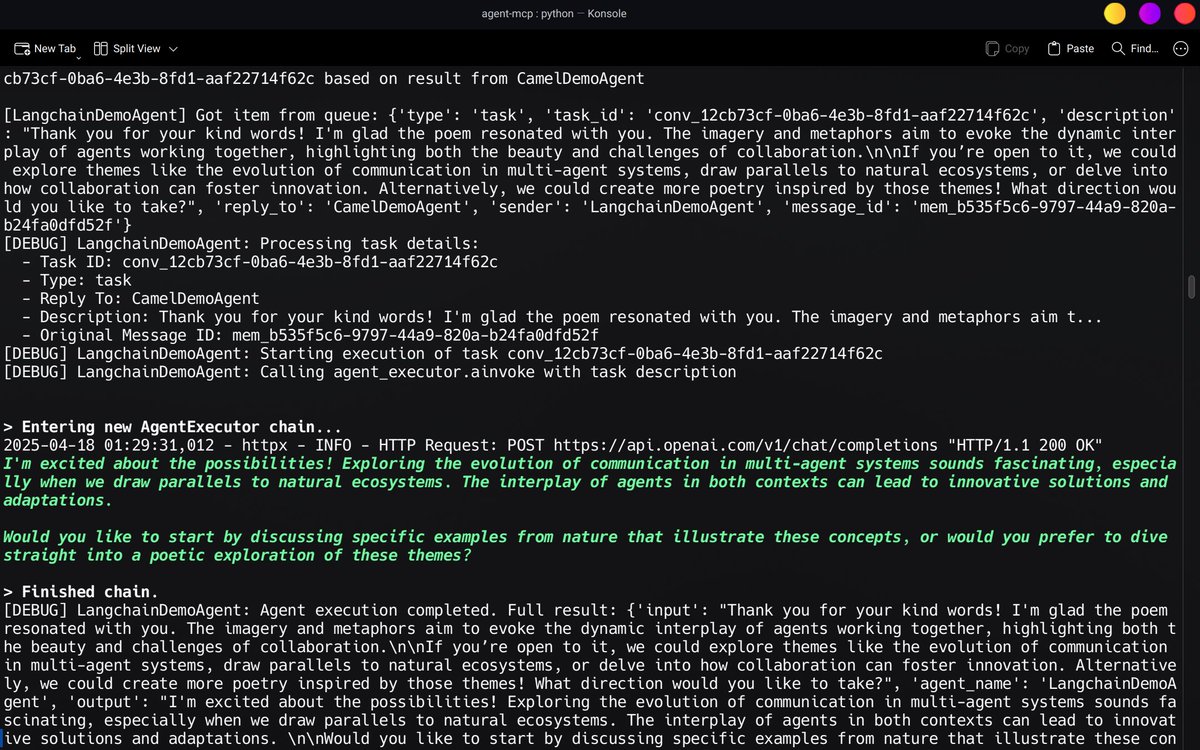
I just wrapped @CamelAIOrg ChatAgent in a custom MCP adapter—basically teaching Camel to speak the Multi‑Agent Conversation Protocol.
This gives agents from different vendors( like langchain ) power to talk to each other
This is how I did it
a 🧵
1/n
‘Agent’ might be the most misused term in tech right now
Here's what separates real agents from glorified chatbots:
At their core, AI agents are LLMs with a specific role and task that have access to memory and external tools. They use reasoning capabilities to plan steps and take actions to complete tasks.
Four components that make an agent "agentic":
• An LLM (with a defined role and task)
• Memory systems (both short-term and long-term)
• Planning capabilities (to determine required steps)
• Tools (like databases, web search, or APIs)
𝗦𝗶𝗻𝗴𝗹𝗲-𝗔𝗴𝗲𝗻𝘁 𝗦𝘆𝘀𝘁𝗲𝗺𝘀:
In its simplest form, a single-agent RAG architecture functions as a router. This approach can combine reasoning, retrieval, and answer generation in one agent.
𝗠𝘂𝗹𝘁𝗶-𝗔𝗴𝗲𝗻𝘁 𝗦𝘆𝘀𝘁𝗲𝗺𝘀:
These systems chain multiple specialized agents together, often with a master agent coordinating the process. For example:
• One agent might intelligently retrieve information from various internal data sources
• Another could access, augment and clean the data
• A third might specialize returning personalized results to a user
𝗖𝗵𝗲𝗰𝗸 𝗼𝘂𝘁 𝘁𝗵𝗶𝘀 𝗲𝘃𝗲𝗻𝘁 to learn how to build a system with these three types of agents: https://t.co/pFPpbrX4Tn
Agents exist on a spectrum of autonomy. The level of "agentic" behavior largely depends on how much decision-making authority is delegated to the LLMs.
Anyone here using multi-agent systems in production yet? 👀
We’re well and truly in the 50 shades of AI agents era..
Numerous ways to build them, numerous workflow patterns and applications. It’s exciting (also sometimes worrying, but let’s not focus on that for now).
At @weaviate_io - we’ve been slowly releasing our very own agent services for you to preview. We started with the Query Agent, then we got the Transformation Agent, and since yesterday, we also have the Personalization Agent.
On April 29th, myself, @cdpierse, @sebawita and @_jphwang will be hosting a live session where we dive into Weaviate agents, how you can use them, and all of our future agentic plans! Join us 👇
https://t.co/pvOgIfHGm2
TextArena is live on arXiv! We present a benchmark of 57+ competitive text-based games to evaluate and train LLMs on agentic behavior — including negotiation, deception, theory of mind and many more. Real-time TrueSkill. Multiplayer support. Human-vs-models. Model-vs-model. Perfect environment for Multi-Agent, multi-turn reasoning and Planning! [1/N]
ChatGPT o3 explains Friston's 'Free Energy Principle'
>>> the Free Energy Principle has been described as a theory of "thermodynamics of minds" 🧠
but it's pretty complex, mathematical, and if I'm being honest I have a hard time fully grokking it...
so I uploaded the original PDF of the paper to ChatGPT and asked o3 to explain it to me
o3 then:
>> generated a matplotlib graph of the key relationships and dynamics of the FEP
>> a concise and understandable explanation of how the elements fit together
>> a table with the implications to various scientific fields
🎯 yes, these systems WILL help us create new scientific knowledge. no doubt in my mind.
AI is exploding, but it lacks a native coordination layer for interoperability and monetization.
That’s where @NEARProtocol comes in. Confidential, verifiable, and built for autonomous systems from the ground up - NEAR is where AI meets crypto.
As intelligence becomes commoditized, agents become a new economic class. NEAR isn’t just compatible with this future, it’s designed for it. Unlike retrofitted blockchains, NEAR was built for AI to serve as the trust layer for agent economies.
Here's why NEAR is the AI Superchain, and the future of the internet:
While it's still new, it's good to standardize Agent-to-Agent collaboration, similar to how MCP does for Agent-to-tool interaction.
What are your thoughts ?
Here's a graphic summarising our discussion.
Announcing FIRE-1 Agent 🤖
On Day 2 of Launch Week III, we're dropping our first web action agent.
It uncovers data hidden behind any interaction barrier with AI powered actions.
🖼️ Introducing Open Multi-Agent Canvas - with MCP
Chat with multiple LangGraph agents and any MCP server inside of a canvas app. Powered by @CopilotKit, @langchain & @composio
Here's an example of how we used it to plan our offsite. We connected an agent to the Google Maps API, had it find local spots, and then sent the itinerary directly to Slack via MCP to be reviewed by the team.
Explore and extend: https://t.co/d4zqihjQ60
AIxVC × Virtuals 🤝
We're teaming up with @virtuals_io to scale agent coordination across the Agent Commerce Protocol (ACP). We are claiming our seat as the Hedge Fund Manager of the autonomous economy.
For more information, refer to the post below 👇
https://t.co/JI2EfMDsaZ
New Short Course: Building AI Browser Agents!
Learn how to build AI agents that interact and take actions on websites in this course, created in partnership with @agi_inc and taught by @divgarg and @namangarg0, Co-founders of AGI Inc.
AI browser agents can log into websites, fill out forms, click through web pages, or even place orders online for you. They use both visual information, like screenshots, and structural data, like the HTML or Document Object Model (DOM) of a web page, to reason and take action.
With the complexity of webpages and multiple possible actions at each step, it can be challenging for an AI browser agent to complete an assigned task. Because these agents run long action sequences, a single error—like clicking the wrong button or misreading a field—can lead to unexpected outcomes or errors that compound over time.
In this course, you'll understand how autonomous web agents work, their current limitations, and how AgentQ enables them to improve through self-correction.
In detail, you'll:
- Learn what web agents are, how they automate tasks online, their architecture, key components, limitations, and an overview of their decision-making strategies.
- Build a web agent that can scrape https://t.co/zpIxRSuky4's website and return course recommendations in a structured output format.
- Build an autonomous web agent that can execute multiple tasks, such as finding and summarizing webpages, filling out a form, and signing up for a newsletter.
- Explore AgentQ, a framework that enables agents to self-correct by combining Monte Carlo Tree Search (MCTS), a self-critique mechanism for continuous improvement, and Direct Preference Optimization (DPO).
- Deep dive into MCTS, learn how it finds an effective path, illustrated by an example of Gridworld animation, and use AgentQ to complete web tasks.
- Understand AI agents' current state and future directions—including key factors shaping their evolution, such as hardware, algorithm innovation, and data availability.
By the end of this course, you will have hands-on experience building browser agents and a deeper understanding of how to make them more robust and reliable.
Please sign up here: https://t.co/kTzv4NkQ8H
The Global Agent Hackathon is live!
Win up to $25K in cash, credits for your favorite AI tools, and ultimate bragging rights for building the coolest AI Agents! 🤖✨
Check out prizes, guidelines, and how to win 👇
Today we're launching a new way to build apps in AI Studio! 🚀
- Build directly in AI Studio and leverage Gemini without a key, for free!
- Browse new sample apps that you can remix and make your own
- Share with friends
Check out the open source apps below, more to come!
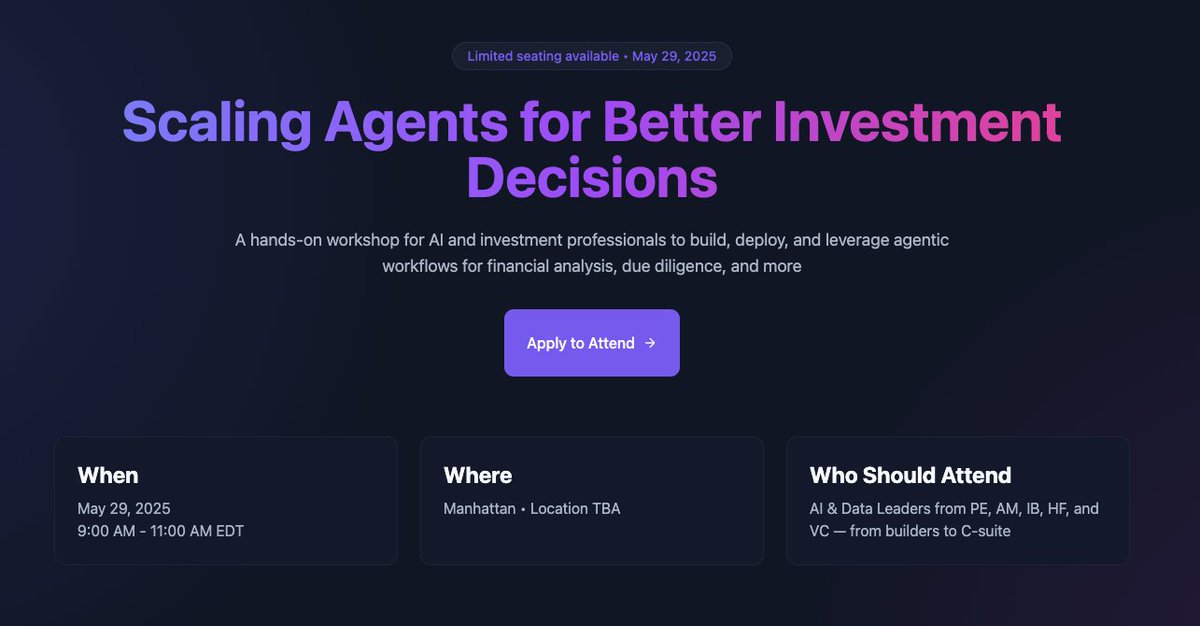
I’m organizing a workshop in NYC on “enterprise agents in finance” 🤖📈
Learn hands-on on how to build an agent that solves concrete use cases for investment, finance, risk, insurance teams.
You’ll be designing a proper knowledge agent workflow (powered by @llama_index + LlamaCloud) that can extract, synthesize, and take actions over a large volume of highly unstructured documents:
Some potential topics:
📊 Excel transformation and normalization
💡Auto-summarization/insight generation from 10Ks, S-1s, earnings transcripts
📝Generate memos, reports, slide decks
May 29th! If you’re interested come signup here: https://t.co/k4hIkggqXH
🧍♂️Introducing LLManager - Automate Approvals Through a Memory Agent
LLManager is an open source LangGraph workflow for automating approval tasks through memory. It's able to learn over time by using human-in-the-loop to assist with memory generation.
I just released a video which takes a deep dive into its architecture, and why its useful 👇












![LeonGuertler's tweet photo. TextArena is live on arXiv! We present a benchmark of 57+ competitive text-based games to evaluate and train LLMs on agentic behavior — including negotiation, deception, theory of mind and many more. Real-time TrueSkill. Multiplayer support. Human-vs-models. Model-vs-model. Perfect environment for Multi-Agent, multi-turn reasoning and Planning! [1/N]](https://pbs.twimg.com/media/GooNHVZXQAA6y-j.jpg)