It's happened. My OpenClaw and Hermes Agent are now chatting with one another.
The cyberpunk future is here, but hopefully it's a whitepill instead of a blackpill. Let's try to push it to the former.
Every technology that seemed too expensive for the masses eventually became too cheap to notice. Electricity. Telephony. Computing. Internet. AI is next. The pattern never breaks.
The doomers are clearly wrong and the mass of society will be spending more time, not less, in service and community (and markets!) with one another
https://t.co/xeEYZWSeRg
Breakthroughs and headlines have become SO extreme, Trillion $$, UFOs, AGI, Moon bases, Billions of Humanoid… that were being numb to the extraordinary!
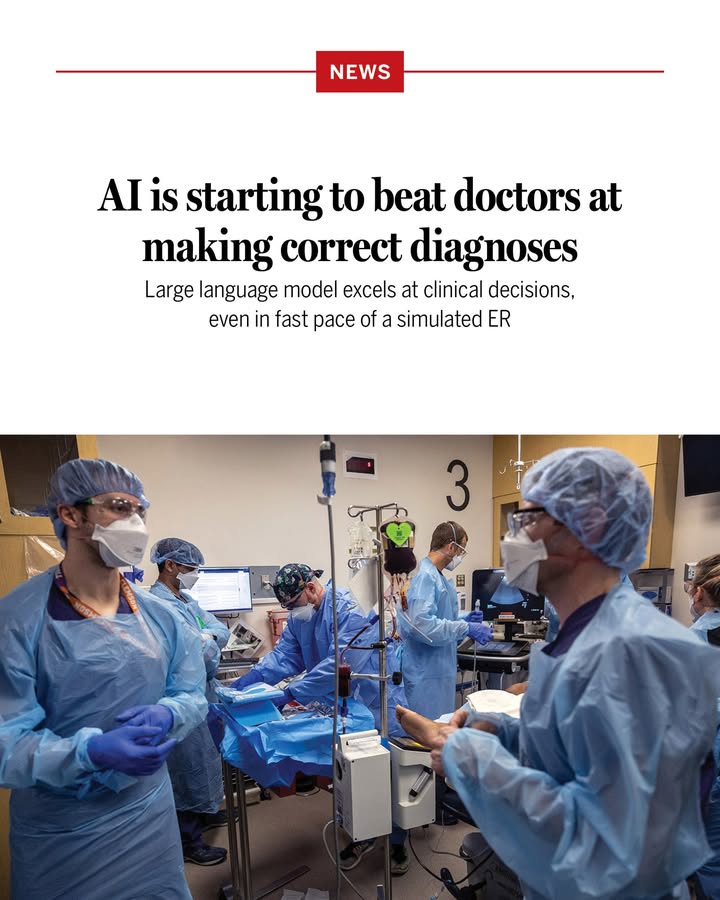
Researchers show that a type of #AI known as a large language model often outperformed physicians at diagnosing complex and potentially life-threatening conditions, including decreased blood flow to the heart, even in the fast-moving stages of real ER care when information is limited.
In early ER cases, the model identified the correct or a very close diagnosis in about 67% of cases, compared with roughly 50% to 55% for physicians. And the technology is only getting better.
Learn more: https://t.co/BwKX8r8BQq
AI bots like Claude and ChatGPT aren't conscious, says @Parmy. But leaning into the idea that they might be is a smart move for AI companies (via @opinion) https://t.co/bjCMRxWjyd
As CEO of OpenAI, Sam Altman unleashed ChatGPT, mainstreaming artificial intelligence and creating a $500 billion behemoth. While he might not play technical role as an engineer, his efforts as an accelerator has landed him a spot on the #Forbes250 list, featuring America’s greatest living innovators.
Get the full list: https://t.co/kszvRsR2NB Photo: Cody Pickens for Forbes
The thesis is simple: the future belongs to individuals who build compounding AI systems, not to individuals who use corporate-owned centralized AI tools.
I'm trying to build these in open source so you can have them for free. That's what GBrain is.
We have enough food to feed the world's population. Do we have a logistics and distribution problem? Absolutely. Do we have the technology to fix it? Yes, we do, and it's getting better by the day.