Advanced Glycation End Products (AGEs) is inflammation in action.
When sugars combine with proteins or fats in the body, a chemical reaction occurs that creates inflammatory compounds - changing the nature and function of the tissues in the body - not just causing wrinkles and sagging skin but affecting all tissues inside the body as well.
They are involved in aging and the development, or worsening, of many degenerative diseases such as: atherosclerosis, chronic kidney disease, and Alzheimer's disease. Additionally, AGEs can cause erectile dysfunction, insulin resistance leading to weight gain, accelerated aging, diabetes and more.
Your lifestyle has a significant effect on total body AGEs load and metabolic consequences.
How to Prevent:
▪️Avoid Sugar 👈 Important
▪️Cook at lower temperatures
▪️Avoid processed foods
▪️Consume a diet rich in antioxidants - such as blueberries, olive oil, coffee, tea, spices
▪️Avoid seed oils (vegetable oil, corn oil, canola oil, soy oil)
▪️Stay hydrated
▪️Sleep well
▪️Use Supplementation such as: L-carnosine, B-1, B-6, PQQ, R-lipoic acid, Taurine .
¿Quieres hacer una #tesis doctoral y te interesa investigar por qué algunas ciliopatías causan #obesidad?
ccontrato #FPI disponible eb la #UCM.
PID2025-171719OB-I00
Si te interesa, escríbeme a [email protected] y consulta las condiciones 👇
https://t.co/A81xK74sNY�
From computer models to the bench 🔬➡️🧪
Identification of novel GLO-I inhibitors through structure-based virtual screening, molecular dynamics simulations, and enzyme activity assays, highlighting the power of integrated drug-discovery pipelines
https://t.co/kS36rtfTEw
New in @JCellBiol 🧪
How do cells decide to recycle peroxisomes when iron runs low? GABARAP binds the FLCN/FNIP1 complex, which switches on TFEB/TFE3 and drives pexophagy. Conserved in C. elegans.
Congrats to Katrine Hartfelt and all co-authors!
https://t.co/NsHdBz0rKb
El paracaídas no sirve para nada. Un Ensayo clínico aleatorizado lo ha DEMOSTRADO:
- 12 participantes saltaron con paracaídas desde un avión y
- 11 sin paracaídas
Se publicó en @bmj_latest
🪂
Sí, este post tiene truco y moraleja
Para @consumidorglob
https://t.co/ynnbVlEzMk
@CigudosaJuan@PSNPSOE@PSOE Defender La ciencia es defender a las personas que la hacen.
Las FPUs 2025 siguen en un cajón esperando resolución definitiva, y las investigadoras en su casa sin trabajar, esperando que le hagan el contrato.
@FPUinvestiga
Soy editora asociada de varias revistas científicas y hay algo que no deja de llamarme la atención: la cantidad de manuscritos, revisiones y versiones corregidas que llegan durante los fines de semana y las vacaciones.
Es una observación anecdótica, desde luego, pero creo que dice bastante sobre cómo estamos organizando la vida universitaria.
Durante la semana, entre clases, reuniones, tareas de gestión, correos y burocracia, cada vez nos queda menos tiempo para leer, pensar, investigar y escribir. Es decir, para algunas de las actividades que deberían estar en el centro de nuestro trabajo.
Las vacaciones y los fines de semana terminan convirtiéndose en una especie de reserva de tiempo para hacer lo que no conseguimos hacer durante la jornada ordinaria. ¡Menuda paradoja! Resulta que necesitamos dejar de trabajar para poder hacer nuestro trabajo.
La organización cotidiana de la vida universitaria está dejando cada vez menos espacio para las actividades que justifican su existencia: investigar, estudiar y preparar buenas clases.
¿Qué hemos hecho con la vida universitaria para que tantas de las cosas que le dan sentido tengan que hacerse cuando la universidad está cerrada?
#VidaUniversitaria #AcademicLife #HigherEducation #AcademicWork
Taurine is the most controversial amino in the longevity field.
Prof. Deep Dixit's latest paper in Cell shows circulating taurine actually increases with age, a possible compensatory, adaptive attempt by the body to counter inflammation. Boosting taurine levels diminishes the effects of inflammaging.
Giving extra taurine to aged mice reduced inflammation, improved physical markers like grip strength, and lowered mortality from sepsis. The work helps reconcile previous contradicitons and academic quarrels. This new paper scores a point for the taurine team
A brief history:
A 2023 paper in Science suggested supplementing with taurine restored youthful levels and extended the healthspan and lifespan of worms and mice, as well as the healthspan of rhesus macaque monkeys. Blood levels of taurine were shown to decline with age in mice, monkeys, and humans. David started taking taurine.
A large-scale longitudinal study at NIH and published in Science later cast serious doubt on these claims. David stopped taking taurine.
Today: Deep and team observed that macrophages dump up to 80% of their taurine when exposed to danger signals, not through standard cell-rupture pores or known taurine transporters. The exact channel or mechanism letting taurine flood out of the cell is still unknown
While overall blood taurine rises with age as a compensatory response, the Dixit lab doesn't yet know why aging immune cells become prone to leaking their internal taurine stores or how to help them hold onto it
A single 4 g oral dose in eight men produced a peak blood-plasma concentration of about 0.69 mM after roughly 1.5 hours, at least 10X less than what was needed in this study for anti-inflammatory effects
So, can oral doses in humans raise intracellular macrophage levels high enough, and safely enough, to replicate this effect? Someone should do a trial
Why do some people seem to age very rapidly while others remain fit into advanced years? And why do some organs and tissues age more rapidly than others? Aging is the single greatest risk factor for neurodegenerative disease, but we still don’t fully understand how it unfolds in the brain.
We present a transcriptomic atlas of 5.3 million cells from 582 samples spanning 11 brain regions of 55 individuals. We identified age-depleted and vulnerable neuronal populations and subtle, age-associated compositional differences in glia—detectable only at single-cell resolution. We charted convergent and divergent age-associated molecular signatures across regions and cell types, which include sex-specific signatures that could underlie biases in neurological disorders.
We found that inflammation-associated immune cells called microglia increased in nearly every region studied. Many of these age-related shifts overlapped with molecular signatures of Alzheimer’s disease.
We found a striking difference between the sexes. In most cell types showing a sex bias, female brains looked molecularly “older” than male brains of the same age — a pattern that parallels women’s higher risk of Alzheimer’s. The exception was spiny projection neurons in the basal ganglia. These cells showed faster aging in male brains, which may help explain why Parkinson’s disease is more common in men.
We also found that aging looks different in different tissues and cell types rather than following one uniform script. Aging also looks continuous, as many cell populations changed steadily from early life onward, suggesting that aging extends developmental programs rather than being a separate phase.
@PennMedicine@Penn@Wharton@ASU@UW
https://t.co/F8921tcWGq
Alguien preparando el proyecto para el Plan Nacional (PGC)?
A quién se le ha ocurrido que los Resultados Preliminares vayan casi al final de la propuesta, DESPUÉS de la metodología, plan experimental, calendario, contingencia???
Otro día hablamos de las 7 secciones de “Impacto”
@MargaFronteraB Este paper era muy bueno para eso, aunque la discusión está muuuuy estirada.
https://t.co/aVYxFNTp3M
Pero no hay que enseñárselo a nadie que tome decisiones sobre la financiación de la ciencia, que nos dan el chocolate y nos quitan el dinero 😜
Why does the whole body age together when damage starts in one organ?
👉 We propose an initiator→communicator→effector model defined by intervention rather than molecules and what would refute it.
Out today, open access ⬇️
https://t.co/Dy4Y8QNL9I
Lifespan drugs are mostly saving fat mice from early death. This is well known in the field: compounds that extend lifespan seem to have a much smaller effect, if any, on individuals in optimal health.
Linda Partridge and Bouvet now show this by pooling 33,780 mice from the NIA's Interventions Testing Program. In males the median lifespan gain was 6.2% in the lightest quarter and 20.2% in the heaviest. Most of the effect comes from heavy untreated mice dying sooner. The effect is weak in females.
https://t.co/ay5flOQ1SC
NAD+ supplementation has become one of the most widely marketed longevity interventions—driven by the assumption that NAD+ levels decline with age and that restoring them can reverse aging processes.
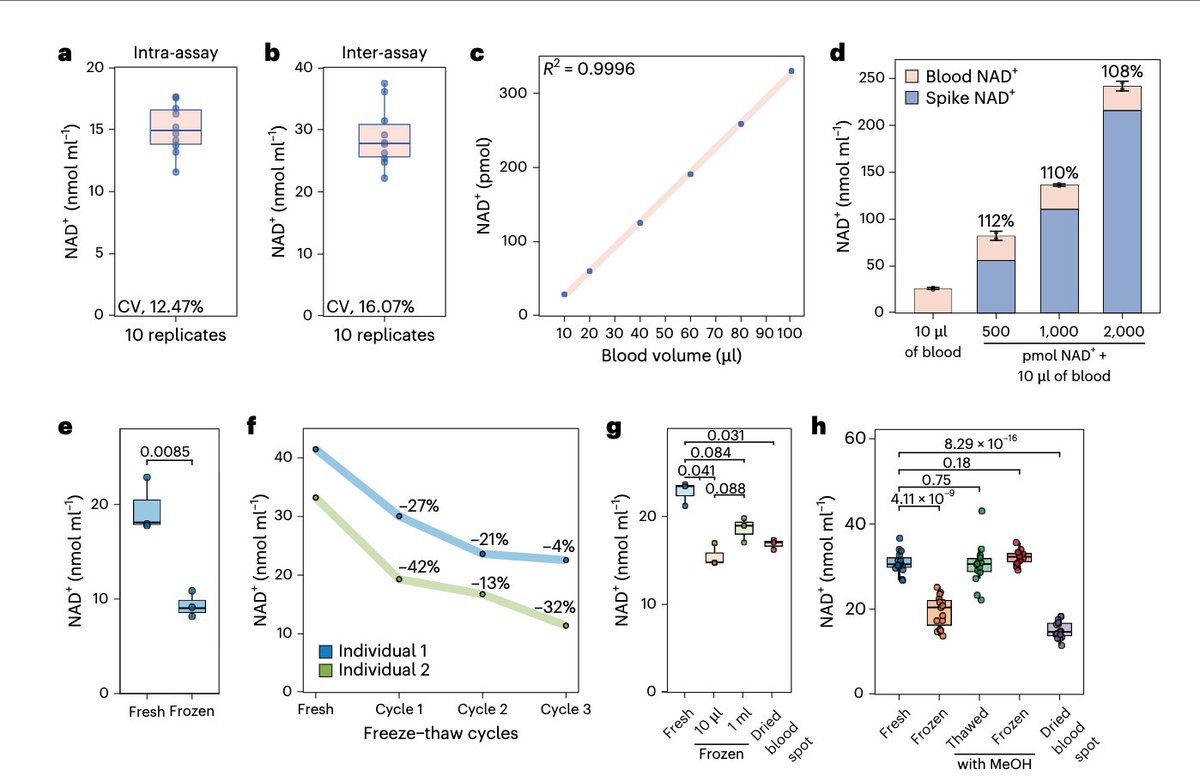
But a new study in Nature Metabolism directly measured NAD+ levels across seven independent human cohorts and found something unexpected.
Whole-blood NAD+ levels don't decline with age. They remain remarkably stable across the lifespan.
The research team used ultra-high-performance liquid chromatography coupled with high-resolution mass spectrometry—one of the most rigorous NAD+ quantification methods available—and measured NAD+ in over 1,100 human blood samples spanning ages 20 to 100.
The cohorts included healthy young adults, elite athletes, individuals undergoing lifestyle interventions (resistance training, Mediterranean diet, multidomain interventions), participants in longevity studies, and elderly adults.
Across all seven cohorts, NAD+ levels remained unchanged with age. No decline in the third decade. No decline in the seventh. No decline in centenarian offspring compared to age-matched controls.
The stability persisted across lifestyle interventions as well.
Six months of progressive resistance training in frail older adults: no change in NAD+.
Mediterranean diet intervention: no change.
Multidomain lifestyle intervention combining exercise, nutrition, and cognitive training: no change.
Elite endurance athletes—individuals with exceptional mitochondrial capacity—had the same NAD+ levels as sedentary controls.
The only intervention that altered blood NAD+ was direct supplementation with nicotinamide riboside, which increased NAD+ levels by ~40% during treatment—exactly what you'd expect from exogenous NAD+ precursor intake.
This contradicts the central hypothesis driving NAD+ supplementation: that systemic NAD+ deficiency is a hallmark of aging that can be restored through lifestyle or dietary interventions.
The disconnect appears to be this: tissue-specific NAD+ depletion may occur during aging—particularly in muscle, liver, and adipose tissue—but those changes don't manifest in whole-blood measurements.
Blood NAD+ is a poor surrogate for tissue NAD+ status.
NAD+ doesn't equilibrate across compartments the way glucose or lactate does. It's synthesized locally within tissues, and blood levels reflect the metabolic activity of circulating cells—primarily erythrocytes and leukocytes—not peripheral tissues where aging-related dysfunction occurs.
This has significant implications.
First, using blood NAD+ as a biomarker for aging or metabolic health appears to be fundamentally flawed. The stability across age and lifestyle suggests it's tightly regulated within a narrow homeostatic range, regardless of what's happening in metabolically active tissues.
Second, it raises questions about whether NAD+ supplementation strategies—nicotinamide riboside, nicotinamide mononucleotide, niacin—are addressing the right problem.
If the goal is to restore NAD+ levels in skeletal muscle mitochondria or hepatocytes, does elevating blood NAD+ by 40% translate to meaningful tissue-level repletion? Or are we measuring the wrong compartment and inferring benefits that may not exist?
Tissue NAD+ measurements require biopsies—invasive, expensive, and logistically complex for large-scale human trials. Blood is accessible and scalable, which is why it's been used as a proxy.
But this study suggests that proxy isn't valid.
The third implication is about mechanism. If NAD+ doesn't decline systemically with age, then the benefits observed in preclinical NAD+ supplementation studies—improved mitochondrial function, enhanced autophagy, extended lifespan in model organisms—aren't operating through a simple restoration-of-deficiency model.
They may be working through pharmacological activation of NAD+-dependent enzymes like sirtuins or PARPs, independent of baseline NAD+ status.
That's a different biological target with different dose-response dynamics and different expectations for human translation.
The study doesn't disprove tissue-specific NAD+ decline during aging. It doesn't invalidate NAD+ as a therapeutic target. But it does challenge the foundational narrative that's been used to justify widespread supplementation.
If blood NAD+ doesn't decline with age, and lifestyle interventions that improve metabolic health don't alter it, then NAD+ may not be the universal aging biomarker it's been positioned as.
The decisions made in the fourth and fifth decades about whether to supplement with NAD+ precursors—and at what doses—should be informed by whether the intervention is addressing a measurable deficiency or activating a pharmacological pathway.
Right now, we're measuring blood NAD+ and inferring tissue status. This study suggests that inference is likely incorrect.
Not all carbohydrates age us equally. Diets rich in high-quality, fiber-containing carbohydrates are associated with healthier aging, supporting a shift from calorie restriction toward precision nutrition strategies. #NutritionScience#HealthyAging
https://t.co/V56W7MeQxL
A scorched-earth approach to aging research by Rich Miller 🔥
Pretty much everything gets criticised, from the hallmarks of aging to cell senescence, epigenetic clocks, and cellular rejuvenation.
But Rich makes some very good points. I particularly like the Rolex analogy regarding aging clocks.
If you’re working in aging science, please read it and thank me later! It's an entertaining and much-needed critical perspective.
For the record, I was a reviewer of this paper, and suggested a little more nuance and balance. My suggestions didn't make it to the final version, though. Why be balanced when you can just burn everything in your path! 🔥
https://t.co/I7BUNoK2W2