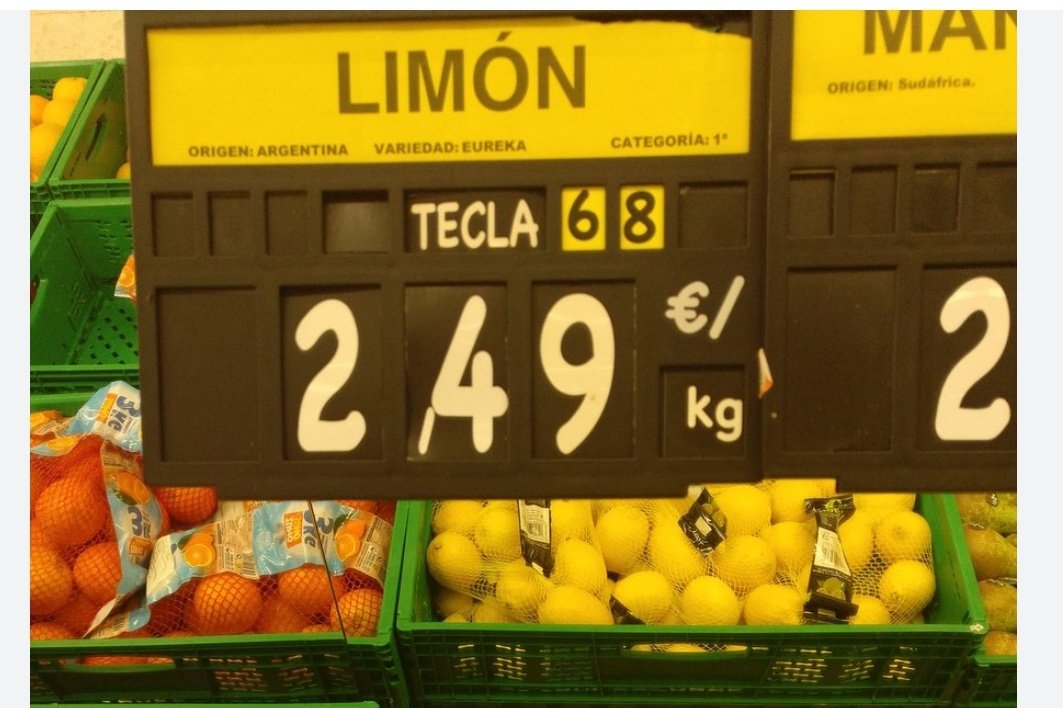
A ver si lo entiendo. El kilo de limones se le está comprando al agricultor a pie de huerto a 0"18 € (por debajo de los costes de producción) pero el Mercadona por ejemplo lo vende a 2'49€ y entonces resulta que la culpa es de la agenda 2030. Es así? 🤨
El Gobierno se estrena difundiendo el mito de que hay muchos rentistas que complementan su pensión con el alquiler y que están desprotegidos.
Hace poco publicamos un estudio que desmonta este bulo: la única población realmente vulnerable es la que no tiene vivienda en propiedad.
Para advertir del inminente colapso climático, en abril y octubre de 2022, sin hacer daño a nada ni a nadie, llevamos a cabo acciones usando zumo y sirope.
Ahora nos enfrentamos a penas de prisión, y la Fiscalía valora estas acciones en el marco del terrorismo.
#JuicioDeCiencia
El desahucio del Edificio Dignidad en Móstoles será este viernes 26 de mayo. Las 18 familias vulnerables del bloque se preparan para resistir y conseguir mantener sus casas
✍ @JairoExtre
🎙 @candelabarro
📹 Jaime García-Morato
https://t.co/SDRvP80WmC
Es muy importante que se sepa:
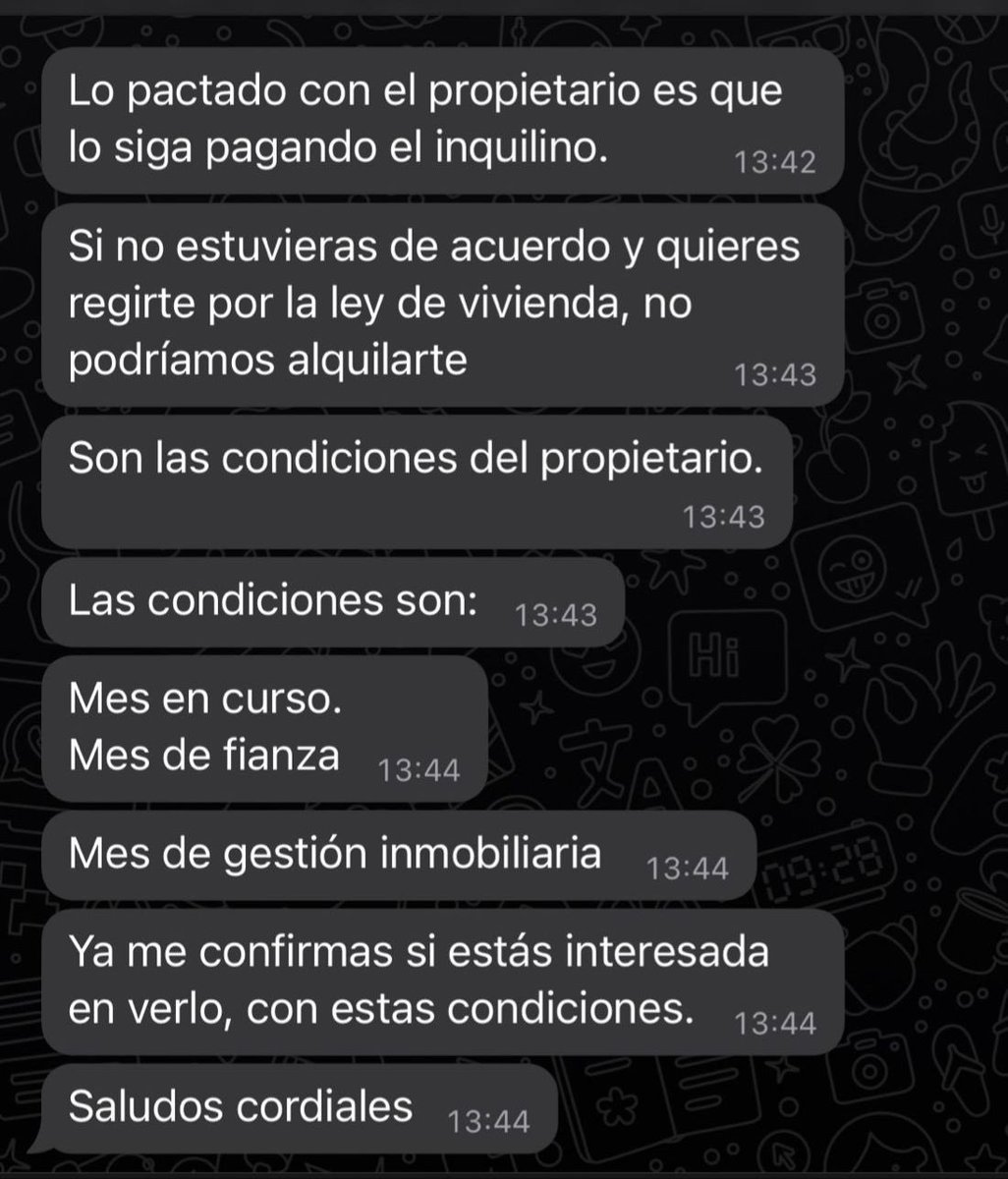
📌 A partir de mañana es ILEGAL que la inmobiliaria cobre honorarios al inquilino, puesto que el servicio se lo da al casero.
📌 Además, las comunidades autónomas podrán regular los precios del alquiler.
La Ley de Vivienda ha entrado en el BOE.
Atención a estos datos:
📌 Cada vez más gente vive de alquiler (40,1%).
📌La gran mayoría no es joven (el 65% tiene más de 35 años).
📌 El 71% no heredará NADA.
Son datos del estudio que hemos hecho en Barcelona, que apunta a una polarización social muy preocupante.
Hilo 🧵
Our latest work with the @cybercarto project has just been published in Cartography and Geographic Information Science: A systematic review of application development in augmented reality navigation research https://t.co/vv40oTkfbd
Durante la semana pasada, Iberdrola procedió al vaciado de 46.000 millones de litros de agua (46 hm3), el equivalente a las necesidades de una población de 600.000 habitantes durante un año. @ElSaltoDiario https://t.co/4tWJI0qNj8
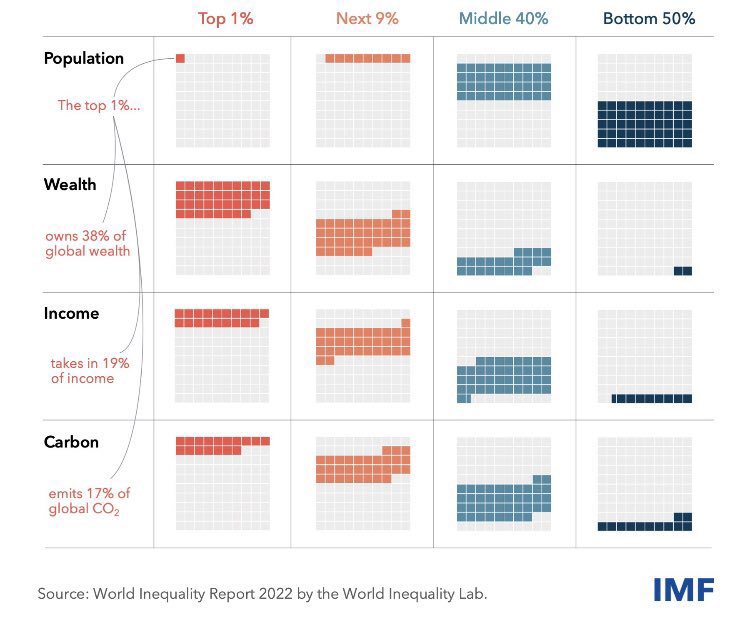
El 10% de la población mundial posee el 75% de la riqueza, recibe el 50% de los ingresos y es responsable de casi la mitad (48%) de todas las emisiones de CO2.
1/ Ayer en Tarrega (Lleida) una persona, mientras decenas de policías estaban en su puerta para desahuciarle, se quitó la vida.
Un caído más en la guerra por sobrevivir, un asesinato más a mano del Estado, que irá a llenar las hipócritas estadísticas de los "suicidios".
I'm in the top 2% of users on StackOverflow. My content there has been viewed by over 1.7M people. And it's unlikely I'll ever write anything there again.
Which may be a much bigger problem than it seems. Because it may be the canary in the mine of our collective knowledge.
A canary that signals a change in the airflow of knowledge: from human-human via machine, to human-machine only. Don’t pass human, don’t collect 200 virtual internet points along the way.
StackOverflow is *the* repository for programming Q&A. It has 100M users & saves man-years of time & wig-factories-worth of grey hair every single day.
It is driven by people like me who ask questions that other developers answer. Or vice-versa. Over 10 years I've asked 217 questions & answered 77. Those questions have been read by millions of developers & had tens of millions of views.
But since GPT4 it looks less & less likely any of that will happen; at least for me. Which will be bad for StackOverflow. But if I'm representative of other knowledge-workers then it presents a larger & more alarming problem for us as humans.
What happens when we stop pooling our knowledge with each other & instead pour it straight into The Machine? Where will our libraries be? How can we avoid total dependency on The Machine? What content do we even feed the next version of The Machine to train on?
When it comes time to train GPTx it risks drinking from a dry riverbed. Because programmers won't be asking many questions on StackOverflow. GPT4 will have answered them in private. So while GPT4 was trained on all of the questions asked before 2021 what will GPT6 train on?
This raises a more profound question. If this pattern replicates elsewhere & the direction of our collective knowledge alters from outward to humanity to inward into the machine then we are dependent on it in a way that supercedes all of our prior machine-dependencies.
Whether or not it "wants" to take over, the change in the nature of where information goes will mean that it takes over by default.
Like a fast-growing Covid variant, AI will become the dominant source of knowledge simply by virtue of growth. If we take the example of StackOverflow, that pool of human knowledge that used to belong to us - may be reduced down to a mere weighting inside the transformer.
Or, perhaps even more alarmingly, if we trust that the current GPT doesn't learn from its inputs, it may be lost altogether. Because if it doesn't remember what we talk about & we don't share it then where does the knowledge even go?
We already have an irreversible dependency on machines to store our knowledge. But at least we control it. We can extract it, duplicate it, go & store it in a vault in the Arctic (as Github has done).
So what happens next? I don't know, I only have questions.
None of which you'll find on StackOverflow.
(I write on AI from a technical and product perspective. If you find that interesting then please do follow me for more)
Un equip investigador de la #URV ha descobert limitacions fonamentals en l'aprenentatge automàtic. Els resultats s'han publicat a la revista Nature Communications. Us ho expliquem avui, Dia Internacional de les Matemàtiques #idm314cat 👇
https://t.co/zMAU8D7sXd
Hoy publicamos un informe sobre la estructura del mercado de alquiler. Hago un hilo con los principales resultados:
1. Los hogares de caseros son la población de mayores ingresos del país. Sus ingresos más que duplican los ingresos de los inquilinos.
Mirad la diferencia 👇