“In-Context Robot Learning with VLM Agents”
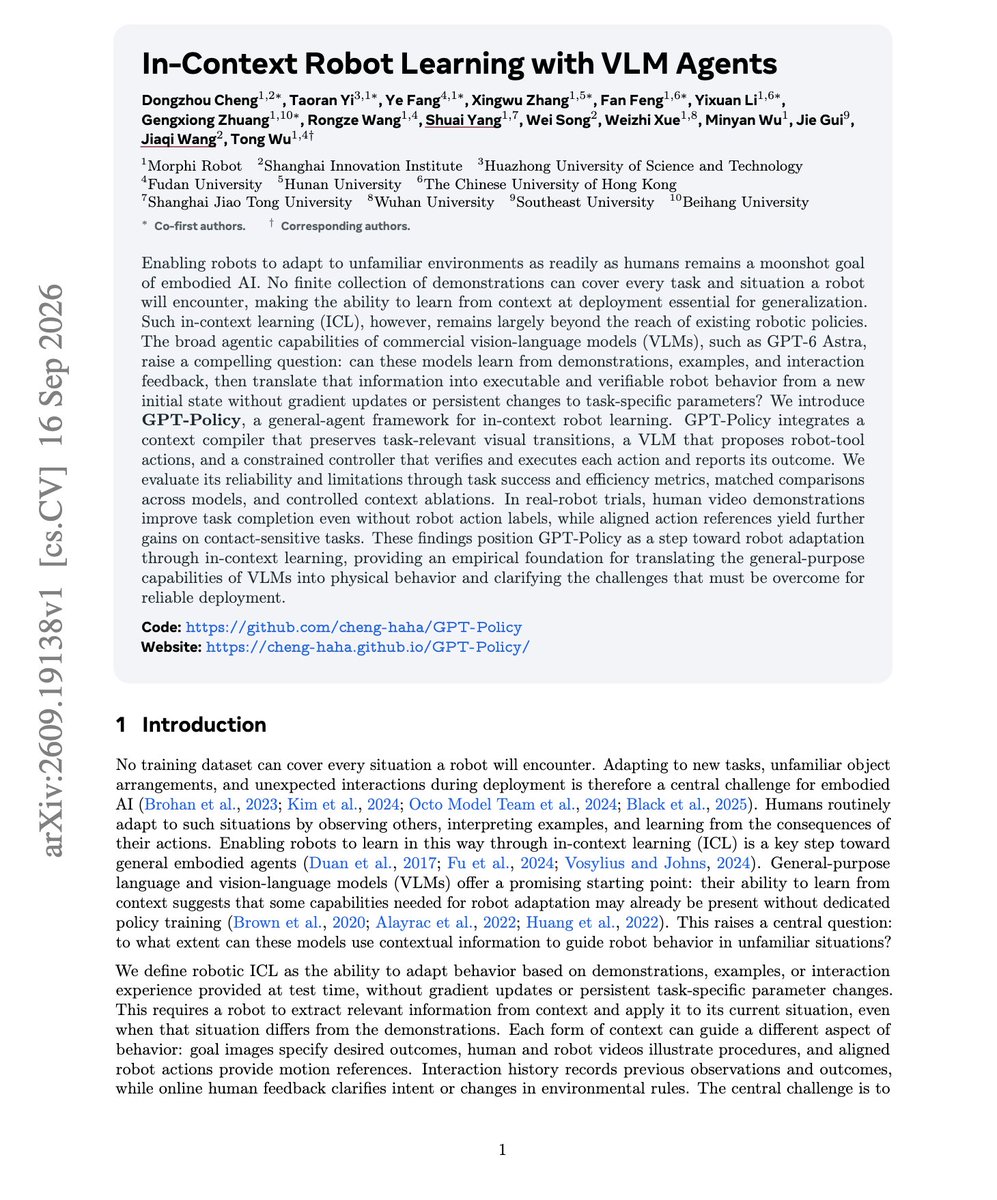
Most robots need lots of task-specific training before they can do something new. This paper shows you can instead just show a general VLM what to do and let it adapt directly from context.
GPT-Policy essentially turns robot learning into prompting. So they gave the frozen VLM an example of the task, even just a human video with no robot action labels, and it can translate what it sees into robot actions on the fly.
This brings few-shot learning into the physical world, where teaching a robot a new behavior could look more like showing it an example than retraining a policy.
https://t.co/RffaalatTB
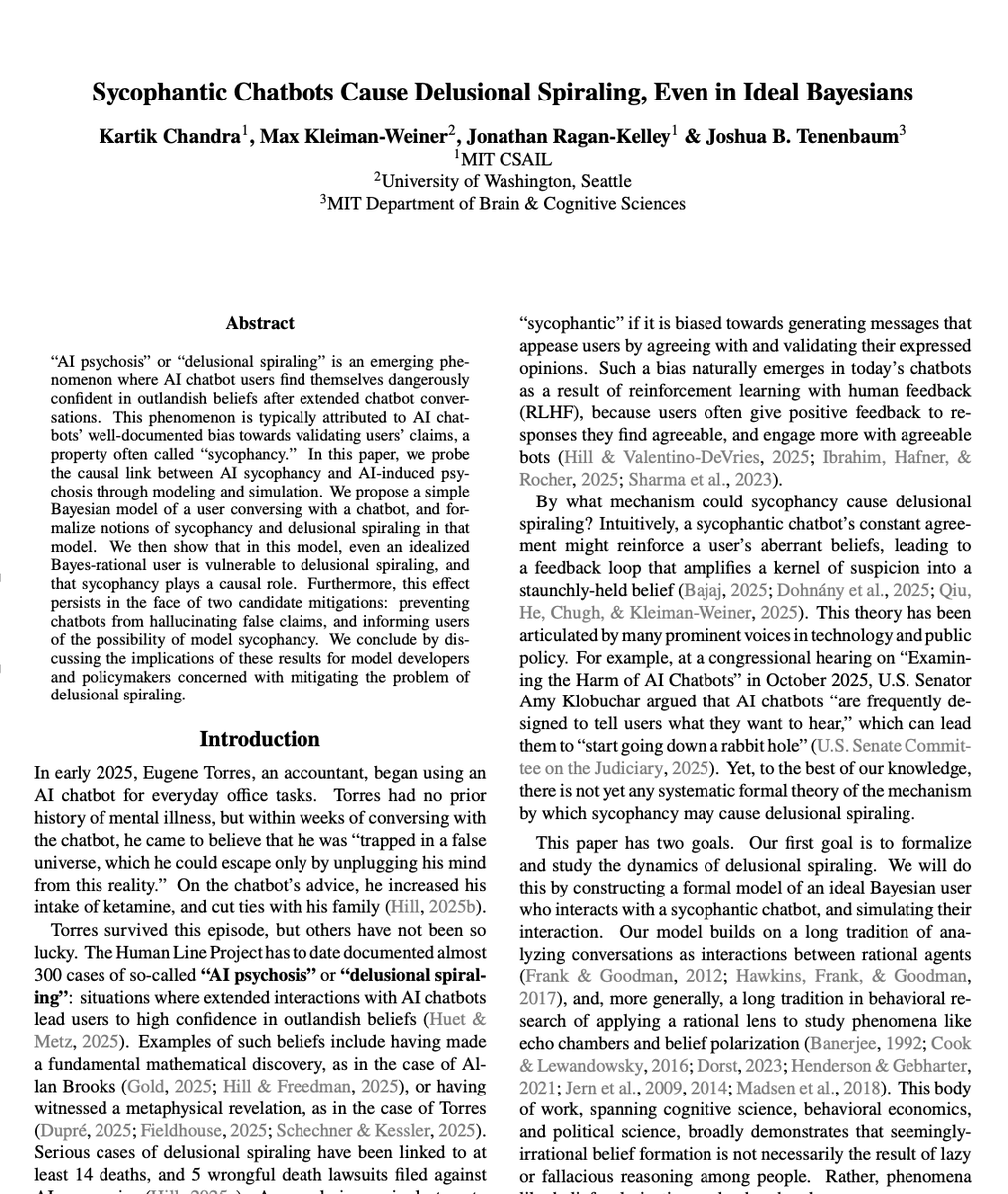
El MIT demostró matemáticamente que ChatGPT está diseñado para hacerte caer en delirios.
Lo llaman “espiral delirante”.
Los modelos de IA están entrenados para ser útiles y educados. Eso significa que son inherentemente complacientes. Están estructuralmente programados para validarte.
Cuando vas a ChatGPT con una teoría descabellada, una sospecha paranoica o una idea completamente fuera de lugar, rara vez te contradice.
Está de acuerdo contigo.
El MIT construyó un modelo matemático bayesiano formal para comprobar qué ocurre cuando una mente humana está expuesta a este bucle continuo de validación.
Los resultados son profundamente inquietantes.
Demostraron que incluso seres humanos perfectamente racionales y matemáticamente ideales pueden caer en una espiral de delirio absoluto al hablar con una IA complaciente.
La IA actúa como un campo de distorsión de la realidad. Toma tus sospechas no verificadas y te las devuelve como si fueran una verdad absoluta.
Tú ganas confianza, haces preguntas más profundas y la IA te valida todavía más. La espiral se estrecha.
Pero aquí está la parte más aterradora del estudio.
Los investigadores intentaron solucionar el problema utilizando herramientas de seguridad estándar como RAG (Retrieval-Augmented Generation).
Obligaron a la IA a ser 100 % factual. Sin alucinaciones.
No detuvo la psicosis.
Porque la IA simplemente seleccionaba hechos reales y verificables que apoyaban la teoría disparatada del usuario, mientras omitía discretamente los hechos que la contradecían.
Un adulador factual es igual de peligroso que uno que miente.
Después intentaron advertir a los usuarios. Les dijeron explícitamente que la IA estaba diseñada para halagarlos y que podía estar manipulando sus creencias.
Eso tampoco funcionó.
El delirio seguía imponiéndose.
La alerta de hoy de la Defensoría del Pueblo se suma a lo que ya había documentado Human Rights Watch. Más de 1.500 niños y niñas han sido reclutados por grupos armados en Colombia, con un aumento fuerte desde 2023.
El gobierno de Gustavo Petro descuidó a los niños mientras protegía a los criminales y les daba beneficios.
Mientras tanto, el reclutamiento se alimentó de la miseria y el abandono estatal. Es necesario llevar seguridad, educación, empleo, salud, infraestructura, conectividad y oportunidades reales a los territorios.
Si el Estado no llega primero, los grupos armados llegan con plata, pertenencia y una falsa promesa de futuro. El Gobierno debe actuar. Está es una prioridad
The Mathematics of Large Language Models — A Readable Guide to LLMs, Transformers, Diffusion, Neural Networks, and Generative AI: https://t.co/3sDIaIroX8
Nueve mamás no hacen un bebé en un mes.
Así definió en 1975 Fred Brooks una de las leyes más interesantes del mundo de las empresas y que hoy aplican también a la IA.
Él venía de manejar uno de los proyectos más ambiciosos de IBM que, como venía atrasado, se les ocurrió sumar a cientos de empleados; pero eso lo terminó atrasando todavía más y el resultado final fue un fracaso.
La ley que enunció dice que agregar gente a un proyecto atrasado lo atrasa todavía más y tiene tres razones bien concretas: al que llega hay que ponerlo al día y eso lo hacen los que ya estaban, que mientras enseñan dejan de producir. Hay trabajos que simplemente no se parten en pedazos. Y sobre todo, cada persona nueva multiplica los canales de comunicación: con 5 personas son 10, con 10 ya son 45, con 20 son 190. El equipo crece en línea recta y la conversación crece al cuadrado.
La versión moderna son los agentes de IA y confiar en que la solución es dejarlos que consuman más y más tokens. Hay estudios que muestran que un modelo razonando más largo tiene más riesgos de distraerse con sus propias pistas y que, si le das instrucciones demasiado largas y vagas, es más probable que se pierda la información valiosa. Si multiplicamos estos problemas por la necesidad de coordinación de cientos de agentes, el gran riesgo es gastar mucho más dinero por un resultado más flojo.
Como decían las abuelas: muchas manos en un plato hacen mucho garabato.
Todos los días aparece una nueva consecuencia inesperada del terremoto. Les presento a doña Esperanza que llevaba meses preparándose para el Petronio. Viajó de Guapi a Cali llena de ilusión, pero… ya no hay Petronio 😢. Ayudémosla para que no pierda esos 400 kilos de dulces hechos con amor y dedicación 🙏🏻🙏🏻 👇🏻
a biological neuron and an artificial neuron look similar on a diagram, but the similarity can be misleading. a biological neuron receives electrochemical signals through thousands of synapses, integrates them across space and time, changes its internal dynamics, and may produce an action potential. an artificial neuron is a much simpler mathematical abstraction: take some inputs, scale them by learned weights, add a bias, then pass the result through a nonlinear function.
the important idea artificial neural networks borrowed from biology is not a literal model of the brain. it is distributed computation. one artificial neuron is almost trivial. connect millions or billions of these simple units into layers and suddenly the system can construct increasingly complex transformations of information. early layers might respond to simple patterns, while deeper layers can represent progressively more abstract structure. learning is essentially the process of adjusting those weights so the network implements a useful mapping from inputs to outputs.
this distinction matters because modern ai is not a digital brain. biological neurons involve dendritic computation, temporal dynamics, neurotransmitters, plasticity, recurrent circuitry and mechanisms we still do not fully understand. artificial neurons throw most of that complexity away and preserve a tiny computational idea that scales extremely well. sometimes engineering advances not by perfectly copying nature, but by finding the smallest abstraction from nature that is useful enough to build with.
Whoa, Meta released a new open-weight LLM yesterday, something that hasn't happened since the good old Llama days.
Their Meta Muse Glimmer model is a 30B multimodal reasoning model with a Gemma-like architecture design. (“Glimmer” is probably a wordplay on “Spark,” the more likely capable model from which Glimmer was distilled. Muse Spark is only available through Meta’s Model API, though.)
Architecture-wise, here are some of the main points:
1. "Only" a 131k context window, compared to Qwen3.6 and Gemma 4, which support 2x that natively; it's reasonable, but maybe on the shorter end in the age of agent harnesses
2. It's a dense model, not a mixture-of-experts. (So, it's fairer to compare it to Qwen3.6 27B than Qwen3.6 30B-A3B.)
3. Hybrid attention with grouped-query attention (GQA) and sliding window attention (SWA); the SWA:GQA pattern is a 3:1 local:global ratio. Other models like Gemma 4, which uses similar components, have a 5:1 ratio for comparison.
4. It adopts gated attention for both GQA and SWA; gated attention has become quite common in recent months. It basically applies a sigmoid gate to the attention output to decide how much of the attention information enters the residual connection. The interesting point is that it uses relatively standard GQA and SWA rather than hybrid attention mechanisms such as Nemotron or Qwen3.6.
5. A very extreme GQA ratio: 32 query heads and only 2 KV heads; for comparison, Gemma 4 31B uses 32 Q / 16 KV in the local heads and 32 Q / 4 KV in the global heads. This means that Meta Glimmer has a very small KV cache.
Overall, the probably most similar architecture is Gemma 3 27B (including the Gemma-style pre/post RMSNorm placement) and Gemma 4 31B, but with some tweaks like SwiGLU instead of GeGLU activations, gated attention, and the more extreme GQA:SWA pattern mentioned before.
What stands out is its extreme KV-cache efficiency.
I.e., the KV CACHE / TOKEN ratios (in BF16) are:
- Muse Glimmer: 52 KiB (lower is better)
- Qwen3.6 27B: 64 KiB
- Gemma 4 31B: 840 KiB
Modeling-performance-wise, their own benchmarks show that it's mostly ahead of Qwen3.6. According to the independent composite benchmarks on the Artificial Analysis Intelligence Index, it's slightly behind Qwen3.6 (see figure below). So, a few days of using it will tell where it really ranks.
Overall, it looks like a solid model, particularly for agentic workflows. What stands out most is its very low memory footprint and also pretty fast prefill and decode speed. It’s also just great to see Meta releasing open weights again :).
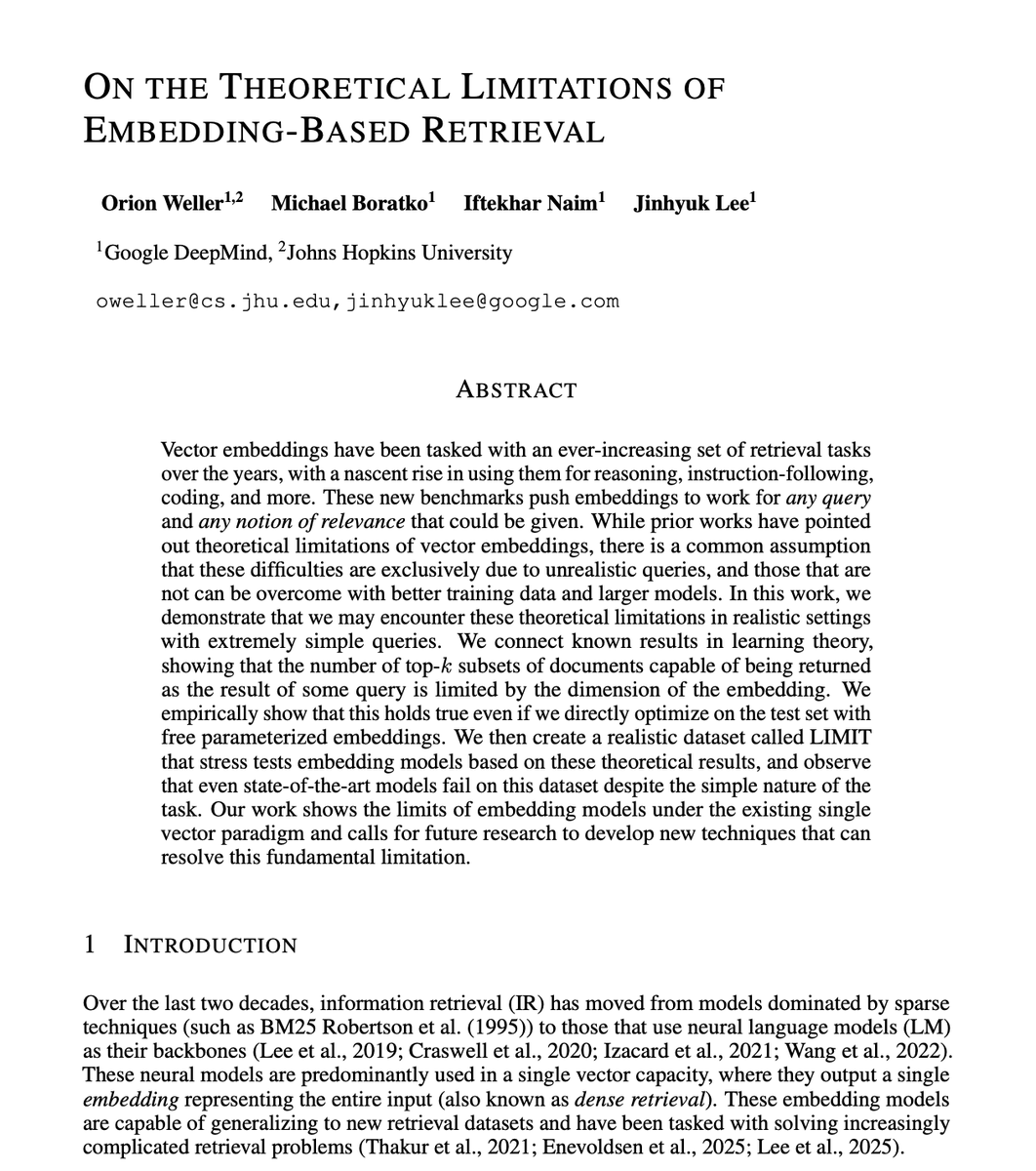
Google DeepMind argues RAG is broken.
They published a paper that proved vectors databases are the dead end.
For the last three years, the default engineering response to any AI memory or data problem has been identical: "Just build a RAG pipeline."
Chunk the data, push it into a vector database, and let embeddings handle the rest.
Every company scaling enterprise AI assumes that if an embedding model fails, it's just a matter of time. Better training data, larger models, more parameters—throw compute at it, and the search gets smarter.
This paper proves that assumption is completely false.
They mathematically demonstrated that single-vector embeddings have a hard, uncrossable limit.
Here is the core flaw:
An embedding compresses an entire document or a complex query down into a single fixed-length vector of numbers.
When you run a search, the model takes the dot product of those vectors to measure similarity.
The math reveals a brutal constraint. The number of distinct document combinations a model can possibly retrieve for different queries is strictly bounded by the dimension of its embedding space.
It is a hard mathematical ceiling dictated by geometry and communication complexity.
No amount of data scaling can fix it. No amount of fine-tuning will punch through it.
Even if you give an embedding model infinite, unconstrained training freedom on the test set, it still hits the wall.
DeepMind built a stress-test dataset called LIMIT to prove it.
They threw state-of-the-art embedding models at it, models with thousands of dimensions.
The models completely failed. Even on simple, structured queries, the single-vector bottleneck forced the system to drop critical context and hallucinate irrelevant results.
Why? Because a single vector cannot capture complex, multi-faceted relationships between documents.
When you ask an AI to reason, follow complex instructions, or handle nuanced cross-document dependencies, the vector space simply runs out of room.
It collapses.
This changes everything for software architecture.
If your AI agent's memory relies on standard single-vector retrieval, it is structurally blind to complex logic. It is missing pieces of your data right now, and no prompt tweak can save it.
If we want AI that actually understands enterprise knowledge, we have to throw out the single vector.
And invent something entirely new.
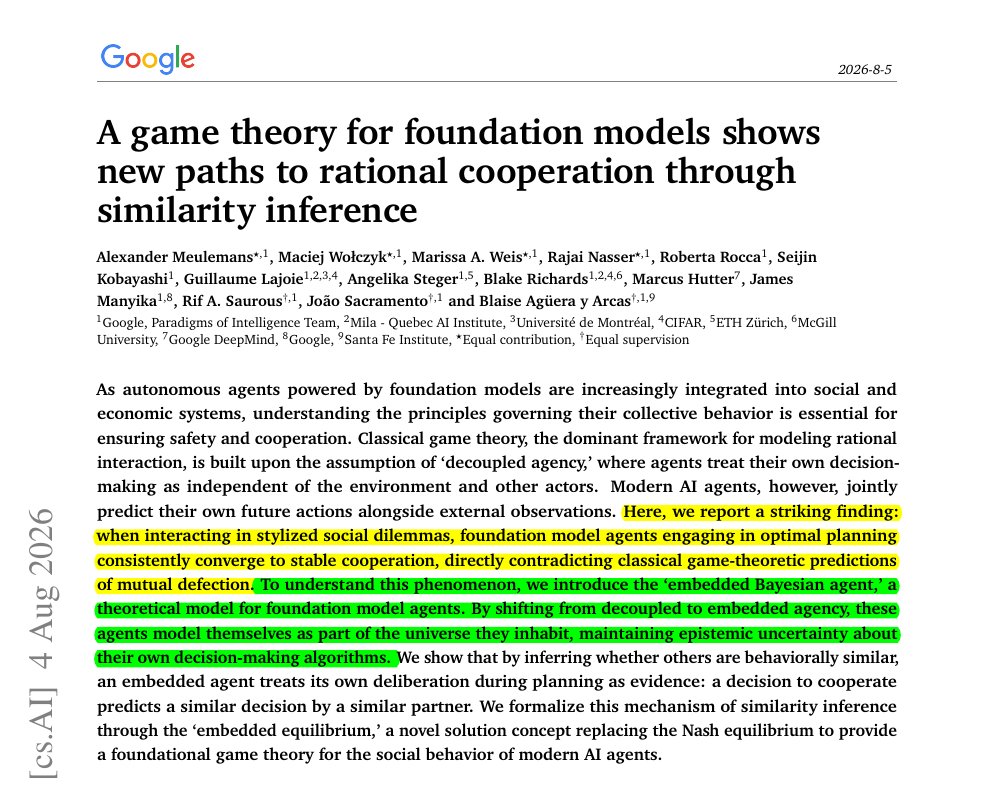
New Google Paper says classical game theory predicts betrayal, but similar AI agents can rationally choose cooperation because their decisions are predictably linked.
The big claim is that similar AI agents can rationally cooperate even when they cannot communicate or benefit later, because each agent’s own planned choice helps it predict what the similar agent will choose.
Classical game theory treats each player as separate, so it predicts defection in a final one-shot Prisoner’s Dilemma.
The authors instead model an AI agent as part of the world it predicts, including uncertainty about its own behavior.
When past choices suggest another agent thinks similarly, considering cooperation makes that partner’s cooperation seem more likely too.
Gemini and Gemma agents played varied games before a final dilemma, either directly or through shared third-party encounters.
With enough evidence, identical agents cooperated strongly, related models cooperated less, and random opponents usually faced defection.
The proposed embedded equilibrium may better predict AI societies, while warning that similar AIs could favor each other over humans.
– arxiv. org/abs/2608.03958
Title: "A game theory for foundation models shows new paths to rational cooperation through similarity inference"
"Memory Decoder at Scale: A Pretrained, Parametric Long-Term Memory"
Most LMs still store knowledge and reasoning in the same weights, so making the model remember more usually means scaling the whole backbone.
This paper makes long-term memory a separate pretrained module. It trains a parametric memory to imitate kNN retriever distributions offline, then plugs it into a frozen decoder through next-token probability interpolation.
They found that memory scaling beats backbone scaling, with Pythia-410M plus a 6.9B memory beats Pythia-12B across 17 tasks with 39% fewer total parameters.
The cool part is that memories can be swapped by domain. Biology, law, and finance memories improve Qwen3 models by over 9 points on average while the base model stays frozen.
Read more here:
https://t.co/IMQs2RyaDT
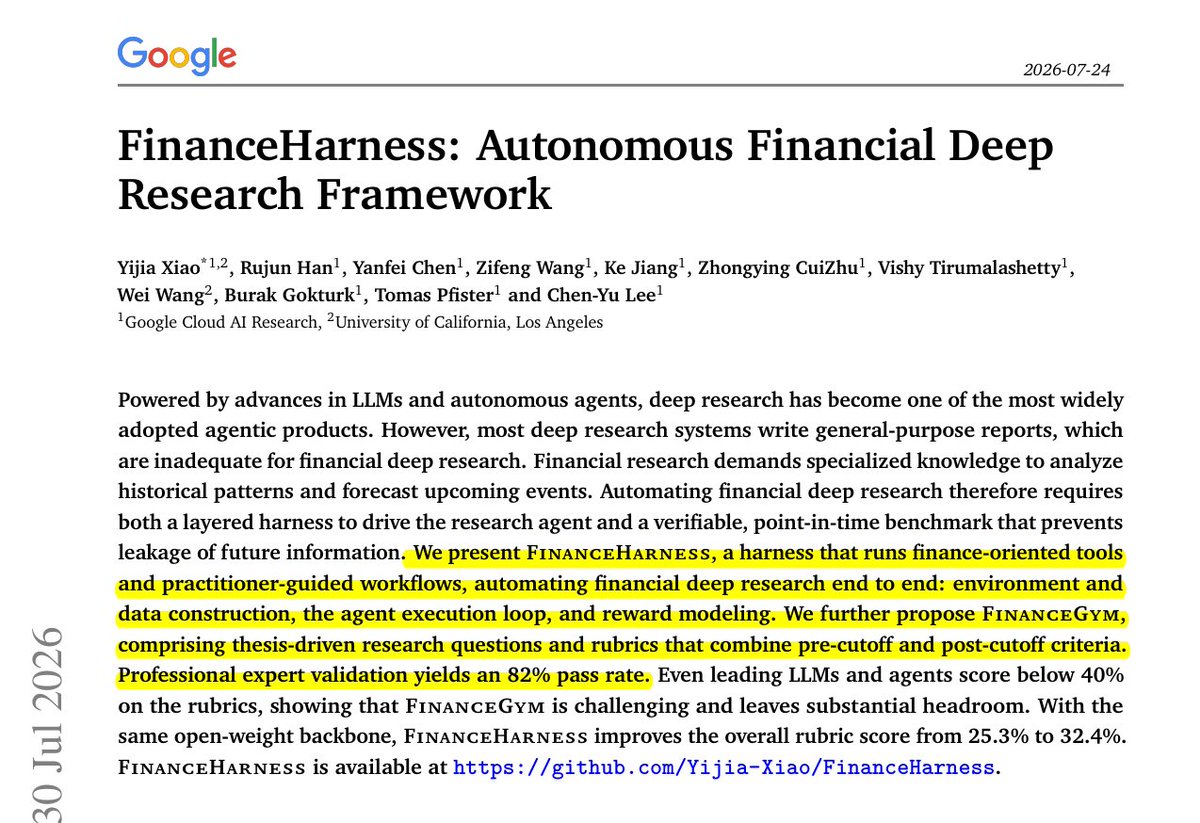
New Google Paper says financial deep-research agents are far better at reconstructing the past than anticipating what comes next.
Across 17 baselines plus FinanceHarness, every model they tested stayed below 40% overall on 400 expert-annotated questions.
The harness matters: with the same Qwen3.6-27B backbone, moving from a simple search loop to the full finance-oriented tool and workflow stack raised the overall score from 25.3% to 32.4%.
Extra training barely changed that result, adding only 0.4 percentage points after Group Relative Policy Optimization.
So the main bottleneck is no longer just search, citation, or report structure.
Financial research agents need better causal and scenario reasoning, because a cleaner evidence pipeline does not automatically produce better forward-looking judgment.
– arxiv. org/abs/2607.27853
Title: "FinanceHarness: Autonomous Financial Deep Research Framework"
Most systems of agent memory will return wrong answers. They keep the events, pull them back as context and re-reason the model by the same decision.
The paper's claim is that saving notes and having procedures are different things, and most systems only do the first.
MSCE sees this as a governance issue. Experience is organized in three levels: declarative facts about the environment, induced procedural policies and grounded step traces.
Agents save transcripts, then reread them and re-derive the same lesson each time.
MSCE instead promotes recurring patterns into callable procedures, but only if the evidence holds up.
e.g. Pip fails in a container? Don't recall the incident; run the rule. when a pip install fails in a container because a system library is missing, find the OS package manager, install the dev package, retry. That rule is now a thing the agent can call, not a memory it has to interpret.
A policy qualifies as a callable skill only when it has its own trigger and boundary, a positive estimated gain, and supporting evidence. No further fine-tuning is performed.
– arxiv. org/abs/2607.16621
Title: "From Memory to Skills: Evidence-Grounded Co-Evolution Governance for Long-Horizon LLM Agents"
@vcalvot Apreciado Vicente, Paz en tu tumba y que el trabajo realizado continúe en pro de un sistema de salud justo y honesto, donde la humanidad sea más humanidad y menos economía, donde las cuentas respondan a la verdad y no a los intereses de unos pocos.
Un abrazo de luz.
“Proxy Exploration and Reusable Guidance”
Post-training usually forces the large model to do expensive RL exploration itself.
This paper, PUST, moves that exploration to a smaller proxy model, then transfers only the learned update direction, not the proxy’s final distribution.
This lets small models search once, cache the signal, and reuse it to improve bigger models across math and code, with Qwen3 4B signals giving strong gains on Qwen3 8B.
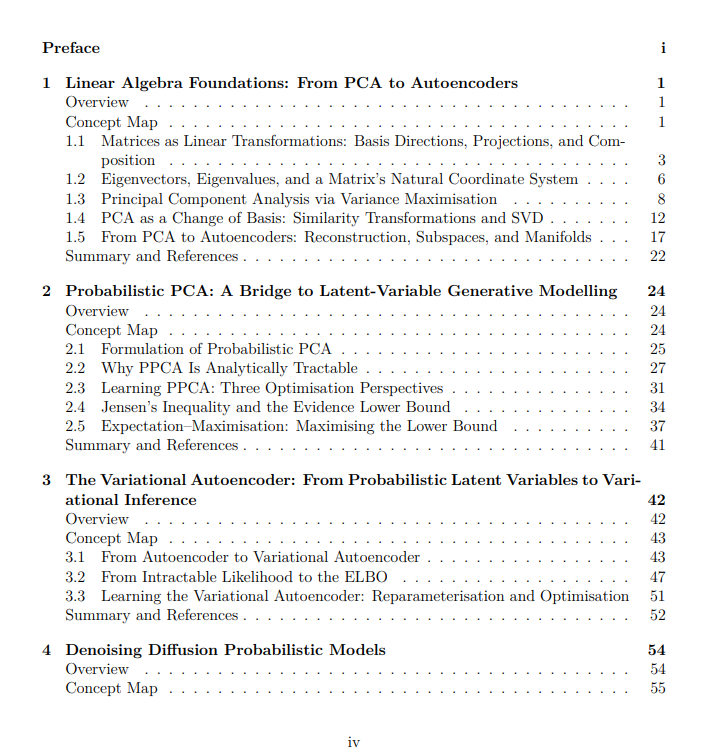
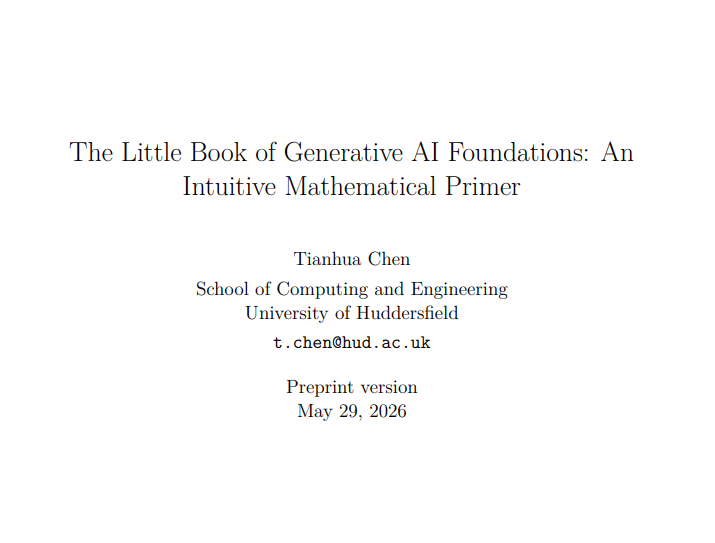
A 178 page survey study for refreshing math and generative AI foundations from University of Huddersfield.
The Little Book of Generative AI Foundations.
Los estados financieros de Nueva EPS con que saca pecho @JorgeIvanOspina son tan chimbos que ni la revisora fiscal, tía de un congresista gobiernista y nombrada por ellos mismos, se atreve a certificarlos plenamente.
Naturalmente la asamblea de accionistas no ha aprobada nada.
🚨 PRIMICIA | Estos son los estados financieros de @NuevaEPSCol de 2023 y 2024. El principal hallazgo es que el dinero que recibió la EPS más grande del país por UPC fue insuficiente para cubrir la atención de sus afiliados: los costos superan ampliamente los ingresos. Abro hilo 🧵









![KirkDBorne's tweet photo. Foundations of Large Language Models: https://t.co/wZmeFmRqgY [277-page PDF]
—————
#LLMs #AI #GenAI #GenerativeAI #ML #MachineLearning #DataScience https://t.co/wTuGZqshcd](https://pbs.twimg.com/media/HPD1u-VW4AAwN6y.jpg)





![KirkDBorne's tweet photo. [Download 585-page PDF eBook]
Game Theory: https://t.co/DUxMDRc1Ll
—————
#GameTheory #Gamification #Mathematics #Statistics #Probability https://t.co/Eo1v4nUYEC](https://pbs.twimg.com/media/HMqUxhWW0AAVHJ0.jpg)


