Ordinary flower wey white people dey gift each other
E reach naija dem turn ham to money bouquet 💐
Dey don monetize everything
If money no dey there no be love 😅
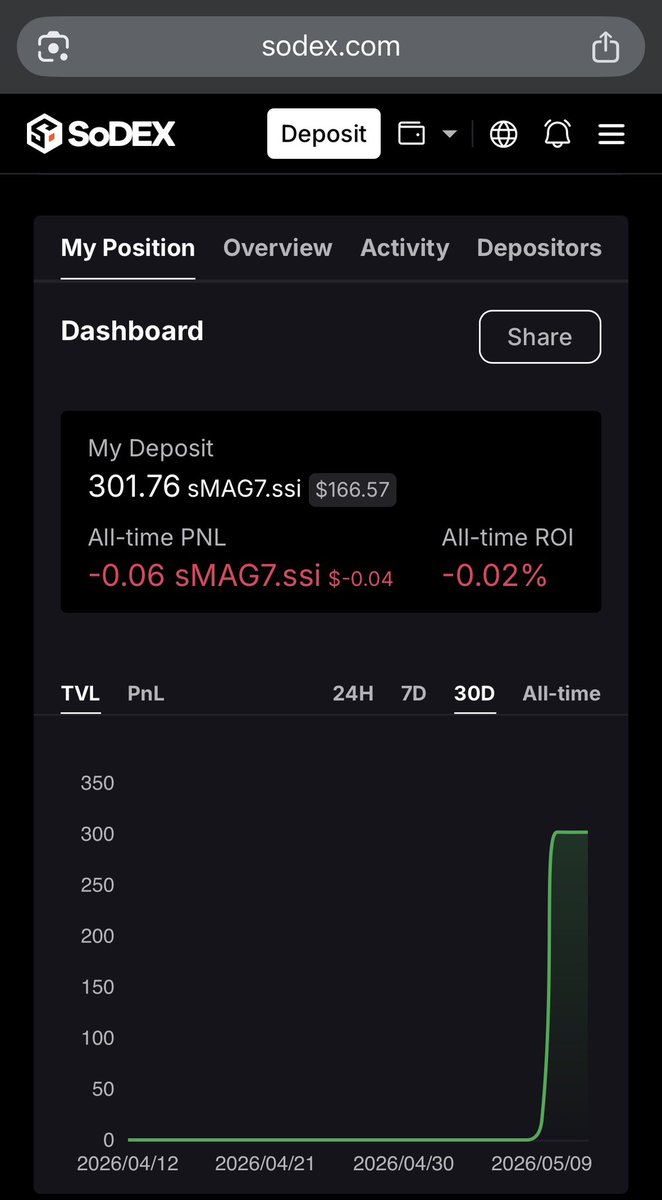
This is becoming extremely concerning @sodex_official.
I deposited funds normally through your platform, converted to MAG7.ssi, deposited into the vault through ValueChain, and everything processed successfully.
Funds visibly reflected within the system but unavailable for withdrawal is a serious issue that requires urgent transparency and communication from the @sodex_official team.
These are funds I urgently need, and I also have full screen recordings documenting the entire flow.
Some of you are saying your parents listened to King Sunny Ade and Ebenezer Obey more than Fela, and you might be right. Fela signed with several foreign labels that helped him distribute his albums abroad, he sold more records abroad than in Nigeria, and he never performed at parties for politicians and socialites like Obey and KSA did. His fans were mainly the common people and he associated with them 24/7.
He played for Nigerians almost daily at his Shrine, all for FREE. That’s why many of your parents didn’t have his records at home, they went to the Shrine to listen to him live and free.
You always see complaints on Twitter: “Merchant held my coins.” “I got scammed on P2P.” “Support didn’t help.”
P2P merchants face more bad-faith actions than regular users (takers). It’s just never talked about.
I wouldn’t like to do this, but Moniepoint @moniepointng has left me with no choice.
I run a legitimate business and trade using escrow marketplaces like Bybit @BybitAfrica. Payments, identities, and deliveries are fully documented.
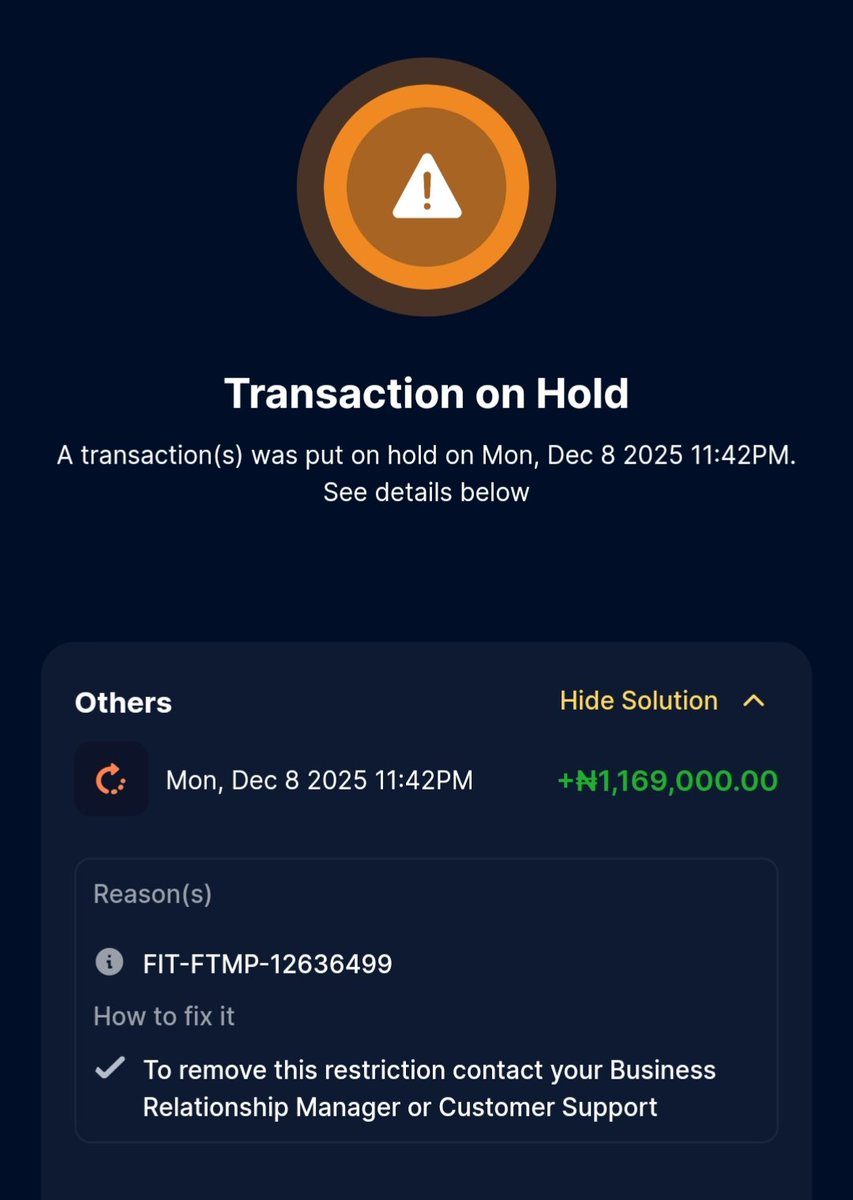
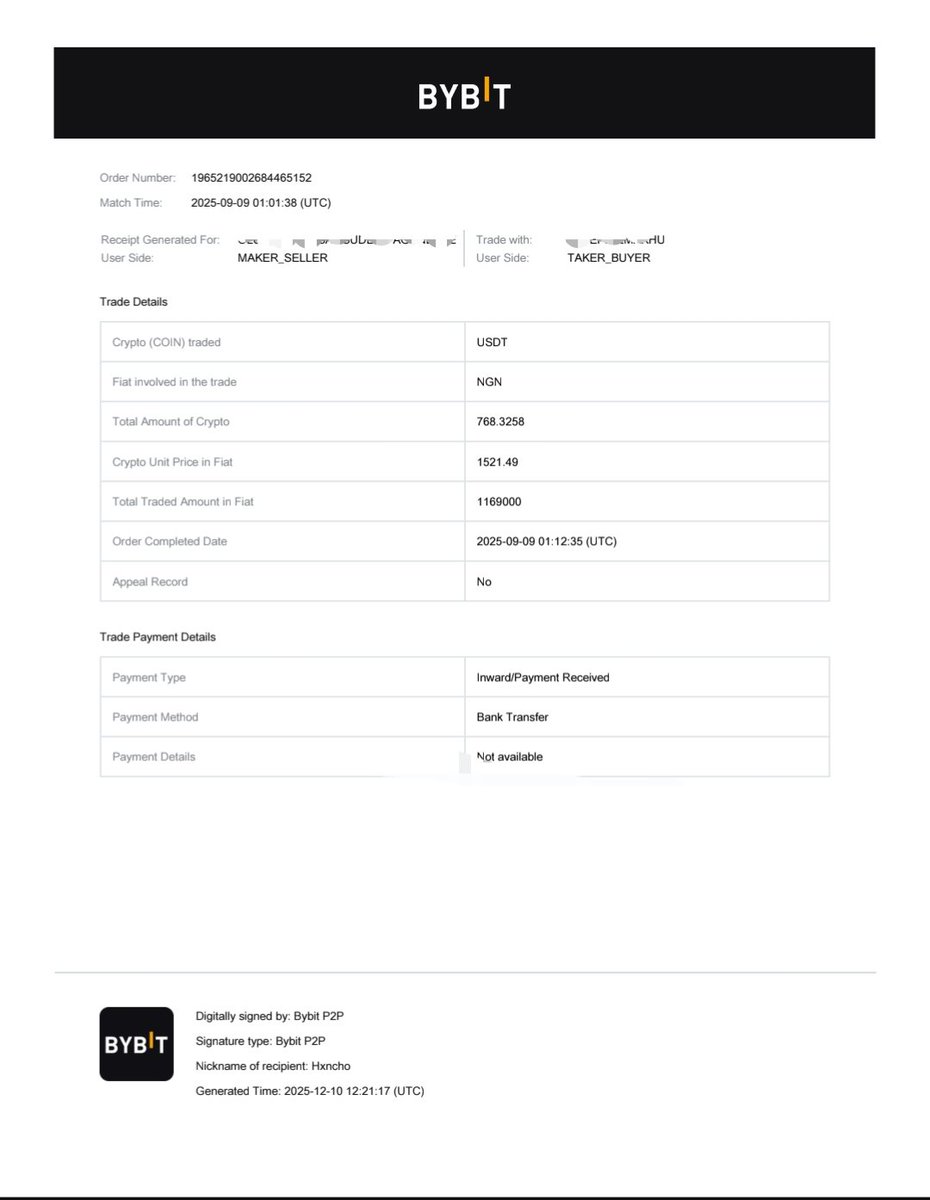
On September 9, 2025, I received a legitimate payment from a Kuda @joinkuda account for the purchase of USDT (₦1,169,000). The transaction was processed through Bybit escrow, fully documented, and the USDT coins were released. Everything was clean and above board.
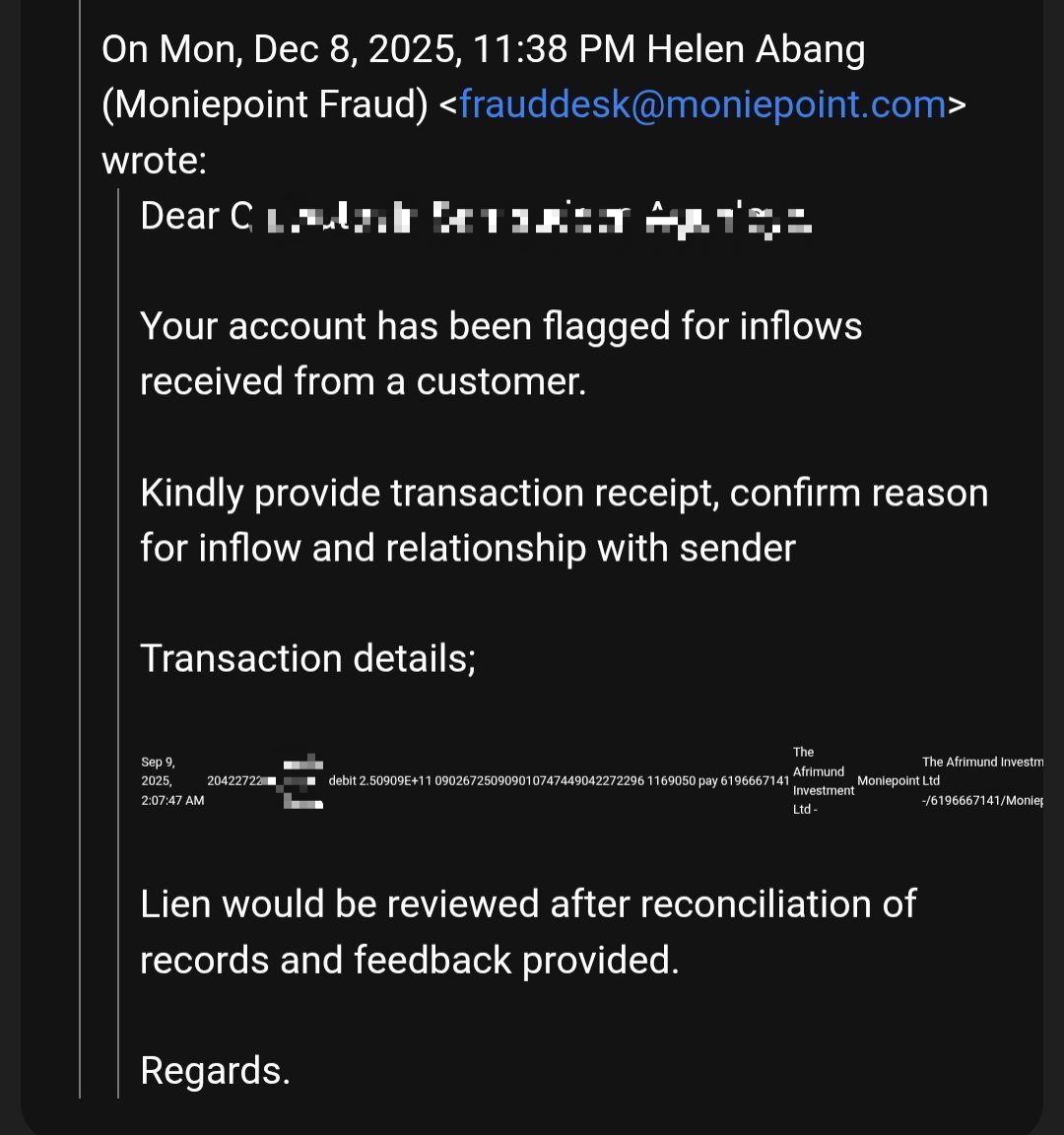
Fast forward almost three months, on December 8, 2025, I received an email from Moniepoint claiming that fraudulent funds were traced to my account from FCMB @MyFCMB, originating from the same transaction three months earlier. I was not the first beneficiary. My account was immediately placed on lien. No warning. No prior communication. No court order. No law-enforcement directive. Just a vague restriction.
I initially thought the process would be simple, like with some other neobanks such as Opay, provide proof of the transaction’s legitimacy, and the lien would be lifted until a court order was provided.
I immediately contacted the bank via Business Relationship Manager (BRM) as required and cooperated fully. I replied to the email and submitted every document requested: the buyer’s payment receipt, Bybit invoice, Bybit chat history, confirmation of delivery, and verification details via email, everything.
For clarity, escrow platforms like Bybit require NIN/BVN verification and Face ID. Buyers upload payment receipts, and every step of the transaction is recorded for proof and to protect merchants. This wasn’t a random transfer or an informal deal, it was transparent from start to finish.
Moniepoint @moniepoint acknowledged receipt of the proofs and said they would get back to me after review and confirmation from FCMB. Then, silence.
Days later, when I followed up, I was only told the account was “under investigation.” No explanation of the alleged issue. No clarity on which transaction was being questioned. No timeline.
Subsequently, I reached out repeatedly via email, spoke directly with my BRM, and even visited their office. Each time, I was met with vague, non-specific, unresponsive answers and unprofessional conduct. My BRM, whom had escalated to his superior, remained effectively incapacitated, repeatedly asking me to “wait for investigation.”
One key detail Moniepoint kept ignoring: I was not the first beneficiary. I received payment from Kuda bank, not directly from the originating bank being referenced, FCMB @fcmb_help. Even more concerning, people I paid onward from the same funds had their accounts restricted. In contrast, Opay lifted their liens immediately after proofs of legitimacy were provided. This suggests Moniepoint implements a blanket freeze across the transaction chain, rather than conducting a targeted review of actual suspects.
Days turned into weeks. Over 21 days have passed. Still, no court order, no EFCC or Police directive has been disclosed to me, and no specific fraud allegation has been explained, despite repeated written follow-ups.
I have repeatedly copied the Central Bank (CBN) @cenbank via its CPD, and FCCPC @fccpcnigeria in the back-and-forth, documenting every email. Yesterday, I formally petitioned them against Moniepoint, copied all involved banks, Kuda @kudahelp_ng, and submitted all supporting evidence.
I didn’t shout. I didn’t insult customer care. I documented everything and escalated properly. Yet here I am, still unable to access my own funds.
In this country, you don’t need to commit fraud to lose access to your money. You only need to be connected to a transaction someone else is questioning. Banks freeze first. Explanations come later, if they come at all. Funds are “preserved pending investigation,” while businesses stall, obligations pile up, and livelihoods are put on pause.
I’ve processed over ₦1 billion in transactions with Moniepoint (my main bank for business) as a trader in the last 6 months, and over double that across other banks.
Clean history - Documented trades - No issues.
One fully completed transaction locked my account.
No fraud allegation.
No court order.
No details.
Just back and forth.
I’ll explain how it all transpired later today. ⏳
https://t.co/8upICKCcs5
Dear @DonAzag
I have previously acknowledged your efforts to educate the public on tax reform. However, some of your contents, including this video, contain technical inaccuracies misleading your audience.
This is precisely why we invited some content creators to a training session on the tax reforms to enhance their understanding for better context and informed public engagement. You declined the invitation and instead made spurious allegations about the intent of the initiative. For the record, no participant was paid or asked to promote the tax laws. Hundreds of creators attended, including many with larger followings.
Tax policy cannot be responsibly analysed through surface-level research or intuition. Unfortunately, your video reflects a mixup of key concepts, leading to incorrect conclusions. Below are some concepts used in your analysis where you need better understanding:
1. Household income and individual income are not the same. You referenced my comment on household income but went ahead to do your entire analysis based on individual income.
2. You assert that poverty must be determined based on the international poverty threshold of USD 3 per day and then you applied it incorrectly. First, the threshold was USD 2.15 per day until June 2025 same month the tax bills were signed into law. Second, you applied market exchange rate instead of purchasing power parity. If you wish to understand the Nigeria context, you may find the Nigeria Living Standards Survey by the NBS in collaboration with the World Bank useful.
3. Taxable income is not the same as gross income. Treating ₦800,000 taxable income as gross income is incorrect and materially alters your analysis.
4. The law expressly exempts the national minimum wage from personal income tax. Insisting that people who earn the national minimum wage will be taxed is incorrect.
Proper understanding is important for constructive public debate. If you're concerned about the tax burden on low-income earners and small businesses, it would be helpful if you also inform your followers the taxes these people currently pay and whether the new tax law is better or not. You may get the clicks and views by presenting incomplete or incorrect information fueling unnecessary discontent but ultimately you are harming the very audience you seek to inform.
Disagreement about public policy is healthy, but it must be grounded in knowledge, not sentiments. Present your opinion if you have a different perspective, rather than asserting that others are wrong or dishonest.
You can do well while also doing good.
Taiwo Oyedele
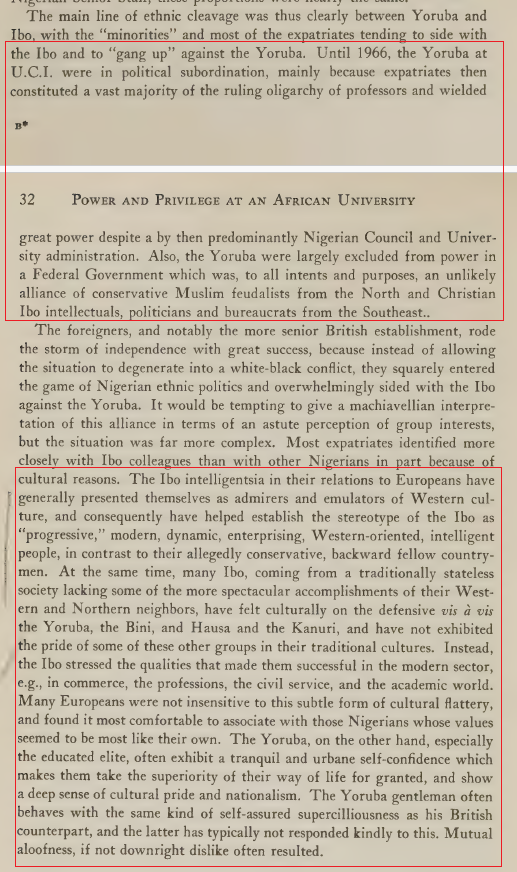
Ordinarily, I would let such ahistorical claims pass, but given their capacity to mislead, a correction is unavoidable. The tweet below is not just inaccurate; it is a deliberate inversion of historical cause and effect. What transpired at the Universities of Ibadan and Lagos was not an unprovoked Yoruba assault on Igbo academics, but a corrective response to entrenched Igbo nepotism and institutional capture. Unfortunately, much of Nigerian historiography has relentlessly painted the Yoruba as the primary aggressors in ethnic struggles, a narrative even echoed by some Yoruba intellectuals who neglect these critical antecedent events.
So let’s set the record straight.
First, a factual correction: Richard Akinjide became the Federal Minister of Education in 1965. The claim that he was "pushing against Igbo academia" at the Universities of Ibadan and Ife in 1962 is chronologically impossible and factually incorrect. The central events revolve around Ibadan and Lagos; the inclusion of the University of Ife here is a red herring.
To understand the events at Ibadan, one must turn to the eyewitness account of Pierre van den Berghe (Power and Privilege at an African University), a visiting professor during this turbulent period. He identified the central dynamic: “The main line of ethnic cleavage was clearly between Yoruba and Ibo, with the ‘minorities’ and most of the expatriates siding with the Ibo and ‘ganging up’ against the Yoruba” (pg. 31).
This alliance was rooted in a cultural clash. Van den Berghe observed that the Yoruba, with their centuries-deep intellectual tradition, carried a natural cultural confidence that "makes them take the superiority of their way of life for granted, and show a deep sense of cultural pride and nationalism". The educated Yoruba often displayed a self-assurance that the expatriates found off-putting, seeing themselves as equals with no need to ape European manners (pg. 31).
The Igbo intelligentsia, by contrast, presented themselves as eager emulators of Western culture, measuring progress by proximity to European norms. Van den Berghe notes that this posture ingratiated them deeply with expatriates and helped entrench the stereotype of the Igbo as “progressive, modern, dynamic, enterprising, Western-oriented, intelligent people”, in contrast to their allegedly “conservative, backward” compatriots. This cultural flattery forged a comfortable British–Igbo partnership that became the backbone of campus politics (pg. 31).
This dynamic took on institutional consequence in 1962 when the University College, Ibadan, became an independent university. The Vice-Chancellorship went to Professor Kenneth Dike, an Igbo historian favored by expatriates and the NCNC-led federal government, rather than to an equally qualified Yoruba candidate, Professor Ajose. This appointment was made by Aja Nwachukwu, the Igbo Minister of Education. At the same time, another Igbo academic, Professor Eni Njoku, was appointed Vice-Chancellor of the University of Lagos. In a country with only two federal universities, both were now headed by Igbo men.
Furthermore, the University of Ibadan Act, crafted by Minister Nwachukwu, appointed Dike as VC without specifying any time limit. Thus, barring removal for misconduct, Dike became, in effect, Vice-Chancellor for life.
Yet despite this glaring imbalance, there was not a single Yoruba riot, not a single newspaper meltdown, not a single declaration of persecution. The Yoruba intelligentsia accepted the situation as part of the politics of the time.
But Dike’s tenure quickly revealed a systematic pattern of ethnic preference. Van den Berghe reports that he “systematically favored fellow Ibo,” placing them in strategic positions: the Deanships of Agriculture and Medicine (both held by his relatives), the Headship of the History Department, and other key administrative offices (pg. 37 - 38). Dike’s stated goal was “ethnic balance,” but in practice, it meant prioritizing Igbo candidates even when better-qualified Yoruba candidates were available. Under him, UI increasingly resembled an Igbo fiefdom.
Dike’s methods were subtle but effective. He would promote Yoruba and Igbo candidates to the professorial level to create an appearance of fairness but reserve the real levers of power — the chairmanships, deanships, and strategic administrative roles — for Igbos (pg. 38). When obstructed, he undermined the officeholder. His campaign against the Registrar, Nathaniel Adamolekun, was the most egregious example. Dike saw Adamolekun as the final obstacle to his full consolidation of the university into an ethnic patronage system (pg. 39). His solution was to remove academic affairs from the Registry's jurisdiction by creating an “Academic Office” under an Igbo loyalist and to bypass Adamolekun in major decisions (pg. 40).
The result was a spiraling administrative crisis. By 1966, the feud had descended into a grotesque spectacle - countermanding memos, press leaks, court injunctions, threats, office lockouts, and even police involvement.
The crisis came to a head in June 1966, when a trivial disciplinary action against an Intermediate Staff clerk, most liklely a non-Yoruba, accused of fornication in a university office escalated into a violent strike and demonstration by the non-Yoruba faction of the University Workers’ Union against Adamolekun, demanding his resignation. The University Council, effectively captured by Dike’s faction, obliged by suspending Adamolekun. The injustice was so transparent that Bola Ige, a personal friend of Dike's, represented Adamolekun against him. When Ige later recounted the story, he described Dike’s shock that he would defend a man subjected to such plainly unfair treatment.
The crisis only ended when Dike resigned in late 1966 and returned to the East in the aftermath of the coup. The Gowon administration reinstated Adamolekun, restoring administrative order. Yet in Chinua Achebe’s telling, Dike becomes the victim of Yoruba small-mindedness. It is therefore laughable to read Chinua Achebe’s portrayal of Dike as a victim of "tribal small-mindedness." To Achebe, this blatant nepotism was acceptable, the resistance to it was the sin. (Achebe, There was a Country, pg. 77)
The crisis at the University of Lagos was a direct parallel. The law establishing UNILAG set a four-year term for the Vice-Chancellor. Professor Eni Njoku, appointed by fellow Igbo, Aja Nwachukwu, completed his full term on May 31, 1965. By then, Chief Richard Akinjide had become Minister of Education. Exercising his lawful discretion, he chose not to renew Njoku’s contract and appointed Dr. Saburi Biobaku. Njoku was not fired; he was offered a professorship and allowed to retain his VC salary. But the reaction from Igbo students and certain expatriate staff was immediate, violent, and politically choreographed. Riots broke out. Picketing intensified. Expatriate deans (mostly British) staged a rebellion against the Federal Government. Zik’s West African Pilot flooded the public space with inflammatory editorials about “tribalism” and “Igbo victimization,” weaponizing the press to manufacture outrage.
The Federal Government’s response was unequivocal: accusations of tribalism were baseless. Both federal universities had previously been under Igbo leadership; if anything, the Igbo had been favored. The government described the behavior of the foreign agitators as “a naked form of neo-imperialism" (Vickers & Post, Structure and Conflict in Nigeria 1960-1966, pg. 210). Chief Akinjide, not one to tolerate such interference, terminated the appointments of the expatriates who had fomented the crisis. Despite riots and an attempted murder, Prof. Biobaku eventually assumed his position.
The fundamental flaw in lies such as the one in this tweet is the neglect of antecedents. The story did not begin with Akinjide’s decision; it began with the lopsided appointments engineered by Nwachukwu, the systemic ethnic favoritism of Kenneth Dike, the patronage network built between British academics and Igbo elites, and the entrenched administrative capture at Ibadan and Lagos. But the revisionists skip all this. They begin the story at the point of correction, erase the provocations, cast Akinjide as the villain, and sanctify the architects of the imbalance.
It is therefore a profound historical misrepresentation to claim that “Akinjide’s actions remain central to the Yoruba–Igbo academic struggle.” The truth is the reverse: the ethnic tensions were set in motion long before Akinjide entered the story. The actions of men like Dike and Nwachukwu, who first entangled these institutions in ethnic competition, are the true origins of the conflict. Akinjide’s role, in contrast, was an attempt to recalibrate a balance that had already been severely compromised and to reassert rightful federal oversight over institutions that had drifted into ethnic capture.
Anyone insisting otherwise is not recounting history — they are manufacturing myth.
@ibidunniOodua@patrickanum@naija1babe
Agree. Dangote is fighting because they want to destroy his investment. He has fought many battles on this refining business.
1. Obasanjo sold the Port Harcourt refinery to him. NNPC staff protested.
2. YarAdua took back the refinery from him
3. Dangote spent $20 billion of his own money to build a brand new refinery.
4. Then, this same NMDSRA issued a statement that Dangote's refined products were sub-standard. This was later proven to be false.
5. Then NNPC refused to supply him crude oil. He turned to the USA to source his crude oil and continues to import from them till this day.
6. Then PBAT ordered NNPC to start supplying him crude oil and to accept naira payment. NNPC was unhappy.
7. Suddenly, NUPENG and PENGASSEN ganged up, claiming Dangote is a monopolist, because he is refusing them the old practice of toll collection of N5m per truck while loading products.
8. Dangote called their bluff and decided to buy his own CNG tankers, 2000 of them.
9. NUPENG and PENGASSEN then declared a strike action demanding that Dangote staff must be allowed to join their union.
10. Smelling a rat, Dangote asked all staff to indicate if they wanted to join PENGASSEN. 800 staff signed. Dangote sacked them all, claiming 22 incidents of sabotage detected in the refinery, including unexplained fire incidents.
11. NUPENG and PENGASSEN again went on strike.
12. NASS intervened and begged Dangote to rehire the 800 staff. Dangote took the staff back, but sent them to cement factories, far away from his $20 billion refinery.
13. Today, Dangote's refinery is working producing PMS, diesel, aviation fluid, fertilizers etc. He is exporting to USA, Asia and other African countries, earning FOREX.
14. Yet, Ahmed Farouk insists on spending our inadequate FOREX earnings to import PMS in order to keep refineries in Europe in business. Now we know why this is so. Obviously, he is receiving kick backs. He will rather do that than support a local investment. If this is not economic sabotage, what is it?
15. Clearly, Dangote and Bua who are locked in a healthy competition are contributing to our economic renaissance.
Saboteurs like Ahmed Farouk must be stopped. They are spending our FOREX while Dangote is generating FOREX for the country.
16. May God deliver this country from cankerworms.🤔
~ Bello Isiaka
If you’re hurting, the Almighty will heal you. If you’re lost, only He can guide you. If you see darkness in your life, only He can be that beacon of light. If you’re contented, only He can give you more happiness & goodness. If you have Him in your life, you have everything.
1/
CRYPTOCURRENCY 101: Introduction to Cryptocurrency - PART 1/2.
This is specifically tailored for the newcomers in the crypto space.
Understanding the basics. The topics below provide a solid foundation without overwhelming you with technical details.
A Thread 🧵